mTOR
The Growth Switch
A molecule scraped from the soil of the world's most remote island led scientists to a single ancient switch — the one every living cell uses to choose between growing now and lasting longer.
The walkthrough
Beat by beat
HOOK
0:26
01HOOK
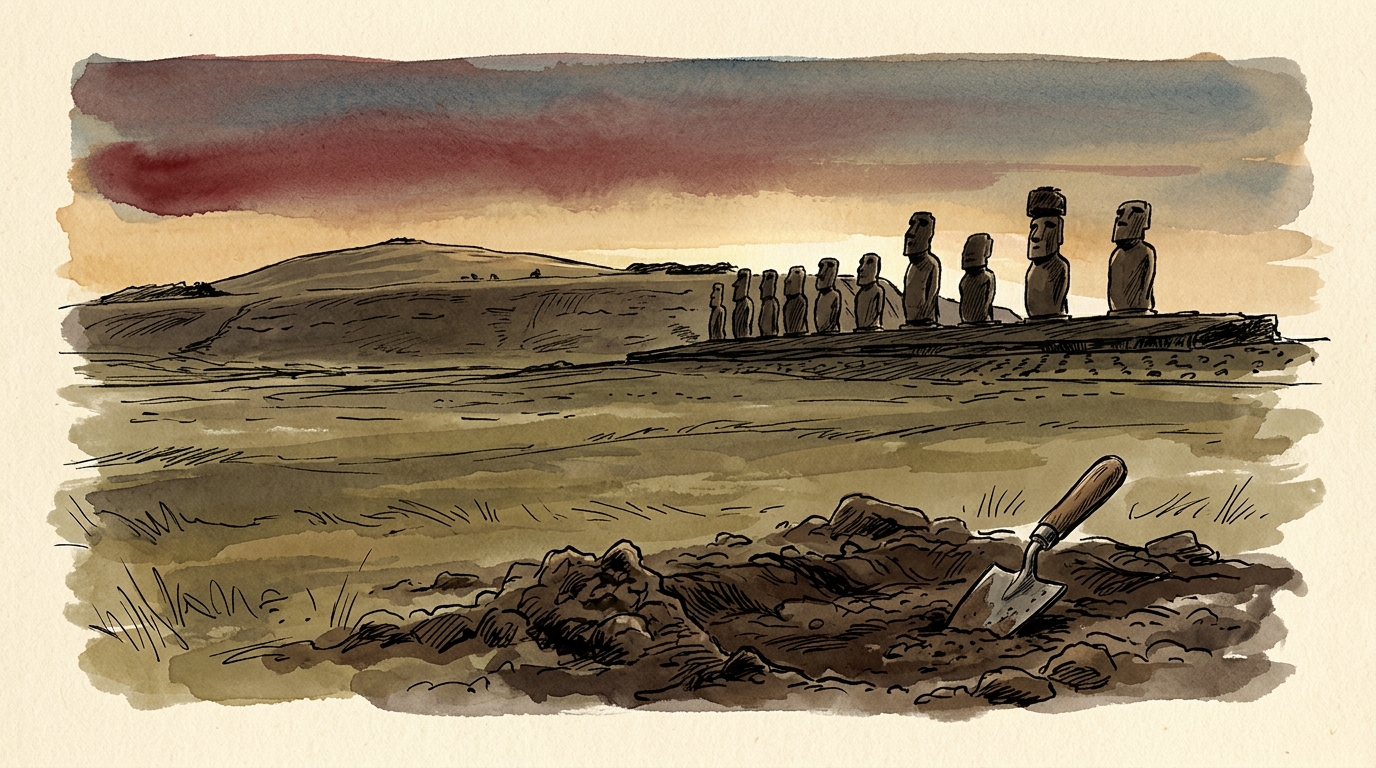
Scientists once scraped a strange molecule from the soil of Easter Island `F1`. It could freeze a living cell in place and stop it growing. Years later, fed to old mice, it made them live longer `F2`. One molecule, two effects — both pointing to a single protein in every cell you own, running the oldest decision in biology: grow now, or last longer.
02THE NAME
That protein is mTOR — the mechanistic Target Of Rapamycin `F3`. Its gene sits near the tip of chromosome one `F4`. mTOR is a kinase: a switch that reads the cell's surroundings and gives one order. Food plentiful? Build. Scarce? Hold back and recycle `F5`. Almost everything with a nucleus runs a version of it. It is that old.
03THE HUNT I
The molecule came first. In the nineteen-seventies, a scoop of Rapa Nui soil gave up a bacterium making a powerful antifungal `F6`. They named it rapamycin, after the island `F6`. For years it was a curiosity with a strange talent — it stopped cells dividing — and no one knew what it was grabbing inside.
04THE HUNT II
To find that target, you go to yeast. In 1991, Michael Hall's lab dosed yeast with rapamycin and watched them stop cold `F7`. Then they hunted for mutants that could grow anyway — and every escape landed on the same two genes. They named them TOR: the Target Of Rapamycin `F7`. Hall would win a Lasker for it `F8`.
05THE HUNT III
Then the same gene turned up everywhere. In 1994 and '95, three labs racing each other pulled the human version from our own cells `F9`. Yeast, worm, fly, mouse, human — the same switch, barely redrawn across a billion years `F10`. That is how you know it matters. Evolution doesn't conserve what it doesn't use.
06THE MECHANISM I (sensor)
So what does the switch actually do? mTOR works inside two machines `F11`. The first, complex one, is the sensor. It rides on the lysosome, counting the amino acids drifting in `F12`. It listens for insulin down a chain of proteins — PI3K, then AKT, past a brake called TSC `F13`. It even reads the cell's fuel gauge `F13`. When every input says plenty, it flips on.
07THE MECHANISM II (outputs)
And when it flips on, the cell commits to growth. Complex one drives the ribosomes to churn out protein `F14`, and at the same moment brakes autophagy, the recycling program that keeps a starving cell alive `F15`. Grow, or clean house — it can't do both. Complex two tunes survival and cell shape from the other side `F16`. And rapamycin grabs a partner protein, and the pair wedges into complex one alone, jamming its gears `F17`.
08THE STAKES I (lifespan)
Now the surprise. Turn that switch down, and life gets longer. Lower TOR in yeast, worms, or flies, and each outlives its normal span `F18`. Then, in 2009, the hardest test: mice. Given rapamycin late in life — the mouse equivalent of your sixties — they lived nine to fourteen percent longer `F19`, the first drug ever shown to extend a mammal's lifespan `F19`. Even eating less works partly through the same switch `F20`.
09THE STAKES II (cancer)
But a growth switch has a shadow. What happens when it's stuck on? That is cancer. The circuit feeding mTOR — PI3K, AKT, and the tumor suppressor PTEN — is among the most frequently broken in human tumors `F21`. Snap the brakes, and the cell just keeps building. So rapamycin's descendants became cancer drugs: temsirolimus and everolimus, approved for kidney, breast, and rare tumors `F22`. In tuberous sclerosis, one broken brake jams mTOR on and sprouts tumors body-wide; blocking mTOR shrinks them `F23`.
10THE OPEN THREAD (SOTA)
So can we borrow the long life without the danger? That's the frontier. Rapamycin is blunt: hold the switch down too long and you disturb the other machine, complex two, and side effects creep in, high blood sugar among them `F24`. The newest drugs are engineered to press complex one alone `F25`. Trials are running in aging dogs `F26`, and low doses have already sharpened the immune systems of the elderly `F27`. The molecule from that island soil is now a leading candidate to slow human aging — still unproven, still under test `F28`.
11TIMELINE + SIGN-OFF
From a scoop of island soil, to a switch in yeast, to the human genome, to a drug that stretches a mouse's life. One protein at the oldest fork there is: grow now, or last longer. And we're only just learning how to choose. — The Gene Channel.
The write-up
In one line: mTOR is an ancient nutrient-sensing kinase — the switch a cell uses to choose between growing now and lasting longer. A molecule scraped from the soil of Easter Island (rapamycin) led us to it; dialing the switch down extends lifespan across yeast, worms, flies, and even mice, while the same switch jammed on helps drive cancer.
The gene
MTOR sits near the very tip of the short arm of chromosome 1 (band 1p36.22) and encodes a large serine/threonine kinase of the PIKK family. It is best understood not as a single machine but as the catalytic core of two of them: mTOR complex 1 (mTORC1) — defined by its partner RAPTOR — and mTOR complex 2 (mTORC2) — defined by RICTOR. Together they make mTOR the cell's master switch between anabolism (build) and catabolism (conserve and recycle). When nutrients are plentiful, the switch says grow; when they are scarce, it steps back and lets the cell live off its own reserves. Almost every eukaryote — yeast to human — runs a version of it.
The hunt (soil → yeast → human)
The story runs backwards from most gene stories: the drug came before the gene. In the 1970s, a soil sample from Rapa Nui (Easter Island) yielded the bacterium Streptomyces hygroscopicus, which produced a potent antifungal. Vézina, Kudelski, and Sehgal at Ayerst named it rapamycin, after the island (published 1975). It had a strange talent — it stopped cells from dividing — but nobody knew what it grabbed inside.
To find the target, the field turned to budding yeast. In 1991, Joseph Heitman, Rao Movva, and Michael N. Hall (Basel) dosed yeast with rapamycin, watched them arrest, then screened for mutants that could grow anyway. Every escape mutation landed on the same two genes, which they named TOR — Target Of Rapamycin. (Hall received the 2017 Lasker Basic Medical Research Award for this line of work.) The mammalian ortholog was then cloned independently by three groups in 1994–95 — Sabatini's RAFT1 (Cell 1994), Brown & Schreiber's FRAP (Nature 1994), and Sabers & Abraham's mTOR (JBC 1995) — each fishing the protein out by its rapamycin-binding activity. The switch was the same from yeast to human, barely redrawn in a billion years of evolution.
The mechanism
mTORC1 is the sensor. Docked on the surface of the lysosome, it integrates three streams of information: amino acids (via the Rag GTPases/Ragulator that recruit it to the lysosome), growth-factor signals (insulin → PI3K → AKT, which relieves the TSC1/TSC2 brake on the small GTPase Rheb), and the cell's energy status (via AMPK). When all three read plenty, mTORC1 switches on and commits the cell to growth: it phosphorylates S6K1 and 4E-BP1 to drive protein synthesis, ramps up lipid and nucleotide production, and — at the same moment — shuts off autophagy (by phosphorylating ULK1/ATG13), the recycling program a cell relies on during famine. Grow, or clean house: it cannot do both. mTORC2 works the other side — phosphorylating AKT at Ser473, plus SGK1 and PKC, to tune survival and cell shape.
Rapamycin doesn't act alone. It first binds the small protein FKBP12; the FKBP12–rapamycin complex then wedges into mTOR's FRB domain and allosterically inhibits mTORC1 specifically — not the active site, and not mTORC2 (which is acutely insensitive; only prolonged treatment can disrupt it in some cell types). That selectivity is the whole reason rapamycin is both a useful drug and a blunt one.
Aging & lifespan (the surprise)
Turn the switch down, and life gets longer — repeatedly, across the tree of life. Reduced TOR signaling extends lifespan in yeast, in C. elegans worms (Vellai, 2003), and in Drosophila flies (Bjedov, 2010). Then came the hardest test. In 2009, the NIA Interventions Testing Program reported (Harrison et al., Nature) that rapamycin fed late in life — starting at 600 days, roughly a human's sixties — extended the lifespan of genetically heterogeneous mice by about 9–14%. It was the first pharmacological agent ever shown to extend the lifespan of a mammal. Caloric restriction, the oldest longevity intervention we know, appears to act in part through the very same pathway.
Cancer (the switch stuck on)
A growth switch has an obvious dark side. The circuit feeding mTOR — PI3K, AKT, and the tumor suppressor PTEN — is among the most frequently dysregulated in human cancer; lose the brakes and the cell keeps building itself. So rapamycin's chemical descendants ("rapalogs") became approved cancer drugs: temsirolimus (advanced renal cell carcinoma, FDA 2007) and everolimus (RCC 2009; pancreatic neuroendocrine tumors 2011; HR+ advanced breast cancer with exemestane 2012). The clearest human "mTOR-pathway disease" is tuberous sclerosis complex, where a germline loss of TSC1 or TSC2 removes the brake on Rheb, leaving mTORC1 constitutively on and sprouting benign tumors (brain SEGAs, kidney angiomyolipomas) — which everolimus can shrink.
The frontier
The open question is whether we can borrow the longevity without the danger. Rapamycin is blunt: hold the switch down long enough and you begin to disturb mTORC2, producing side effects such as glucose intolerance — and even on mTORC1 it inhibits some outputs (notably 4E-BP1) incompletely. Two responses are in play. First, third-generation, mTORC1-selective "bi-steric" inhibitors (e.g. RMC-5552) engineered to press complex 1 alone and spare complex 2. Second, dosing strategy — intermittent, low-dose regimens meant to keep the beneficial mTORC1 effect while limiting the rest. On the aging side, rapamycin is now the leading candidate geroprotector: it's being tested in healthy middle-aged companion dogs (the Dog Aging Project / TRIAD trial), and low-dose mTOR inhibition has already been shown to sharpen the immune systems of elderly people (Mannick et al., 2014 and 2018). But the human anti-aging benefit remains unproven — the trials are ongoing, and the molecule under test is the same sirolimus approved back in 1999 for transplant rejection.
Sources
Full claim-by-claim evidence is in references.md. Primary/authoritative anchors:
- MTOR gene (location 1p36.22, kinase): OMIM 601231 — https://omim.org/entry/601231 ; UniProt P42345 — https://www.uniprot.org/uniprotkb/P42345/entry
- Rapamycin isolated from Rapa Nui soil (1975): Vézina, Kudelski & Sehgal, J Antibiot 28:721 — https://pubmed.ncbi.nlm.nih.gov/1102508/
- Yeast TOR discovered (1991): Heitman, Movva & Hall, Science 253:905 — https://pubmed.ncbi.nlm.nih.gov/1715094/
- Mammalian ortholog cloned (1994–95): Sabatini et al. (RAFT1), Cell — https://pubmed.ncbi.nlm.nih.gov/7518356/ ; Brown et al. (FRAP), Nature — https://www.nature.com/articles/369756a0 ; Sabers et al. (mTOR), JBC — https://pubmed.ncbi.nlm.nih.gov/7822316/
- "mTOR = mechanistic" nomenclature: Laplante & Sabatini, Biochem Soc Trans 2013 — https://pubmed.ncbi.nlm.nih.gov/23863150/
- Signaling reviews (complexes, inputs, outputs): Saxton & Sabatini, Cell 2017 — https://pubmed.ncbi.nlm.nih.gov/28388417/ ; Laplante & Sabatini, Cell 2012 — https://pmc.ncbi.nlm.nih.gov/articles/PMC3331679/
- Amino-acid sensing at the lysosome (Rag GTPases): Sancak et al., Cell 2010 — https://pmc.ncbi.nlm.nih.gov/articles/PMC3024592/
- TSC2 is a GAP for Rheb: Inoki et al., Genes Dev 2003 — https://pmc.ncbi.nlm.nih.gov/articles/PMC196227/
- Rapamycin mechanism (FKBP12 → FRB, mTORC1-selective): Yang et al., Nature 2013 — https://pmc.ncbi.nlm.nih.gov/articles/PMC4512754/ ; mTORC2 acute insensitivity — Sarbassov et al., Mol Cell 2006 — https://pubmed.ncbi.nlm.nih.gov/16603397/
- Rapamycin extends mouse lifespan (late-life, +9–14%): Harrison et al., Nature 2009 — https://pubmed.ncbi.nlm.nih.gov/19587680/ ; worms — Vellai et al. 2003 — https://pubmed.ncbi.nlm.nih.gov/14668850/ ; flies — Bjedov et al. 2010 — https://pmc.ncbi.nlm.nih.gov/articles/PMC2824086/
- Rapalogs in cancer: temsirolimus FDA summary — https://pmc.ncbi.nlm.nih.gov/articles/PMC3227966/ ; everolimus (Afinitor) approval history — https://www.drugs.com/history/afinitor.html ; mTOR inhibitors in TSC — https://pmc.ncbi.nlm.nih.gov/articles/PMC3520048/
- State of the art / geroscience: bi-steric RMC-5552 — Liao et al., J Med Chem 2023 — https://pmc.ncbi.nlm.nih.gov/articles/PMC9841523/ ; mTOR & aging review — Nature Aging 2023 — https://www.nature.com/articles/s43587-023-00416-y ; Dog Aging Project TRIAD — https://dogagingproject.org/triad ; human immune trials — Mannick et al., Sci Transl Med 2014 — https://www.science.org/doi/10.1126/scitranslmed.3009892 and 2018 — https://www.science.org/doi/10.1126/scitranslmed.aaq1564
- Hall's 2017 Lasker Award: Lasker Foundation — https://laskerfoundation.org/awards/show/nutrient-activated-tor-proteins-regulate-cell-growth/
Accuracy notes (the traps this episode states carefully):
- The "m" in mTOR now stands for mechanistic, not "mammalian." TOR is present in all eukaryotes; the rename (Laplante & Sabatini, 2013) reflects that it is the mechanistic target of rapamycin everywhere, not just in mammals.
- Yeast TOR and mammalian mTOR were two separate discoveries. Hall's group found TOR in yeast (1991); the mammalian protein was cloned by three labs in 1994–95 (Sabatini/Snyder, Brown/Schreiber, Sabers/Abraham). The episode keeps them as distinct events and does not credit "the discovery of mTOR" to one person.
- Rapamycin acutely inhibits mTORC1 only — via FKBP12 binding the FRB domain, an allosteric action, not ATP-competitive. mTORC2 is acutely insensitive (prolonged treatment can disrupt it in some cells). ATP-site inhibitors like Torin1 block both complexes.
- Rapalogs are cytostatic, not curative. In most solid tumors they slow progression (extend progression-free survival) rather than shrink tumors; single-agent efficacy outside RCC/pNET/TSC is modest. They are not a "cancer cure."
- The mouse result is a ~9–14% late-life extension, not a doubling of lifespan — and it was measured with rapamycin started late in life.
- The human anti-aging benefit is unproven. Evidence so far is animal lifespan data plus improved immune biomarkers in the elderly; the dog and human trials are ongoing. The candidate drug (sirolimus) is the same molecule approved in 1999 for transplant rejection.
The evidence
Every claim, sourced
Each [F#] you hear in the film links to the source it came from. Nothing gets narrated until every one is checked and signed off.
Sign-off
- PhD sign-off — facts above correct; the ⚠️ traps stated correctly in
script.md: - Numbers/dates verified, or narration kept qualitative (mouse 9–14% [F19]; rapamycin 1970s [F6]; yeast 1991 [F7]; human cloning 1994–95 [F9]; drug approvals [F22/F23]).
- User sign-off on the EXTENDED runtime (~5 min) — approved 2026-07-11 (all four angles; comparable to BRCA 5:32).
Gate OPEN → narration + render may proceed.
- F1
Rapamycin was isolated from a soil bacterium found on Rapa Nui / Easter Island
Streptomyces hygroscopicus isolated from Easter Island soil; active principle named rapamycin (Ayerst code AY-22,989)
- F2
Fed to old mice, rapamycin made them live longer
Rapamycin started at 600 days (late life) extended lifespan of genetically heterogeneous mice; first drug to extend mammalian lifespan
- F3⚠ commonly confused
The protein is mTOR — the mechanistic Target Of Rapamycin
HGNC-endorsed rename: the "m" = mechanistic, not "mammalian" (TOR is conserved across all eukaryotes)
- F4
The MTOR gene sits near the tip of chromosome 1
Official symbol MTOR; cytogenetic location 1p36.22
- F5
mTOR is a kinase — a nutrient-sensing master switch (plenty→build, scarce→conserve/recycle)
Ser/Thr protein kinase of the PIKK family; master regulator of growth vs. catabolism
- F6
1970s: Rapa Nui soil → Streptomyces hygroscopicus → a potent antifungal named rapamycin (after the island)
Taxonomy + isolation of the antifungal antibiotic; named for Rapa Nui. (Soil collected 1964; first published 1975 — cite the 1975 isolation, not 1964 collection.)
- F7
1991, Michael Hall's lab: rapamycin arrests yeast; screen for resistant mutants → genes TOR1/TOR2 ("Target Of Rapamycin")
Rapamycin irreversibly arrests S. cerevisiae in G1; resistance-mutant screen identified TOR1, TOR2 (and FKBP12)
- F8
Hall later won a Lasker Award for the TOR discovery
2017 Albert Lasker Basic Medical Research Award, "for discoveries concerning the nutrient-activated TOR proteins…"
- F9⚠ commonly confused
1994–95: three labs, independently, cloned the human ortholog
RAFT1 (Sabatini/Snyder, Cell 1994), FRAP (Brown/Schreiber, Nature 1994), mTOR (Sabers/Abraham, JBC 1995). Distinct from Hall's 1991 yeast TOR — don't conflate
- F10
The switch is deeply conserved across yeast, worm, fly, mouse, human
mTOR/TOR orthologs conserved across eukaryotes; human mTOR ~43%/39% identical to yeast TOR2/TOR1
- F11
mTOR works inside two distinct complexes
mTORC1 and mTORC2 are "structurally and functionally distinct" (defining partners RAPTOR vs. RICTOR)
- F12
Complex 1 senses amino acids at the lysosome
Rag GTPase–Ragulator recruits mTORC1 to the lysosomal surface for amino-acid–dependent activation
- F13
It listens for growth signals (insulin → PI3K → AKT → the TSC brake) and checks energy
PI3K–AKT inhibits TSC1/2; TSC is a GAP for Rheb→mTORC1; AMPK signals low energy to mTORC1
- F14
Switched on, complex 1 drives protein synthesis
mTORC1 phosphorylates S6K1 (p70S6K) and 4E-BP1 to activate mRNA translation
- F15
…and suppresses autophagy (the cell's recycling/famine program)
mTORC1 phosphorylates ULK1/ATG13, inhibiting autophagy initiation
- F16
Complex 2 tunes survival and cell shape
mTORC2 phosphorylates AKT (Ser473), SGK1, PKC; regulates cytoskeleton/survival
- F17⚠ commonly confused
Rapamycin grabs a partner protein then wedges into complex 1 specifically
Rapamycin binds FKBP12; the FKBP12–rapamycin complex binds the FRB domain and allosterically inhibits mTORC1. Acutely it does NOT inhibit mTORC2
- F18
Lowering TOR extends lifespan in yeast, worms, and flies
Worm: Vellai et al. Nature 2003; fly: Bjedov et al. Cell Metab 2010; yeast: Powers et al. Genes Dev 2006
- F19
2009: rapamycin fed late in life extended mouse lifespan 9–14%; first drug to extend a mammal's lifespan
UM-HET3 mice, rapamycin from 600 days: ~14% (females) / ~9% (males) at 90% mortality; NIA Interventions Testing Program
- F20
Caloric restriction extends lifespan partly through the same switch
CR overlaps mTORC1 signaling; decreased TOR signaling is a shared longevity mechanism
- F21
The PI3K–AKT–PTEN circuit feeding mTOR is among the most frequently broken in human tumors
Activating PI3K/AKT mutations + PTEN loss deregulate mTOR — one of the most common oncogenic events across solid tumors
- F22
Rapamycin's descendants are approved cancer drugs — temsirolimus, everolimus (kidney, breast, rare tumors)
Temsirolimus: advanced RCC, FDA 2007. Everolimus: RCC 2009, pNET 2011, HR+ breast (with exemestane) 2012. ⚠️ Cytostatic — extend progression-free survival, not a "cure"
- F23
Tuberous sclerosis: a broken brake leaves mTOR jammed on, growing tumors; blocking mTOR shrinks them
Germline TSC1/TSC2 loss → constitutive mTORC1 → hamartomas (SEGA, angiomyolipoma). Everolimus approved for TSC-SEGA (2010 accelerated / 2012 full)
- F24⚠ commonly confused
Held down too long, rapamycin disturbs complex 2 → side effects incl. high blood sugar
Chronic/high-dose rapamycin disrupts mTORC2 (AKT-Ser473) → glucose intolerance; classic rapalogs also incompletely inhibit 4E-BP1
- F25
Newest drugs engineered to press complex 1 alone, cleanly
Third-gen bi-steric mTORC1-selective inhibitors (e.g. RMC-5552, ~40× mTORC1-over-mTORC2 selectivity)
- F26
Rapamycin trials are running in aging dogs
Dog Aging Project TRIAD — double-blind placebo-controlled RCT of rapamycin in healthy middle-aged companion dogs
- F27
Low-dose mTOR inhibition has improved the immune systems of elderly people
Everolimus improved influenza-vaccine response (2014); RTB101 ± low-dose everolimus reduced respiratory infections in elderly (2018)
- F28⚠ commonly confused
The island molecule is a leading anti-aging candidate — still unproven in humans
Rapamycin/sirolimus (the same drug approved 1999 for transplant) is the leading geroprotector candidate; human longevity benefit is not yet proven (trials ongoing)