USP7
The Eraser
Every cell keeps a molecular eraser that rubs out the 'destroy me' tags on proteins. Inherit one broken copy and a child's brain runs on half — and most never learn to speak. That's Hao-Fountain syndrome.
The walkthrough
Beat by beat
HOOK
0:34
01HOOK
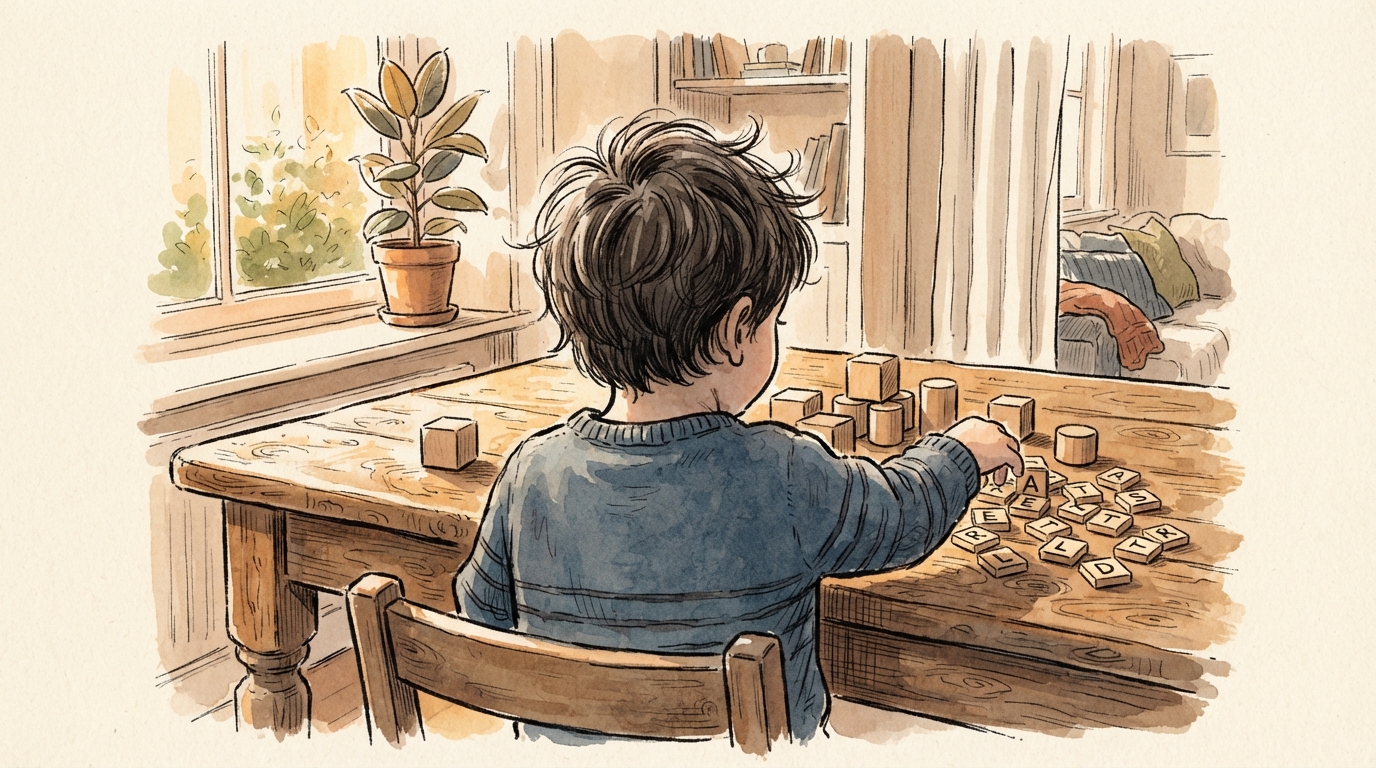
Every cell in your brain is constantly being told which proteins to keep — and which to throw away. F1 The system that does the throwing away: ubiquitin — a molecular tag, stamped onto proteins marked for destruction. But there is a gene whose entire job is to go around erasing those stamps. F1 Half a working copy of that gene, and the wrong proteins are lost — and the brain, from the very beginning, cannot finish wiring itself. F1 Its name is USP7.
02THE NAME
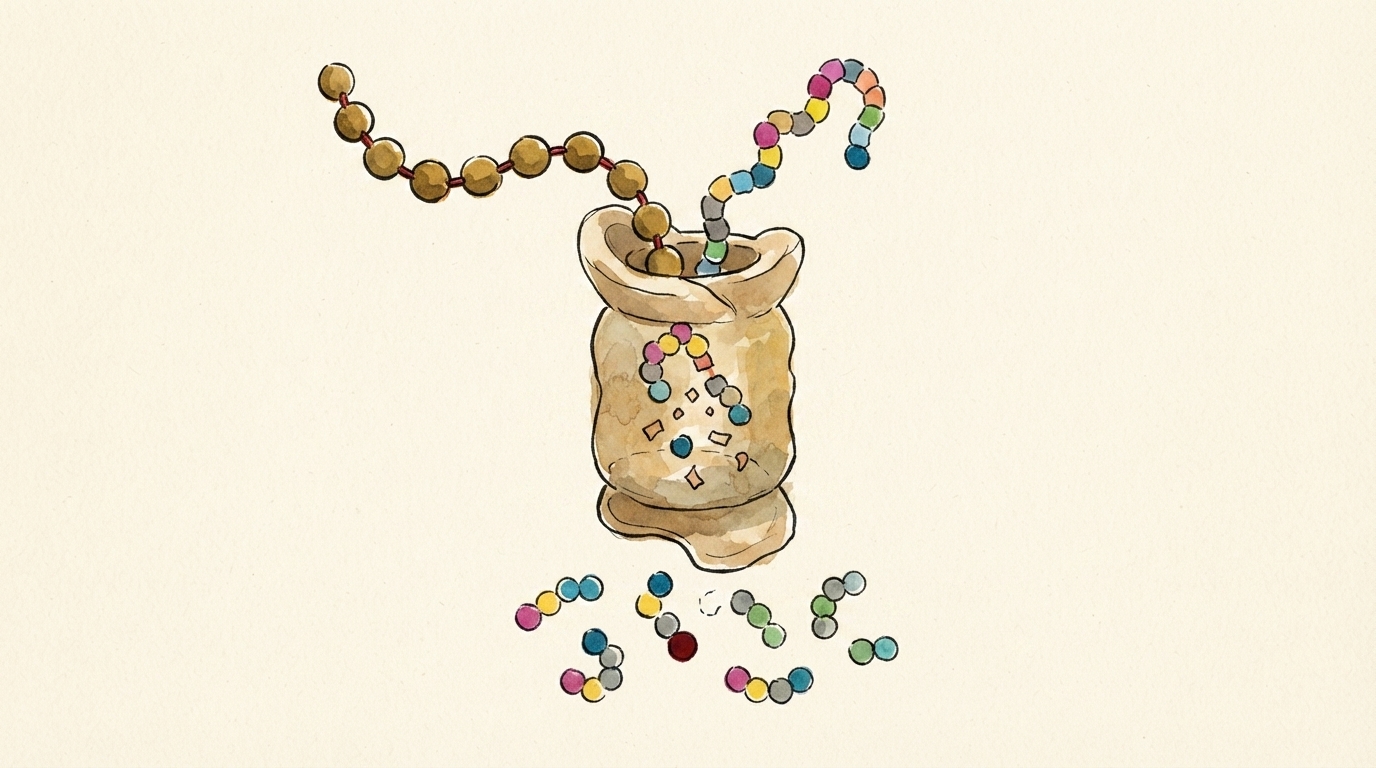
USP7 sits on chromosome sixteen. F1 It encodes ubiquitin-specific protease 7 — one of the body's most important molecular erasers. F1 Ubiquitin is a small protein tag. When a cell wants to destroy something, it stamps ubiquitin on the target: one tag, then another, building a chain that says "shred this." F1 USP7 finds those chains and cuts them — rescuing the labeled protein before the shredder can reach it. F1 There is a gene that does the opposite: UBE3A, whose protein stamps the tags on. When UBE3A is lost, that is Angelman syndrome. F1F6 USP7 is the eraser. UBE3A is the pen. And both ends of the same system, when broken, cost a developing brain. F1F6
03THE HUNT
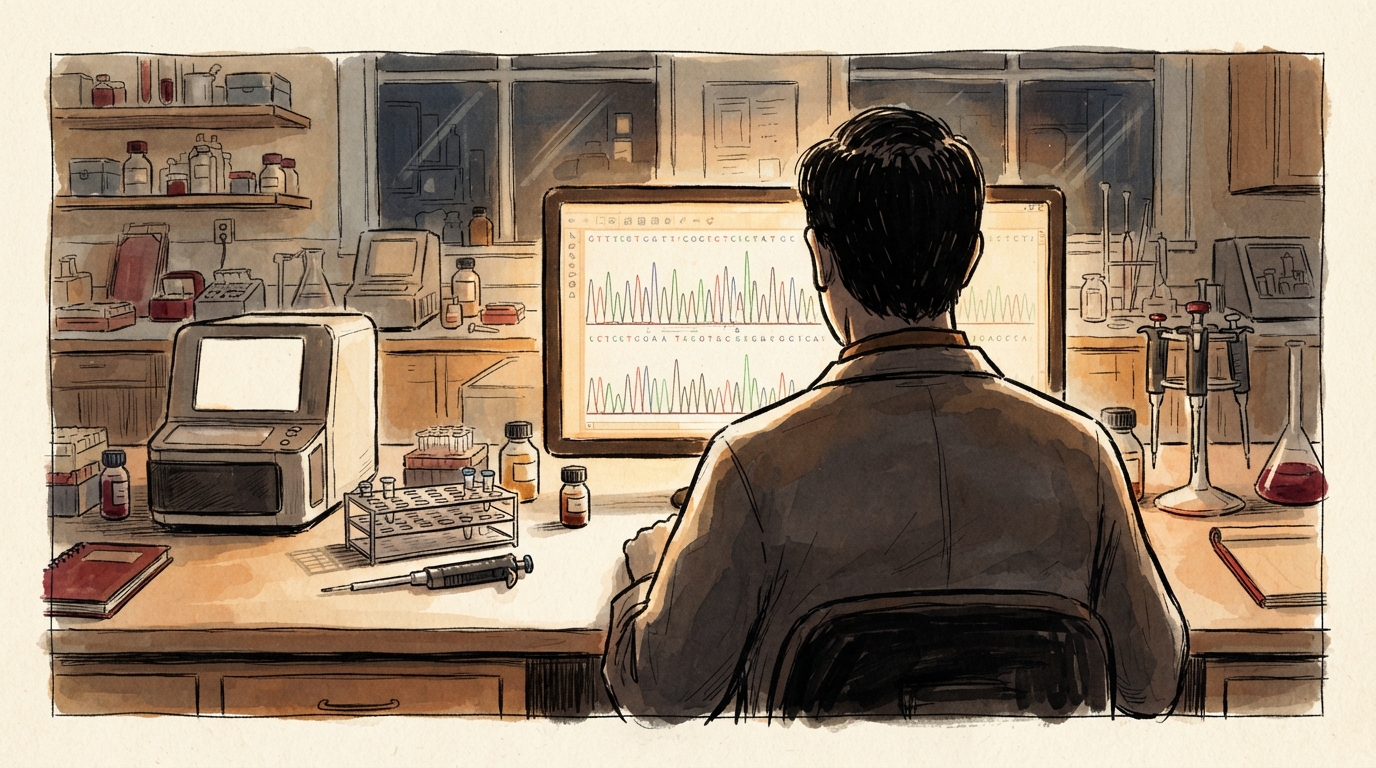
For most of medical history, Hao-Fountain syndrome did not have a name — because the gene at its center was not known to cause disease at all. Then in twenty fifteen, Yi-Hong Hao, Michael Fountain, and their colleagues found it: F2 seven children with de novo disruptions of USP7 — six carrying large deletions that swept the gene away, one with a single nonsense variant that stopped the protein cold. F2 Each change new in the child; neither parent carried it. F1F2 Published in Molecular Cell, the paper named the disorder and mapped the first mechanism. F2 Christian Schaaf and his team at Baylor would go on to characterize the growing roster of patients — the syndrome bears both discoverers' names. F2F3
04HOW THE ERASER WORKS (hero 1, normal function)
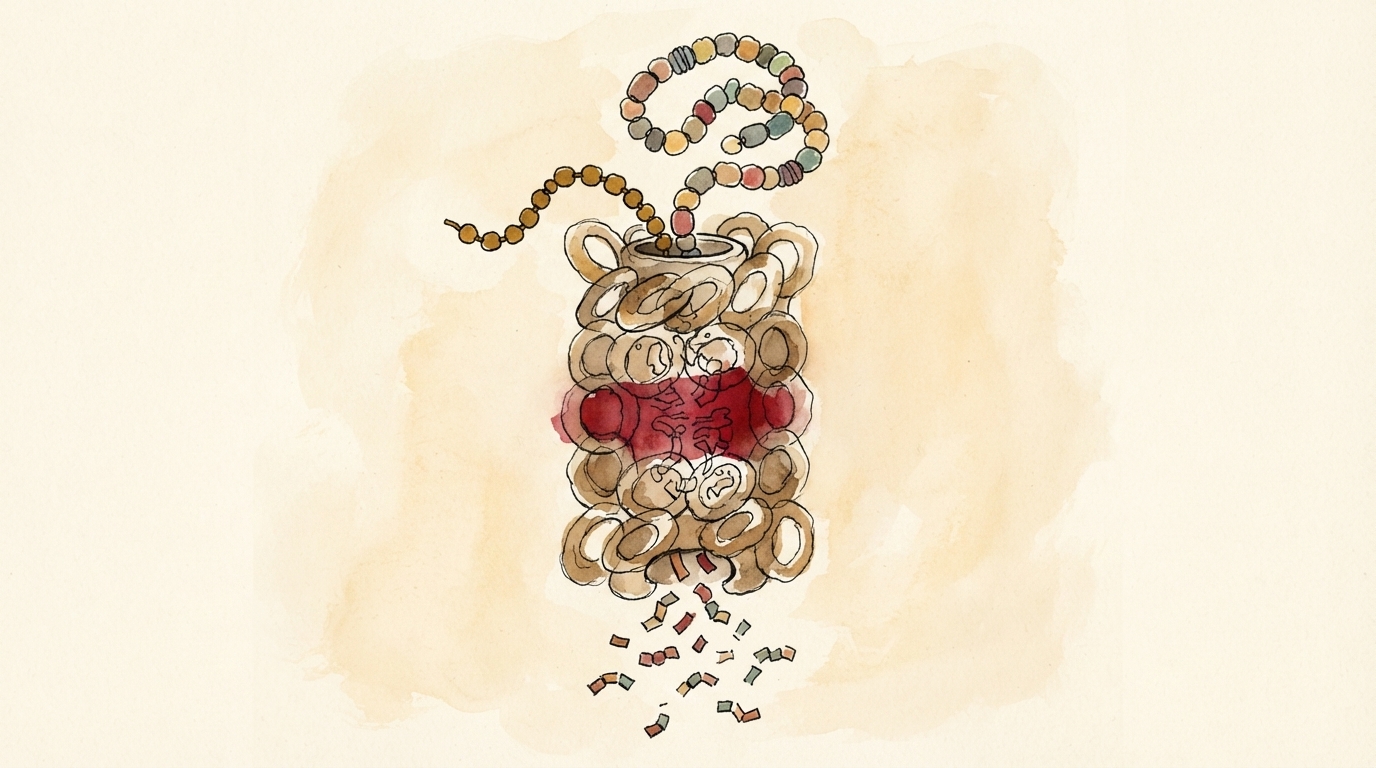
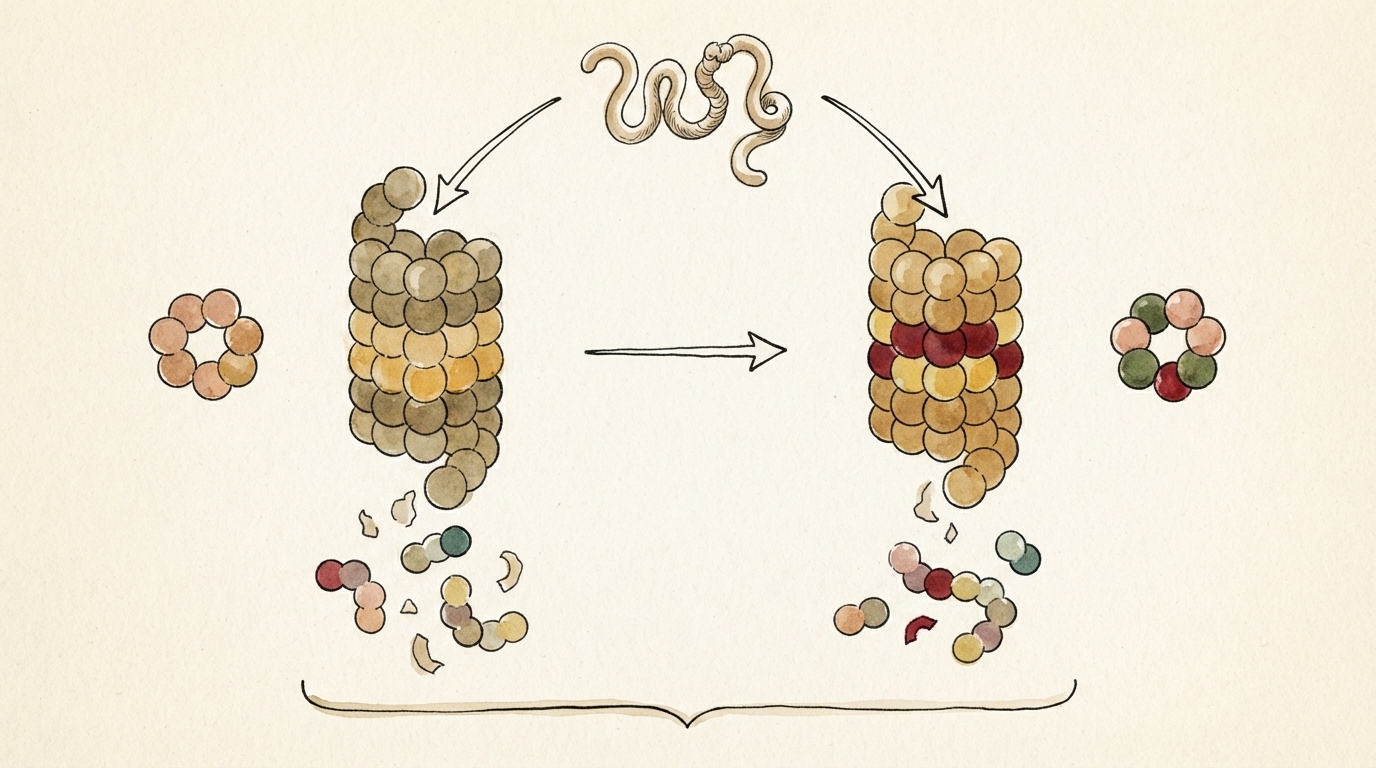
Here is what the eraser does. F5 At the chromatin level, USP7 rescues a protein called BCOR — the scaffold of a silencing complex that controls how genes are switched on and off as the brain develops. F5 USP7 cuts the ubiquitin tag off BCOR before the proteasome can take it. BCOR survives, the gene programs run on schedule, and the neuron knows when to branch and when to connect. F5 Down at the synapse, USP7 rescues a second protein — a splicing factor called Ppil4 — that shapes the messenger RNA the synapse is built from. F5 Ppil4 survives, the right versions are made, and the tiny spines that receive signals form. F5 One eraser, protecting the proteins a developing neuron cannot do without. F5
05ONE BROKEN COPY (the dosage)
So what happens when one copy of USP7 is broken? F1 The disease is dominant. The change is new in the child — carried by neither parent — and the single intact copy cannot make up the difference. F1F2 From the very first cell, the child runs on roughly half the normal supply of erasers. F1 Not none. Half. And half, it turns out, is not enough. F1F3
06WHAT HALF A DOSE BREAKS (hero 2, the consequence)
With only half the erasers, USP7 cannot keep up. F1F5 The tagging never stops — and now some of the BCOR and Ppil4 that should have been rescued reach the proteasome first, and are destroyed. F5 A little less BCOR, and the gene programs falter. A little less Ppil4, and the synapse is built wrong, its spines too few. F5 None of this happens all at once. It is a small, constant shortfall, playing out across the years the brain spends wiring itself — while it is still branching, still reaching for connections. F1F5 And the proteins the developing brain cannot do without are, again and again, not making it through. F1F5
07THE STAKES
Every child with this condition has developmental delay. F4 Speech is the clearest cost — the most consistent finding across every study. Most children with Hao-Fountain syndrome have severely limited language; many do not speak. F4F5 Autism is common — seen in nearly three in four. F4 Hypotonia, feeding difficulties, and eye problems follow many through childhood. F4 Hypogonadism — in boys, undescended testes — reflects the same complex disrupted in a related syndrome, Schaaf-Yang, whose gene shares the same molecular machine. F4F6 About four in ten have seizures. F4 And intellectual ability spans a wide range — not uniformly severe, but always with real impact. F4 The syndrome carries both discoverers' names: Hao and Fountain. Named in 2015. Fewer than three hundred individuals worldwide have been identified — a number still growing as whole-exome sequencing reaches more families. F1F9
08THE OPEN THREAD
There is no approved treatment. F9 But a research team has found something that points toward a path. In cancer, USP7 is being blocked — because in tumors, too much USP7 keeps the wrong proteins alive. F7 In Hao-Fountain syndrome the opposite is true: not enough USP7, and the right proteins are lost. F1F7 A small molecule called MS-8 was designed to do the reverse — to slip into an allosteric pocket on USP7 and coax the enzyme back toward full activity. F8 In laboratory tests, it rescued deubiquitinase function for variants that had partially lost it. F8 It cannot help variants where the enzyme is entirely absent — and it has not yet reached a clinical trial. F8 But the logic is clear: if the problem is a half-powered eraser, the answer is to restore the eraser. F8 That work is underway. F8
09RECAP + FAMILIES SIGN-OFF
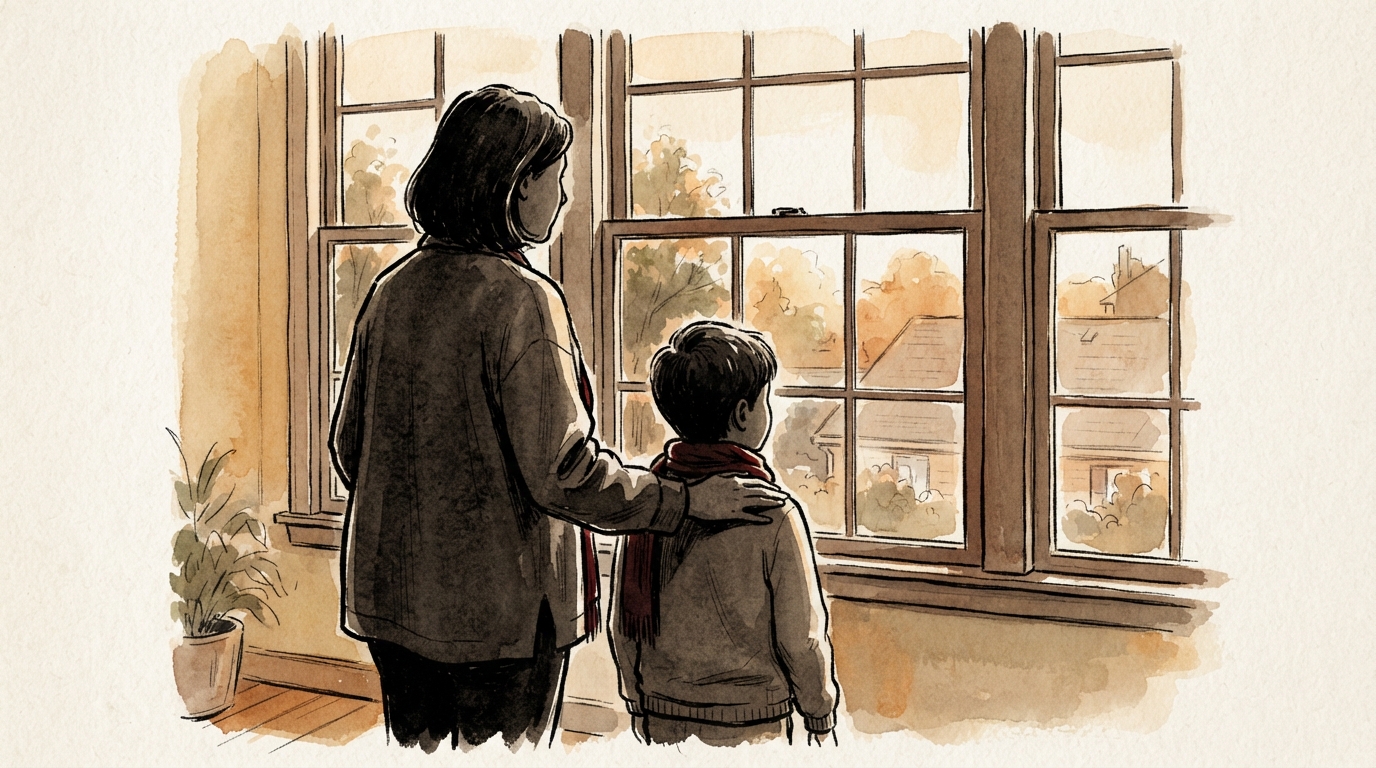
A decade from seven children with no name to a mechanism — and a first attempt to switch the eraser back on. F2F8 The families named the syndrome, built the foundation, and are funding the search. Hao-Fountain Syndrome Foundation: built by parents, for the children who need the eraser. Find them at usp7.org. — The Gene Channel.
The write-up
In one line: USP7 is the cell's molecular eraser — it strips the "destroy me" ubiquitin tag off key proteins; inherit just one working copy and a developing brain, running on half the eraser supply, can't finish wiring itself. That's Hao-Fountain syndrome.
The gene
USP7 sits on chromosome 16p13.2 and encodes ubiquitin-specific protease 7, a deubiquitinating enzyme (a DUB — a cysteine protease). Ubiquitin is a small protein tag: when a cell wants to destroy something, an E3 ligase stamps ubiquitin onto it, chain by chain, marking it for the proteasome. USP7 does the opposite — it finds those chains and cuts them off, rescuing the labelled protein. It is the mirror image of UBE3A, the E3-ligase "pen" whose loss causes Angelman syndrome: both ends of the same tagging system, and breaking either one costs a developing brain.
The hunt
For most of medical history the disorder had no name, because USP7 wasn't known to cause disease. In 2015, Yi-Hong Hao, Michael Fountain and colleagues found it (Molecular Cell): seven children with de novo disruptions of USP7 — six carrying large deletions that swept the gene away, one with a single nonsense variant — each change new in the child. Christian Schaaf's group at Baylor went on to characterise the growing cohort. The syndrome bears both discoverers' names.
The mechanism
The disease is haploinsufficiency: one working copy isn't enough, so every neuron runs on ~half the normal eraser supply. The neuronal mechanism is p53-independent (that's USP7's separate cancer story) and runs on two confirmed axes:
- Chromatin — BCOR. USP7 deubiquitylates and stabilises BCOR, the scaffold of a non-canonical Polycomb silencing complex (ncPRC1.1). With enough USP7, BCOR survives, the complex lays down its gene-silencing marks, and the neuron's differentiation program runs on schedule. Halve USP7 and BCOR is dragged to the proteasome — the program falters.
- Synapse — Ppil4. USP7 also rescues Ppil4, a synaptic splicing factor. It survives → the right mRNA splice variants build the synapse → dendritic spines form. Lose it and spines fail to form; circuits don't knit together.
The stakes, and the frontier
Developmental delay is universal; speech impairment is the hallmark — most have severely limited language and many never speak. Autism is seen in nearly three in four; hypotonia, feeding and eye problems are common; hypogonadism reflects the shared MUST complex (MAGEL2–USP7–TRIM27) that also underlies Schaaf-Yang syndrome; about four in ten have seizures. Intellectual ability spans a wide range — not uniformly severe. Fewer than 300 people have been identified worldwide, a number still growing.
There is no approved therapy. But in cancer, where tumours have too much USP7, the drug goal is to block it — and Hao-Fountain is the mirror: too little, so the goal is to restore it. A small-molecule allosteric activator, MS-8, was shown in 2025 to switch partially-active USP7 variants back on in the lab. It can't help variants where the enzyme is entirely absent, and it hasn't reached a clinical trial — but it's the first proof that a half-powered eraser can be pharmacologically restored.
Sources
Full claim-by-claim evidence is in references.md. Primary anchors:
- GeneReviews NBK619577 "USP7-Related Hao-Fountain Syndrome" (Suter/Schaaf, 2023) — clinical frequencies, mechanism, management.
- Hao, Fountain et al., Molecular Cell 59:956–969 (2015), PMID 26365382 — discovery.
- Fountain et al., Genet Med 21:1669 (2019), PMC6752677 — expanded cohort; haploinsufficiency.
- van der Meer et al., Genes Dev (2025) PMC11875088 (BCOR/H2AK119ub1) & Chen et al., Cell Rep (2025) PMC11922642 (Ppil4/synapse) — p53-independent axes.
- Jaen Maisonet et al. & Korchak et al., PNAS (2025) PMC12557520 / PMC11957113 — the MS-8 activator.
Accuracy note: USP7 removes ubiquitin tags (a DUB) — it never stamps them on; that's the E3-ligase job. The neuronal mechanism is p53-independent — the p53/MDM2 story is cancer, and USP7 inhibitors (useful in oncology) would be exactly the wrong direction here. Intellectual disability is variable, not uniformly profound — speech impairment is the consistent hallmark; seizures affect a minority (~40%). MS-8 is a preclinical proof-of-concept for residual-activity variants only.
Art credit: the schematic cortical pyramidal neuron is rebuilt from a SciDraw reference by John Chilton (CC-BY).