UBE3A
The Dormant Copy
In neurons, one parent's copy of this gene is silenced from birth. Lose the copy that's left and you get Angelman syndrome; inherit an extra and you get its mirror image — and one class of drug can turn the gene's volume up or down.
The walkthrough
Beat by beat

HOOK
0:20
01HOOK
Most children with this condition will never speak a word. F8 And yet — they are almost always smiling. One gene. On loan from only one parent. And when that copy is lost, the silence that results is total. Its name is UBE3A.
02THE NAME
UBE3A sits on chromosome fifteen. F1 It builds a protein called E6-AP — an enzyme that goes around the neuron tagging proteins for disposal. F7 Like a recycling crew that keeps the synapse clean. F7 Without it, the proteins that should be cleared keep piling up — and synapses that should grow and learn cannot. F7 But here is what makes UBE3A different from almost any other gene. In neurons, only one copy ever works. The maternal copy. F1 The copy from your father is there — intact, complete — but silent. F1F6
03THE HUNT
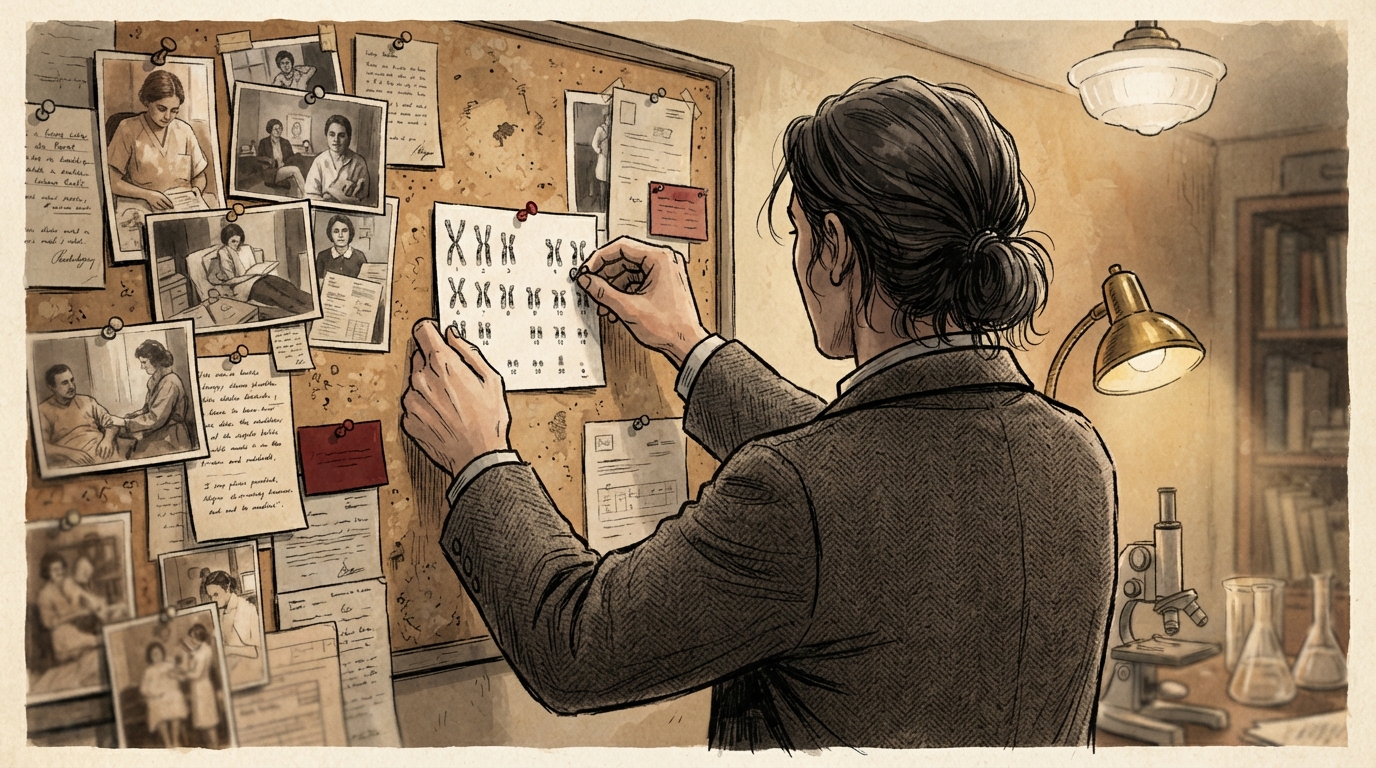
Doctors first described children with this condition in nineteen sixty-five. F4 Harry Angelman, a British pediatrician, wrote about three children — severe intellectual disability, no speech, a characteristic unsteady walk — and a smile that never left them. F4F8 For thirty years, the cause was unknown. Then, in nineteen ninety-seven, two teams published simultaneously in Nature Genetics: F5 Tatsuya Kishino, Marc Lalande, and Joseph Wagstaff; and Tatsushi Matsuura and colleagues at Baylor. F5 In patients whose chromosome fifteen looked normal, who had no deletion anyone could see — they found it: mutations in UBE3A's maternal copy. Broken in the child, not the parents. F5 The gene hidden in the imprinting. F1F5
04THE IMPRINT
Genomic imprinting is a molecular memory: a permanent chemical mark that says "read this copy" or "silence this one." F1 On chromosome fifteen, the paternal copy carries one of the longest silencing signals in the human genome. A noncoding RNA — called UBE3A-ATS — threads itself back through the UBE3A gene in the opposite direction, physically blocking the machinery trying to read it. F6 Two trains on the same track, heading toward each other. The paternal UBE3A never gets through. F6 So the neuron has one chance. One working copy. The maternal one. Now here is how Angelman syndrome begins. In most children, that maternal copy is deleted outright — a whole stretch of the chromosome, gene and all, simply missing. F2 In others, the gene is still there, but a mutation has broken it. F2 Either way, the one working copy goes dark. And because the paternal copy was already silenced, the neuron is left with no working UBE3A at all. F1F2
05HOW A SYNAPSE LEARNS (hero 1)
At a healthy synapse, a signal arrives and a cascade begins. F7 E6-AP — the UBE3A protein — moves through the neuron, attaching small molecular tags to a protein called Arc. F7 Arc's job is to pull the synapse's signal receivers — the AMPA receptors — back inside the cell. F7 Those tags mark Arc for disposal, and Arc is cleared. F7 With Arc gone, the AMPA receptors stay on the surface where they belong: the synapse can now catch an incoming signal, the connection strengthens, and a piece of memory takes hold. F7 E6-AP has a second job, too. It clears Ephexin5 — a molecular brake on building new synapses. F7 Clear that brake, and new connections can form. Two different jobs, one enzyme: keeping the synapse's housekeeping in balance. F7
06WHAT ONE LOST COPY BREAKS (hero 2)
Now take away the maternal UBE3A. F1F2 The paternal copy is there; you can see it. But it cannot respond. The antisense RNA has it locked. F6 Arc builds up. F7 The AMPA receptors that should move in and strengthen the synapse stay internalized instead. Ephexin5 accumulates. F7 New synapses cannot form. The whole machinery of synaptic plasticity, from learning to memory formation to circuit refinement, slows to a crawl. F7F8 And this breakdown is not uniform. The pattern leaves specific marks: severe intellectual disability, the absence of speech, seizures that begin before age three. F8 And through it all, the smile. The happy, excitable affect that defines the syndrome, and that does not mean the brain is undamaged. F8
07THE DIAL RUNS BOTH WAYS
So far this has been a story of too little. But UBE3A is not a switch. It is a dial. F9 Duplicate that same stretch of chromosome fifteen — the maternal copy this time — and neurons carry too much active UBE3A. F9 That condition has its own name: Dup15q syndrome. And its signature is different: autism, intellectual disability, and seizures. F9 Duplicate the father's copy instead, and far less happens — the extra copy stays silenced, exactly as it always was. F6F9 The same gene and the same piece of chromosome, dosed in opposite directions, cause two different diseases. F9 Which is the warning folded into any treatment: the goal was never simply more UBE3A. It is the right amount. F9
08THE STAKES
Every child with Angelman syndrome has profound intellectual disability. F8 Virtually none will speak in sentences. F8 Nine in ten will develop seizures, often before the age of three. F8 Sleep is disrupted — often severely. F8 And because the happy affect is so visible, the depth of the condition is sometimes invisible to the world. These children need full-time care, for life. One in fifteen thousand. F3 One gene. One lost copy.
09THE OPEN THREAD
There is no approved treatment for Angelman syndrome as of today. F11 But the biology points at something remarkable: the paternal copy is still there. Intact. Silenced, but intact. F1F6 What if you could wake it? That is the idea behind the antisense oligonucleotide programs now in Phase 3 trials, GTX-102 and ION582. F11 A synthetic strand, matched to one stretch of the silencing transcript UBE3A-ATS, guides the cell's own demolition enzymes to it. F10 The silencing RNA is destroyed, the collision stops, and the dormant paternal gene begins to work for the first time in that child's neurons. F10F12 The silent copy speaks. But the dial cuts both ways: wake the paternal copy too far, and you risk the opposite extreme. So the aim is to restore the right amount, not to flood the cell. F9 Which is exactly the problem in Dup15q, where there is too much UBE3A. There the goal flips: the same kind of tool, aimed this time at the UBE3A message itself, to trim the surplus back toward normal. F9F13 In patient neurons, that lowering calmed the overexcitable cells, though those programs are still preclinical. F13 Until any of this arrives, the seizures both conditions bring are managed the older way, a broad-spectrum drug at a time. F14 It is early, and nothing is approved. But children with Angelman are receiving the first injections now, and researchers are watching to see if that dormant copy can carry the weight. F11
10RECAP + FAMILIES SIGN-OFF
Sixty years from three children with no name, to a gene, to a mechanism, to the first attempt to wake a dormant copy. The families made the registries. The families funded the science. The families are still moving it forward. Angelman Syndrome Foundation: awareness, research, and support since 1992. Find them at angelman.org. FAST — Foundation for Angelman Syndrome Therapeutics: driving the cure. Find them at cureangelman.org. And on the other side of the dial, the Dup15q Alliance carries the same fight for families living with duplication. Find them at dup15q.org. Found in a library. Carried by families. — The Gene Channel.
The write-up
In one line: In neurons, UBE3A works from only one parent's copy — lose the active maternal copy and you get Angelman syndrome; carry an extra maternal copy and you get Dup15q; and the same class of therapy can push the gene's dosage in either direction.
The gene
UBE3A sits on chromosome 15 (15q11.2‑q13.1) and encodes E6‑AP, a HECT‑domain E3 ubiquitin ligase — an enzyme that tags other proteins with ubiquitin to mark them for the cell's disposal system. In neurons its jobs include clearing Arc (which lets synapses take up AMPA receptors and strengthen) and Ephexin5 (a brake on new synapse formation). What makes UBE3A unusual is genomic imprinting: in most tissues both copies are active, but in mature neurons the paternal copy is silenced, so neurons run almost entirely on the single maternal copy.
The hunt
Harry Angelman, an English pediatrician, first described the syndrome in 1965 ("Puppet Children") — three children with severe intellectual disability, absent speech, an unsteady gait, and a persistently happy affect. The cause stayed unknown for thirty years. In 1997, two teams published simultaneously in Nature Genetics — Kishino, Lalande & Wagstaff; and Matsuura and colleagues at Baylor — finding mutations in the maternal copy of UBE3A in patients whose chromosome 15 otherwise looked normal.
The mechanism
The paternal copy is silenced by UBE3A‑ATS, one of the longest noncoding antisense transcripts in the genome, which runs back through the gene in the opposite direction and blocks it by transcriptional collision. So neurons have one working copy. Lose the maternal one (Angelman syndrome) and E6‑AP's substrates — Arc, Ephexin5 — pile up, AMPA receptors stay internalized, new synapses fail to form, and synaptic plasticity slows to a crawl.
But UBE3A is a dial, not a switch. Duplicate the same stretch of chromosome 15 on the maternal copy and neurons carry too much UBE3A — that's Dup15q syndrome (developmental delay, hypotonia, autism, and seizures). Duplicate the paternal copy instead and far less happens, because the extra copy stays silenced. The same gene and the same piece of chromosome, dosed in opposite directions, cause two different diseases.
The stakes, and the frontier
Every child with Angelman syndrome has profound intellectual disability; virtually none speak in sentences; ~90% develop seizures (often before age three); sleep is frequently disrupted — and the visible happy affect can hide the depth of the condition. Prevalence is roughly 1 in 15,000.
There is no approved disease‑modifying therapy for either condition. For Angelman, the frontier is paternal‑allele reactivation: antisense oligonucleotides (GTX‑102, ION582 — both in Phase 3; rugonersen in Phase 1/2) that degrade the silencing UBE3A‑ATS transcript so the intact‑but‑dormant paternal copy can finally work. For Dup15q, the logic runs in reverse — the same class of tool aimed at the UBE3A message itself to lower the surplus (still preclinical; programs at Quiver Bioscience and Kicho, with the Dup15q Alliance). Because dosage matters in both directions, the Angelman therapies must be titrated, not maximized. Until any of this arrives, the seizures both conditions bring are managed the older way, with broad‑spectrum antiseizure drugs.
Foundations
- Angelman Syndrome Foundation — angelman.org
- FAST — Foundation for Angelman Syndrome Therapeutics — cureangelman.org
- Dup15q Alliance — dup15q.org
Sources
Full claim‑by‑claim evidence is in references.md. Primary anchors:
- GeneReviews "Angelman Syndrome" (Williams CA, Driscoll DJ), NBK1144 — clinical genetics reference for molecular classes, features, prevalence.
- Kishino et al. Nat Genet 15:70–73 (1997), PMID 8988171; Matsuura et al. Nat Genet 15:74–77 (1997), PMID 8988172 — UBE3A identified as the Angelman gene.
- Meng et al. PLoS Genet 2013 (PMC3873245) & EMBO Mol Med 2015 (PMC4351819) — UBE3A‑ATS silencing and ASO proof of concept.
- Khatri & Man, Front Cell Neurosci 2019 (PMC6502993) — neuronal E6‑AP substrates and synaptic consequences.
- GeneReviews "Maternal 15q Duplication Syndrome," NBK367946; CRISPR‑corrected Dup15q neurons, PMC10147551 (PMID 36898382) — Dup15q as the dosage mirror; lowering UBE3A normalizes hyperexcitability.
Accuracy note: Angelman syndrome is loss of the maternal UBE3A copy, not a total absence of the gene — even in deletion‑class patients the paternal copy is present but silenced (which is exactly what makes reactivation therapy possible). The discovery year is 1997, not 1996. The Angelman ASO is a gapmer that degrades the UBE3A‑ATS silencing RNA — it is not a microRNA blocker. The happy affect is a genuine biological feature and does not indicate mild disease. UBE3A imprinting is neuron‑specific. Dup15q is the mirror condition: the same class of tool (an ASO) but a different target — an Angelman‑type ASO would push UBE3A higher and worsen Dup15q — and UBE3A is the leading but not the only Dup15q driver (the duplicated region also carries the GABA‑A subunit cluster).