Thymulin
The Forgotten Organ's Hormone
The thymus quits on you in childhood — but the hormone it leaves behind turns out to be a master switch for the inflammation of aging. In 2026, putting it back into old mice rolled that inflammation back and made cancer immunotherapy work again. And after fifty years, we still can't say which gene even makes it.
The walkthrough
Beat by beat
HOOK
0:22
01HOOK
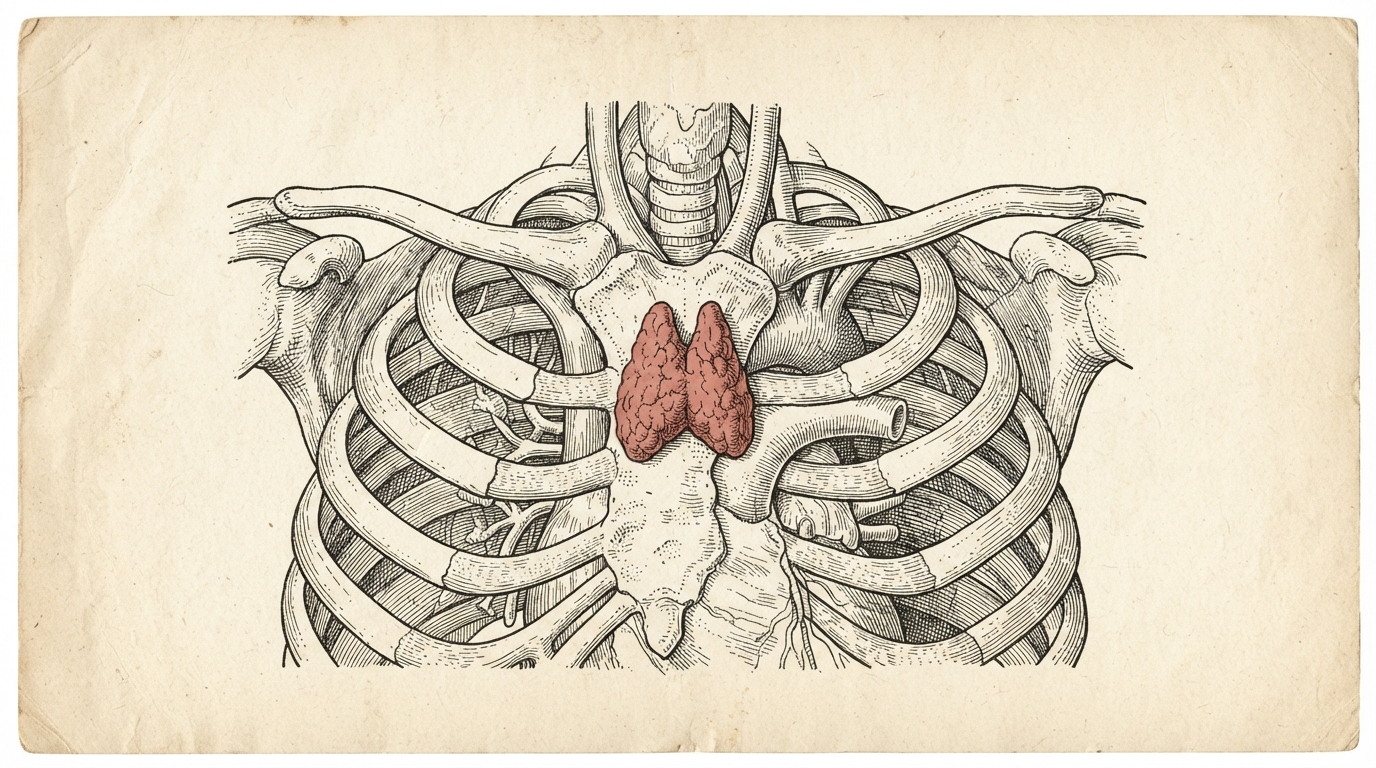
Give it back to an old, sick mouse, and its worn-out immune system starts to reset. Inflammation drops. Tumors shrink. A cancer drug that had quit working — starts working again. F1 The "it" is a hormone. And it comes from an organ most anatomy books treat as a spare part: the thymus. F2
02THE DISCOVERY
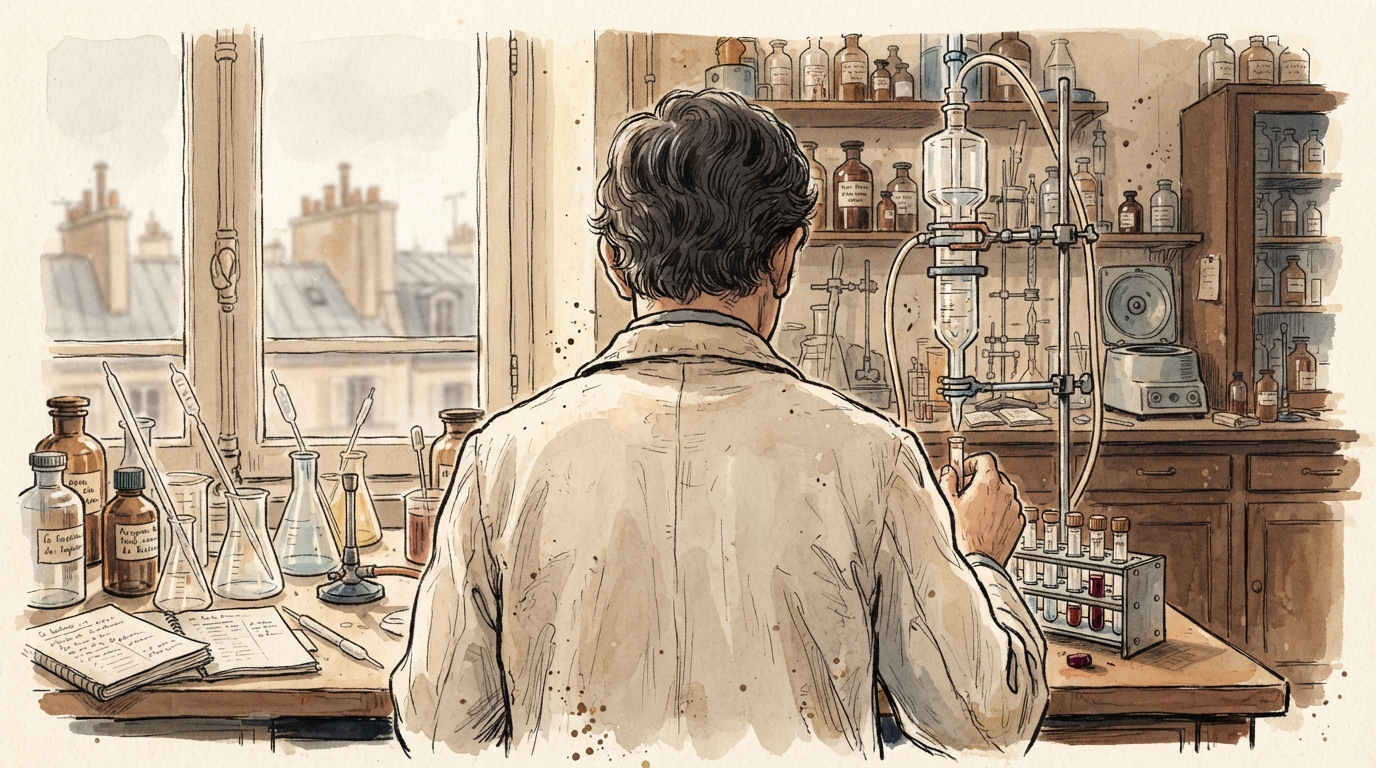
Paris, 1977. Two immunologists, Jean-François Bach and Mireille Dardenne, are chasing a rumor: that the thymus talks to the rest of the body through the blood. F3 They find the voice. A tiny factor in serum that pushes immature immune cells to grow up. They call it, plainly, serum thymic factor. F4
03WHAT IT IS (the zinc twist)
On paper it's almost nothing. Nine amino acids in a row. F5 But the peptide alone is dead. It only comes alive gripping a single atom of zinc. F6 Take the zinc away, and it stops working. No other thymic hormone needs a metal like this. F7 Once they understood that, the factor got a proper name: thymulin. F8
04WHAT IT DOES
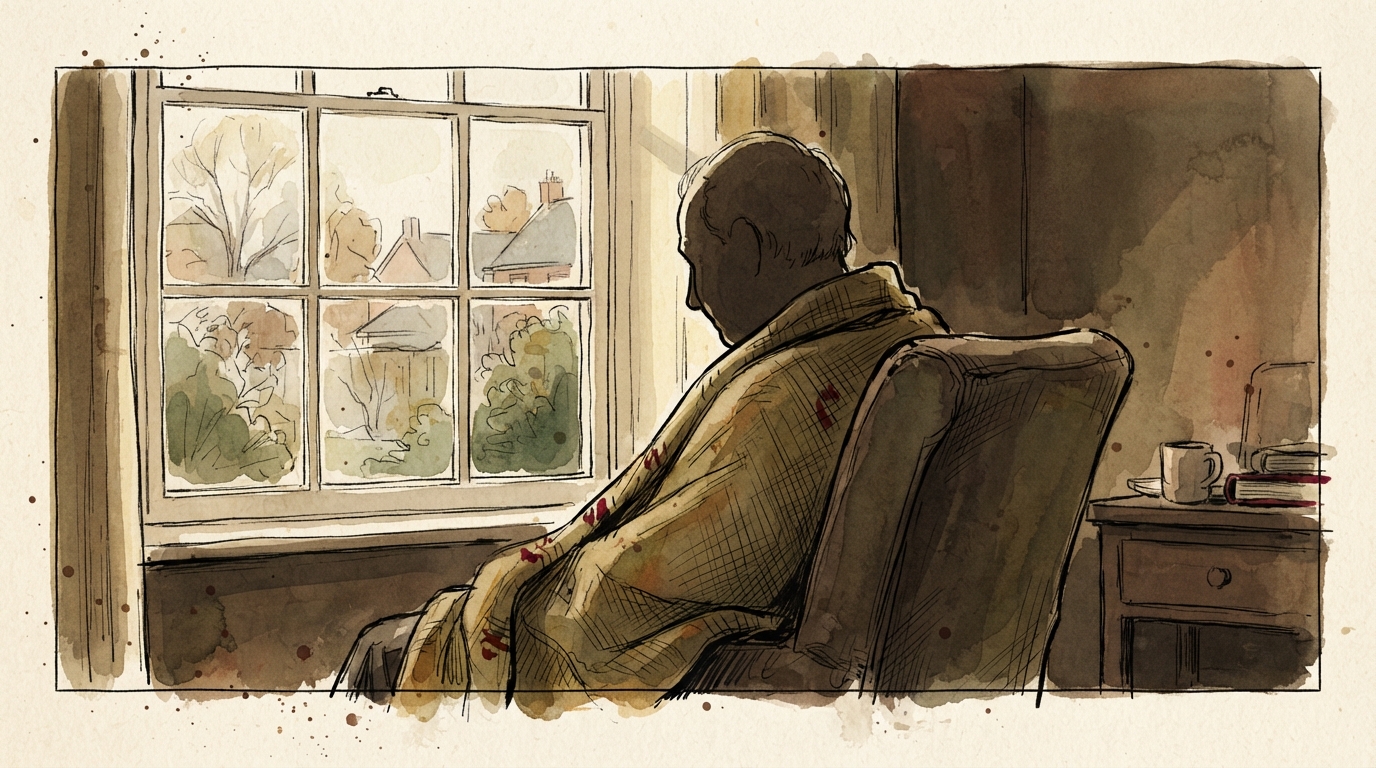
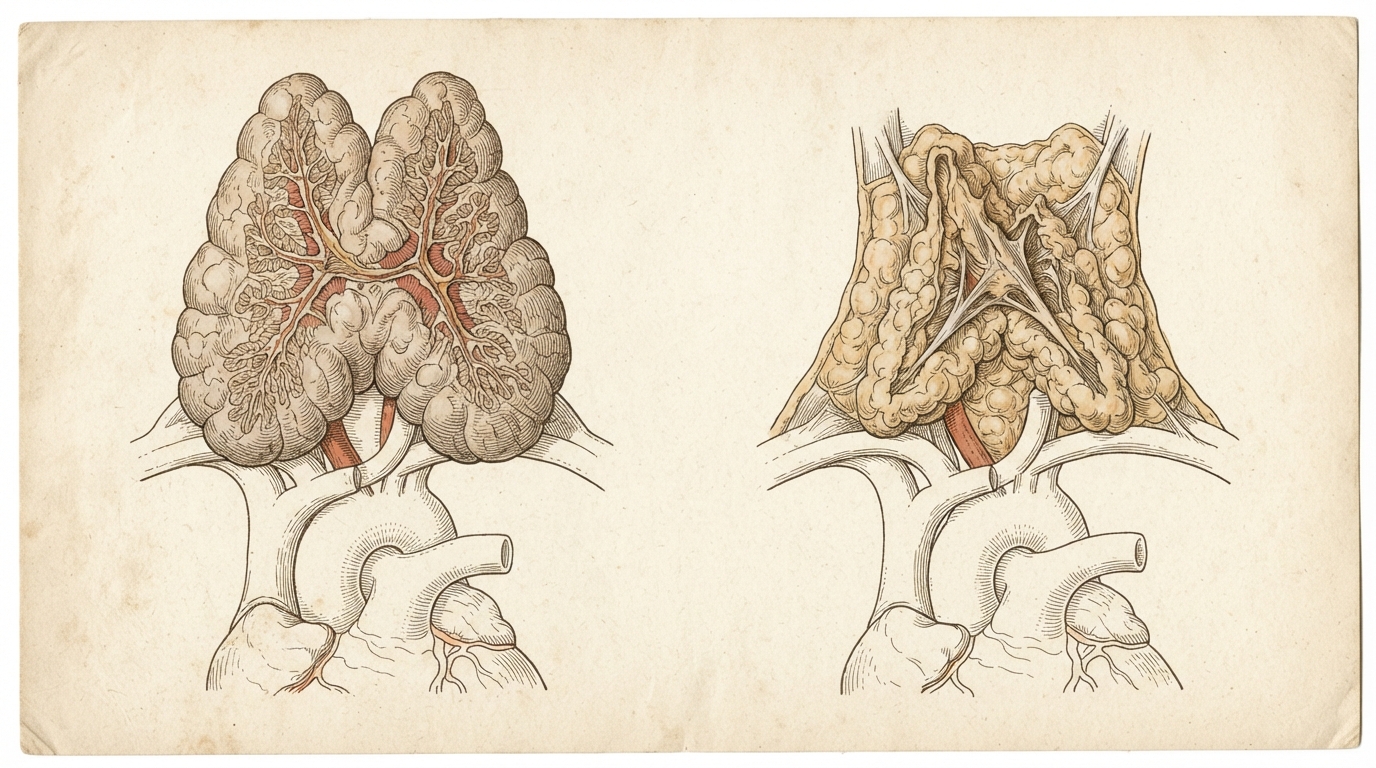
Thymulin is made by the epithelial cells of the thymus, and its day job is schooling T cells — the immune system's officers. F9 But here's the catch. The thymus doesn't last. It starts shrinking in childhood, and as it fades, so does thymulin. F10 By old age, there's almost none left. F11
05THE MECHANISM (hero)
For decades, that decline looked like just a symptom of getting old. The 2026 work says it may be a cause. F12 Inside the immune system's front-line cells — the myeloid cells — sits a master inflammation switch called NF-κB. Thymulin holds that switch down, keeping the inflammatory signals quiet. F13 Lose the thymulin, and the switch drifts up. The cells begin to smolder: the chronic, low-grade fire researchers call "inflammaging." F14
06HOW THEY PROVED IT
How do you prove a hormone in the blood does all this? You share the blood. The team surgically joined an old mouse to a young one, so the two pooled a single circulation. F15 The young blood calmed the old animal's inflammation — and human blood samples told the same story: thymulin down as the inflammatory signals climbed. F16
07THE STAKES
Then the real test. They put thymulin back into old mice with cancer. F17 The inflammation eased. The animals lived longer. F18 And a checkpoint immunotherapy — anti-PD-1 — that had barely worked in aged animals, suddenly did. F19 One faded hormone, sitting right at the junction of aging, inflammation, and whether cancer treatment even works. F20
08WHY IT MATTERS
Most cancers strike older bodies: the very patients in whom immunotherapy tends to work worst. F25 A natural molecule that wakes their defenses back up, with few side effects, would help exactly the people who need it most. F27 And the reach may be wider. The slow inflammation thymulin holds down also feeds heart disease and the aging brain. F26 Quiet that fire, and cancer may be only the beginning. For now, though, this lives in mice and human blood. Not yet the clinic. F27
09THE OPEN QUESTION
One last strangeness. Fifty years on, we still can't say for certain which gene spells out those nine letters. F22 The leading suspect isn't an immune gene at all — it's a stress protein called SPATS2L, which seems to shed the peptide when a cell is under threat. F23 The hormone that tunes our inflammation may itself be a fragment we don't yet fully understand. F24
10TIMELINE + SIGN-OFF
From a whisper in the blood in 1977, to a lever on aging in 2026 — all from an organ we were ready to forget. F21 Thymulin. — The Gene Channel.
The write-up
In one line: A zinc-dependent nonapeptide from the thymus — discovered in 1977, forgotten for decades — turns out to hold the master inflammation switch of aging, and in 2026 it reversed inflammaging and rebooted cancer immunotherapy in old mice.
The hormone (not quite a gene)
Thymulin is a hormone, not a mapped gene — which is why this episode bends the channel's one-gene rule. It is a nonapeptide: nine amino acids in a row (pyroGlu-Ala-Lys-Ser-Gln-Gly-Gly-Ser-Asn), made by the epithelial cells of the thymus. Its defining quirk is chemical: the bare peptide is biologically dead, and only springs to life when it grips a single atom of zinc in a one-to-one ratio. It is the only thymic hormone that needs a metal cofactor at all. Take the zinc away, and it stops working.
The hunt
In Paris, 1977, immunologists Jean-François Bach and Mireille Dardenne were chasing the idea that the thymus signals to the rest of the body through the bloodstream. They isolated a tiny circulating factor that pushed immature immune cells to mature, and named it, plainly, serum thymic factor (FTS). Only later — once Dardenne and colleagues showed (PNAS, 1982) that its activity depended on zinc — did the zinc-bound active form get the name we use today: thymulin. (FTS and thymulin are the same molecule; thymulin just refers to the active, zinc-loaded form.)
The mechanism
The thymus is one of the first organs to age: it begins involuting in childhood, and as it shrinks, thymulin fades — by old age there is almost none left. For decades that decline read as a symptom of getting old. The 2026 work from the Ito lab at USC argues it may be a cause. Inside myeloid cells — the immune system's front line — sits NF-κB, a master switch for inflammation. Thymulin holds that switch down. Lose the thymulin, and NF-κB drifts up, the cells begin to smolder, and you get the chronic, low-grade fire researchers call "inflammaging."
The stakes, and the frontier
To prove a blood-borne hormone was responsible, the team used heterochronic parabiosis — surgically joining an old mouse to a young one so they shared a single circulation — and matched it against human blood samples, where thymulin again fell as inflammatory signals rose. Then the payoff: restoring thymulin in old, tumor-bearing mice eased inflammation, extended survival, and revived anti-PD-1/PD-L1 checkpoint immunotherapy that had barely worked in aged animals. The result maps a thymus–myeloid cell axis linking aging, inflammation, and cancer immunity.
Why it matters: cancer is largely a disease of older bodies — precisely the patients in whom checkpoint immunotherapy tends to work worst. A naturally occurring hormone that reboots their anti-tumor response, with (in the senior author's words) "minimal side effects," would help the people who need it most. And the reach may run wider than oncology: the same low-grade "inflammaging" thymulin restrains is implicated in cardiovascular disease and neurodegeneration, and prior work has tied thymus health to longer lifespan — so a lever on thymulin is potentially a lever on more than cancer. All of this remains, for now, a mouse-and-human-sample finding that requires human confirmation before any clinical use — not an approved therapy.
Sources
Full claim-by-claim evidence is in references.md. Primary anchors:
- Ito et al., Thymulin restrains age-associated myeloid inflammation and enhances cancer immunotherapy, Nature Communications (2026), DOI 10.1038/s41467-026-75383-0.
- Bach, Dardenne, Pléau, Rosa, Biochemical characterisation of a serum thymic factor, Nature 266:55–57 (1977).
- Dardenne et al., Contribution of zinc and other metals to the biological activity of the serum thymic factor, PNAS (1982).
Accuracy note: Thymulin is a hormone, not a mapped gene (no clean native "thymulin gene" — gene-therapy work used synthetic constructs), so there is deliberately no locus beat. "FTS" and "thymulin" are the same molecule (thymulin = the zinc-bound active form). The 1977 discovery (Bach & Dardenne, Paris) and the 2026 mechanism (Ito, USC) are different teams decades apart. The inflammaging reversal is an experimental result in mice plus human blood samples — not a proven human treatment.
The evidence
Every claim, sourced
Each [F#] you hear in the film links to the source it came from. Nothing gets narrated until every one is checked and signed off.
Sign-off
- PhD sign-off — facts above are correct; traps A–F stated correctly in
script.md. (user-approved 2026-07-22) - Numbers/dates verified (1977 Nature; 1982 PNAS PMID 6957870; 2026 Nat Commun) — or narration kept qualitative.
- Length sign-off — extended ~3.5–4 min, 9-segment cut approved by user (2026-07-22).
**Gate OPEN** — narration/assets cleared. Then Video.tsx → render → `writeup.md`. *(seg-07b implications beat + F25–F27 added post-sign-off at user request, 2026-07-22; all sourced — quotes attributed to Ito via coverage, results to Nat Commun 2026; caveat kept in narration.)*
- F1
Restoring thymulin in old, tumor-bearing mice reduced inflammation, improved survival, and restored response to a cancer immunotherapy that had stopped working
Key result of the 2026 study: restored thymulin in aged mice → reduced age-related inflammation, improved survival, enhanced anti-PD-1/PD-L1 immunotherapy response
- F2
Thymulin is a hormone made by the thymus — an organ often dismissed as vestigial
Thymus-derived hormone; thymus involutes with age and is commonly treated as a "spare part"
- F3
Jean-François Bach and Mireille Dardenne, working in Paris in 1977, pursued a blood-borne thymic factor
Bach & Dardenne (Institut Necker/INSERM, Paris) characterized a circulating serum thymic factor
- F4
They named it "serum thymic factor" (FTS); it drives immature T cells to differentiate
FTS = facteur thymique sérique; assayed by induction of T-cell differentiation markers (rosette bioassay)
- F5
It is a nonapeptide — nine amino acids
Sequence pyroGlu-Ala-Lys-Ser-Gln-Gly-Gly-Ser-Asn (
<Glu-Ala-Lys-Ser-Gln-Gly-Gly-Ser-Asn), 9 residues; synthetic peptide fully active - F6
The peptide is inactive alone; it becomes biologically active only when bound to a single zinc atom (equimolar)
Metal-chelation abolishes FTS activity; Zn²⁺ (and, weakly, some other metals) restores it — activation is secondary to metal binding to the peptide
- F7
No other thymic hormone requires a metal cofactor
Thymulin is the only thymic hormone requiring a metal (Zn²⁺) for biological activity
- F8
Once the zinc dependence was understood, FTS was renamed "thymulin"
The zinc-bound active form was designated "thymulin" (~1980); zinc contribution formalized 1982
- F9
Thymulin is produced by thymic epithelial cells; it supports T-cell differentiation/maturation
Exclusively produced by thymic epithelial cells (TECs); promotes T-cell differentiation, modulates cytokines, enhances NK activity
- F10
The thymus involutes beginning in childhood, and thymulin declines with age
Age-associated thymic involution; circulating thymulin falls with age
- F11
By old age there is very little thymulin left
Thymulin markedly reduced in aged individuals/animals
- F12
The 2026 work reframes the decline of thymulin as a possible cause of inflammaging, not just a marker
Integrative analyses identify thymulin as a mediator that suppresses inflammation; its loss drives age-associated inflammation
- F13
Thymulin suppresses pro-inflammatory cytokine production in myeloid cells by inhibiting NF-κB signaling
"thymulin … suppresses pro-inflammatory cytokine production by inhibiting NF-κB signaling" in myeloid cells
- F14
As thymulin falls, cytokines rise → chronic low-grade inflammation ("inflammaging")
Thymulin decline → increased pro-inflammatory cytokines → age-associated ("myeloid") inflammation
- F15
They surgically joined an old mouse to a young one to share one circulation (heterochronic parabiosis)
Heterochronic parabiosis used to test blood-borne effect of the young/old systemic environment
- F16
Human blood samples showed the same pattern — thymulin down as inflammatory signals rose
Human blood analyses corroborated the mouse findings (thymulin inversely tracks inflammatory cytokines with age)
- F17
They restored thymulin in aged mice bearing cancer
Restoration of thymulin in old tumor-bearing mice
- F18
Restoration reduced inflammation and improved survival
Reduced age-related inflammation; improved survival
- F19
It restored response to anti-PD-1/PD-L1 checkpoint immunotherapy in aged animals
Enhanced response to anti-PD-1/PD-L1 immunotherapy in aged mice
- F20
The finding defines a thymus–myeloid cell axis linking aging, inflammation, and cancer immunity
"a thymus-myeloid cell regulatory axis linking aging, inflammation, and cancer immunity"
- F21
Discovery in 1977 → the aging/immunotherapy finding in 2026
Timeline: FTS characterized 1977 (Nature); thymulin/inflammaging finding 2026 (Nat Commun)
- F22
Even now, we can't say for certain which gene encodes the nonapeptide
No dedicated native gene/mRNA transcribed-and-processed specifically to make thymulin has been unambiguously cloned; precursor remains unresolved (see TRAP-A)
- F23
The leading candidate precursor is SPATS2L, a stress-response protein that appears to shed the peptide under cellular stress
BLAST of thymulin sequence hits a thymulin-like stretch in SPATS2L (~60 kDa); anti-thymulin/anti-SPATS2L antibodies co-stain the same band (r≈0.925); stressed non-thymic cells release extracellular thymulin within ~2 h. Single-group hypothesis, framed as unresolved.
- F24
Thymulin may itself be a fragment (of a larger, incompletely-understood protein)
Consistent with SPATS2L-fragment hypothesis + extrathymic, stress-induced release; mechanism not fully established (kept qualitative: "may … not yet fully understand")
- F25
Cancer is largely a disease of older bodies, and immunotherapy response tends to be weaker with age
The study's premise + rationale: aging myeloid inflammation blunts anti-tumor immunity; restoring thymulin most benefits aged animals
- F26
The same age-related ("inflammaging") inflammation thymulin restrains is tied to more than cancer — e.g. heart disease and the aging brain
Inflammaging is broadly linked to cardiovascular disease and neurodegeneration; prior work correlated thymus health with longer lifespan + lower cardiovascular/lung-cancer rates
- F27
As a naturally occurring hormone it could improve immunotherapy in older patients with minimal side effects — but this is preliminary (mice + human blood samples), not yet clinical
Ito (senior author): "This hormone can slow down tumor growth, improve survival and enhance treatment efficacy of cancer immunotherapy"; "This naturally occurring hormone would cause minimal side effects while potentially improving immunotherapy efficacy"; results "require human confirmation before clinical application"