TP53
The Guardian We Mistook for the Enemy
The “guardian of the genome” was first mistaken for the enemy. It is the most commonly mutated gene in human cancer.
The walkthrough
Beat by beat
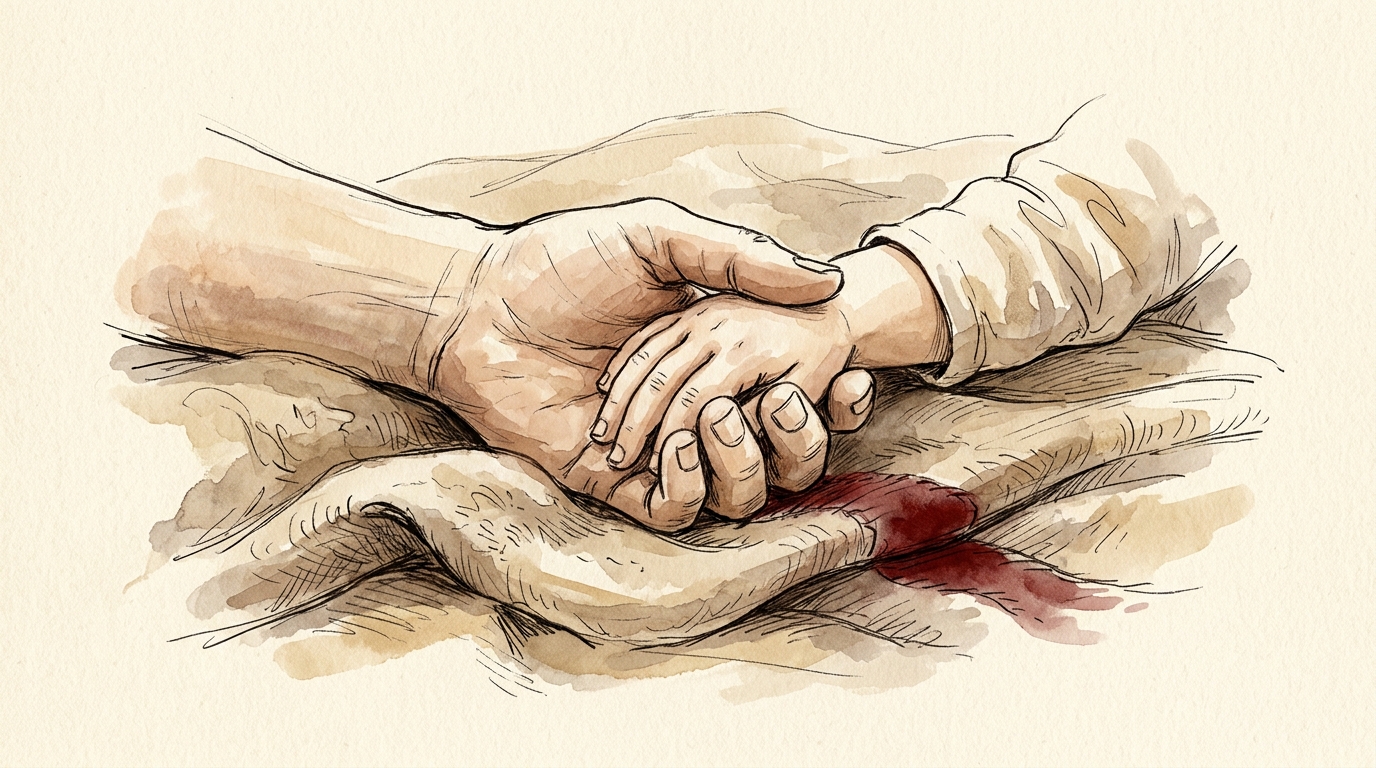
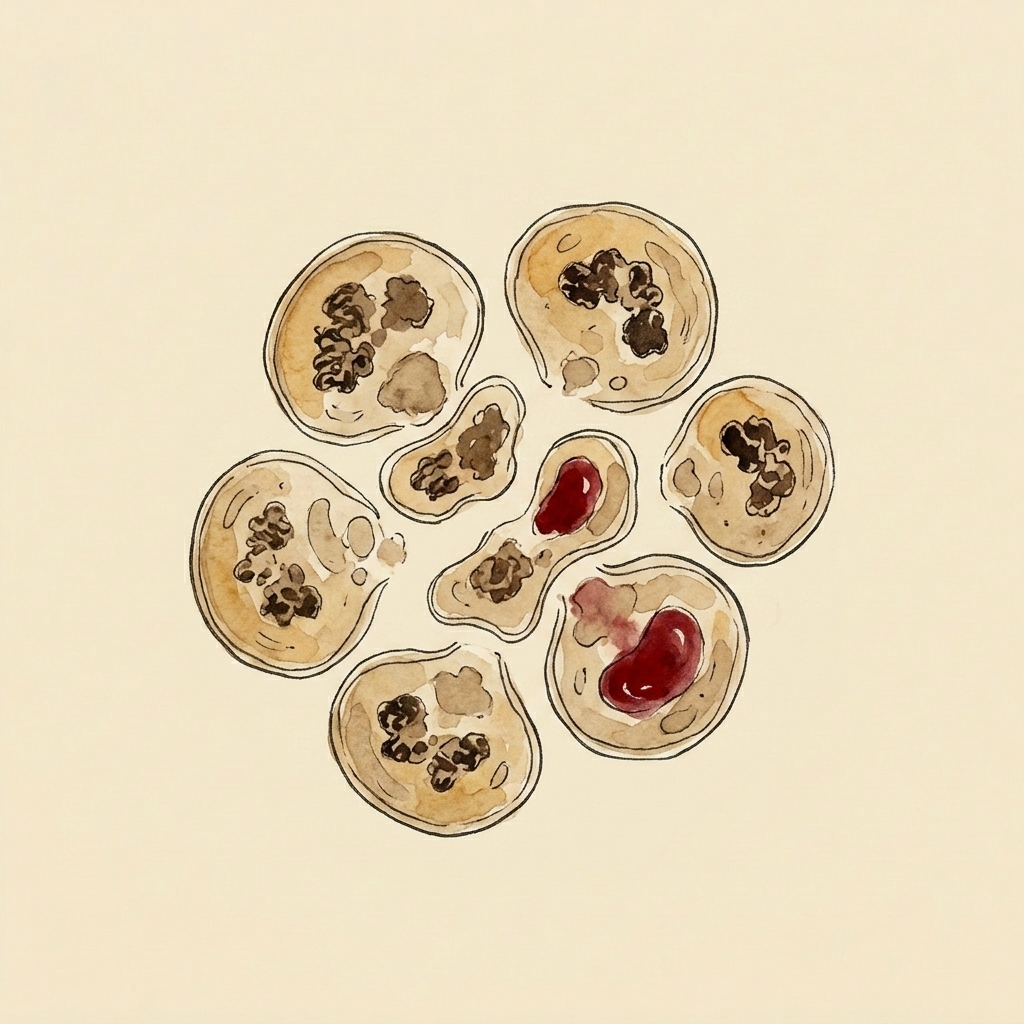
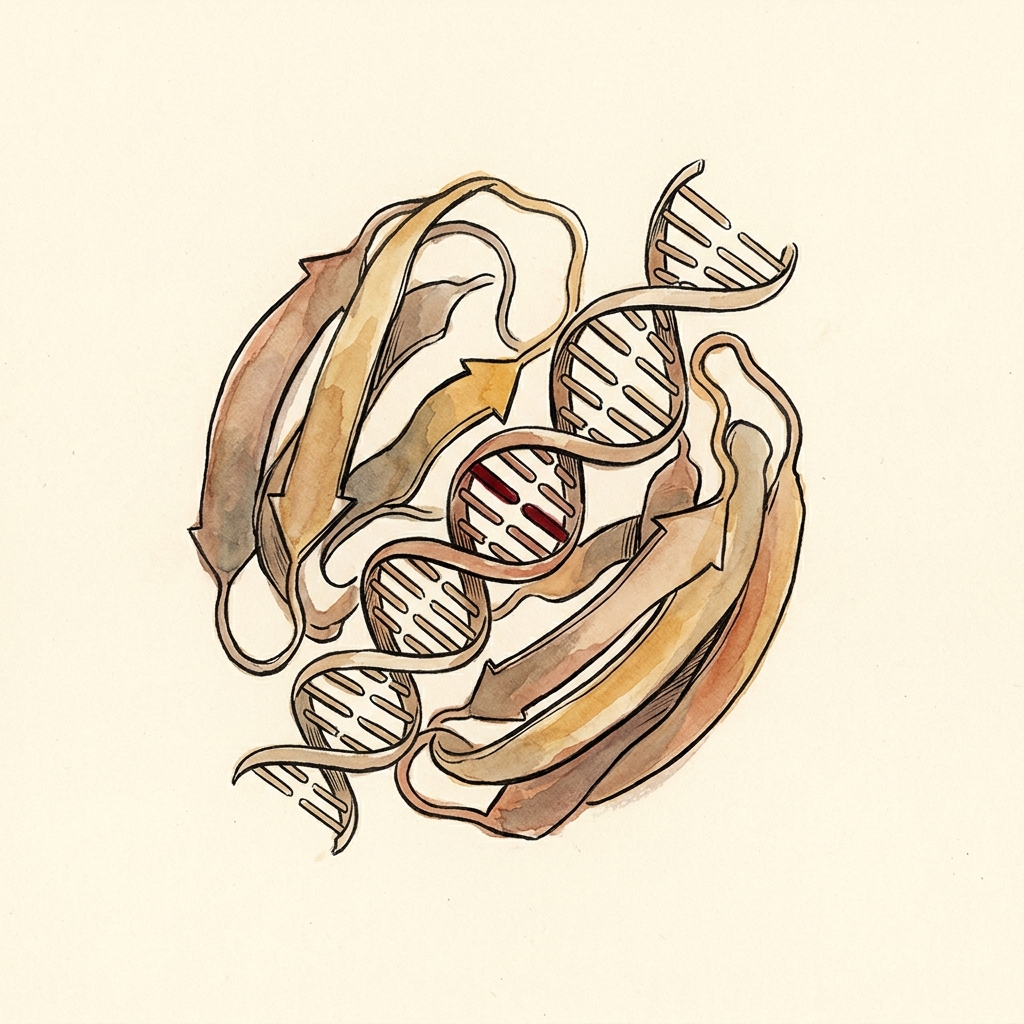
HOOK
0:28
01HOOK
Roughly half of all human cancers carry a fault in the same single gene `F1`. But here is the strange part: this gene is not a cancer gene. It is the cell's own defense against cancer — a tumor suppressor `F2`. Scientists named it the guardian of the genome `F3`. And for years, they were convinced it was the villain.
02THE NAME
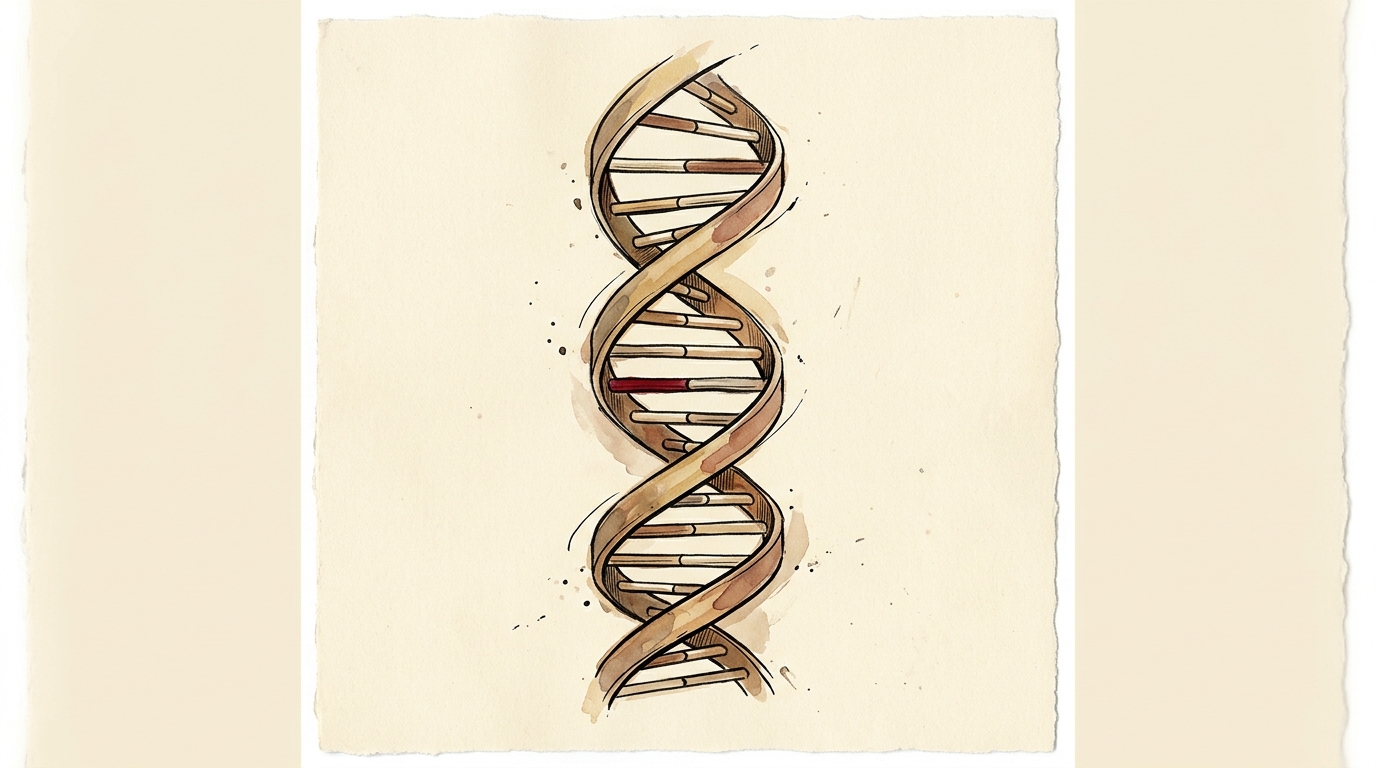
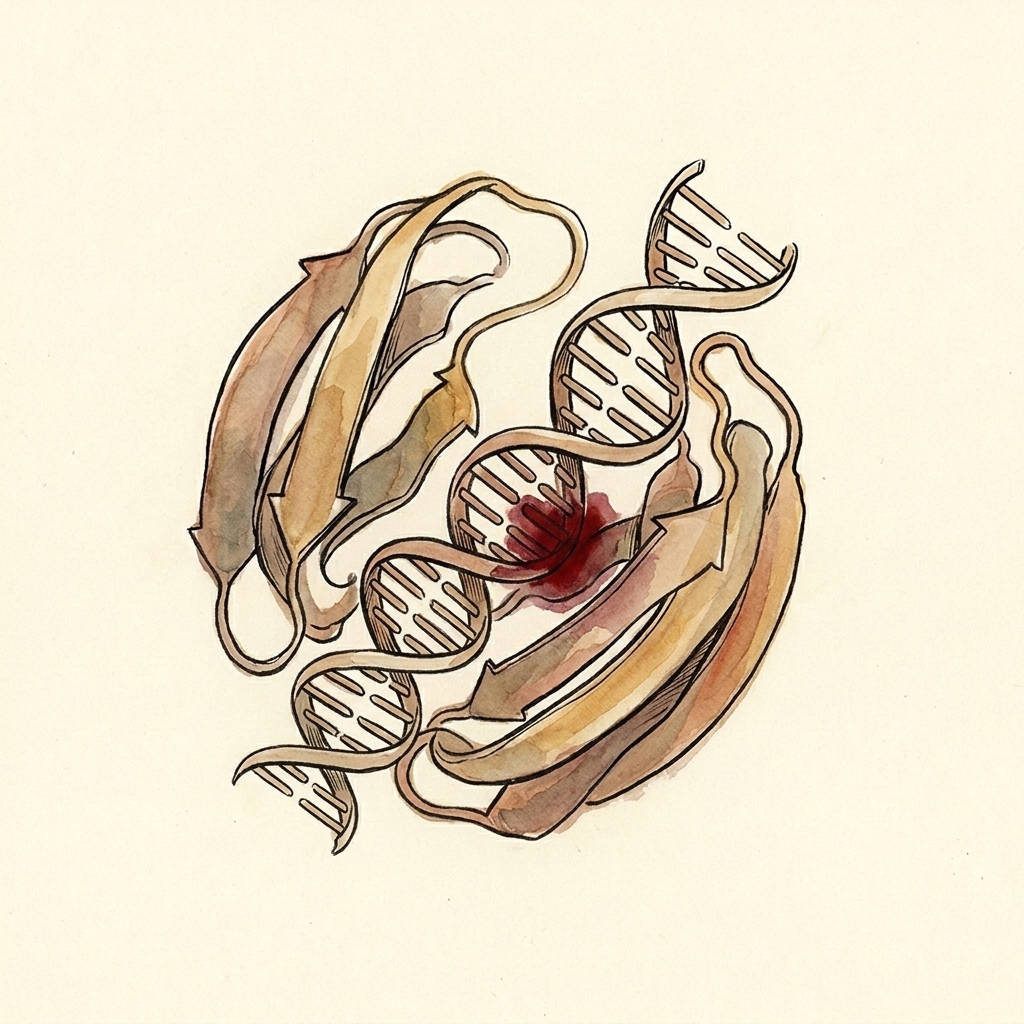
The gene is TP53. It sits on the short arm of chromosome 17 `F4`. It builds a protein called p53 — named, almost by accident, for how heavy it looked on a laboratory gel: about 53 kilodaltons `F5`. p53 is a master switch — a transcription factor that reaches into your DNA and turns other genes on `F6`. Its one responsibility: decide whether a damaged cell is allowed to live.
03THE HUNT
It was found in 1979 — but no one was looking for a cancer defender. They were studying a tumor virus. Six laboratories, at almost the same moment, noticed a fifty-three-kilodalton protein clinging to a viral protein called large-T `F7`. Because it piled up inside cancer cells, they drew the obvious conclusion: this protein must cause cancer. They filed it away as an oncogene `F8`.
04THE TURN
They were wrong — because of a beautiful trap. The very first p53 genes they cloned were broken copies `F9`. The healthy version did the opposite of what they expected: put intact p53 back into cancer cells, and it stopped them from dividing `F10`. By the early 1990s the picture had flipped completely — p53 was not an oncogene but the most important tumor suppressor ever found `F11`. In 1992, David Lane gave it the name that stuck: the guardian of the genome `F3`.
05THE MECHANISM (hero)
Here is what the guardian actually does. Every time a cell divides, it copies three billion letters of DNA — and copying makes mistakes `F12`. When p53 senses that damage, it slams on the brakes: it halts the cell cycle, holding the cell still while repair crews fix the error `F13`. But if the damage is too severe to mend, p53 makes a colder call — it orders the cell to destroy itself, a built-in self-destruct called apoptosis `F14`. A damaged cell that dies can never grow into a tumor. That is how one protein guards an entire genome.
06THE STAKES
Now imagine being born with the guardian already half-broken. That is Li-Fraumeni syndrome — inherit a single faulty TP53 copy, and the lifetime risk of cancer climbs above seventy percent, often striking in childhood `F15`. And TP53 fails in an unusual way. Most tumor-suppressor genes are deleted outright; TP53 is usually disabled by a single changed letter, right in the part of the protein that grips DNA `F16` — one tiny edit that blinds the guardian without removing it.
07THE OPEN THREAD
Rebuilding a broken guardian is one of the hardest problems in cancer medicine — you cannot easily drug a function that has simply gone missing `F17`. The first attempt was audacious: in 2003, China approved Gendicine, a virus engineered to ferry healthy p53 back into tumor cells — the world's first approved gene therapy `F18`. Today the frontier is drugs that snap a mutant p53 back into its correct shape, or that unleash the healthy p53 some tumors still quietly carry `F19`.
08TIMELINE + SIGN-OFF
From a protein on a virus in 1979, to the guardian of the genome, to the most mutated gene in all of cancer. We spent decades learning what p53 protects us from. Now we are learning how to protect it. — The Gene Channel.
The write-up
In one line: TP53 is the most frequently mutated gene in human cancer — broken in roughly half of all tumors — yet it isn't a cancer gene at all. It's the cell's own guardian, a switch that halts or kills damaged cells before they can turn malignant. For about a decade after its discovery, scientists believed the exact opposite: that it caused cancer.
The gene
TP53 sits on the short arm of chromosome 17 (band 17p13.1) and encodes p53, a 393-amino-acid transcription factor — a master switch that binds DNA and turns other genes on. Its job is to stand at the crossroads of a stressed cell and decide its fate: pause and repair, retire (senescence), or die. The protein's odd name is an accident of technique: on an SDS-PAGE gel it migrates at an apparent ~53 kilodaltons, so it was christened "p53" — even though its true mass is closer to 43.7 kDa. The "53" is a gel artifact, not biology.
The hunt, and the reversal (1979 → 1992)
p53 was discovered in 1979, by roughly six groups at once — not by anyone hunting for a tumor suppressor, but by people studying the tumor virus SV40. They kept finding a ~53 kDa cellular protein stuck to the viral large-T antigen. Because it was abundant in cancer cells, the field reached the natural conclusion: this protein must drive cancer. Several groups published it as an oncogene, showing cloned TP53 could cooperate with RAS to transform cells.
They were wrong — for a subtle and now-famous reason. The TP53 genes first cloned out of tumors were mutant copies. When the Levine group cloned the wild-type gene in 1989 and put it back into cancer cells, it did the opposite of an oncogene: it suppressed their growth. Within a few years the verdict had completely flipped — p53 was the most important tumor suppressor yet found. In 1992, David Lane crowned it with the name that stuck: the "guardian of the genome."
The mechanism
Every cell division copies ~3 billion letters of DNA, and copying makes mistakes. p53 is the checkpoint that catches them. When it senses DNA damage, it halts the cell cycle (largely by switching on CDKN1A/p21), freezing the cell so repair machinery can work. If the damage is too severe to fix, p53 makes the harder call and triggers apoptosis — programmed self-destruction (via targets like BAX, PUMA, NOXA) — because a damaged cell that dies can never become a tumor. Lose that checkpoint, and broken cells are free to divide.
TP53 also fails in an unusual way. Most tumor-suppressor genes are knocked out by deletion or truncation; TP53 is most often disabled by a single missense substitution clustered in its DNA-binding domain (hotspot codons R175, R248, R273, R282, G245, R249). One changed letter blinds the guardian without removing it — and some mutants even gain new, actively harmful functions.
The stakes, and the frontier
Inherit a single faulty TP53 copy and you have Li-Fraumeni syndrome — an autosomal-dominant predisposition identified by Malkin and colleagues in 1990 — with a lifetime cancer risk well above 70% and often early, even childhood, onset. Across sporadic cancers, TP53 is disrupted in ~half of all tumors, the single most common genetic lesion in cancer.
Restoring a lost guardian is one of the hardest problems in oncology — you can't simply block an overactive target; you have to rebuild a missing function. The first attempt was bold: in 2003, China approved Gendicine, a recombinant adenovirus carrying healthy p53 — the world's first approved gene therapy product (approved in China, not by the FDA or EMA). Today the frontier runs two ways: small molecules that refold mutant p53 back into a working shape (e.g. eprenetapopt/APR-246), and MDM2 inhibitors that unleash the wild-type p53 that some tumors still quietly carry. The guardian is being rebuilt.
Sources
Full claim-by-claim evidence is in references.md. Primary/authoritative anchors:
- Barnoud T, Indeglia A, Murphy ME. "Shifting the paradigms for tumor suppression: lessons from the p53 field." Oncogene 40:4281 (2021). https://www.ncbi.nlm.nih.gov/pmc/articles/PMC8238873/ (the oncogene→suppressor reversal; the mutant first-clone)
- Lane DP. "p53, guardian of the genome." Nature 358:15–16 (1992). https://www.nature.com/articles/358015a0
- Finlay CA, Hinds PW, Levine AJ. "The p53 proto-oncogene can act as a suppressor of transformation." Cell 57:1083 (1989). https://doi.org/10.1016/0092-8674(89)90045-7
- Malkin D, et al. "Germ line p53 mutations in a familial syndrome of breast cancer, sarcomas, and other neoplasms." Science 250:1233 (1990). https://doi.org/10.1126/science.1978757
- TP53 gene (location 17p13.1, p53 function): NCBI Gene 7157 — https://www.ncbi.nlm.nih.gov/gene/7157 ; MedlinePlus — https://medlineplus.gov/genetics/gene/tp53/
- Gendicine (first approved gene therapy, China 2003): Zhang et al., Hum Gene Ther 29:160 (2018), PMID 29338444 — https://www.liebertpub.com/doi/10.1089/hum.2017.218
Accuracy note: the episode keeps three commonly-confused points straight. (1) p53 was first published as an oncogene and only later shown to be a tumor suppressor — the error traced to cloning mutant copies. (2) "p53" is the protein's apparent gel mass (~53 kDa), not its true weight (~43.7 kDa). (3) TP53 is usually broken by a point mutation in the DNA-binding domain, not deleted — unlike most tumor suppressors. And Gendicine's 2003 first-approval was in China, not an FDA/EMA milestone.
The evidence
Every claim, sourced
Each [F#] you hear in the film links to the source it came from. Nothing gets narrated until every one is checked and signed off.
Sign-off
- PhD sign-off — facts above correct; the ⚠️ traps stated correctly in
script.md. (Awaiting human sign-off — this is the gate.) - F1 / F15 numbers kept qualitative in narration ("roughly half"; "above seventy percent") — confirm acceptable, or pin exact cohort figures.
- F5 / F12 — narration kept qualitative ("about 53 kilodaltons"; "three billion letters"); exact values (43.7 kDa true mass; 3.1 Gb genome) noted here for the write-up.
On sign-off → check the boxes, then run `gen-narration.mjs` (gate opens). Until then, narration TTS + render stay blocked.
- F1
A fault in TP53 is found in roughly half of all human cancers; it is the most frequently mutated gene in cancer
"the TP53 gene continues to hold distinction as the most frequently mutated gene in cancer" and is "inactivated by mutation in over 50% of sporadic human tumors"
- F2
TP53 is not a cancer-causing gene — it is a tumor suppressor, the cell's own defense against cancer
"p53 serves to protect damaged cells from malignant transformation by controlling cell fate"
- F3
Nicknamed the "guardian of the genome"
Title + thesis of the 1992 commentary that coined the phrase
- F4
TP53 sits on the short arm of chromosome 17 (17p13.1)
"TP53, located on chromosome 17p13.1, encodes p53"
- F5⚠ commonly confused
The protein p53 is named, almost by accident, for how heavy it looked on a gel — about 53 kDa
"p53" = its apparent molecular mass (~53 kDa) on SDS-PAGE; it migrates anomalously slowly (proline-rich), so the true mass is ~43.7 kDa. The "53" is a gel artifact, not the real weight. (Narration kept qualitative: "about 53 kilodaltons.")
- F6
p53 is a transcription factor — a master switch that turns other genes on
p53 binds DNA and transactivates target genes (e.g. CDKN1A/p21, BAX, PUMA, NOXA)
- F7
Found in 1979, as a ~53 kDa protein clinging to the SV40 tumor-virus protein large-T; multiple groups, independently, at once
p53 was discovered in 1979 by ~six groups independently as a cellular protein co-precipitating with SV40 large-T antigen
- F8⚠ commonly confused
Because it piled up in cancer cells, it was first filed as an oncogene
"TP53 is an oncogene, and then a tumor suppressor gene … three different groups published papers supporting the conclusion that this gene was an oncogene, and … could cooperate with RAS to transform cells"
- F9⚠ commonly confused
The very first p53 genes cloned were broken (mutant) copies — the reason for the error
"the original version of p53 that was cloned from tumor cells contained a point mutation that inactivated its tumor suppressor function"
- F10
Healthy (wild-type) p53 does the opposite — put it back into cancer cells and it stops them dividing
"In 1989 the Levine group … provided meticulous and compelling evidence that p53 functions as a tumor suppressor, not an oncogene"; the proto-oncogene "can act as a suppressor of transformation"
- F11
By the early 1990s the picture had flipped: p53 is the most important tumor suppressor found
"These findings solidified the identification of p53 as a tumor suppressor gene, not an oncogene"
- F12
Every division a cell copies ~three billion letters of DNA, and copying makes mistakes
Human (haploid) genome ≈ 3.1 billion base pairs; replication is error-prone. (Narration's "three billion letters" = the genome.)
- F13
When p53 senses damage it halts the cell cycle so repair crews can work
p53 induces cell-cycle arrest (via CDKN1A/p21) and genomic-stability / DNA-repair programs
- F14
If the damage is too severe, p53 orders the cell to self-destruct — apoptosis
p53 controls cell fate "by inducing cell cycle arrest, senescence, or death"; apoptotic targets BAX, PUMA, NOXA, BID
- F15
Li-Fraumeni syndrome: inherit a single faulty TP53 copy → lifetime cancer risk above ~70%, often in childhood
Germline TP53 mutations cause LFS (autosomal dominant); penetrance very high — lifetime risk >70% (approaching ~100% in women in some cohorts), with early/childhood onset
- F16⚠ commonly confused
TP53 fails unusually: not deleted but disabled by a single changed letter, right where the protein grips DNA
~Most TP53 mutations are missense, clustered in the DNA-binding domain (hotspot codons R175, R248, R273, R282, G245, R249) — unlike most tumor suppressors, which are truncated/deleted
- F17
Restoring a broken guardian is one of the hardest problems in cancer medicine — you can't easily drug a missing function
Reactivating lost tumor-suppressor function is far harder than inhibiting an overactive oncogene; p53 long deemed "undruggable"
- F18
In 2003, China approved Gendicine (a virus carrying healthy p53) — the world's first approved gene therapy
rAd-p53 (Gendicine), Shenzhen SiBiono; approved by China's SFDA on Oct 16, 2003 for head-and-neck squamous cell carcinoma — the first gene therapy product approved for clinical use anywhere. (Careful: approved in China, not by FDA/EMA.)
- F19
Today's frontier: drugs that snap mutant p53 back into shape, or that unleash the wild-type p53 some tumors still carry
Two active strategies: mutant-p53 reactivators/refolders (e.g. eprenetapopt/APR-246) and MDM2 inhibitors (nutlins) that release WT p53