TNFA
The most valuable off-switch
The best-selling medicine in history isn't a cancer cure or a vaccine — it switches off one protein your own body makes: Tumor Necrosis Factor. Quieting it has earned over $200 billion.
The walkthrough
Beat by beat

HOOK
0:26
01HOOK
The best-selling medicine in history isn't a cancer cure or a vaccine. It's a drug that switches off one protein your own body makes — a protein with a frightening name: Tumor Necrosis Factor. `F4` Quieting it has earned over two hundred billion dollars. `F1`
02THE NAME
The gene is TNF, and it sits in a telling place — buried inside the MHC, the cluster of genes that runs your immune system, on chromosome six. `F2` Its protein, released mostly by immune cells called macrophages, is a master switch for inflammation. `F3`
03THE HUNT
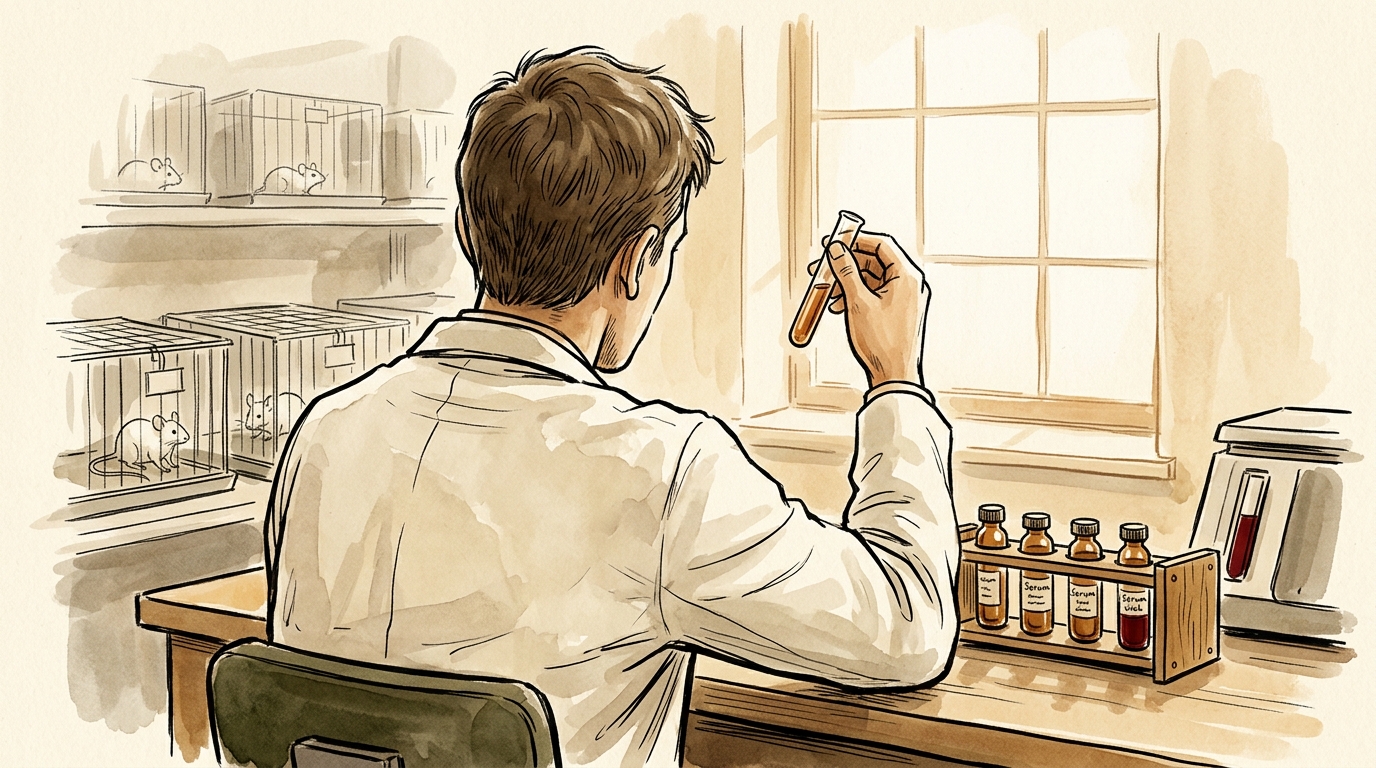
It was named for what it could destroy. In nineteen seventy-five, a team at a New York cancer institute found a factor in the blood of infected mice that made solid tumors blacken and die — and called it Tumor Necrosis Factor. `F4` A decade later, scientists hunting the cause of body-wasting found their molecule, "cachectin," was the very same protein. One name for killing tumors, another for wasting the body. `F5`
04TWO FACES
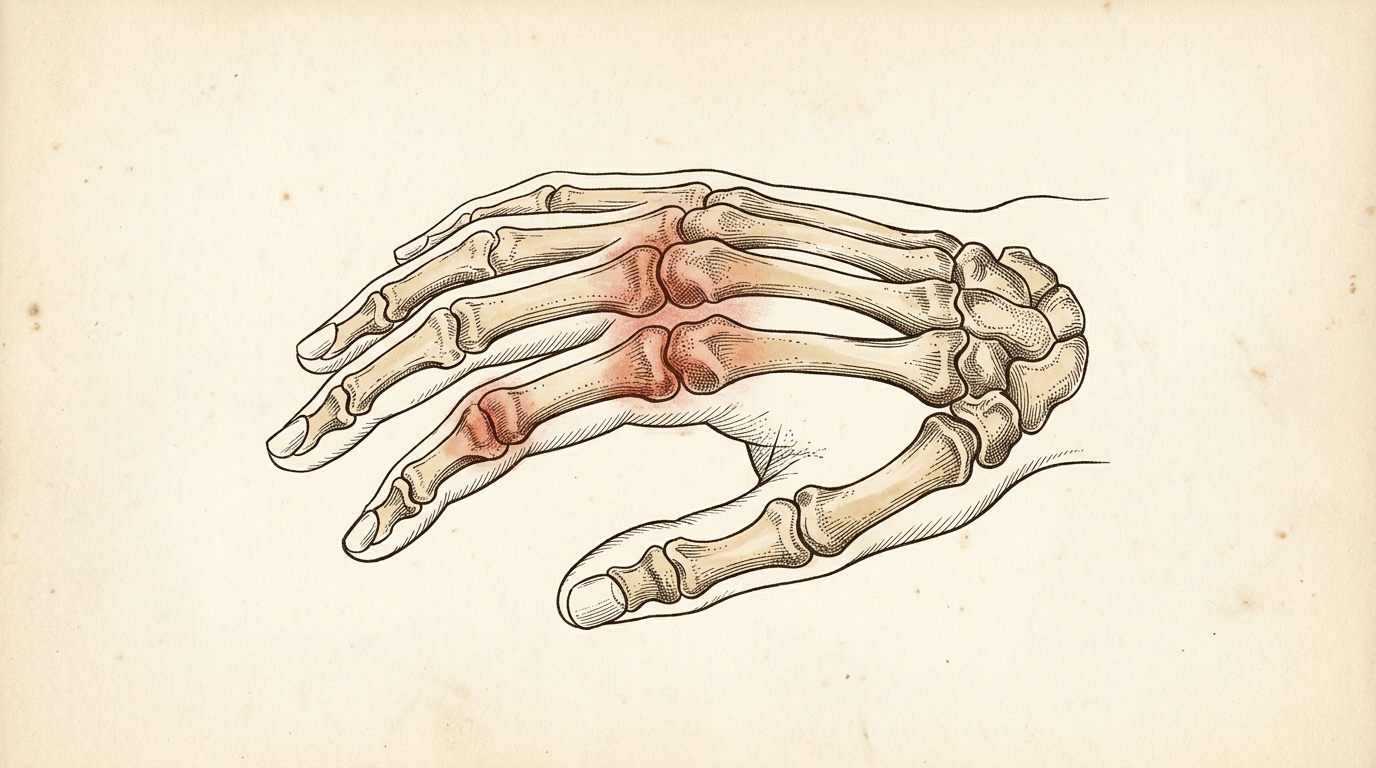
One molecule, two faces. In short bursts it's a defender — your body needs it to fight infection; block it, and dormant tuberculosis can roar back. `F6` But when it never shuts off, it turns on you, driving rheumatoid arthritis, Crohn's disease, and psoriasis. `F7`
05THE MECHANISM (hero)
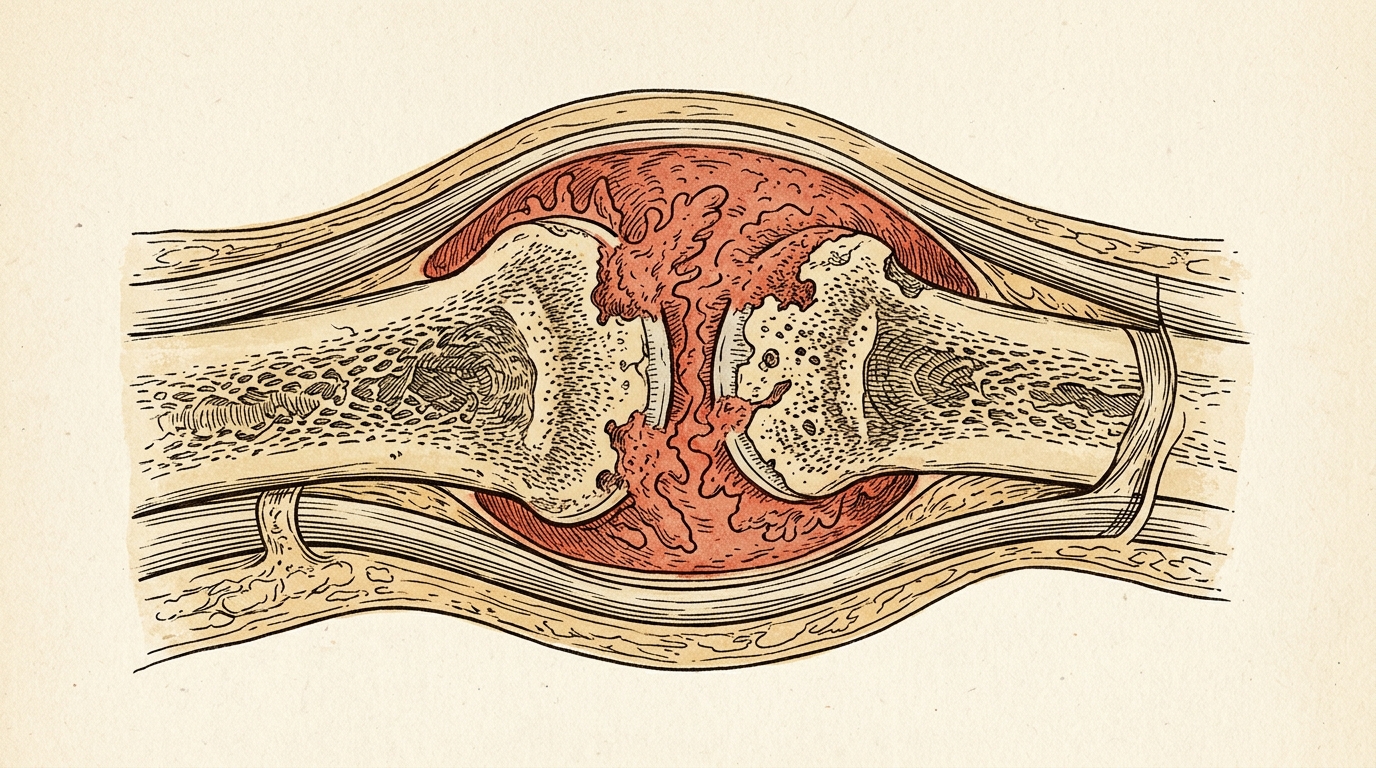
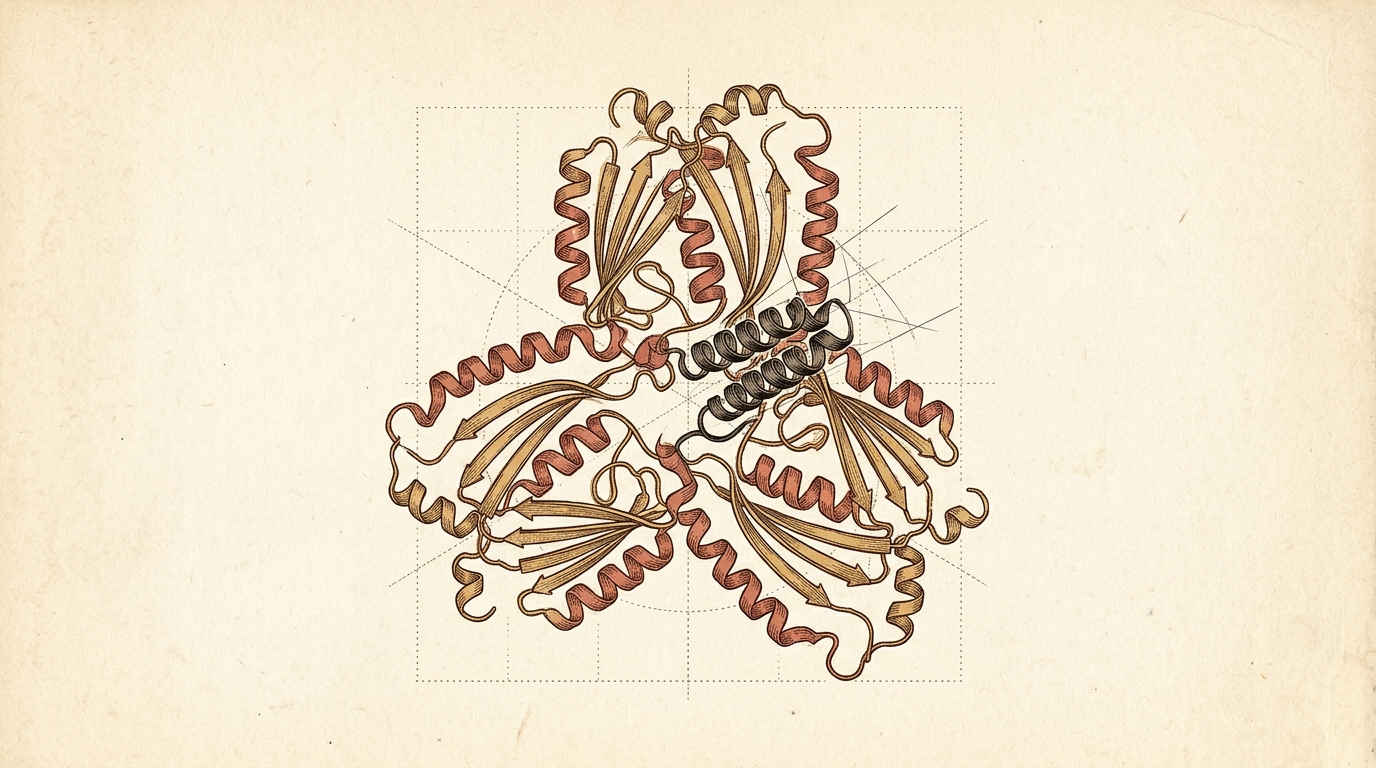
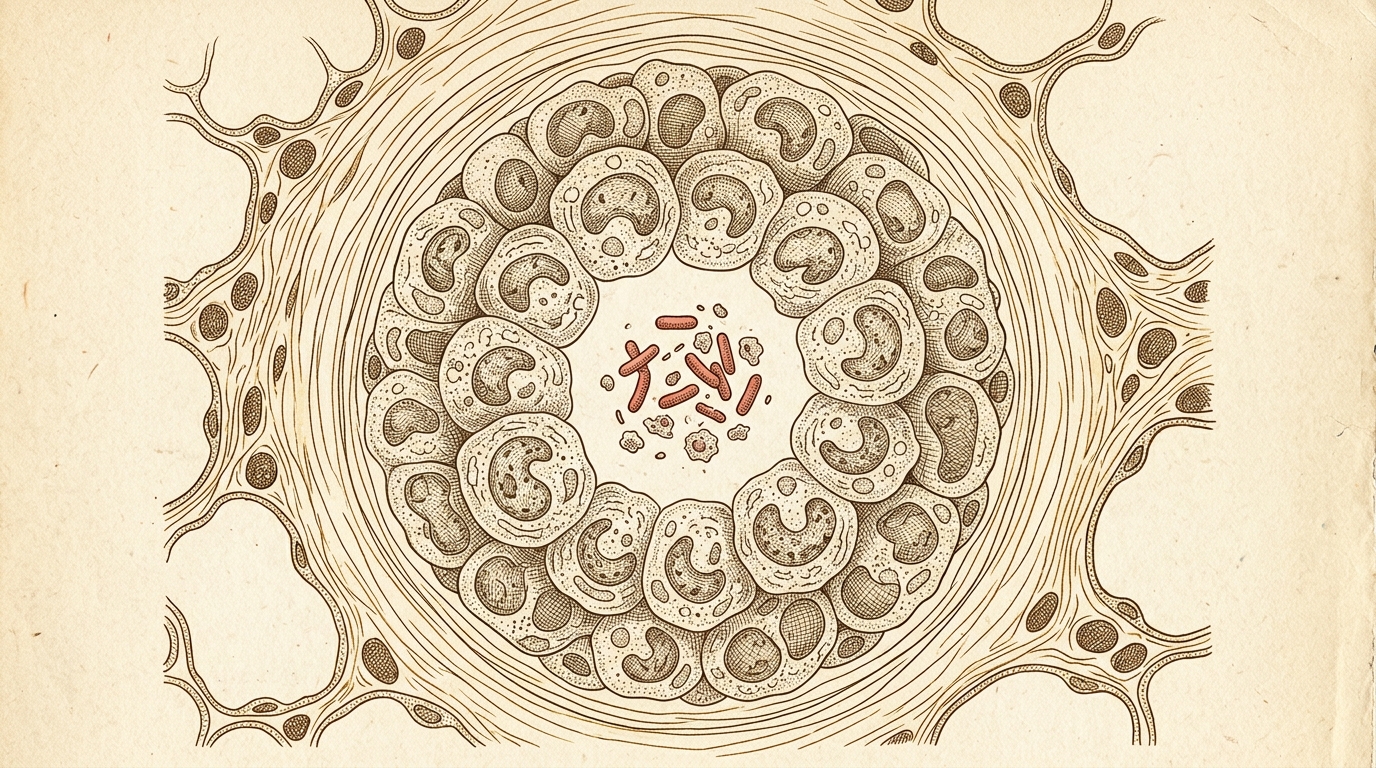
Here's how. TNF travels as a trio — three identical proteins locked together. `F8` It docks onto receptors on the surface of your cells, clustering them — and that flips a master switch inside the cell called NF-kappa-B, which turns on the genes of inflammation. `F9` A single burst clears an infection and then shuts down. But when the signal jams on, that same inflammation grinds away at your own joints and gut. `F7`
06THE STAKES
For the roughly eighteen million people living with rheumatoid arthritis, that jammed switch meant swollen, eroding joints — one of the world's leading causes of disability. `F10` For decades, there was little to halt the damage.
07THE BLOCKERS
The fix was to catch TNF before it can dock. The first drugs did it two ways: antibodies that clamp onto the TNF protein and haul it out of circulation — infliximab, and the fully-human Humira `F11` — and a decoy, a copy of the receptor set loose to soak TNF up before it reaches a cell: etanercept, not an antibody but a lure. `F12` Approved starting in nineteen ninety-eight, they became the best-selling drugs on earth. `F13F1` But every one of them had to be discovered — Humira took years of screening. `F11` The newest blockers aren't discovered at all; they're designed. Give a computer the shape of TNF, and artificial intelligence builds a tiny protein — a minibinder — that grips it as tightly as an antibody, yet is small and stable enough to make more cheaply and deliver more easily. `F14` Researchers have already designed minibinders that switch off human TNF in the lab `F15` — and the method behind them won the twenty twenty-four Nobel Prize in chemistry. `F14`
08TIMELINE + SIGN-OFF
A protein named for killing cancer became the most valuable target in medicine — by teaching us when to switch it off. — The Gene Channel.
The write-up
In one line: TNF was named in 1975 for a protein that makes tumors die — but it turned out to be the master switch of inflammation, and the drugs that switch it off (for arthritis, not cancer) became the best-selling medicines in history.
The gene
TNF (also written TNF-α / TNFA) sits on chromosome 6p21.33, buried inside the MHC class III region — the densest immune-gene neighborhood in the genome, flanked by the lymphotoxin genes. That address is fitting: the protein it encodes, released mostly by macrophages, is a central pro-inflammatory cytokine — a master switch for inflammation. (One housekeeping note: the official gene symbol is TNF; the channel slug "TNFA" is an older alias, and the gene should not be confused with its neighbor LTA, the old "TNF-β.")
The hunt — two names, one molecule
The molecule was discovered twice, under two very different names:
- 1975 — "Tumor Necrosis Factor." Lloyd Old's group at Memorial Sloan-Kettering in New York found that the serum of mice primed with BCG and then given bacterial endotoxin contained a factor that caused solid tumors to blacken and die. They named it for what it could destroy (Carswell, Old et al., PNAS 1975). Even then they suspected the source was a host cell — "probably macrophages."
- ~1985 — "cachectin." Anthony Cerami and Bruce Beutler were chasing a different problem: the wasting (cachexia) that hollows out the body in chronic infection. They purified the culprit, "cachectin" — and then showed it was the very same protein as TNF (Beutler, Cerami et al., Nature 1985). The tumor-killer and the body-waster were one molecule.
Two faces — defender and destroyer
TNF is a textbook double-edged sword:
- In short bursts, it defends you. It is essential to mount an immune response and, in particular, to build and maintain the granulomas that wall off tuberculosis. This isn't theoretical: blocking TNF carries a boxed warning because it lets latent TB — and other serious infections — reactivate.
- When it never shuts off, it destroys you. Chronic, unresolving TNF signaling drives rheumatoid arthritis, Crohn's disease and ulcerative colitis, psoriasis, and ankylosing spondylitis — which is exactly why blocking it treats all of them.
The mechanism
TNF acts as a homotrimer — three identical subunits locked together. The trimer docks onto TNF receptors on a cell's surface and clusters them; that clustering flips an internal master switch, NF-κB, which drives the transcription of inflammation genes. A single, self-limiting burst clears an infection and shuts down. But when the signal jams on, the same machinery floods the tissue and grinds away at joints and gut. The therapeutic idea writes itself: catch TNF before it can dock, and the switch goes dark.
The stakes
Roughly 18 million people live with rheumatoid arthritis worldwide (GBD 2021: ~17.6 million in 2020), and it is one of the leading causes of years-lived-with-disability — swollen, eroding joints, and, for decades, little that could halt the damage.
The blockers — and the biggest business in pharma
The fix was to intercept TNF before it can dock, and the first generation did it with two distinct designs, both acting at the protein level:
- Monoclonal antibodies that clamp onto the TNF protein and pull it out of circulation — infliximab (Remicade, chimeric, FDA 1998) and adalimumab (Humira, the first fully-human monoclonal antibody, FDA Dec 31 2002).
- A decoy receptor — etanercept (Enbrel, FDA Nov 1998): two copies of the extracellular, TNF-binding part of TNF receptor 2 fused to an antibody's IgG1 Fc tail. It floats free and soaks up TNF before it reaches a cell. Crucially, it is not an antibody — it's a lure.
This class became the best-selling drug class in the history of medicine. Humira alone was the world's top-selling drug from 2012 to 2020, peaked near $20 billion a year, and has booked over $200 billion in cumulative sales.
The frontier — discover → design
Every one of those drugs had to be discovered: Humira came from years of phage-display screening. The newest approach inverts that. With deep-learning protein design — the field that won the 2024 Nobel Prize in Chemistry (David Baker) — you can hand a computer the structure of TNF and have it design a tiny protein, a "minibinder," to grip it. These designed binders are small (under ~65 amino acids), hyperstable, and bind with antibody-grade (nanomolar-or-better) affinity, which could make them cheaper to manufacture and easier to deliver than the giant antibodies — and they can be made to order rather than found. Researchers have already de-novo-designed minibinders that neutralize human TNFα in the lab (Weng et al., Communications Biology, 2025), with cell-based activity matching or beating an existing anti-TNF. These are research-stage lead molecules — not approved drugs and not yet in patients — but they point past the blockbuster antibodies toward biologics that are designed, not discovered.
A protein named for killing cancer became the most valuable target in medicine — by teaching us when to switch it off.
Sources
Full claim-by-claim evidence is in references.md. Primary anchors:
- Gene/locus & function: NCBI Gene 7124 · OMIM 191160
- Named "Tumor Necrosis Factor" (1975): Carswell, Old et al., PNAS 72:3666-3670 — PMID 1103152
- Cachectin = TNF (1985): Beutler, Cerami et al., Nature 316:552-554 — PMID 2993897
- Mechanism (trimer → NF-κB): Regulation of NF-κB by TNF-family cytokines, PMC4156877 · Reactome: TNFR1-induced NF-κB
- Defender face / infection risk: TNF Inhibitors, StatPearls NBK482425 · Anti-TNF & infection, PMC3615849
- Disease burden: GBD 2021 rheumatoid arthritis, Lancet Rheumatol (PMC10546867)
- Drugs: Adalimumab/Humira FDA history · Etanercept = TNFR-Fc fusion (review) · Mechanisms of anti-TNF agents, PMID 27567553
- The business: Pharmaceutical Accountability Foundation: Humira · AJMC: the first $20B drug
Accuracy note: the episode is careful with the things people routinely get backwards — (1) TNF was named to kill tumors, but the blockbuster drugs work by switching it off, and they treat autoimmune disease, not cancer; (2) "Tumor Necrosis Factor" and "cachectin" are the same molecule; (3) TNF is a needed defender in bursts (blocking it reactivates TB) and a destroyer when chronic; and (4) the two drug designs are distinct — a monoclonal antibody (infliximab/Humira) versus a decoy receptor (etanercept), which is not an antibody.
The evidence
Every claim, sourced
Each [F#] you hear in the film links to the source it came from. Nothing gets narrated until every one is checked and signed off.
Sign-off
- PhD sign-off — facts above are correct; the name-irony, the cachectin identity, the defender-vs-destroyer
- Numbers/dates verified (Humira best-seller 2012-2020 + >$200B cumulative; 6p21.33 in MHC class III; PNAS 1975;
- Etanercept welded to "decoy receptor / TNFR2-Fc fusion, NOT an antibody"; cancer-treatment misread explicitly avoided.
- AI minibinders verified (F14/F15, added 2026-06-14): de-novo/computational design = Cao 2022 Nature (minibinders
Gate OPEN → narration + render may proceed.
- F1
Anti-TNF drugs are the best-selling medicines in history — adalimumab (Humira) alone was the world's top-selling drug 2012–2020 and has booked over $200 billion in cumulative sales.
Humira was the largest-selling pharmaceutical worldwide from 2012 until 2020; peak annual sales ~$18–21B; cumulative ≈ $231B (2003–2024). (Narration kept qualitative: "over two hundred billion dollars.")
- F2
The gene is TNF, on chromosome 6p21.33, inside the MHC class III region (the immune-gene cluster), flanked by the lymphotoxin genes.
NCBI Gene 7124 (official symbol TNF; aliases TNFA, TNF-alpha, TNFSF2), location 6p21.33, GRCh38 chr6:31,575,565–31,578,336; lies in the MHC class III region between LTA and LTB.
- F3
The TNF protein is released mainly by macrophages and is a master pro-inflammatory cytokine ("master switch for inflammation").
TNF is produced chiefly by activated macrophages; a central mediator of inflammation. The 1975 paper already traced it to "a factor released from host cells, probably macrophages."
- F4
1975 — named "Tumor Necrosis Factor": a New York cancer institute (Lloyd Old's group, Memorial Sloan-Kettering) found a serum factor in infected mice that caused necrosis of solid tumors.
Carswell EA, Old LJ, et al. "An endotoxin-induced serum factor that causes necrosis of tumors." PNAS 72(9):3666-3670 (1975). Serum of BCG-infected, endotoxin-treated mice → hemorrhagic tumor necrosis; named TNF.
- F5
~A decade later — "cachectin" is the same molecule: the factor blamed for body-wasting (cachexia) turned out to be TNF.
Beutler B, …, Cerami A. "Identity of tumour necrosis factor and the macrophage-secreted factor cachectin." Nature 316:552-554 (1985). Cachectin = TNF-α.
- F6
The defender face: in bursts TNF is essential to fight infection — block it and latent tuberculosis can reactivate (TNF maintains the granulomas that wall off TB).
TNF is required for granuloma formation/maintenance; anti-TNF therapy raises TB-reactivation risk markedly (up to ~25×), the basis of the drugs' boxed warning for serious infections.
- F7
The destroyer face: chronic, unresolving TNF signaling drives rheumatoid arthritis, Crohn's disease, and psoriasis (and ankylosing spondylitis).
These are the FDA-approved indications for anti-TNF drugs — direct in-human proof that excess TNF is causal in each.
- F8
TNF acts as a homotrimer — three identical subunits locked together.
The biologically active soluble TNF is a homotrimer; it must be a trimer to engage its receptors.
- F9
Mechanism: the TNF trimer docks onto TNF receptors and clusters/trimerizes them → activates NF-κB → transcription of inflammation genes.
Binding of the TNF-α homotrimer to TNFR1 trimerizes the receptor, recruits TRADD/TRAF2/RIP and the IKK complex, and activates NF-κB, driving transcription of inflammatory target genes.
- F10
The stakes: ~18 million people live with rheumatoid arthritis worldwide; it is a leading cause of disability (swollen, eroding joints).
GBD 2021: 17.6 million prevalent RA cases in 2020 (≈18M); years-lived-with-disability = 76% of the disease burden.
- F11
Block design #1 — antibodies: drugs that are monoclonal antibodies which bind and neutralize the TNF protein: infliximab (Remicade, chimeric) and adalimumab (Humira, the first fully-human mAb).
Infliximab = chimeric anti-TNF IgG1 mAb; adalimumab = first fully-human mAb (phage display), FDA-approved 2002, specific for human TNF.
- F12
Block design #2 — a decoy receptor (NOT an antibody): etanercept is the extracellular ligand-binding part of human TNF receptor 2 (p75) fused to an IgG1 Fc — a soluble lure that soaks up TNF before it reaches a cell.
Etanercept = 2 copies of the extracellular domain of human TNFR2 fused to the Fc of human IgG1; a soluble decoy receptor, mechanistically distinct from the antibodies.
- F13
Approved starting 1998: Remicade (infliximab) Aug 1998, Enbrel (etanercept) Nov 2 1998, Humira (adalimumab) Dec 31 2002.
FDA approval records: infliximab Aug 1998 (Crohn's); etanercept Nov 2 1998 (RA); adalimumab Dec 31 2002 (RA).
- F14
Frontier — discover → design. Today's anti-TNF biologics had to be discovered (Humira came from years of phage-display screening, F11); the newest approach designs binders computationally: given a target's structure alone, deep-learning protein design builds small "minibinder" proteins (<65 aa, hyperstable, low-immunogenicity) that bind with nanomolar–picomolar affinity. Significance: antibody-grade grip in a small, stable, cheaper-to-make, easier-to-deliver protein, made to order. The field won the 2024 Nobel Prize in Chemistry (David Baker, computational protein design).
De-novo minibinders designed "from the target structure alone," all <65 aa, hyperstable, nM–pM affinity (Cao et al.). 2024 Nobel: half to David Baker "for computational protein design."
- F15
TNF-specific proof — already done in the lab (NOT a drug yet). Minibinders have been de-novo designed as universal antagonists of human (and canine) TNFα; top designs bind human TNFα with sub-nanomolar–nanomolar affinity and neutralize TNFα in cell-based assays comparably to / better than an existing anti-TNF nanobody. Research-stage lead molecules — not approved, not in patients.
Weng et al.: hotspot-guided de-novo computational design of universal cTNFα/hTNFα minibinders; sub-nM–nM affinity; cell-based anti-TNFα activity ≥ nanobody TNF30; framed as lead molecules.