STXBP1
Half a Signal
The gene builds the starter that lets every synapse fire. Lose one of your two copies and the brain's calming neurons fail first — catastrophic seizures in the first weeks of life. No cure yet, but the first therapies are moving through the lab.
The walkthrough
Beat by beat
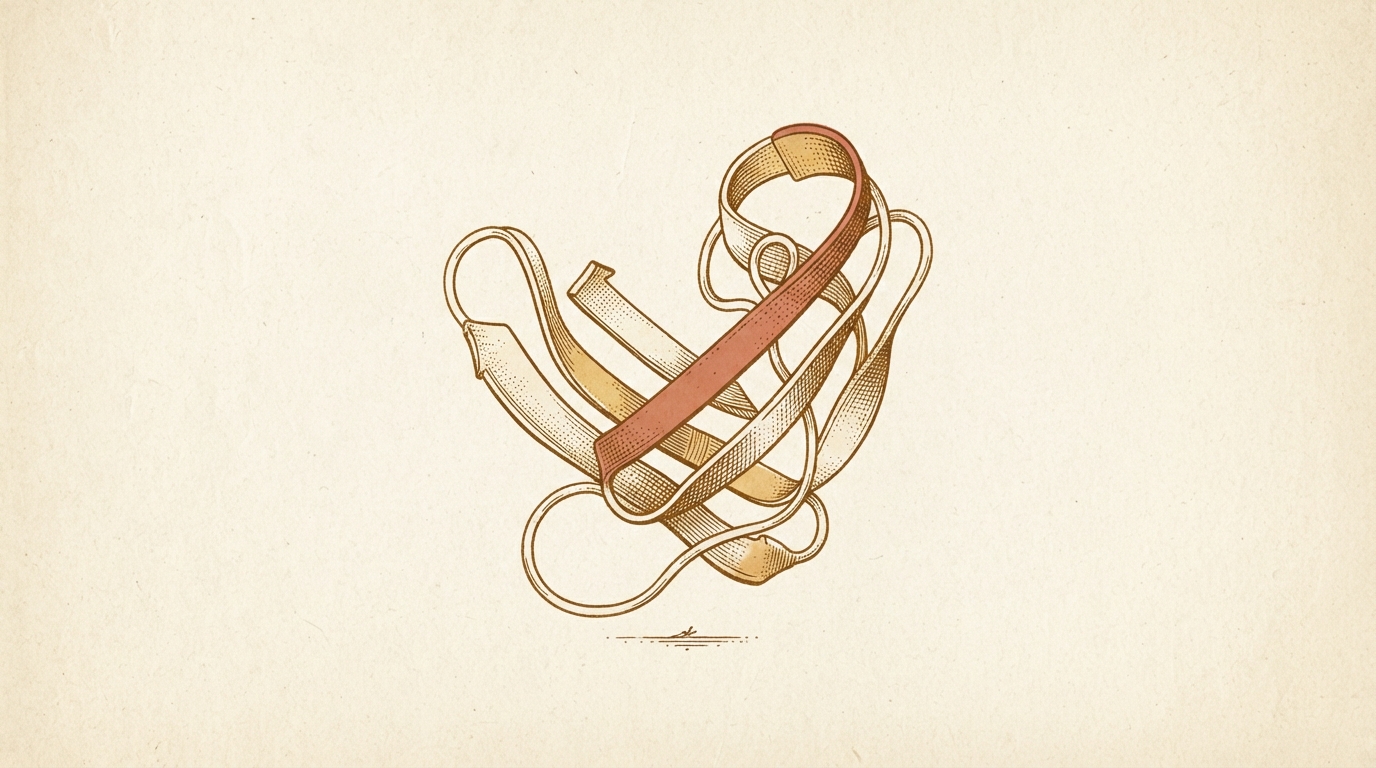
HOOK
0:20
01HOOK
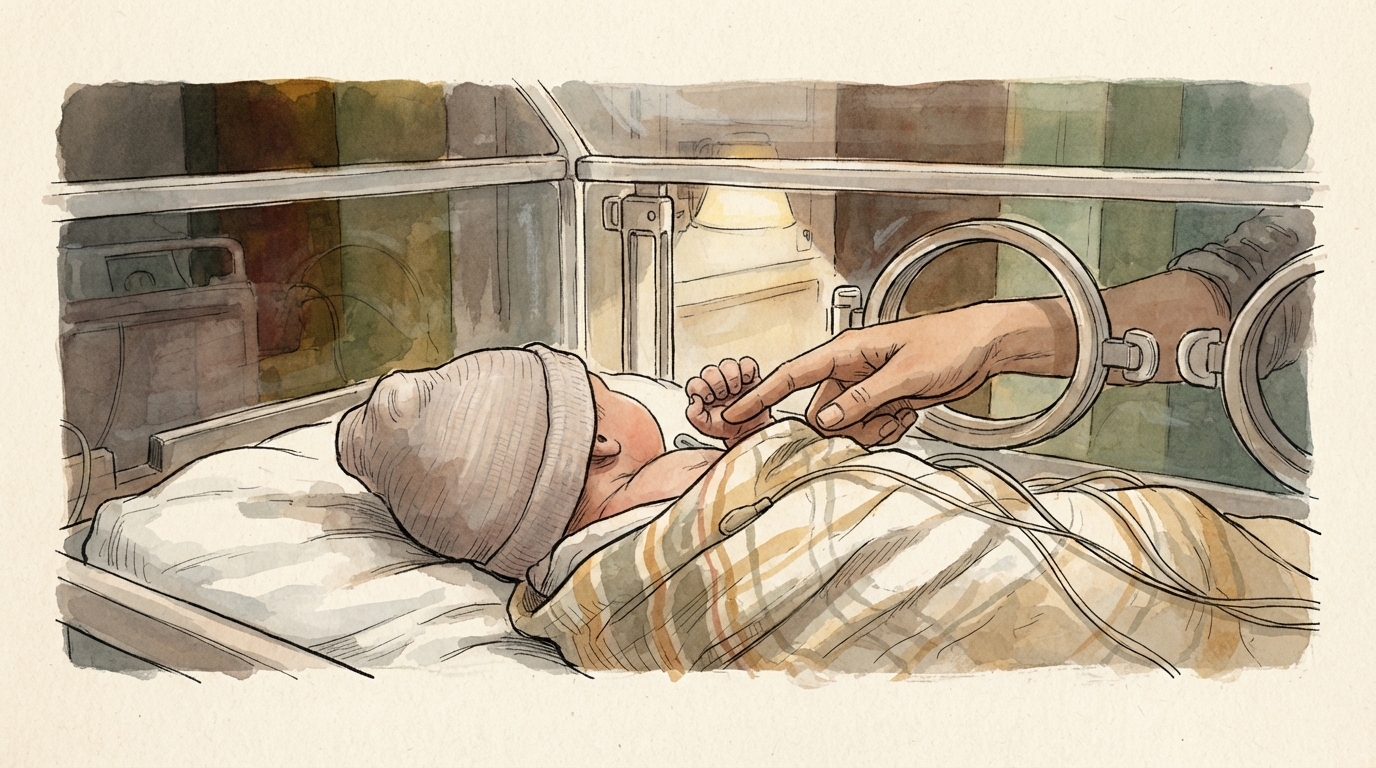
Some children begin seizing before they ever leave the hospital. F2 In the first days of life — before a face is fully recognized, before a hand can grip — a seizure. One missing copy of one gene is enough. F1 Its name is STXBP1.
02THE NAME
STXBP1 sits on chromosome nine. F1 It builds a protein called Munc18-1. And Munc18-1 has one job at every synapse in the brain: readying the tiny sacs of neurotransmitter for release. Those sacs — synaptic vesicles — line up at the edge of the neuron like runners on a block. F3 Munc18-1 is what puts them there. F3
03THE BALANCE (E/I neurons)
But not every synapse sends the same message. Some are excitatory — the accelerator, pushing the next cell to fire. Others are inhibitory — the brake, holding it back. F5 A healthy brain holds the two in balance. Weaken the brake, and excitation runs away — and that runaway wave of firing is a seizure. F5
04THE HUNT
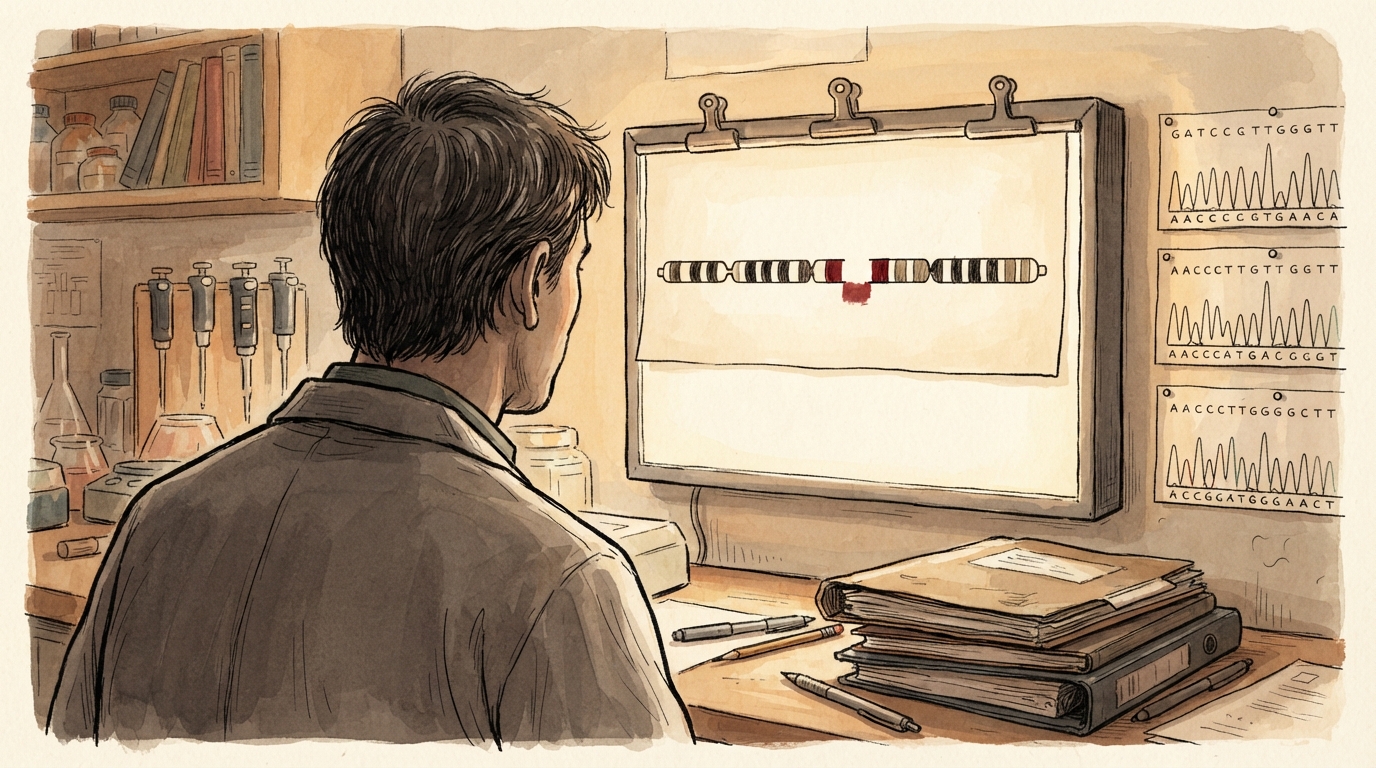
For years children with this condition had no diagnosis. Then, in two thousand eight, Hirotomo Saitsu, Mitsuhiro Kato, Takeshi Mizuguchi, and their colleagues at Yokohama City University found the culprit. F4 In five children with catastrophic early seizures, the same gene was disrupted — in one, a deletion had swept it away; in the others, a single-letter change had broken it. F4 And every change was new in the child, carried by neither parent. F1F4 Published in Nature Genetics — one of the first genes ever tied to this earliest, most severe epilepsy. F4
05THE PROOF
Most of the harmful variants simply stop the protein mid-build — a truncated Munc18-1 that the cell discards. F1 So the neuron runs on half the normal supply. F1 Half is not enough. And a subset of missense variants go further: the altered protein actively traps other key release factors, pulling them away from the synapse. F6 Either way, the machinery is short. F1F6
06HOW A VESICLE FIRES (hero)
To release its cargo, a vesicle must fuse with the cell wall. F3 That fusion is driven by SNARE proteins: syntaxin and SNAP-25 waiting on the wall, synaptobrevin hanging from the vesicle. F3 Munc18-1 is the starter. First it clamps syntaxin shut, folded on itself. Then, on cue, it opens syntaxin and lines it up with SNAP-25. F3 Synaptobrevin drops in from the vesicle, and the four strands zip together, top to bottom, into one tight bundle — hauling the two membranes together until they fuse, and the cargo spills out. F3 Its work done, Munc18-1 is pushed aside. F3 Without it, syntaxin never opens, the bundle never forms — the vesicle docks, but stays silent. F3F13
07WHAT HALF A DOSE BREAKS (hero)
Now halve the Munc18-1. F1 The vesicles are there. The signal arrives. But the priming step is sluggish. And the neurons that suffer most are the inhibitory neurons. The cells whose job is to calm a circuit down. F5 Mouse models built to mimic this — cutting Munc18-1 to half in only the inhibitory cells — develop epilepsy, movement problems, and cognitive deficits, just as the children do. F5 Halve the silence, and the circuit tips into a storm. F5
08THE STAKES
Intellectual disability touches every child with this condition. F7 Seizures follow most — often in the first weeks of life, before any treatment plan is in place. F2 Movement disorders come too: tremor, unsteady gait, repetitive movements that are not seizures but look like them. F7 And in adults, eight in ten still have active seizures, most managed on several medicines at once. F8
09THE OPEN THREAD
There is no approved treatment that changes the course. F10 But the logic points straight at what to try: if the problem is too little protein, could you make the healthy copy do more? That is the idea behind an antisense oligonucleotide — a short synthetic strand matched to one stretch of the gene's own RNA message. F12 It clamps onto a control site where a silencing molecule, a microRNA, normally docks to quiet the message. Take that seat, and the message is read more, lifting Munc18-1 toward a full dose. F12 Gene-therapy vectors that deliver a second working copy are in development too. F10 It is early work — nothing is approved. But the target is clear, and the path is lit. F10
10RECAP + FAMILIES SIGN-OFF
Eighteen years: from five children whose seizures had no name, to a mechanism we can read, to the first attempts to restore what is missing. F4F10 The families made that happen. They are still moving it forward. STXBP1 Foundation: built by parents, funding the search. Found in a lab. Carried by families. Find them at stxbp1disorders.org. — The Gene Channel.
The write-up
In one line: STXBP1 builds Munc18-1, the protein that arms every synapse to fire — lose one of your two copies and the brain runs on half a supply, the calming neurons fail first, and catastrophic seizures begin in the first weeks of life; there is no cure yet, but the first therapies are moving through the lab.
The gene
STXBP1 sits on chromosome 9 (9q34.11) and builds a protein called Munc18-1. Its whole job is at the synapse: it readies the tiny sacs of neurotransmitter — synaptic vesicles — for release, and it templates the SNARE "zipper" that fuses a vesicle to the cell membrane so a neuron can fire. Every message the brain sends — the signals that excite the next neuron, and the signals that calm it — rides on that release.
The hunt
For years, children with catastrophic early seizures had no diagnosis. In 2008, Hirotomo Saitsu, Mitsuhiro Kato, Takeshi Mizuguchi and colleagues at Yokohama City University found the culprit: in five children, the same gene was disrupted — in one by a deletion that swept it away, in the others by a single-letter change — and every change was new in the child, carried by neither parent. Published in Nature Genetics, STXBP1 was one of the first genes tied to this earliest, most severe form of epilepsy.
The mechanism
Most harmful STXBP1 variants stop the protein mid-build, and the cell discards the fragment — so the neuron runs on about half the normal Munc18-1. Without enough of it, the SNARE zipper can't assemble: vesicles still dock at the membrane, but they can't be primed to fire ("docked, but silent"). The neurons hit hardest are the inhibitory ones — the brakes that calm a circuit. Cut Munc18-1 to half in only those inhibitory cells, and mouse models develop epilepsy, movement problems and cognitive deficits, just like the children. Lose the brakes, and the circuit tips into a storm — a seizure. (A subset of missense variants do extra damage, trapping other release factors away from the synapse.)
The stakes, and the frontier
Intellectual disability touches essentially every child with STXBP1-DEE; most have treatment-resistant epilepsy, and movement disorders — tremor, unsteady gait, repetitive movements that look like seizures but aren't — are common. Eight in ten adults still live with active seizures. There is no approved disease-modifying treatment. But the logic of the disorder — too little protein — points straight at what to try: antisense oligonucleotides designed to make the healthy copy produce more Munc18-1 (by blocking a repressive microRNA that normally quiets the gene's own message), and gene-therapy vectors that deliver a second working copy, are both moving through development. Much of that push is led by families as well as scientists — the STXBP1 Foundation (stxbp1disorders.org), built by parents, funds the search.
Sources
Full claim-by-claim evidence is in references.md. Primary anchors:
- Saitsu H, Kato M, Mizuguchi T, et al. "De novo mutations in the gene encoding STXBP1 (MUNC18-1) cause early infantile epileptic encephalopathy." Nature Genetics 40:782–788 (2008). PMID 18469812.
- Freibauer A, Wohlleben M, Boelman C. "STXBP1-Related Disorders." Genes 14:2179 (2023). PMC10742812.
- GeneReviews: "STXBP1 Encephalopathy with Epilepsy" (Mercimek-Andrews, updated 2023). NBK396561.
- Kim et al. J Neurosci 44 (2024). PMC10993039 — inhibitory-neuron cell-type specificity.
- Verhage M, et al. Science 287:864–869 (2000); Deak F, et al. J Cell Biol 184:751–764 (2009) — docking vs. priming.
- Stamberger H, et al. "Natural History Study of STXBP1-DEE Into Adulthood." Neurology 99:e228–e241 (2022). PMC9302932.
- Goss JR, Prosser B, Helbig I, Son Rigby C. Ther Adv Rare Dis (2024). PMC11186390 — therapy landscape + Foundation.
Accuracy note: A few points the episode states carefully — STXBP1-DEE is broader than Ohtahara syndrome; the disorder is caused by haploinsufficiency (half a dose), not a dominant-negative effect (though a subset of missense variants add one); the 2008 discovery paper reported five patients (one deletion + four missense), not four; the ASO approach raises protein by blocking a repressive microRNA on STXBP1's own message — it is not a knockdown, and not a free-floating antimiR; and without Munc18-1, synaptic vesicles still dock but can't fire ("docked but silent"), which is distinct from the floating/undocked picture seen with dense-core vesicles.
The evidence
Every claim, sourced
Each [F#] you hear in the film links to the source it came from. Nothing gets narrated until every one is checked and signed off.
Sign-off
- F1 locus/protein/function + de novo haploinsufficiency (PMC10742812, NBK396561, PMC10993039)
- F2 median seizure onset ~6 weeks; 84–89% within first year (NBK396561)
- F3 Munc18-1 SNARE priming mechanism (PMC10742812, PMC10993039)
- F4 Saitsu, Kato, Mizuguchi et al. 2008 discovery — ✅ patient count resolved = 5 (1 deletion + 4 missense of 13 screened); primary PMID 18469812 + NBK98196/PMC3083607 (2026-07-19)
- F5 GABAergic-neuron cell-type specificity (PMC10993039)
- F6 Doc2 dominant-negative (missense subset only) (PMC11146428)
- F7 core clinical features: ID 100%, epilepsy ~70–95%, movement ≥87%, ASD ~65% (NBK396561, PMC10742812)
- F8 adult seizures — ✅ resolved: 80% active epilepsy on multiple ASMs at last follow-up (37% had prior seizure-free periods); full text Stamberger 2022, PMC9302932 / PMID 35851549 (2026-07-19)
- F9 incidence 3.61/100k (90% CI 3.30–3.81) — ✅ resolved: modelled estimate, full text + supplement López-Rivera Brain 2020, PMC7174049 (2026-07-19)
- F10 no approved disease-modifier as of 2026-07-19; ASO/gene-therapy in development (PMC10742812, NBK396561, PMC11186390)
- F11 >200 unique variants; one of the most frequent monogenic DEE genes (PMC10742812, NBK396561)
- F12 ASO mechanism = up-regulation via microRNA-site blocking on STXBP1's own mRNA (PMC10742812, PMC11186390, US20220228146A1) — ⚠️ miR-218 identity + ~2× figure are patent/preclinical only; keep unnamed & unquantified in narration
- F13 no-Munc18 = docked-but-silent at the synapse (SNARE priming fails, docking intact); floating/undocked is the DCV story (Verhage 2000, Deak 2009 PMC2686405, de Wit 2006 PMC1762430; contrast Voets 2001)
- Foundation URL verified: stxbp1disorders.org confirmed loaded 2026-07-19
- PhD reviewer has checked F1–F11 and signed below
A PhD reviewer must verify each claim, resolve the ⚠️ items, then check every box and add a "Gate OPEN" line.
- F1
STXBP1 (chr 9q34.11) encodes Munc18-1; losing one copy (haploinsufficiency, ~50% protein) impairs vesicle priming and neurotransmitter release. Variants are de novo and dominant — nearly all patients are the only case in their family.
SEC1/Munc18-family protein essential for synaptic vesicle fusion; ~50% protein is insufficient for normal priming/release.
- F2
Seizures usually begin about six weeks after birth; 84–89% of patients have seizures within the first year.
Median seizure onset ~6 weeks; most within the first year, often before leaving the neonatal unit.
- F3
Munc18-1 first holds syntaxin-1 closed, then with Munc13-1 opens it and templates SNARE assembly to fuse the vesicle; too little Munc18-1 leaves vesicles unprimed.
Chaperone + template for SNARE zippering; readily-releasable-pool vesicles cannot be primed without adequate Munc18-1.
- F4⚠ commonly confused
In 2008 Saitsu, Kato, Mizuguchi and colleagues found STXBP1 disruptions in five children — in one a deletion, in the others a single-letter change.
One de novo ~2 Mb 9q34 deletion index case (array-CGH) plus four de novo missense found by sequencing 13 Ohtahara-syndrome patients (4 of 13). Full cohort = 5; the abstract's "four" counts only the missense screen.
- F5
Removing one STXBP1 copy only from inhibitory neurons reproduces the full disorder; doing so in excitatory neurons causes only a small part — so failing inhibition is the primary driver.
Cell-type-specific mouse models: GABAergic/glycinergic haploinsufficiency recapitulates the phenotype; glutamatergic-restricted gives only a subset.
- F6
Some missense variants add a dominant-negative hit — the altered protein drags Doc2 into aggregates, deepening the fusion deficit.
Doc2 sequestration depletes functional Doc2 from synapses; may explain variability between truncating and missense variants.
- F7
Nearly everyone has developmental delay/intellectual disability; ~70–95% have epilepsy; most have movement problems; about two-thirds have autism.
ID 100% (mostly severe-to-profound); epilepsy ~70–95% (often drug-resistant); movement disorders ≥87%; ASD ~65%; hypotonia common in infancy.
- F8
Followed into adulthood, eight in ten still have active seizures, most managed on several medicines at once.
Natural-history study (n=30 adults): 24/30 (80%) active epilepsy at last follow-up on mean ~3 ASMs; 37% had earlier prolonged seizure-free periods before relapse.
- F9
STXBP1 disorders are estimated at roughly 1 in 26,000–30,000 births — one of the more common single-gene epileptic encephalopathies.
Modelled incidence 3.61/100,000 (90% CI 3.30–3.81) from a de novo mutation-rate model — a predicted estimate, not a birth-cohort count.
- F10
As of 2026 no treatment fixes the underlying cause; seizure medicines only manage symptoms while gene-targeted therapies are still in development.
No disease-modifying therapy approved (2026-07-19); ASO/gene-therapy programs are preclinical/early; ASMs (phenobarbital, valproate, vigabatrin) are symptomatic.
- F11
More than 200 different disease-causing changes are known across the gene, with no single hotspot.
Missense, nonsense, frameshift, splice-site, and whole-gene deletions; one of the most frequently implicated monogenic DEE genes.
- F12⚠ commonly confused
The lead therapy is an oligonucleotide that raises Munc18-1 — it blocks the seat a silencing microRNA uses on STXBP1's own message, letting the intact copy make more protein toward a full dose.
Site-blocking oligo on STXBP1 mRNA (candidate repressor miR-218); an up-regulator — NOT an RNase-H knockdown, free-floating antimiR, or gene edit. miR-218 identity + ~2× magnitude are patent/preclinical only, so narration keeps them unnamed and unquantified.
- F13⚠ commonly confused
With Munc18-1 gone, the vesicle is docked but silent — parked at the membrane yet unable to fuse — not floating away.
In full knockout, synaptic vesicles still dock normally but SNARE assembly/priming fails, abolishing release. The "floating/undocked" picture is the dense-core-vesicle (chromaffin) story, not the synapse.