SHH
The cartoon that builds you
Named after a video-game hedgehog, this gene draws the body plan — telling an embryo its left from its right.
The walkthrough
Beat by beat

HOOK
0:16
01HOOK
This gene is named after a video-game character `F1`. It is also one of the master switches of the human body — the signal that decides whether a face grows two eyes, or one `F2`.
02THE NAME
It's called Sonic hedgehog — SHH — and it sits on chromosome 7 `F3`. The name is a joke that stuck. The original "hedgehog" gene was found in fruit flies, whose mutant larvae bristle with tiny spikes `F4`. The vertebrate versions were named after real hedgehog species — until one lab named theirs after the Sega character `F5`.
03THE HUNT
Those fly genes came from a famous 1980 genetic screen by Christiane Nüsslein-Volhard and Eric Wieschaus — work that won a Nobel Prize `F6`. In 1993, three labs found the vertebrate hedgehog genes, and the legend was born `F7`.
04THE MECHANISM (hero)
Sonic hedgehog is a morphogen — a signal released from one spot in the embryo that spreads outward into a gradient `F8`. Every nearby cell measures how much it sees, and that number tells the cell where it is and what to become — a thumb or a little finger, one kind of nerve cell or its neighbour `F9`. One molecule, drawing the body's map.
05THE STAKES
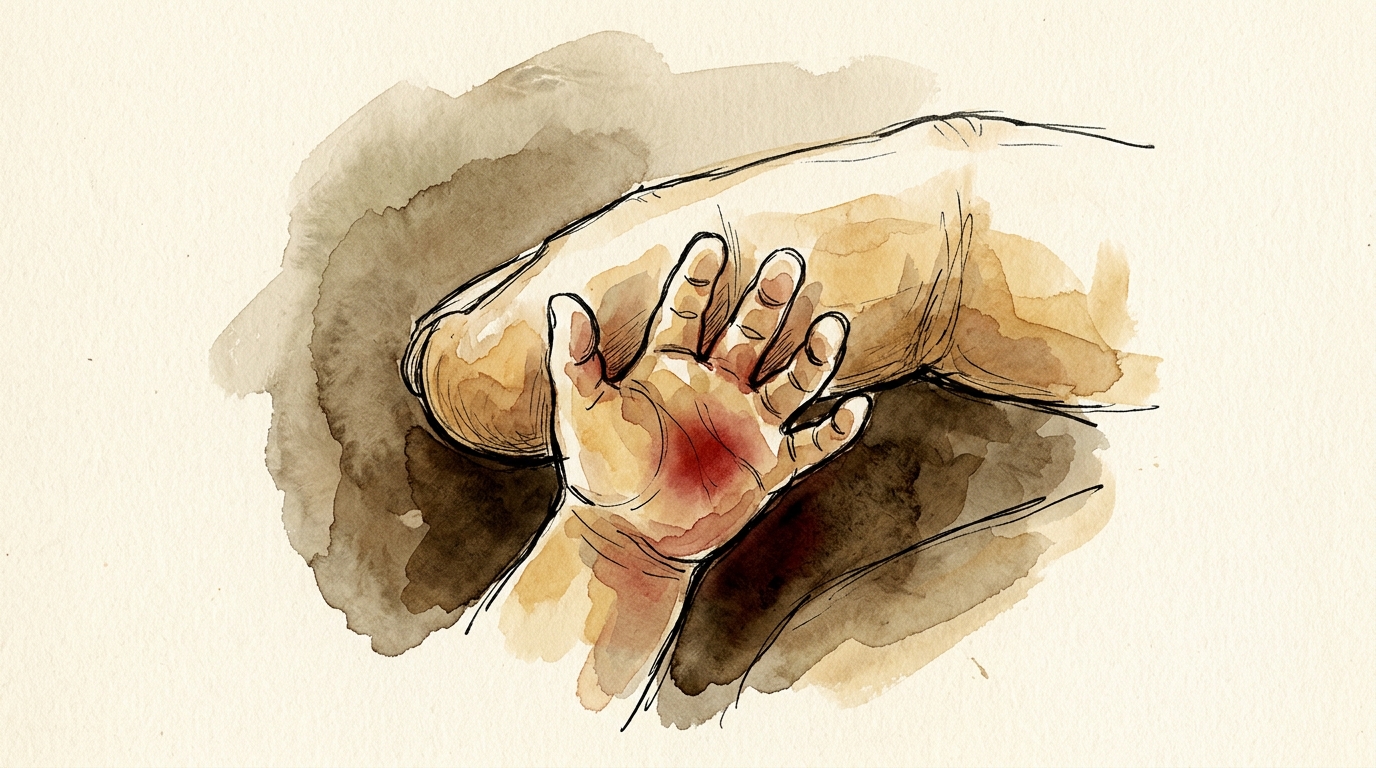
Get too little of that signal, and the map fails at the midline. The forebrain never splits in two — a severe birth defect called holoprosencephaly `F10`. At the mild end, a single front tooth; at the most severe, a single eye `F11`. Sonic hedgehog was the first gene tied to it `F12` — which is why some clinicians wince at delivering so grave a diagnosis under a cartoon's name `F13`.
06THE TWIST
Nature ran the same experiment by accident. In 1957, lambs in Idaho were born with a single eye `F14`. The cause was a wildflower — the corn lily — and its toxin, cyclopamine, which jams the very same hedgehog signal `F15`. The plant was phenocopying the genetic disease.
07THE FRONTIER
Then the dial turns the other way. Too much hedgehog signaling, and cells keep dividing — the root of basal cell carcinoma, the most common cancer in the world `F16`. And the target cyclopamine revealed — a protein called Smoothened `F17` — is exactly where we now strike: vismodegib, approved in 2012, the first medicine to drug the hedgehog pathway `F18`. The poison that blinded lambs pointed the way to a cancer cure.
08TIMELINE + SIGN-OFF
A cartoon name. A gradient that builds a body. One-eyed lambs, and a cancer cure. All written into one gene. — The Gene Channel.
The write-up
In one line: A gene whimsically named "Sonic hedgehog" turns out to be a master architect of the body — a morphogen whose gradient tells each cell where it is; too little of it leaves an embryo with a single eye, too much drives the most common cancer, and the plant toxin that first jammed it pointed the way to a cure.
The name
The original hedgehog gene was found in fruit flies in the famous 1980 genetic screen of Christiane Nüsslein-Volhard and Eric Wieschaus (Nobel Prize, 1995): mutant larvae are covered in spike-like denticles, like a hedgehog. When three labs (Ingham, McMahon, Tabin) cloned the vertebrate versions in 1993, two were named after real hedgehog species (Desert, Indian) — and a postdoc in Tabin's lab named the third Sonic hedgehog, after the Sega game. The whimsy has real friction: SHH mutations cause grave disease, and some clinical geneticists wince at delivering such a diagnosis under a cartoon's name.
The gene, and the mechanism
SHH sits at chromosome 7q36.3 and encodes a secreted signalling protein — a morphogen. Released from a small "organizer" region of the embryo (the notochord; the limb's zone of polarizing activity), it spreads outward into a concentration gradient. Each nearby cell measures how much SHH it sees, and that number is a coordinate: it tells the cell where it sits and what to become — which digit of the hand, which class of neuron in the spinal cord. One molecule, drawing the body's map.
Too little: holoprosencephaly
Lose that signal and the map fails at the midline. The forebrain never divides into two hemispheres — a severe malformation called holoprosencephaly, whose spectrum runs from a single central front tooth at the mild end to a single median eye (cyclopia) at the most severe, the latter usually incompatible with life. In 1996, SHH became the first gene tied to holoprosencephaly (Roessler et al.).
Nature's accident: the corn lily
In 1957, lambs in Idaho were born with a single eye. A USDA investigation traced it to a wildflower — the corn lily, Veratrum californicum — and its steroidal-alkaloid toxin, cyclopamine. Cyclopamine binds a protein called Smoothened and shuts the Hedgehog pathway off; pregnant ewes that grazed the plant produced lambs that phenocopied the genetic disease. (Note the careful causal chain: the plant blocks the same signal that SHH mutations lose.)
Too much: cancer — and the cure
Turn the dial the other way and the danger flips. Over-active Hedgehog signalling drives basal cell carcinoma, the most common cancer in the world. And the very target cyclopamine revealed — Smoothened — is where we now strike: vismodegib (Erivedge), approved by the FDA on 30 January 2012, the first medicine to drug the Hedgehog pathway. Cyclopamine revealed the target; vismodegib is a separate, synthetic Smoothened inhibitor — the plant didn't become the drug, it pointed to it.
Sources
Full claim-by-claim evidence is in references.md. Primary anchors:
- SHH gene/locus/morphogen: NCBI GTR 6469 · OMIM 600725
- Naming history: STAT oral history
- SHH → holoprosencephaly: Roessler et al. 1996, PMID 8896572 · OMIM 142945
- Cyclopamine ⊣ Smoothened: Chen et al. 2002, PMC187469 · Cyclopamine
- Vismodegib FDA 2012: FDA approval, PMID 23515405 · StatPearls
Accuracy notes: (1) direction matters — too little SHH → birth defect, too much → cancer; (2) cyclopamine ≠ vismodegib — the toxin revealed the Smoothened target; vismodegib is a separate synthetic SMO inhibitor.
The evidence
Every claim, sourced
Each [F#] you hear in the film links to the source it came from. Nothing gets narrated until every one is checked and signed off.
Sign-off
- PhD sign-off — facts correct; both ⚠️ traps held; F9 reworded to "one nerve cell or its neighbour"
Gate OPEN → narration + render done.
- F1
SHH is named after a video-game character
The vertebrate gene was named "Sonic hedgehog" after Sega's Sonic the Hedgehog
- F2
SHH patterns the midline; its dose decides two eyes vs one
SHH morphogen patterns CNS/face midline; loss → cyclopia (single eye)
- F3
SHH sits on chromosome 7
HBB… no — SHH cytogenetic location 7q36.3
- F4
"hedgehog" came from fruit flies whose mutant larvae are covered in spike-like denticles
Drosophila hedgehog loss-of-function larvae are covered in denticles resembling hedgehog spikes
- F5
vertebrate hedgehogs named after hedgehog species, except one named for the Sega character
Desert/Indian hedgehog (real species); Sonic named by Robert Riddle (Tabin lab) after the game
- F6
the fly genes came from a 1980 screen by Nüsslein-Volhard & Wieschaus (Nobel)
Their Drosophila segmentation screen (Nature, 1980); Nobel Prize 1995 (with Lewis)
- F7
in 1993, three labs found the vertebrate hedgehog genes
Ingham, McMahon & Tabin labs cloned vertebrate hedgehogs incl. Sonic, 1993
- F8
SHH is a morphogen — released from one spot, spreads into a gradient
Secreted morphogen; limb ZPA sets up a posterior→anterior gradient
- F9
cells read the SHH concentration → positional identity (limb digits, CNS L/R-… midline)
Concentration-dependent specification of digit identity (ZPA) and ventral neural tube
- F10⚠ commonly confused
too little SHH → forebrain fails to divide → holoprosencephaly
LOSS-of-function; Shh-null mice show cyclopia + failed ventral forebrain specification
- F11
spectrum: mild = single central incisor; severe = cyclopia (single eye)
"mild … single central incisor … severe … cyclopia (alobar HPE, usually incompatible with life)"
- F12
SHH was the first gene tied to holoprosencephaly
Roessler et al., Nature Genetics 1996, "Mutations in the human Sonic Hedgehog gene cause holoprosencephaly"
- F13
clinicians object to the whimsical name in grave-diagnosis contexts
Documented discomfort among clinical geneticists
- F14
1957, Idaho lambs born with a single eye
Idaho ewes bore cyclopic lambs; USDA investigation began 1957
- F15
cause = corn lily (Veratrum californicum); its toxin cyclopamine jams hedgehog signaling
Cyclopamine (steroidal alkaloid) binds Smoothened, blocking Hedgehog → phenocopies SHH loss
- F16⚠ commonly confused
too much hedgehog signaling → basal cell carcinoma, the most common cancer
GAIN of pathway activity (PTCH1 loss / SMO activation) drives BCC, the most common human cancer
- F17
cyclopamine revealed the target — Smoothened (SMO)
Cyclopamine = first specific Hedgehog inhibitor; direct SMO antagonist (target validation)
- F18⚠ commonly confused
vismodegib, approved 2012, first medicine to drug the hedgehog pathway (SMO inhibitor)
FDA approved Erivedge/vismodegib Jan 30 2012; first FDA Hedgehog-pathway inhibitor (SMO). NOT chemically derived from cyclopamine — separate synthetic SMO inhibitor; cyclopamine only revealed the target.