PAX6
The Switch That Builds an Eye
One gene decides where an eye goes. Force it on where it doesn't belong — a wing, an antenna, a leg — and an eye grows there anyway. Meet PAX6, the master switch of the eye.
The walkthrough
Beat by beat
HOOK
0:19
01HOOK
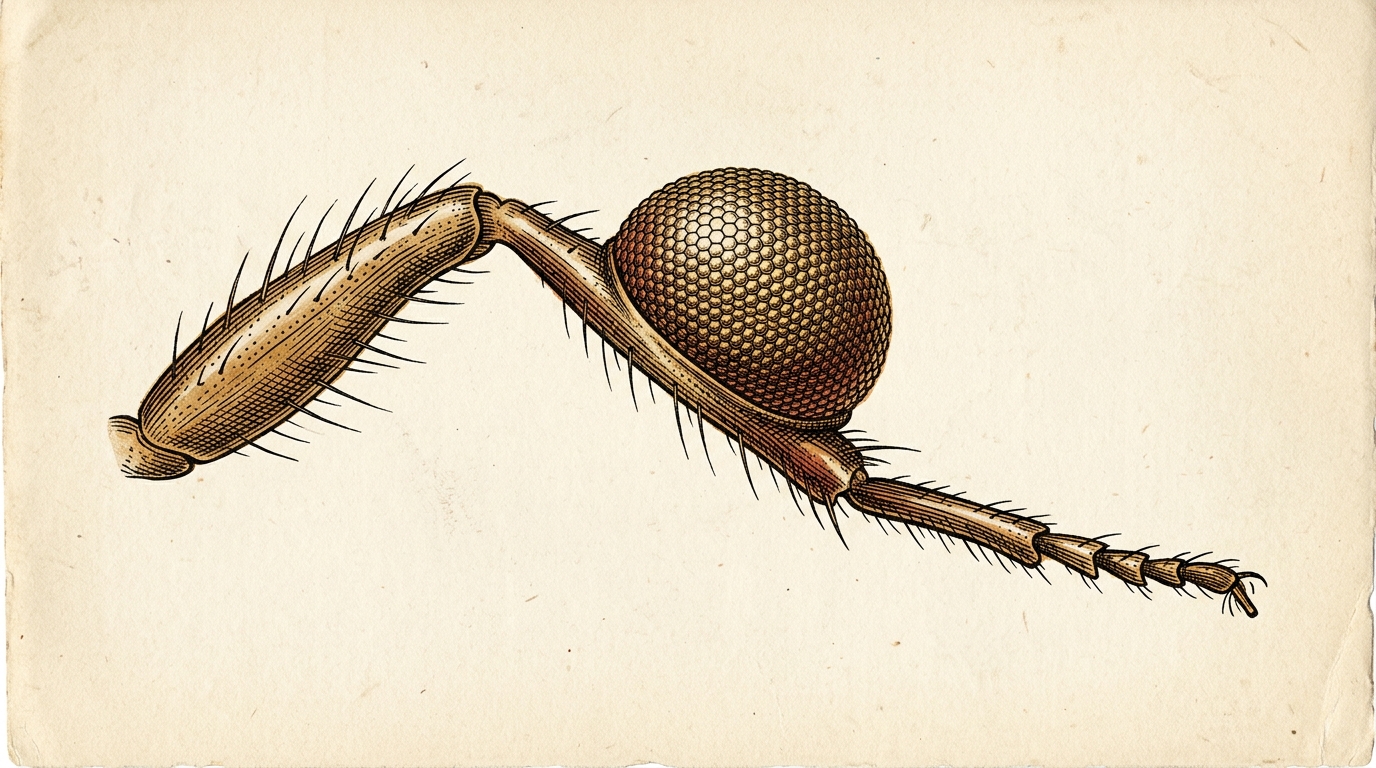
On the leg of a fruit fly, something is looking back. A cluster of tiny lenses, hundreds of them, packed into a dome. A working eye. It grew where a leg should be. It didn't happen by accident. Someone switched on a single gene. `F1`
02THE TWIST
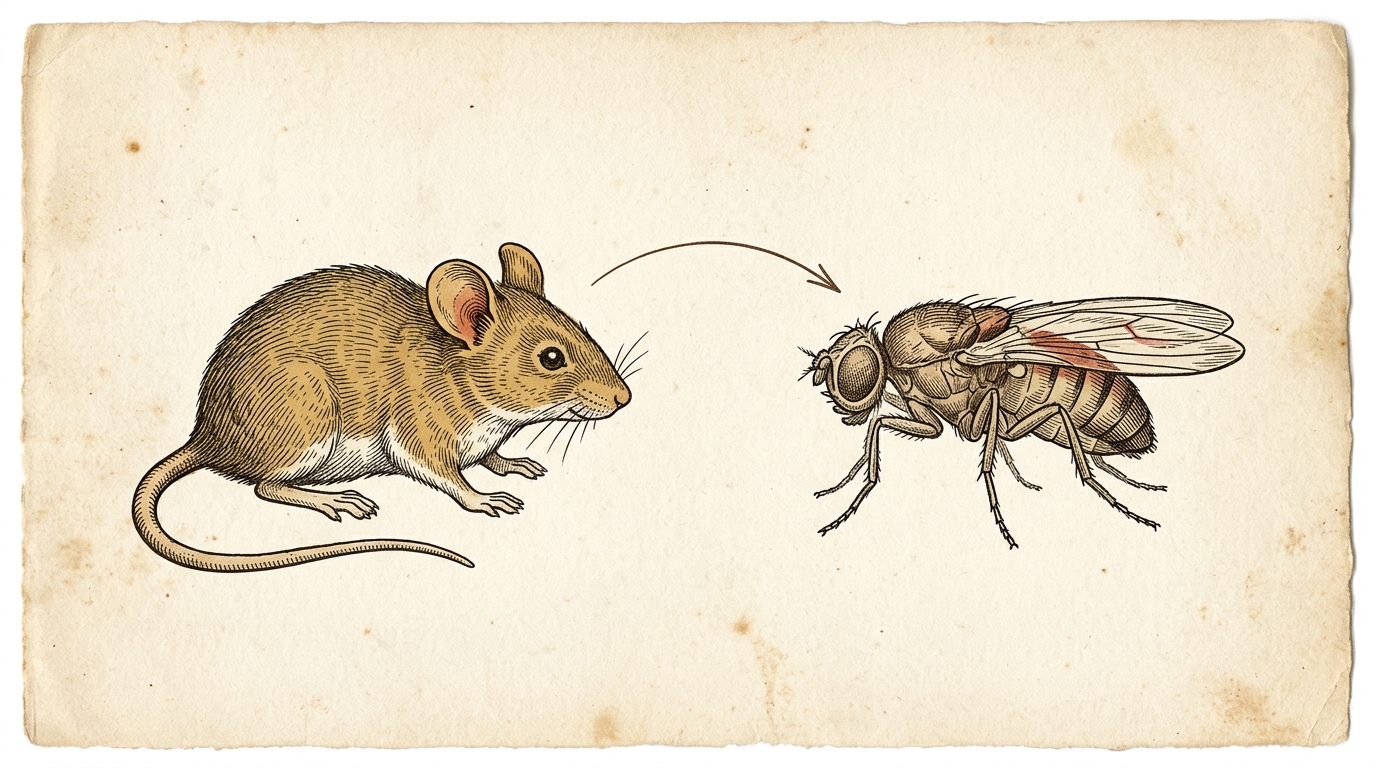
And it didn't have to be a fly's own gene. Take the matching gene from a mouse, switch it on in a fly, and an eye still grows. The same instruction, read across more than five hundred million years of evolution. `F2`
03THE NAME
It has a plain name. PAX6. It sits on chromosome eleven. `F3` But it doesn't build the eye itself. It's a switch — a protein that lands on the DNA and turns on the hundreds of genes that do. `F4` The master switch for making an eye.
04THE HUNT
It was found three times over. In the fly, a mutant with no eyes at all: eyeless. In the mouse, one with shrunken eyes: Small eye. In people, children born without the coloured ring of the iris: aniridia. `F5` Three species. Three defects. Nobody knew it was the same gene.
05THE METHOD
So Walter Gehring's lab in Basel tried the opposite of breaking it. They forced the gene on, deliberately, in tissue that should never hear it. A wing. An antenna. A leg. `F1` And the switch they used wasn't even the fly's own. It was PAX6, taken from a mouse. `F2` Eyes grew there anyway. Complete ones.
06THE MECHANISM (hero)
Look closely at the eyes that mouse gene grew. They're fly eyes. Faceted, compound. The fly's own design, not a mouse's. `F6` The switch came from a mouse. The blueprint did not. PAX6 gives just one command: build an eye here. And the fly answers in its own language. The switch is universal. The eye it builds is local.
07THE STAKES
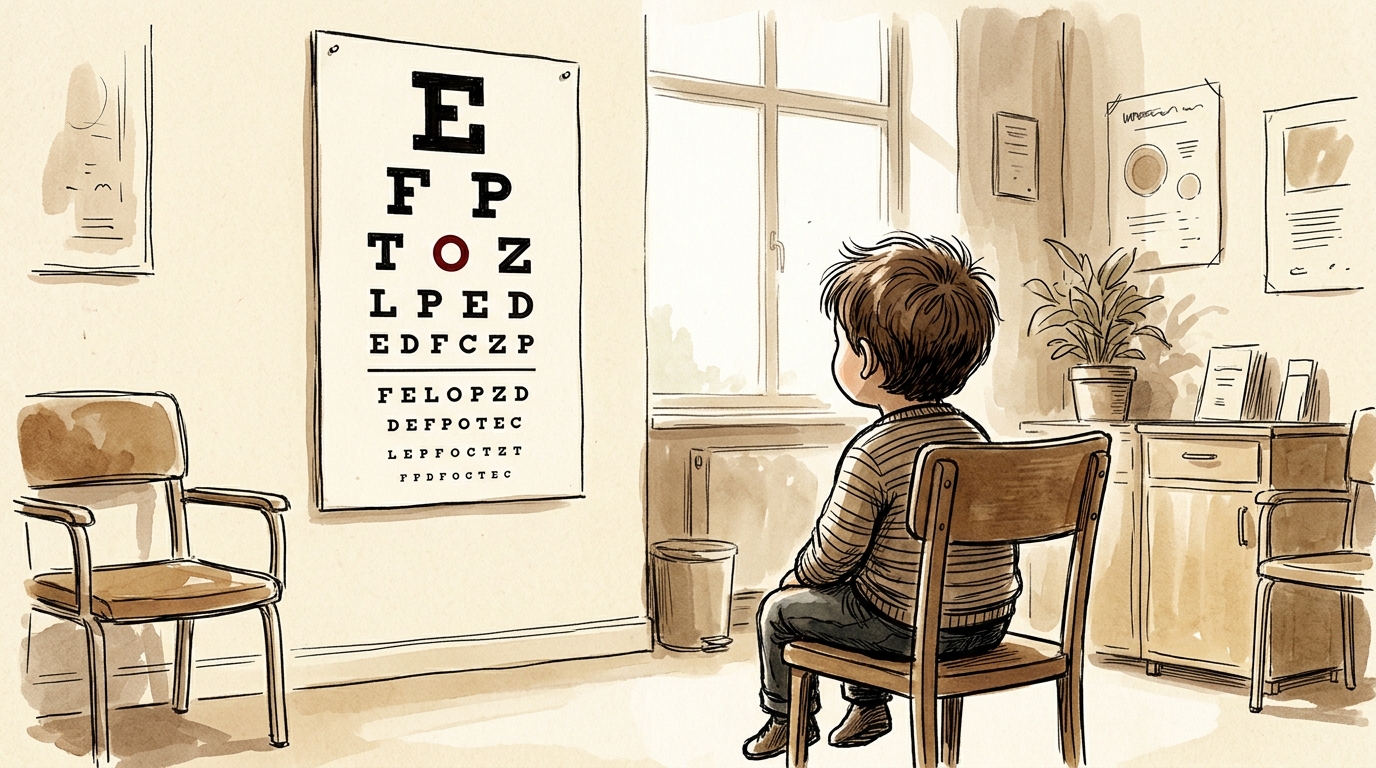
In us, PAX6 comes in two copies. Lose the function of just one, and it isn't enough. `F7` The iris never fully forms. The centre of the retina stays unfinished. This is aniridia — one gene, running at half its dose.
08BEYOND THE EYE
And the eye isn't all it builds. The same switch runs in the growing brain. In the nose. In the pancreas, where it lays down the cells that manage blood sugar. `F10` Lose one copy, and the iris suffers. Lose both, and an embryo forms with no eyes at all. And no nose. `F11` One gene, drawing up organ after organ.
09THE FRONTIER
For a century, biologists thought the eye had been invented over and over. Dozens of separate times, across the animal kingdom. `F8` One gene, shared from flies to mice to us, told a different story: the same ancient switch, kept for half a billion years. And now, for children with aniridia, the search is on to coax a broken copy back to work. `F9`
10TIMELINE + SIGN-OFF
Eyeless in a fly. Small eye in a mouse. Aniridia in a child. One switch, at the top of it all. — The Gene Channel.
The write-up
In one line: PAX6 is the master switch for building an eye — one gene so ancient and so universal that a mouse's copy, switched on in a fruit fly, grows a fly's eye where a leg should be.
The gene
PAX6 sits on the short arm of human chromosome 11, at band 11p13. It doesn't build an eye itself — it's a transcription factor, a protein that lands on DNA (through two binding domains, a paired domain and a homeodomain) and switches on the hundreds of downstream genes that actually do the building. It behaves like the topmost switch of the eye's genetic program, which is why Walter Gehring called it a master control gene.
The hunt
The strangest thing about PAX6 is that it was discovered three separate times, in three species, by people who didn't know they'd found the same gene. In the fruit fly it was eyeless — a mutant born with no eyes. In the mouse it was Small eye — shrunken eyes when one copy failed, no eyes at all when both did (Hill et al., 1991). In humans it was aniridia — children born without the coloured ring of the iris (Ton et al., 1991). In 1994, Gehring's lab showed all three were the same gene (Quiring, Walldorf, Kloter & Gehring, Science).
The mechanism
Then, in 1995, they did the opposite of breaking it. Using targeted expression, Gehring's lab forced eyeless on in tissues that should never hear it — the wing, the antenna, the leg — and complete, functional eyes grew there (Halder, Callaerts & Gehring, Science). The result that stunned biologists: the mouse Pax6 gene did it too. A mouse gene, switched on in a fly, still grew an eye.
But look closely, and those eyes are fly eyes — faceted compound eyes made of fly ommatidia, not mouse eyes. PAX6 doesn't carry the blueprint for an eye. It throws a switch, and the host's own downstream network — a cascade of many genes — builds whatever kind of eye that animal makes. The switch is universal; the eye it builds is local.
The stakes, and the frontier
In humans PAX6 is haploinsufficient: two working copies are needed, and losing the function of just one is enough to cause aniridia — an underdeveloped iris, an unfinished fovea at the centre of the retina, and reduced vision. (This is isolated aniridia, caused by mutations inside PAX6 itself. It should not be confused with WAGR syndrome, where a larger deletion of 11p13 removes PAX6 and the neighbouring WT1 gene, adding a risk of Wilms tumour.)
And the eye is only part of what PAX6 builds. The same switch is at work in the developing brain, the olfactory system (the nose), and the endocrine pancreas — where it helps specify the islet cells that manage blood sugar, including the glucagon-producing alpha cells (St-Onge et al., 1997; Sander et al., 1997). The dose matters: losing one copy leaves the iris underdeveloped, but in mice, losing both copies produces an embryo with no eyes and no nose at all (Hill et al., 1991; Grindley et al., 1995) — a reminder of how much of the body this one gene helps lay out.
The universality carries a deeper message. For most of the last century, biologists thought eyes had been invented independently dozens of times across the animal kingdom (Salvini-Plawen & Mayr estimated ~40 to 65 separate origins). One shared gene, conserved from flies to mice to us, told a different story — what's now called deep homology: a single ancient genetic program for building eyes, even though the eyes themselves (compound, camera, pinhole) each evolved their own form.
For children with aniridia, the frontier is therapeutic. Many PAX6 mutations introduce a premature "stop" in the gene; one experimental strategy is to coax the cell to read through that stop (the drug ataluren was tested in the Phase 2 STAR trial). It did not meet its primary endpoint, and gene-therapy approaches remain preclinical — the search to restore a broken copy is real, and still open.
Sources
Full claim-by-claim evidence is in references.md. Primary anchors:
- Halder, Callaerts & Gehring, Induction of ectopic eyes by targeted expression of the eyeless gene in Drosophila. Science 267:1788–1792 (1995).
- Quiring, Walldorf, Kloter & Gehring, Homology of the eyeless gene of Drosophila to the Small eye gene in mice and Aniridia in humans. Science 265:785–789 (1994).
- Ton et al., Cell 67:1059–74 (1991); Hill et al., Nature 354:522–5 (1991).
- Shubin, Tabin & Carroll, Deep homology and the origins of evolutionary novelty. Nature 457:818–823 (2009); Salvini-Plawen & Mayr, Evol Biol 10:207–263 (1977).
- GeneReviews: PAX6 Aniridia Syndrome (NBK1360); ClinicalTrials.gov NCT02647359 (STAR).
Accuracy note: "Master control gene" is Gehring's framing — PAX6 acts at the top of a network of eye-selector genes, not entirely alone. "Deep homology" means the shared thing is the genetic switch, not the eye as a single ancestral organ. And isolated aniridia (PAX6 alone) is distinct from WAGR syndrome (an 11p13 deletion removing PAX6 and WT1).
The evidence
Every claim, sourced
Each [F#] you hear in the film links to the source it came from. Nothing gets narrated until every one is checked and signed off.
Sign-off
- PhD sign-off — facts above are correct; the traps (WAGR vs. isolated aniridia; master-switch caveat; deep-homology framing; het-vs-hom in the new organs beat) are stated correctly in
script.md. (Signed off 2026-07-10; F10/F11 organs beat added 2026-07-11 with primary sources.) - Numbers/dates verified or narration kept qualitative (prevalence kept qualitative on-screen; exact 1:64,000–1:96,000 lives here; bilaterian split stated conservatively as "more than 500 million years").
Gate OPEN → narration + render may proceed.
- F1
Switching on a single gene (eyeless, the fly's Pax6) by targeted expression grows complete, functional eyes where they don't belong — on wings, legs, antennae of Drosophila.
Halder, Callaerts & Gehring used the GAL4/UAS system to drive eyeless ectopically; ectopic eyes formed on wing, leg and antenna, with functional photoreceptors (ERG-confirmed on antennal eyes).
- F2
It didn't have to be the fly's own gene — the mouse Pax6 gene, switched on in a fly, also grows an eye. Same instruction across >500 Myr.
The same body of work showed mouse Pax-6 (the Small eye gene) induces ectopic eyes in Drosophila; conservation across species formalized in Gehring's reviews. Bilaterian (protostome–deuterostome) split ≈ 550–600 Mya → "more than five hundred million years" is conservative.
- F3
PAX6 sits on chromosome eleven (exact: 11p13).
Human PAX6, NCBI Gene ID 5080, cytogenetic band 11p13; ~22 kb; 422-aa protein.
- F4
It doesn't build the eye itself — it's a switch (a DNA-binding protein) that turns on the hundreds of genes that do.
PAX6 is a transcription factor with two DNA-binding domains (a paired domain + a paired-type homeodomain); acts near the top of the eye gene regulatory network. ChIP found Pax6 occupying >2,300 promoters in lens — "hundreds" is a conservative floor.
- F5
The same gene was found three times: eyeless (fly), Small eye (mouse), aniridia (human) — each a Pax6 loss of function.
Human aniridia gene cloned at 11p13 (Ton 1991); mouse Small eye shown to be a paired-box/homeobox gene mutation (Hill 1991); Drosophila eyeless shown homologous to mouse Small eye and human Aniridia (Quiring/Gehring 1994).
- F6
The ectopic eyes are fly eyes — compound, faceted — even when the mouse gene throws the switch. PAX6 gives the command; each animal's own downstream network builds its own eye type.
Ectopic eyes induced by mouse Pax6 in Drosophila are fly-type compound eyes; Pax6/eyeless sits atop the host's own retinal-determination network (~20 factors) that executes eye morphogenesis. The gene is the switch; the blueprint is the host genome's.
- F7
In humans PAX6 is haploinsufficient — losing one working copy is enough. The iris fails to form; the fovea stays underdeveloped. This is aniridia.
PAX6 haploinsufficiency (heterozygous loss of function, mostly PTC variants → nonsense-mediated decay → ~50% protein) causes aniridia: iris hypoplasia + foveal hypoplasia, ± keratopathy, glaucoma, cataract, nystagmus. Prevalence 1:64,000–1:96,000.
- F8
Biologists long thought eyes were invented independently dozens of times (~40–65). One shared gene told a different story — a common ancient genetic program ("deep homology").
Salvini-Plawen & Mayr (1977) estimated eyes arose independently ~40 (up to ~65) times. Pax6 conservation reframed this as deep homology: a shared genetic toolkit initiates eye development, even though eye morphologies (compound vs. camera) evolved separately.
- F9
For children with aniridia, the search is on to coax a broken copy back to work.
~70–85% of pathogenic PAX6 variants create a premature stop; read-through (ataluren/PTC124) was tested for nonsense-mutation aniridia in the Phase 2 STAR trial (NCT02647359) — completed, did not meet its primary endpoint (positive trend); ataluren is not approved for aniridia. Gene-therapy/base-editing/CRISPR approaches remain preclinical.
- F10
Beyond the eye, the same switch runs in the growing brain, the nose, and the pancreas (where it lays down the blood-sugar cells).
PAX6 is broadly expressed across the developing brain/forebrain (an expression atlas; functional cortical role shown later); it is required for nasal/olfactory development, and for the endocrine pancreas — glucagon-producing alpha cells and normal islet-hormone (insulin/glucagon/somatostatin) transcription.
- F11
Lose one copy → the iris suffers; lose both → an embryo with no eyes at all, and no nose.
Homozygous Pax6-null (mouse Small eye, Sey/Sey) embryos entirely lack eyes and nasal structures and die at/around birth. Heterozygotes (Sey/+) have only small eyes — the load-bearing het-vs-hom distinction (aniridia = one damaged copy, NOT the no-eyes/no-nose null).