OR6A2
A Nose for Soap
Why does fresh cilantro taste like soap to some people? The trail runs through one of ~400 smell-receptor genes — and the GPCR family that a third of all medicines target.
The walkthrough
Beat by beat


HOOK
0:19
01HOOK
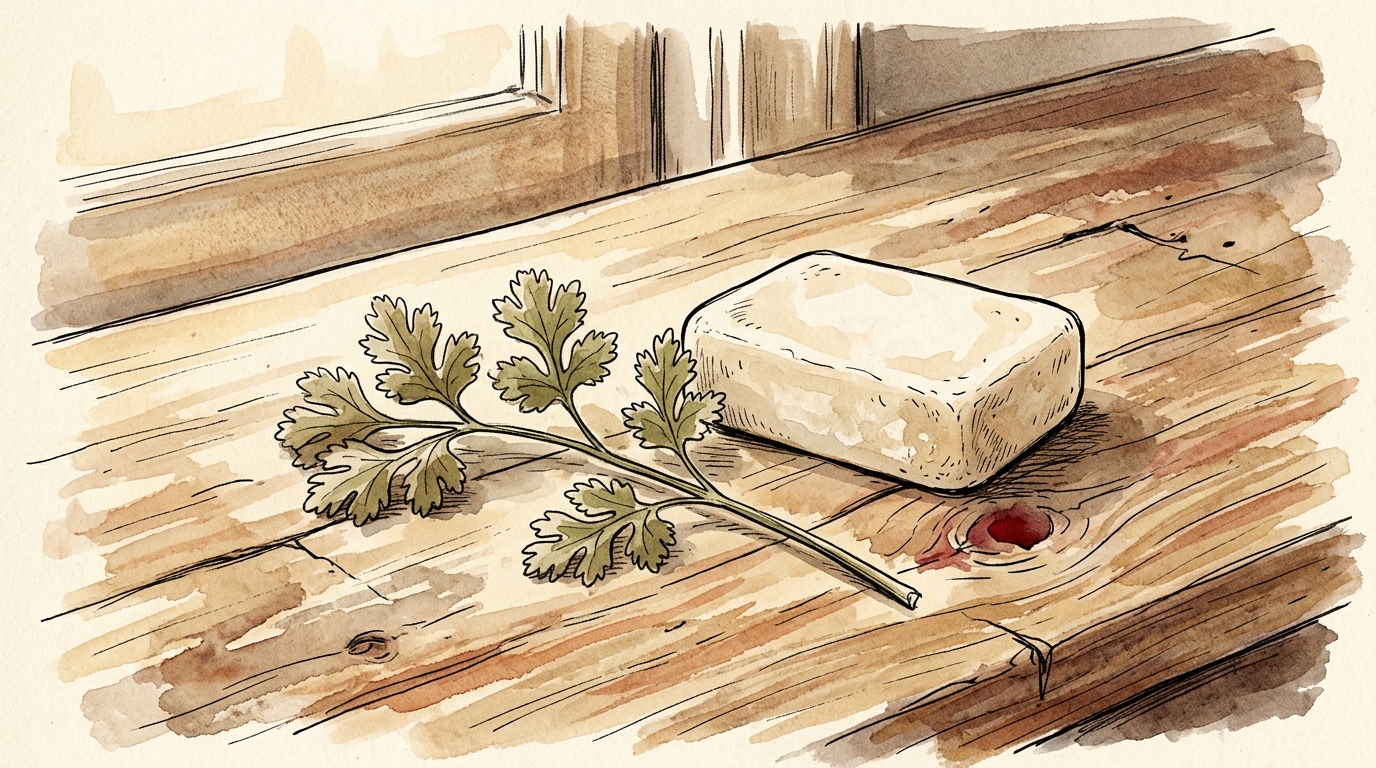
To some people, fresh cilantro doesn't taste fresh — it tastes like soap. Not a preference. A perception, written into their DNA, in a gene called OR6A2 `F1`. It's the story of how one smell sensor lets you read the chemistry of the world.
02THE NAME
OR6A2 is an olfactory receptor — a smell sensor — tucked into a cluster of similar genes on chromosome 11 `F2`. And it has a lot of cousins: you carry around four hundred working olfactory-receptor genes — the largest single gene family in your genome `F3`. Hundreds of genes, just to detect smells.
03THE FAMILY
But OR6A2 belongs to a bigger club. It's a GPCR — a G-protein-coupled receptor: a protein that threads through the cell's outer membrane seven times, with a pocket facing the outside world `F4`. GPCRs are the body's universal sensors — around eight hundred of them let your cells feel light, hormones, adrenaline, and smell `F5`. About half are olfactory receptors `F5`.
04THE MECHANISM (hero)
Here's how one fires. An odor molecule drifts up your nose and slots into the receptor's pocket. The receptor changes shape, and inside the cell it switches on its olfactory G-protein — G-olf, the olf for olfactory `F6`. That trips a relay: an enzyme spits out a burst of the messenger cAMP, ion channels swing open, and the nerve cell crackles to life `F6`. One molecule of air, turned into a signal to your brain `F6`.
05THE CODE
But no receptor spells "coffee" or "rose" by itself. Each smell neuron carries just one type of receptor `F7`; each receptor answers to many molecules; and each molecule lights up a whole combination of receptors `F8`. Your brain reads the pattern — which is how just four hundred sensors tell apart thousands of different smells `F8`.
06THE CILANTRO TWIST
Which brings us back to cilantro. In 2012, a study of nearly fifteen thousand people found a single DNA letter, right beside OR6A2, that tracks with tasting cilantro as soapy `F9`. Here's the chemistry: cilantro's aroma is mostly aldehydes, and OR6A2 is tuned to detect them `F10`. Some of those aldehydes smell fresh and green — others smell distinctly soapy, the same compounds found in real soap `F10`. The leading idea is that this version of the receptor makes the soapy ones ring out louder — so one sprig can smell fresh to you, and like soap to me `F9`. A small effect, one nudge to one sensor, but enough to split the dinner table `F9`.
07THE STAKES
And this reaches far past the dinner table. Because GPCRs are so central to how cells listen, they're the single biggest target in all of medicine — about a third of every drug the FDA has ever approved works through a GPCR `F11`. And when smell itself fails — as millions relearned with COVID `F12` — the loss is its own quiet proof that these sensors run deep.
08TIMELINE + SIGN-OFF
We only cracked this open in 1991, when Linda Buck and Richard Axel found the olfactory-receptor genes — work that won the 2004 Nobel Prize `F13`. Four hundred sensors. Eight hundred receptors. One of them, maybe, deciding whether you reach for the cilantro. — The Gene Channel.
The write-up
In one line: OR6A2 is one of ~400 olfactory-receptor genes — members of the GPCR superfamily, the body's universal molecular sensors — and a DNA variant beside it is the leading explanation for why, to some people, fresh cilantro tastes like soap.
The gene
OR6A2 (olfactory receptor family 6 subfamily A member 2) sits in a dense cluster of olfactory-receptor genes on the short arm of chromosome 11 (band 11p15.4). It encodes a G-protein-coupled receptor (GPCR) — a protein that threads through the cell membrane seven times, with a binding pocket facing the outside world. Humans carry roughly 400 functional olfactory-receptor genes (plus a similar number of pseudogenes): the largest single gene family in the human genome, and almost half of all ~800 human GPCRs.
How smell actually works (the mechanism)
GPCRs are the body's universal sensors — different ones detect light, hormones, adrenaline, neurotransmitters, and odors. An olfactory receptor runs the canonical GPCR relay:
- An odorant molecule drifts into the nasal lining and slots into the receptor's pocket.
- The receptor changes shape and activates its olfactory G-protein, Gαolf.
- Gαolf switches on adenylyl cyclase III, which makes a burst of the second messenger cAMP.
- cAMP opens cyclic-nucleotide-gated (CNG) ion channels; the olfactory sensory neuron depolarizes and fires an electrical signal toward the brain.
The genius is in the encoding. Each olfactory sensory neuron expresses essentially one receptor type (the "one-neuron–one-receptor" rule); each receptor responds to many odorants; and each odorant lights up a whole combination of receptors. The brain reads the pattern — which is how just ~400 sensors discriminate many thousands of distinct smells (combinatorial coding, Malnic & Buck, Cell 1999).
The hunt (why cilantro tastes like soap)
In 2012, 23andMe ran a genome-wide association study on ~14,600 people who reported whether cilantro tastes soapy (replicated in another ~11,900 on cilantro liking). One variant stood out: rs72921001, sitting within a cluster of olfactory-receptor genes on chromosome 11. The most compelling nearby candidate is OR6A2, which has high binding specificity for aldehydes — and cilantro's aroma is dominated by aldehydes, including the (E)-2-alkenals that smell distinctly "soapy" and that also turn up in actual soaps. The honest caveat: this is an association with a small effect (heritability of soapy-taste detection was only ~0.087) — a nudge to one sensor, not a switch that single-handedly decides your dinner.
Why GPCRs matter in the clinic
Because GPCRs sit at the front door of so much cell signaling, they are the single biggest target class in medicine: roughly one in three (~34%) of all FDA-approved drugs act on a GPCR. And smell itself is clinically load-bearing — anosmia (smell loss) became a household word during COVID-19. (Mechanism note: SARS-CoV-2 mostly infects the sustentacular support cells of the olfactory epithelium, not the sensory neurons directly — the receptors aren't destroyed so much as their support is knocked out.)
The arc
We only opened this up in 1991, when Linda Buck and Richard Axel discovered the odorant-receptor gene family — work that earned the 2004 Nobel Prize in Physiology or Medicine. The cilantro variant followed in 2012. One family of sensors, four hundred strong, deciding everything from danger to dinner.
Sources
Full claim-by-claim evidence is in references.md. Primary/authoritative anchors:
- OR6A2 gene (11p15.4, GPCR, olfactory receptor): NCBI Gene 8590 — https://www.ncbi.nlm.nih.gov/gene/8590
- Cilantro GWAS (rs72921001 near OR6A2; aldehyde tuning; ~14,600): Eriksson et al., Flavour 2012;1:22 — https://link.springer.com/article/10.1186/2044-7248-1-22
- ~400 functional OR genes / largest gene family: Niimura & Nei, PNAS 2003 — https://www.pnas.org/doi/10.1073/pnas.0307882100
- ~800 GPCRs, ~half olfactory: G-protein-coupled receptors at a glance, J Cell Sci 116:4867 — https://journals.biologists.com/jcs/article/116/24/4867/27397/
- Olfactory transduction (Golf → AC III → cAMP → CNG channel): Neuroscience (NCBI Bookshelf) — https://www.ncbi.nlm.nih.gov/books/NBK11039/
- Combinatorial coding / one-neuron–one-receptor: Malnic, Hirono, Sato & Buck, Cell 1999 — https://www.cell.com/cell/fulltext/S0092-8674(00)80581-4
- GPCRs ~34% of approved drugs: Hauser et al., Nat Rev Drug Discov 2017;16:829 — https://www.nature.com/articles/nrd.2017.178
- COVID anosmia via sustentacular cells: Brann et al., Sci Adv 2020 — https://www.science.org/doi/10.1126/sciadv.abc5801
- Discovery (1991) & Nobel (2004): Buck & Axel, Cell 1991;65:175 — https://www.cell.com/cell/fulltext/0092-8674(91)90418-X ; NobelPrize.org 2004 — https://www.nobelprize.org/prizes/medicine/2004/press-release/
Accuracy notes (the traps this episode states carefully):
- The 2012 hit is an association near OR6A2, with OR6A2 the leading candidate — not a proven cause. The effect is small (heritability ~0.087); the script says a variant "tracks with" soapy taste and "may" flip the herb.
- COVID-19 smell loss is not the virus destroying olfactory receptors. It primarily infects the support (sustentacular) cells; the script only says smell "failed," it does not claim the receptors are destroyed.
- Buck & Axel's 1991 estimate (~1,000 genes) ≠ the ~400 functional genes humans actually have — the rest are pseudogenes. The episode uses ~400 for the working count.
The evidence
Every claim, sourced
Each [F#] you hear in the film links to the source it came from. Nothing gets narrated until every one is checked and signed off.
Sign-off
- PhD sign-off — facts above are correct; the three ⚠️ traps are stated correctly in
script.md. (Signed off 2026-06-27.) - Numbers verified or kept qualitative: ~400 OR genes, ~800 GPCRs, ~half olfactory, ~34% of approved drugs, n≈14,600 (2012), 1991 discovery / 2004 Nobel.
- Length-gate decision recorded — extended cut approved (~3 min, full 8-beat conceptual arc; wording trimmed to ~3 min). Signed off 2026-06-27.
- Revision 2026-06-27 (user feedback on 2 scenes) — stays within already-signed sources:
Gate OPEN → narration + render may proceed.
- F1⚠ commonly confused
A genetic variant near OR6A2 is associated with perceiving cilantro as soapy (OR6A2 is the leading candidate, association — not proven causal)
23andMe GWAS: SNP rs72921001 near a cluster of olfactory-receptor genes is significantly associated with soapy-taste detection (p=6.4×10⁻⁹). OR6A2, which "detects the aldehydes that may make cilantro smell soapy," is named "a compelling candidate gene." Association, modest effect — not a proven causal mechanism.
- F2
OR6A2 is an olfactory receptor in an OR gene cluster on chromosome 11 (cytoband 11p15.4)
NCBI Gene 8590: "olfactory receptor family 6 subfamily A member 2," Homo sapiens, cytogenetic location 11p15.4, chromosome 11; resides in an OR gene cluster.
- F3
Humans have ~400 functional olfactory-receptor genes — the largest gene family in the human genome
"~400 functional ORs, … the largest gene family within the human genome" (plus a comparable number of OR pseudogenes). Original family discovered by Buck & Axel.
- F4
OR6A2 / olfactory receptors are GPCRs with a 7-transmembrane structure and an external binding pocket
NCBI: OR6A2 "encodes a G protein-coupled receptor … seven-transmembrane domain structure typical of olfactory receptors." ORs are "members of a large family of G-protein-coupled receptors."
- F5
Humans have ~800 GPCRs (sensing light, hormones, neurotransmitters, smell); ~half are olfactory receptors
"~800 GPCRs … of which about half have sensory functions, mediating olfaction (~400), taste (33), light (10), pheromone (5)."
- F6
Smell transduction: odorant→OR→G-olf→adenylyl cyclase III→cAMP burst→CNG ion channels open→neuron depolarizes→signal to brain. The G-protein Gαolf ("Golf") is the olfactory-specific G-protein — the olf subscript = olfactory (gene GNAL), named like Gs/Gi/Gt(transducin), so read "G-olf" (not the sport)
"Odors bind ORs → Golf-GTP activates adenylyl cyclase III → ATP→cAMP → cAMP opens cyclic-nucleotide-gated (CNG) channels → depolarization of olfactory sensory neurons." Jones & Reed titled it "Golf: an olfactory neuron specific-G protein" — the name encodes its olfactory role.
- F7
Each olfactory sensory neuron expresses essentially one OR type — the "one neuron–one receptor" rule
"Each ORN typically expresses one olfactory receptor type"; OR genes are expressed mutually exclusively per neuron.
- F8
Combinatorial coding: each receptor responds to many odorants, each odorant activates a combination of receptors → ~400 sensors discriminate thousands of smells
"A single OR can be activated by many odorants and a single odorant can activate many ORs"; combinatorial codes let a limited receptor set encode a large number of odorants.
- F9⚠ commonly confused
2012 GWAS, ~14,600 people (European-ancestry discovery cohort); a single DNA letter beside OR6A2 tracks with soapy cilantro; effect is small
Discovery GWAS n=14,604 (soapy-taste), replication n=11,851 (liking). rs72921001 OR=0.81 per A allele; heritability of soapy-taste detection was low (~0.087) — keep narration hedged ("small effect," "may be enough").
- F10
OR6A2 is tuned to detect aldehydes; cilantro aroma is mostly aldehydes in two flavours — fruity/green n-aldehydes (e.g. decanal) and soapy (E)-2-alkenals (e.g. (E)-2-decenal), the soapy class also found in real soap
OR6A2 "has high binding specificity for several of the aldehydes that give cilantro its characteristic odor." Cilantro leaf oil ≈82% aldehydes; the n-aldehydes (decanal, dodecanal) read as fruity/green/pungent, the (E)-2-alkenals ((E)-2-decenal, (E)-2-dodecenal) read as "soapy/fatty"; these aldehydes also occur in soaps & lotions.
- F11
GPCRs are the biggest drug-target class — ~34% (about a third) of FDA-approved drugs act on a GPCR
"475 drugs (~34% of all FDA-approved drugs) act on 108 unique GPCR targets."
- F12⚠ commonly confused
COVID-19 caused widespread smell loss (anosmia)
Anosmia is a hallmark of COVID-19. Mechanism trap: SARS-CoV-2 primarily infects non-neuronal sustentacular support cells (ACE2⁺), not the olfactory sensory neurons / OR proteins directly — so narration only says "smell failed," it does NOT claim the virus destroys the receptors.
- F13
Buck & Axel discovered the OR genes in 1991; awarded the 2004 Nobel Prize in Physiology or Medicine
Nobel Prize 2004 to Richard Axel & Linda B. Buck "for their discoveries of odorant receptors and the organization of the olfactory system"; founding paper Buck & Axel, Cell 1991.