NLRP3
The Alarm
For some families, stepping into the cold triggers fever and welts within hours. The cause is a single gene — an immune alarm wired to misfire — and the very same tripwire drives gout, clogged arteries, and Alzheimer's.
The walkthrough
Beat by beat
HOOK
0:19
01HOOK
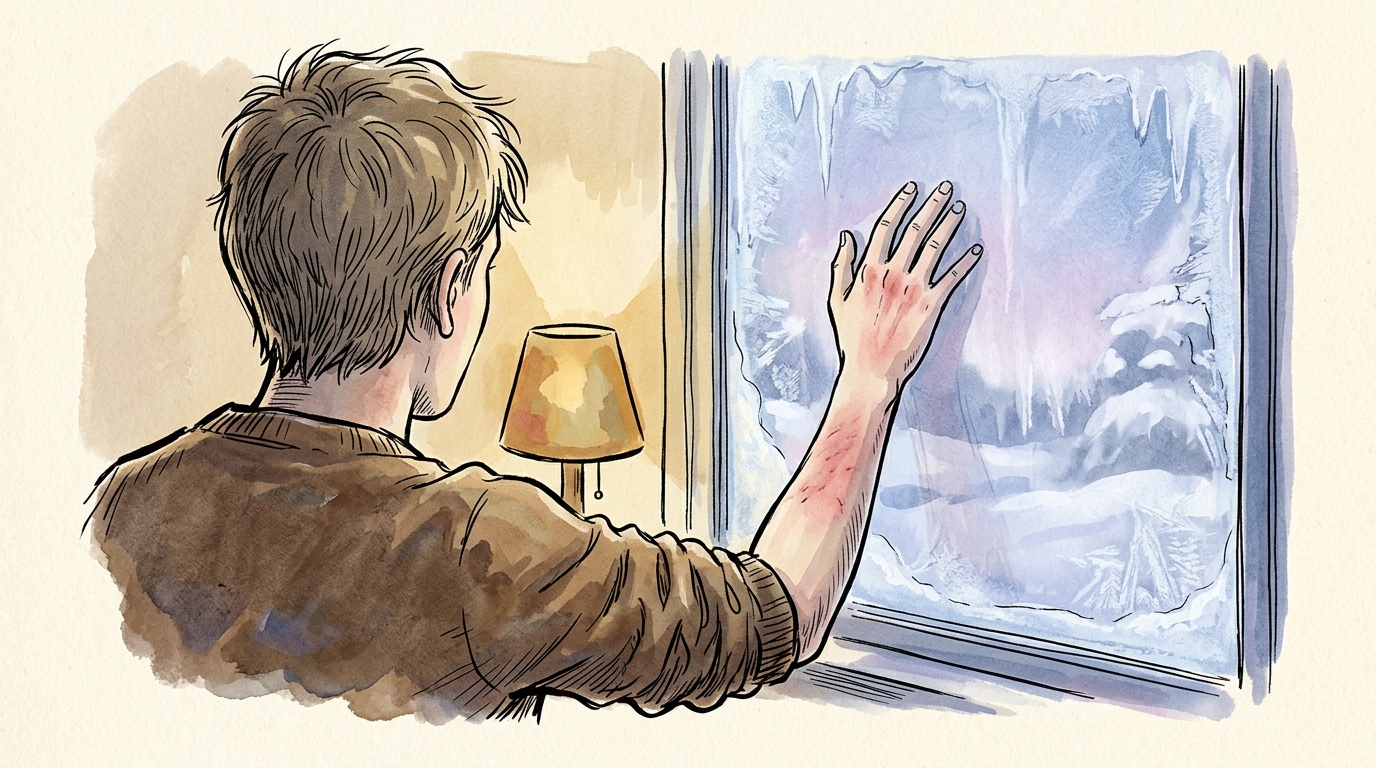
For some families, the cold was dangerous. Step outside on a winter morning, and within hours the skin erupts in welts and the body burns with fever `F1`. Not an allergy. Not an infection. A single gene — a built-in alarm, wired to go off at the wrong moment `F2`.
02THE NAME
The gene is NLRP3. It sits near the far end of chromosome 1 `F3`. It builds a protein that works as a sensor — a tripwire inside your immune cells, always listening for signs of danger `F4`. Its older name says it best: cryopyrin.
03THE HUNT
In 2001, immunologist Hal Hoffman and his team in San Diego chased those cold-fever families all the way down to their DNA `F5`. The cause was mutations in this one gene. They named the protein cryopyrin — cryo, for cold; pyrin, for its fever-linked core `F6`. The mutation didn't break the alarm. It made it too easy to trip `F7`.
04THE METHOD
But what was this alarm? A year later, in Lausanne, Jürg Tschopp's lab gave the machine its name: the inflammasome `F8` — a cluster of proteins that, once triggered, switches on inflammation itself.
05THE MECHANISM (hero)
Here is how it fires. A danger signal appears. NLRP3 snaps together and pulls in a partner protein, ASC, and an enzyme called caspase-1 `F9`. Caspase-1 does two things. It slices a dormant messenger, IL-1β, into its active form — the body's master switch for fever and swelling `F10`. And it punches pores in the cell until it bursts, spilling that alarm into the surrounding tissue `F11`.
06THE STAKES
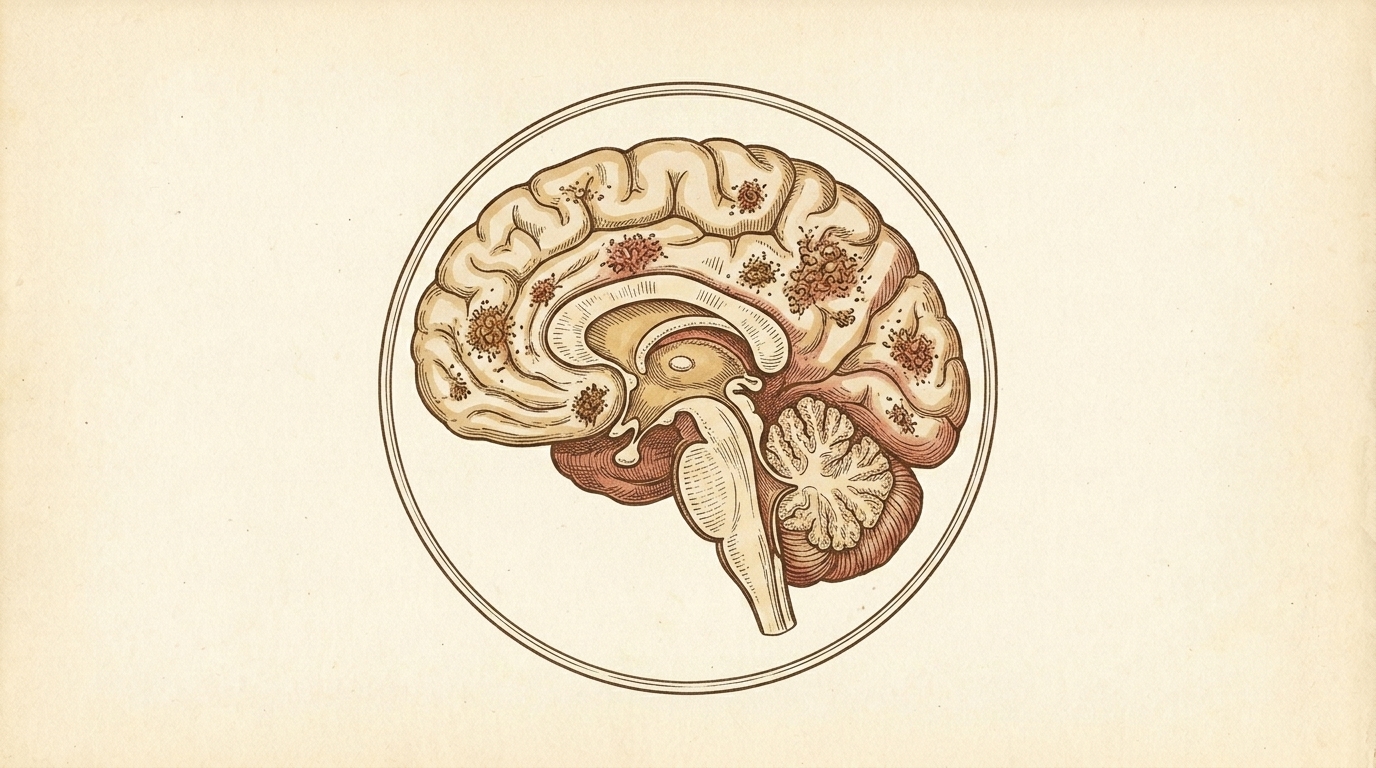
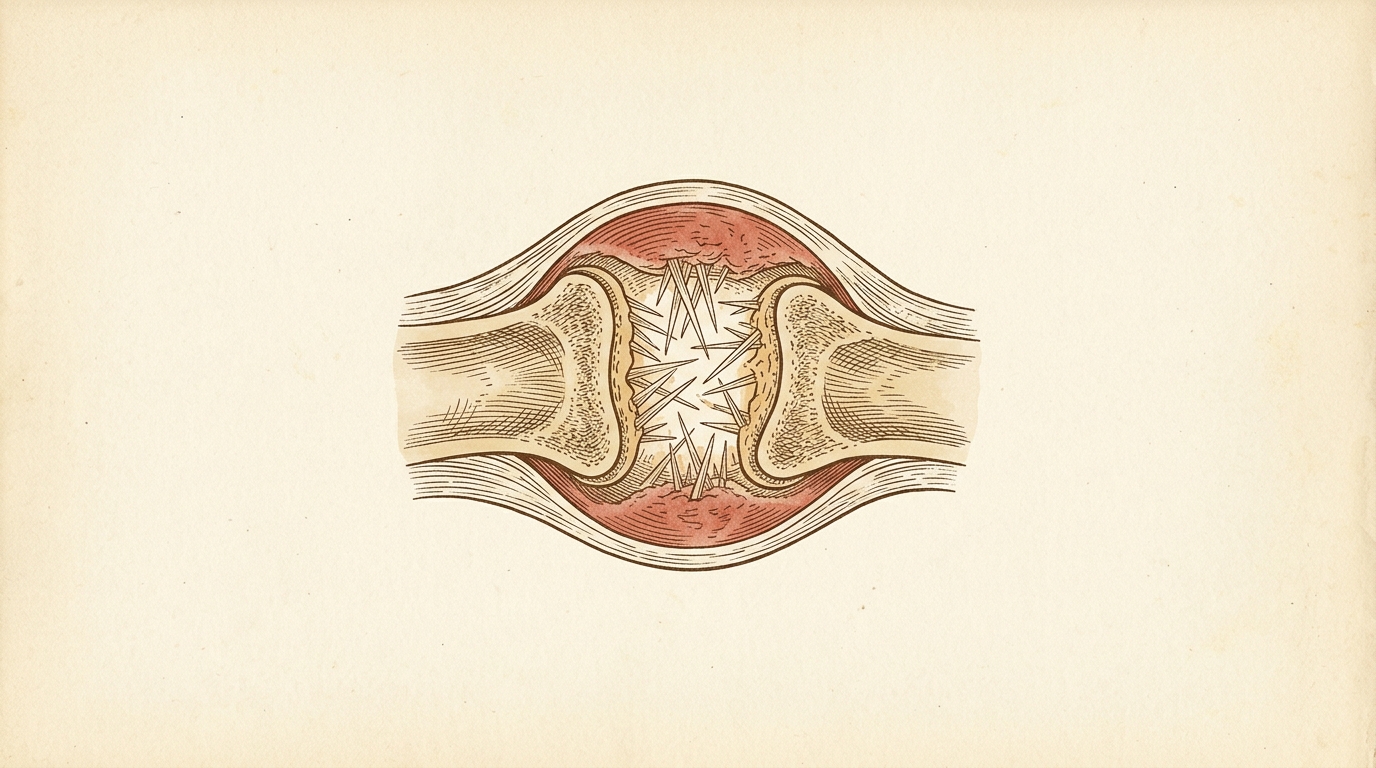
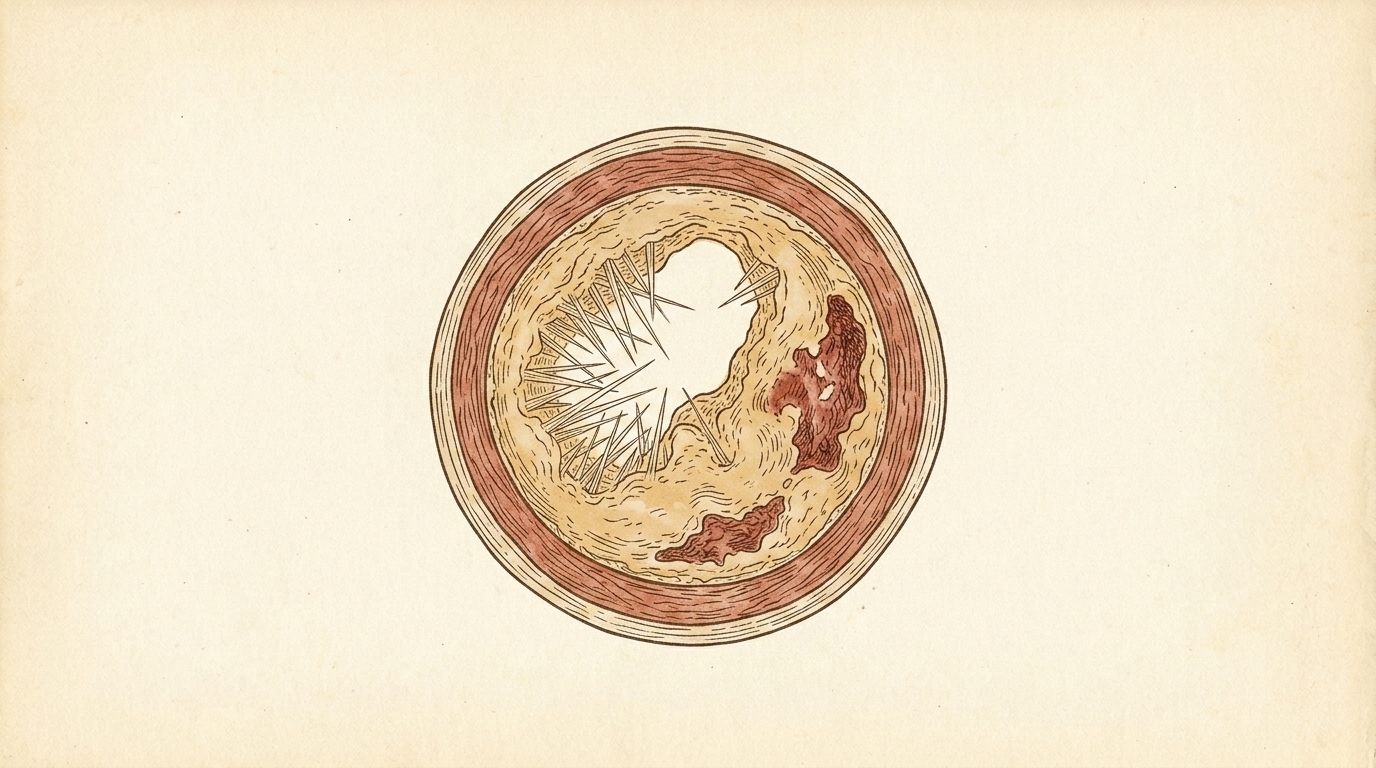
Against a real threat, that is exactly what you want. The problem is what else sets it off. In 2006, Tschopp's lab found the cause of gout: uric-acid crystals that trip the very same alarm `F12`. Cholesterol crystals do it too, inside the walls of arteries. That is atherosclerosis `F13`. And clumps of amyloid do it in the brain, feeding the inflammation of Alzheimer's `F14`. One sensor, misreading the debris of common disease as an enemy.
07THE OPEN THREAD
So switch it off. First we went downstream — antibodies that mop up IL-1β. One of them, canakinumab, silenced the rare fever syndromes `F15`. And in 2017, a massive trial showed the very same drug cut heart attacks `F16`. But the real prize is the alarm itself. In 2015, a molecule called MCC950 became the first to shut NLRP3 down directly — in the lab `F17`. It stalled. But it started a race: Roche, Novartis, a dozen startups `F18`.
08TIMELINE + SIGN-OFF
And yet, after all of it, not one drug that blocks NLRP3 directly has crossed the finish line `F19`. The gene, in 2001. The machine, in 2002. The chase, still on. One alarm, wired into our joints, our arteries, and our minds, and we are only now learning to turn it down. — The Gene Channel.
The write-up
In one line: NLRP3 builds an innate-immune "alarm" — the inflammasome sensor — and the same tripwire that misfires in rare cold-fever families turns out to fuel gout, atherosclerosis, and Alzheimer's, which is why the race to switch it off is one of the hottest targets in medicine.
The gene
NLRP3 (older name cryopyrin; disease-gene name CIAS1) sits near the far end of chromosome 1, at band 1q44. It encodes a cytosolic pattern-recognition receptor — a three-part protein (a PYD domain, a central NACHT/NOD, and a leucine-rich-repeat tail) that acts as a tripwire inside immune cells, always listening for signs of danger. The name splits neatly: cryo for the cold that sets it off in patients, pyrin for its fever-linked protein domain.
The hunt
In 2001, immunologist Hal Hoffman and colleagues at UC San Diego traced families with cold-triggered fever and hives down to mutations in this one gene — the same paper linked it to both Familial Cold Autoinflammatory Syndrome and Muckle-Wells syndrome. Crucially, the mutations don't break the alarm; they're gain-of-function changes that make it too easy to trip. A year later, in 2002, Jürg Tschopp's lab in Lausanne coined the term inflammasome for the protein machine at the center of it all.
The mechanism
When a danger signal appears, NLRP3 oligomerizes and recruits the adaptor ASC (gene PYCARD), which in turn recruits pro-caspase-1 — assembling the inflammasome. Active caspase-1 then does two things: it cleaves dormant pro-IL-1β into mature IL-1β, a master driver of fever and swelling; and it cleaves gasdermin D, whose fragments punch pores in the cell membrane until the cell bursts (pyroptosis), spilling alarm signals into the surrounding tissue. (Note the sensor doesn't bind crystals or amyloid directly — it senses the downstream cellular damage they cause.)
The stakes, and the frontier
Against a real pathogen this response is exactly what you want. The problem is what else trips it. Tschopp's lab showed in 2006 that uric-acid crystals activate NLRP3 — the molecular cause of gout; cholesterol crystals do it in artery walls (atherosclerosis, 2010); and amyloid-β does it in the brain (the neuroinflammation of Alzheimer's, 2008). The first drugs went downstream: anti-IL-1β antibodies like canakinumab silenced the rare fever syndromes, and in 2017 the CANTOS trial showed the same drug cut heart attacks — independent of cholesterol. The real prize is the alarm itself: MCC950 (2015) was the first molecule to shut NLRP3 down directly, in the lab. It stalled, but it started a race — Roche, Novartis, and a dozen startups. As of 2026, no drug that blocks NLRP3 directly is FDA-approved — all remain in clinical trials.
Sources
Full claim-by-claim evidence is in references.md. Primary anchors:
- Hoffman HM, et al. Nat Genet 2001;29:301–305 — CIAS1/cryopyrin mutations cause FCAS + Muckle-Wells.
- Martinon F, Burns K, Tschopp J. Mol Cell 2002;10:417–426 — coins "inflammasome."
- Martinon F, et al. Nature 2006;440:237–241 — uric-acid crystals → NLRP3 → gout.
- Duewell P, et al. Nature 2010;464:1357–1361 — cholesterol crystals → atherosclerosis.
- Halle A, et al. Nat Immunol 2008;9:857–865 — amyloid-β → NLRP3.
- Coll RC, et al. Nat Med 2015;21:248–255 — MCC950, first direct inhibitor.
- Ridker PM, et al. NEJM 2017;377:1119–1131 — CANTOS: canakinumab cuts cardiovascular events.
Accuracy note: Several points the episode states carefully — cryo = cold (the trigger), not fever; Tschopp's lab coined the inflammasome concept in 2002 (the first one described was NLRP1's, with the NLRP3 inflammasome characterized shortly after); NLRP3 doesn't directly bind crystals or amyloid — it senses the downstream damage; canakinumab and its kin act downstream on IL-1β, not on NLRP3 itself; and as of 2026 no direct NLRP3 inhibitor is FDA-approved.
The evidence
Every claim, sourced
Each [F#] you hear in the film links to the source it came from. Nothing gets narrated until every one is checked and signed off.
Sign-off
- PhD sign-off — facts above correct; the ⚠️ traps stated correctly in
script.md(F6 etymology, F8 "coined not discovered," F14 "trips ≠ binds," F15 "downstream ≠ NLRP3," F19 "no direct inhibitor approved"). Signed off by user 2026-07-11. - Length sign-off — extended ~3 min cut approved (8 beats: discovery → people → mechanism → 3 diseases → drug race), 2026-07-11.
- Dates/approvals kept as stated (2001 / 2002 / 2006 / 2009 / 2015 / 2017 / 2020).
On sign-off → run `gen-narration.mjs` (the gate opens). Then assets → Video.tsx → render → `writeup.md`.
- F1
Some inherited syndromes cause cold-triggered fever + hives (urticaria) within hours of cold exposure
Familial Cold Autoinflammatory Syndrome (FCAS), part of the CAPS spectrum: cold-induced fever, urticarial rash, joint pain
- F2
The cause is a single gene encoding an innate-immune "alarm" that misfires
CAPS is caused by autosomal-dominant mutations in one gene, NLRP3/CIAS1, encoding the inflammasome sensor
- F3
NLRP3 sits near the far end of chromosome 1 (cytogenetic band 1q44)
NLRP3, HGNC 16400, NCBI Gene ID 114548, cytogenetic location 1q44; originally cloned as CIAS1 mapping to 1q44
- F4
The protein is a cytosolic sensor (tripwire) of danger in immune cells
NLRP3 is a tripartite cytosolic pattern-recognition receptor: N-terminal PYD + central NACHT (NOD) + C-terminal LRR; senses DAMPs/PAMPs
- F5
2001 — Hal M. Hoffman & team (UC San Diego) traced cold-fever families to mutations in this gene
Hoffman HM, Mueller JL, Broide DH, Wanderer AA, Kolodner RD. Nat Genet 2001;29(3):301–305 — CIAS1 mutations cause FCAS and Muckle-Wells (one paper, both syndromes). PMID 11687797. Positional cloning followed a 2000 1q44 mapping paper.
- F6⚠ commonly confused
They named the protein cryopyrin — cryo (cold) + pyrin (its fever-linked domain)
Hoffman named it for "the N-terminal pyrin domain and link to cold-induced symptoms." Trap: cryo = cold (the trigger); pyrin = the protein domain (itself named from Greek pyr, fire/fever) — do not say "cryo = fever."
- F7
The mutations are gain-of-function — they make the alarm too easy to trip (hyperactive), not broken
CAPS mutations are autosomal-dominant gain-of-function missense mutations that hyperactivate the NLRP3 inflammasome
- F8⚠ commonly confused
2002, Lausanne — Jürg Tschopp's lab named the machine the inflammasome
Martinon F, Burns K, Tschopp J. "The inflammasome…" Mol Cell 2002;10(2):417–426. PMID 12191486 — coined the term. Trap: the first inflammasome they described was the NALP1 (NLRP1) one; the NLRP3 inflammasome was characterized shortly after — so "coined the concept," not "discovered the NLRP3 inflammasome in 2002."
- F9
The inflammasome = NLRP3 + ASC + caspase-1; assembly activates caspase-1
Activated NLRP3 oligomerizes, recruits the adaptor ASC (gene PYCARD) via PYD–PYD, which recruits pro-caspase-1 via CARD–CARD → active caspase-1. Trap: ASC's gene is PYCARD; ASC is the adaptor, not a sensor/enzyme.
- F10
Caspase-1 cleaves dormant IL-1β into its active form — a master driver of fever/inflammation
Active caspase-1 cleaves pro-IL-1β (and pro-IL-18) into mature cytokines; IL-1β "controls fever, pain threshold, vasodilatation." (IL-18 also cleaved; drives IFN-γ.)
- F11
Caspase-1 also punches pores in the cell until it bursts (pyroptosis), spilling alarm signals
Caspase-1 cleaves gasdermin D; the N-terminal fragment forms membrane pores → lytic, pro-inflammatory cell death (pyroptosis), releasing IL-1β/IL-18 and DAMPs
- F12
2006 — Tschopp's lab: uric-acid (MSU) crystals trip NLRP3 → the molecular cause of gout
Martinon F, Pétrilli V, Mayor A, Tardivel A, Tschopp J. "Gout-associated uric acid crystals activate the NALP3 inflammasome." Nature 2006;440(7081):237–241. PMID 16407889
- F13
Cholesterol crystals activate NLRP3 in artery walls → atherosclerosis
Duewell P, Kono H, Rayner KJ, et al. "NLRP3 inflammasomes are required for atherogenesis and activated by cholesterol crystals." Nature 2010;464(7293):1357–1361. PMID 20428172
- F14⚠ commonly confused
Amyloid-β activates NLRP3 → the neuroinflammation of Alzheimer's
Halle A, Hornung V, Petzold GC, et al. "The NALP3 inflammasome is involved in the innate immune response to amyloid-β." Nat Immunol 2008;9(8):857–865. PMID 18604209. Trap: NLRP3 does not directly bind MSU/cholesterol/amyloid — it senses their downstream damage (lysosomal rupture, K⁺ efflux). Narrate as "trips/sets off," not "recognizes/binds."
- F15⚠ commonly confused
Canakinumab (anti-IL-1β antibody) silenced the rare fever syndromes (CAPS)
Canakinumab (Ilaris), a human anti-IL-1β mAb, FDA-approved for CAPS June 2009. (Also for CAPS: anakinra/Kineret — IL-1Ra; rilonacept/Arcalyst — IL-1 trap, 2008.) Trap: these block IL-1β downstream, not NLRP3 itself.
- F16
2017 (CANTOS) — the same anti-IL-1β drug cut cardiovascular events, independent of lipid lowering
Ridker PM, Everett BM, Thuren T, et al. "Antiinflammatory Therapy with Canakinumab for Atherosclerotic Disease." NEJM 2017;377:1119–1131 — n=10,061; fewer recurrent CV events vs placebo, independent of LDL.
- F17
2015 — MCC950: the first molecule to shut NLRP3 down directly, in the lab
Coll RC, Robertson AAB, … O'Neill LAJ, Cooper MA, et al. "A small-molecule inhibitor of the NLRP3 inflammasome…" Nat Med 2015;21(3):248–255 — potent, selective NLRP3 inhibitor (aka CP-456,773 / CRID3)
- F18
MCC950 stalled but seeded a race — Roche, Novartis, and startups now chase direct NLRP3 inhibitors
MCC950 (as CP-456,773) had an earlier RA trial halted; MCC950 itself stalled on hepatotoxicity signals — never approved, but validated the target. Inflazome (O'Neill & Cooper) acquired by Roche, Sept 2020; Novartis (DFV890), dapansutrile/OLT1177 (Olatec), NodThera, Ventus, IFM (→BMS) in trials.
- F19⚠ commonly confused
As of 2026, no drug that blocks NLRP3 directly is FDA-approved — all are still in clinical trials
Every direct NLRP3 inhibitor remains Phase 1–2 (gout, cardiovascular, Parkinson's, etc.); the only approved NLRP3-pathway drugs act downstream on IL-1β/its receptor. Trap: an FDA IND clearance (permission to start trials) ≠ approval.
- —
(people) Jürg Tschopp (1951–2011), Univ. of Lausanne — inflammasome pioneer; coined the term (2002), linked NLRP3 to gout (2006); died 2011
Obituaries in Science, Cell Death Differ, Nature