NANOG
The Land of the Young
Named for a Celtic land where no one grows old, this one gene keeps a cell able to become anything — and in 2026, editing it inside a human embryo revealed what it takes to build a body.
The walkthrough
Beat by beat
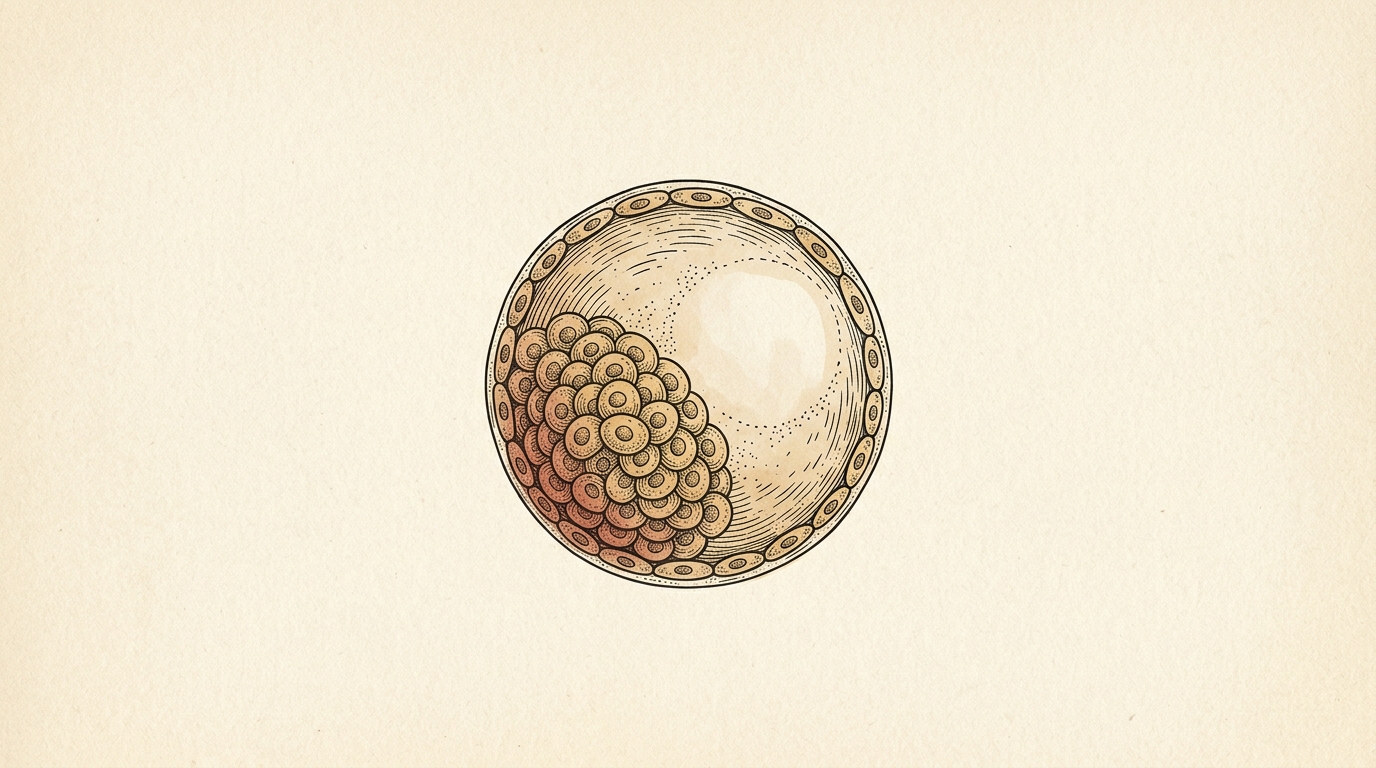
HOOK
0:22
01HOOK
In the first days of a life, a few cells can still become anything. Any tissue. Any organ. A whole body `F2`. One gene holds them there — poised, undecided, endlessly young. Its finders named it for a Celtic land where no one ever grows old `F1`. Nanog.
02THE NAME
Nanog sits near the top of chromosome 12 `F3`. It codes a transcription factor — a protein that switches other genes on and off `F4`. What it switches on is potential. Hold Nanog high, and a cell stays pluripotent: able to become any part of the body, though never the placenta around it `F5`. Let it fall, and the cell starts to choose.
03THE DISCOVERY (2003)
Nanog was found twice, in the same month. In 2003, two teams landed on it at once — one in Edinburgh, one in Kyoto `F6`. Edinburgh switched it on in mouse stem cells, and they renewed forever, free of the signal they usually need `F7`. Kyoto did the reverse. They deleted it, and the embryo never formed its epiblast — the cluster that becomes the body `F8`.
04THE CIRCUIT
A cell is not held young by Nanog alone. It works as one of three `F9`. Nanog, Oct4, and Sox2 lock into a circuit, each switching on the others, and the state itself `F9`. This is the core of pluripotency. Find these three together, and you have found a stem cell.
05REPROGRAMMING
That circuit did something no one expected. In 2006, Shinya Yamanaka ran a grown cell backward — skin into a stem cell, with a short list of factors `F10`. His famous four did not include Nanog `F11`. A year later, a second recipe reprogrammed human cells with a different set. This time, Nanog was in it `F12`. A handful of switches can rewind a life.
06THE 2026 TOOL
For twenty years, almost all we knew of Nanog in the embryo came from the mouse `F13`. The human embryo stayed nearly untouchable. Then, in 2026, a team in Cambridge reached it with a gentler tool. Not the molecular scissors of ordinary CRISPR, which cut both strands and can shatter a chromosome. Base editing rewrites a single letter, chemically, without a cut `F14`. The first time anyone read a gene this way in a human embryo `F15`.
07THE RESULT (hero)
They switched Nanog off in donated embryos, and watched. The placenta still formed. The yolk sac still formed `F16`. But the epiblast never did — the body's beginning, missing `F16`. Cells that should have built a body drifted into other fates `F16`. And here, human split from mouse. In mice, losing Nanog ruins more than the epiblast. In humans, the loss was cleaner, and stranger `F17`.
08THE OPEN THREAD
The embryos were surplus from IVF, donated with consent, grown just six days, then stopped `F18`. Nothing was implanted. Nothing was meant to be `F18`. The method is not a therapy. It is a way to ask the human embryo its own questions, one letter at a time `F19`. Most of those questions are still open.
09TIMELINE + SIGN-OFF
One gene, named for a land where no one grows old. It keeps a cell young enough to become us. From a mouse in 2003 to a human embryo read letter by letter — the same small switch, at the very start of a body. — The Gene Channel.
The write-up
In one line: NANOG is the master switch that keeps a cell pluripotent — able to become any tissue in the body. Named after a Celtic land of eternal youth, discovered twice in 2003, it sits at the heart of stem-cell science — and in 2026 became the first gene read inside a human embryo with single-letter base editing, which revealed that without it, the embryo builds a placenta and a yolk sac but never a body.
The gene
NANOG sits near the top of the short arm of chromosome 12 (band 12p13.31) and codes for a homeodomain transcription factor — a protein that binds DNA and switches other genes on and off. Its job is to hold a cell in the pluripotent state: able to give rise to any of the body's cell types (all three germ layers), though not the extra-embryonic tissue like the placenta — that would require totipotency. Keep NANOG high and a cell stays a blank slate; let it fall and the cell begins to commit to a fate.
The name is a small piece of poetry. Ian Chambers, who led the Edinburgh team, is Scottish, and named the gene after Tír na nÓg — the Celtic "land of the young," a mythic realm where no one ever grows old. It's a rare case of a gene's name capturing exactly what it does.
The discovery (2003) — found twice, from opposite directions
NANOG was described by two labs in the same May 2003 issue of Cell, back to back:
- Edinburgh (Ian Chambers, Austin Smith and colleagues) used functional expression cloning — a gain-of-function screen — and found that forcing Nanog on let mouse embryonic stem cells self-renew without limit, independently of the LIF/STAT3 signal they normally depend on. Nanog alone held them young.
- Kyoto (Kaoru Mitsui, Shinya Yamanaka and colleagues) came at it from loss-of-function: delete Nanog, and the mouse embryo fails to form its epiblast — the small cluster of pluripotent cells that becomes the body itself.
Two labs, one gene, opposite experiments — and the same conclusion from both ends: Nanog is what makes and keeps the pluripotent state.
Stem cells — the circuit, and the reprogramming trap
NANOG doesn't act alone. It works as one of three: NANOG, OCT4, and SOX2 form the core regulatory circuit of pluripotency (mapped genome-wide by Boyer et al., 2005), each activating the others and, together, the self-renewal program. Find those three burning together and you've found a stem cell.
That circuit powered one of biology's great surprises — cellular reprogramming. Here is the point most people get wrong:
- Shinya Yamanaka's original iPS cells (2006) were made from just four factors: Oct4, Sox2, Klf4, c-Myc (OSKM). NANOG was not among them. It was in the screen of candidate genes, but not in the minimal cocktail.
- A year later, James Thomson's group (Yu et al., 2007) reprogrammed human cells with a different four-factor set: OCT4, SOX2, NANOG, LIN28 — and here NANOG was one of the reprogramming factors.
So NANOG belongs to the Thomson human-iPSC recipe, not the Yamanaka one. Any sentence that says "Yamanaka used NANOG to reprogram cells" is simply wrong.
2026 — the first base edit inside a human embryo
For two decades, almost everything known about Nanog's role in the early embryo came from the mouse. The human embryo was nearly untouchable — precious, scarce, and easily damaged by blunt tools.
In June 2026, a Cambridge-led team (first author Oliver Bower, senior author Prof. Kathy Niakan), publishing in Nature, reached it with a gentler instrument. Ordinary CRISPR/Cas9 cuts both strands of DNA and can scramble whole chromosomes. Base editing instead converts a single DNA letter chemically, without a double-strand break — far less collateral damage. This was the first time base editing was used to study a gene's role in a human embryo. (It is not the first human-embryo edit at all — Niakan's own group knocked out OCT4 with CRISPR in 2016.)
The result: switch NANOG off, and the placenta (trophectoderm) and yolk sac (hypoblast) still form — but the epiblast, the founder tissue of the body, never does. The cells that should have become the body instead drift toward extra-embryonic fates. And crucially, the human differs from the mouse: in mice, losing Nanog disrupts more than the epiblast (the primitive endoderm too); in humans the loss is more specific — a reminder that our earliest developmental rules are our own.
The open thread
The embryos were surplus from IVF, donated with informed consent, cultured for about six days and then allowed to perish — under HFEA and research-ethics oversight, with nothing implanted. The method is not a therapy and was never aimed at making an edited baby. What it gives is something quieter and, arguably, more powerful: a precise way to ask the human embryo its own questions, one letter at a time. Most of those questions are still open.
Sources
Full claim-by-claim evidence is in references.md. Primary/authoritative anchors:
- Chambers I, et al. "Functional expression cloning of Nanog…" Cell 113:643-655 (2003). https://pubmed.ncbi.nlm.nih.gov/12787505/
- Mitsui K, et al. "The homeoprotein Nanog is required for maintenance of pluripotency…" Cell 113:631-642 (2003). https://pubmed.ncbi.nlm.nih.gov/12787504/
- NANOG gene (location 12p13.31): NCBI Gene 79923 — https://www.ncbi.nlm.nih.gov/gene/79923
- Boyer LA, et al. "Core Transcriptional Regulatory Circuitry in Human Embryonic Stem Cells." Cell 122:947-956 (2005). https://pmc.ncbi.nlm.nih.gov/articles/PMC3006442/
- Takahashi K, Yamanaka S. "Induction of Pluripotent Stem Cells… by Defined Factors." Cell 126:663-676 (2006). https://www.cell.com/fulltext/S0092-8674(06)00976-7
- Yu J, et al. (Thomson lab). "Induced Pluripotent Stem Cell Lines Derived from Human Somatic Cells." Science 318:1917-1920 (2007). https://www.science.org/doi/10.1126/science.1151526
- Bower OJ, et al. "Base editing reveals an essential role for NANOG in human embryogenesis." Nature (2026). doi:10.1038/s41586-026-10792-1 — https://www.nature.com/articles/s41586-026-10792-1 ; Cambridge summary — https://www.cam.ac.uk/research/news/first-use-of-precision-editing-to-study-human-embryo-development-reveals-role-of-master-gene
Accuracy note: two commonly-confused points are kept straight on purpose. (1) NANOG is not a Yamanaka factor — the 2006 OSKM cocktail is Oct4/Sox2/Klf4/c-Myc; NANOG is in the Thomson 2007 human set (Oct4/Sox2/Nanog/Lin28). (2) The 2026 "first" is scoped to base editing to study gene function in a human embryo — not the first human-embryo edit (CRISPR/OCT4, 2016). The 2026 finding is one of mis-specification (epiblast cells switch to other fates), not simply that the other tissues are spared.
The evidence
Every claim, sourced
Each [F#] you hear in the film links to the source it came from. Nothing gets narrated until every one is checked and signed off.
Sign-off
- PhD sign-off — facts above are correct; the "traps" (Yamanaka-vs-Thomson factors; "first base editing" scope; mis-specification vs sparing; species difference) are stated correctly in
script.md. - Any numbers/dates verified (2003 · 2006 · 2007 · 2026; chr 12p13.31; ~6.5 days) or narration kept qualitative.
On sign-off → run `gen-narration.mjs` (the gate opens). Then assets → Video.tsx → render → `writeup.md`.
- F1
The gene is named after Tír na nÓg, the Celtic/Gaelic land of the ever-young; the name was coined by the Edinburgh group (Ian Chambers).
Chambers, being Scottish, chose the name after the Tír na nÓg legend ("Land of the Young"). Eternal youth is the mythic property of the place; literal Gaelic = "land of the young."
- F2
In the early embryo a few cells can still become any tissue/organ of the body (pluripotency).
Pluripotent cells give rise to all three germ layers → every adult cell type.
- F3
NANOG sits near the top (short arm) of chromosome 12.
Human NANOG, cytoband 12p13.31, NCBI Gene ID 79923.
- F4
NANOG codes a transcription factor — a protein that switches other genes on/off.
NANOG is a (divergent, NK-2-type) homeodomain transcription factor; Mitsui 2003 title: "The homeoprotein Nanog."
- F5
Pluripotent = can build any part of the body but not the placenta (that would be totipotent).
Standard developmental-biology distinction: pluripotent (three germ layers, no extra-embryonic/trophectoderm) vs totipotent (embryo + placenta).
- F6
Discovered twice in 2003 — two teams, one in Edinburgh, one in Kyoto — same journal issue.
Back-to-back in Cell 113(5), 30 May 2003: Chambers/Smith (Edinburgh) pp.643-655; Mitsui/Yamanaka (Kyoto) pp.631-642. Co-discoverers, simultaneous — don't imply one "came first."
- F7
Edinburgh forced Nanog ON in mouse ES cells → self-renewal without the usual signal.
Functional expression cloning: Nanog overexpression sustains ES-cell self-renewal independently of LIF/STAT3 (gain-of-function).
- F8
Kyoto deleted Nanog → mouse embryo fails to form the epiblast.
Loss-of-function: Nanog-null mouse embryos lack epiblast / lose pluripotency at implantation.
- F9
Nanog works with Oct4 and Sox2 as a mutually-reinforcing core circuit of pluripotency.
ChIP genome-scale: OCT4/SOX2/NANOG co-occupy shared targets, form auto- and feed-forward loops = core regulatory circuitry of human ES cells.
- F10
In 2006 Yamanaka reprogrammed a grown cell into a stem cell with a short list of factors (iPSCs).
Takahashi & Yamanaka: mouse fibroblasts → induced pluripotent stem cells by defined factors.
- F11
Trap: Yamanaka's four factors did NOT include Nanog.
The 2006 set = Oct4, Sox2, Klf4, c-Myc (OSKM). Nanog was among 24 candidates screened but is not in the minimal cocktail.
- F12
A year later a different human-iPSC recipe DID include Nanog.
Thomson lab (Yu et al. 2007): human iPSCs from OCT4, SOX2, NANOG, LIN28. NANOG is in the Thomson set, absent from Yamanaka's.
- F13
For ~20 years most of what we knew about Nanog in the embryo came from the mouse; the human embryo stayed nearly untouchable.
Prior functional Nanog embryo data were mouse (Mitsui 2003 etc.); the 2026 work is framed as the first functional base-edit study of a gene in the human embryo.
- F14
Base editing rewrites a single DNA letter chemically, without cutting both strands (unlike CRISPR/Cas9).
Base editing (adenine base editor) converts one base to another with no double-strand break → far lower risk of chromosomal damage than Cas9 cutting.
- F15
First use of base editing to study a gene's role in a human embryo (Cambridge, 2026).
Bower et al., "Base editing reveals an essential role for NANOG in human embryogenesis." Note: first base editing to study gene function in human embryos — not the first-ever human-embryo edit (Niakan's OCT4 CRISPR was 2016). Senior author Kathy Niakan; first author Oliver Bower.
- F16
With Nanog off: placenta and yolk sac still formed, but the epiblast did not; cells that should have become the body took other fates.
NANOG-disrupted human embryos: trophectoderm (placenta) & hypoblast (yolk sac) still specify, but epiblast fails — cells mis-specify toward extra-embryonic transcriptional programmes.
- F17
Human differs from mouse: mouse Nanog loss wrecks more than the epiblast; the human effect was more specific.
Mouse Nanog loss disrupts epiblast and primitive endoderm; in human it is more specific to the epiblast — a genuine species difference in early lineage wiring.
- F18
Embryos were surplus IVF, donated with consent, grown ~6 days then stopped; none implanted.
Unused IVF embryos donated by couples; cultured to ~6.5 days post-fertilisation then allowed to perish; regulated by HFEA + research ethics committee; not for reproductive use.
- F19
The method is a research tool (not a therapy) for asking precise questions of the human embryo; much remains unknown.
Framed by the authors as basic-research capability to probe human embryo gene function, with implications for fertility/development understanding — not clinical embryo editing.