MSTN
The Brake
A bull with the muscle of two. A dog that outruns its breed. A child stronger than any child should be — all from the same silenced gene, whose job was never to build muscle, but to stop you building too much.
The walkthrough
Beat by beat
HOOK
0:28
01HOOK
This is what one silenced gene can do. A bull with the muscle of two. A dog that outruns its breed. A child stronger than any child should be. Different species — the same broken gene `F1`. Its job was never to build muscle. It was to stop you building too much.
02THE NAME
The gene is MSTN — it makes a protein called myostatin, on chromosome 2 `F2`. And it does something backwards: your muscles make myostatin, and it travels back to the muscle with one order — stop growing `F3`. Myostatin isn't the engine. It's the brake.
03THE HUNT
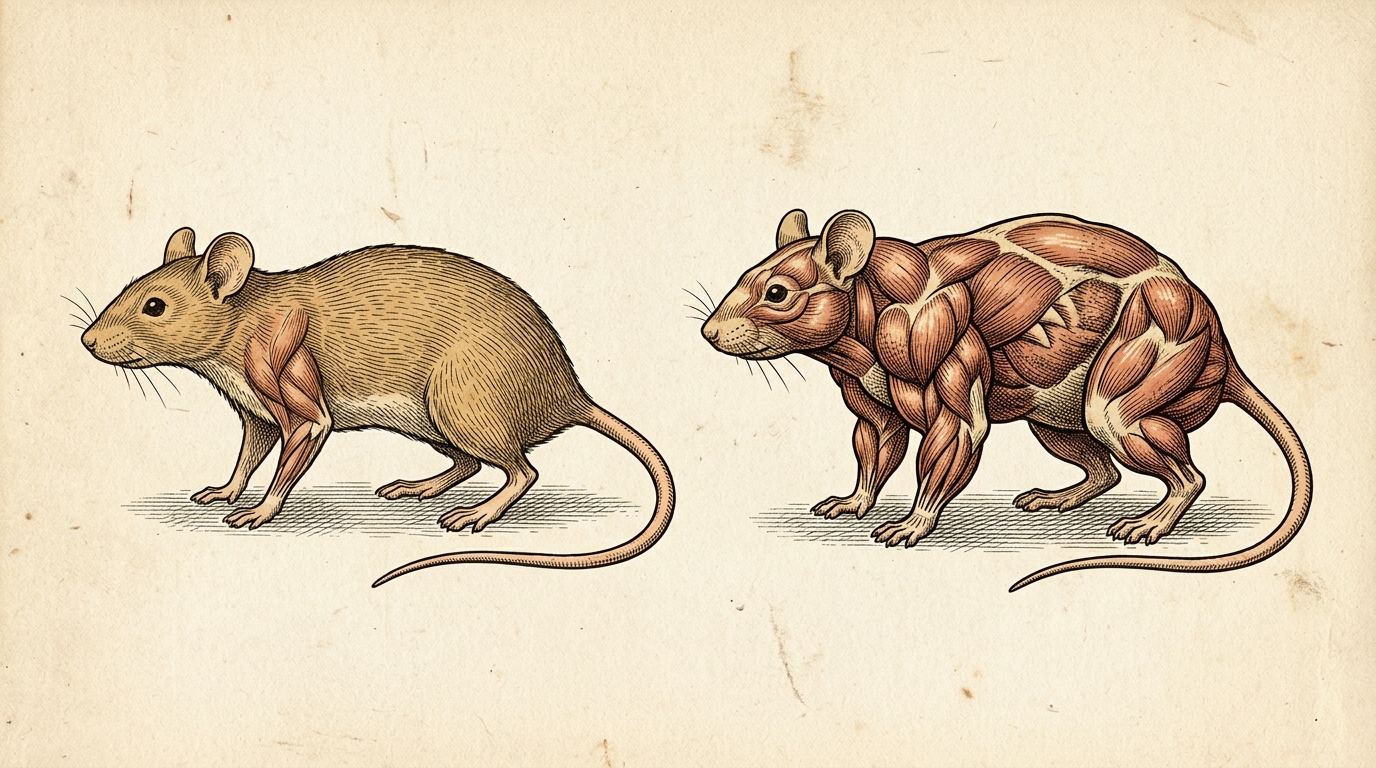
We learned this almost by accident, in 1997. At Johns Hopkins, Alexandra McPherron and Se-Jin Lee deleted the gene in mice — and the mice grew muscles two to three times normal size `F4`. The press called them mighty mice. Take off the brake, and muscle just keeps going.
04NATURE'S EXPERIMENT I
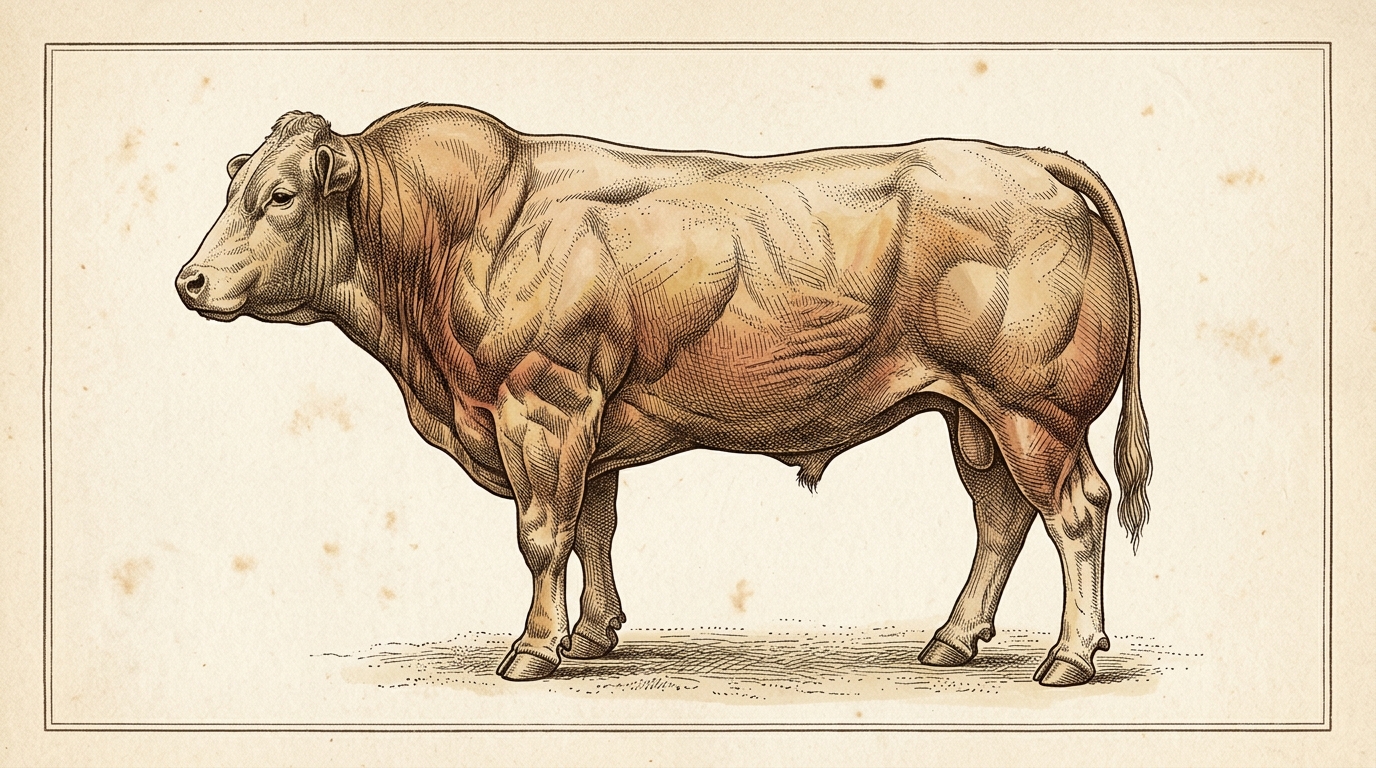
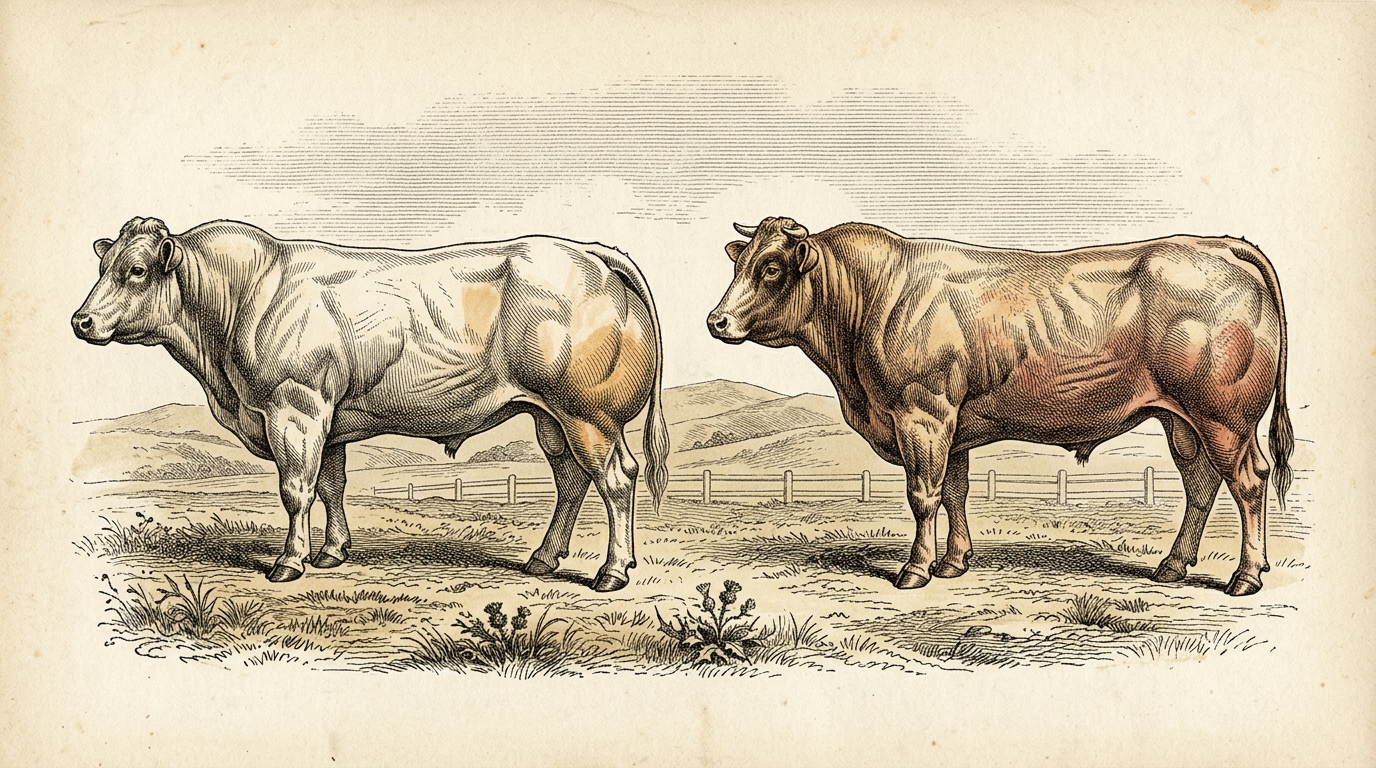
But nature had already run the experiment. For a century, farmers bred two kinds of cattle — the Belgian Blue and the Piedmontese — rippling with muscle. They call it double-muscling `F5a`. The cause: a broken myostatin gene. In the Belgian Blue, eleven letters of DNA, simply deleted `F5b`.
05NATURE'S EXPERIMENT II
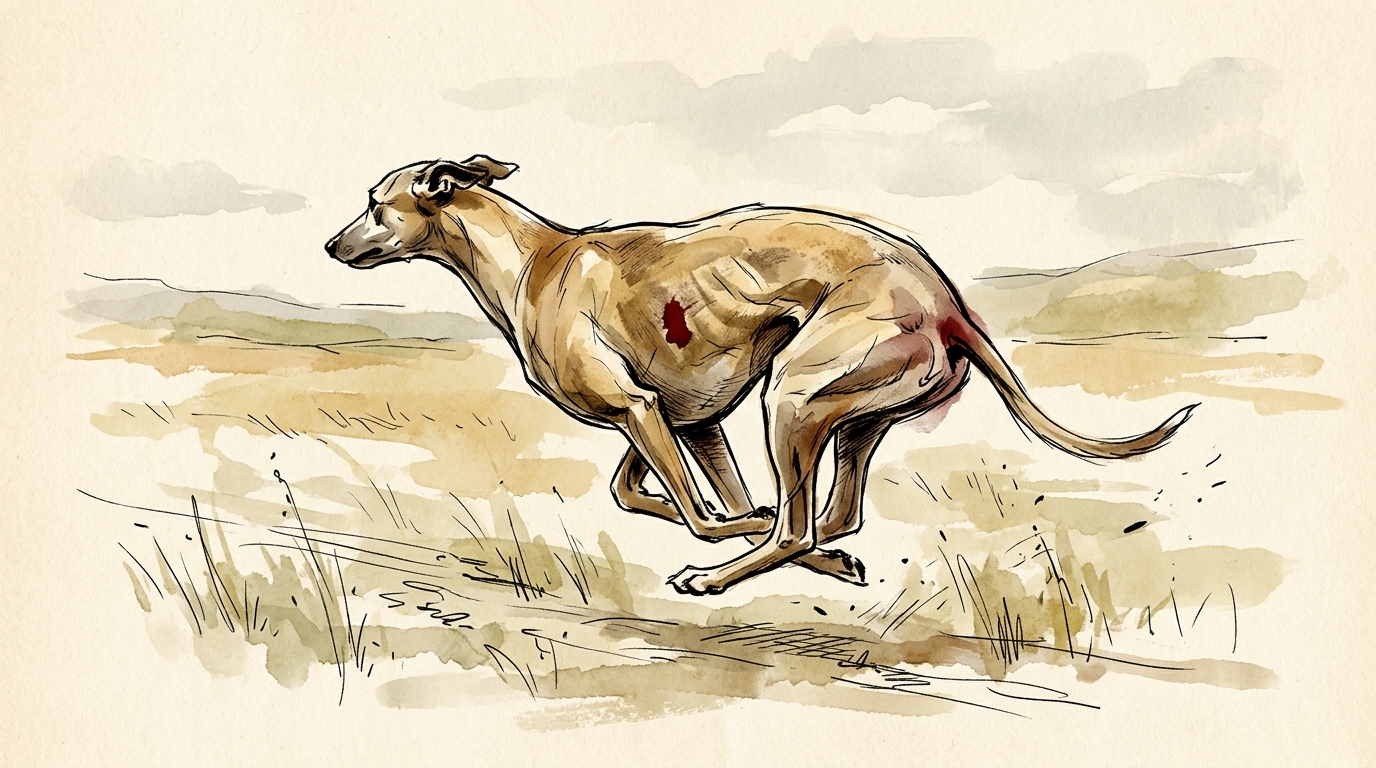
Then the dogs. Whippets are bred to race — and a few carry one broken copy of myostatin. Those dogs aren't just more muscular; they're measurably faster, crowding the top of the rankings `F6a`. Inherit two broken copies, and you get a bully whippet — too overgrown to fit the breed `F6b`.
06THE HUMAN
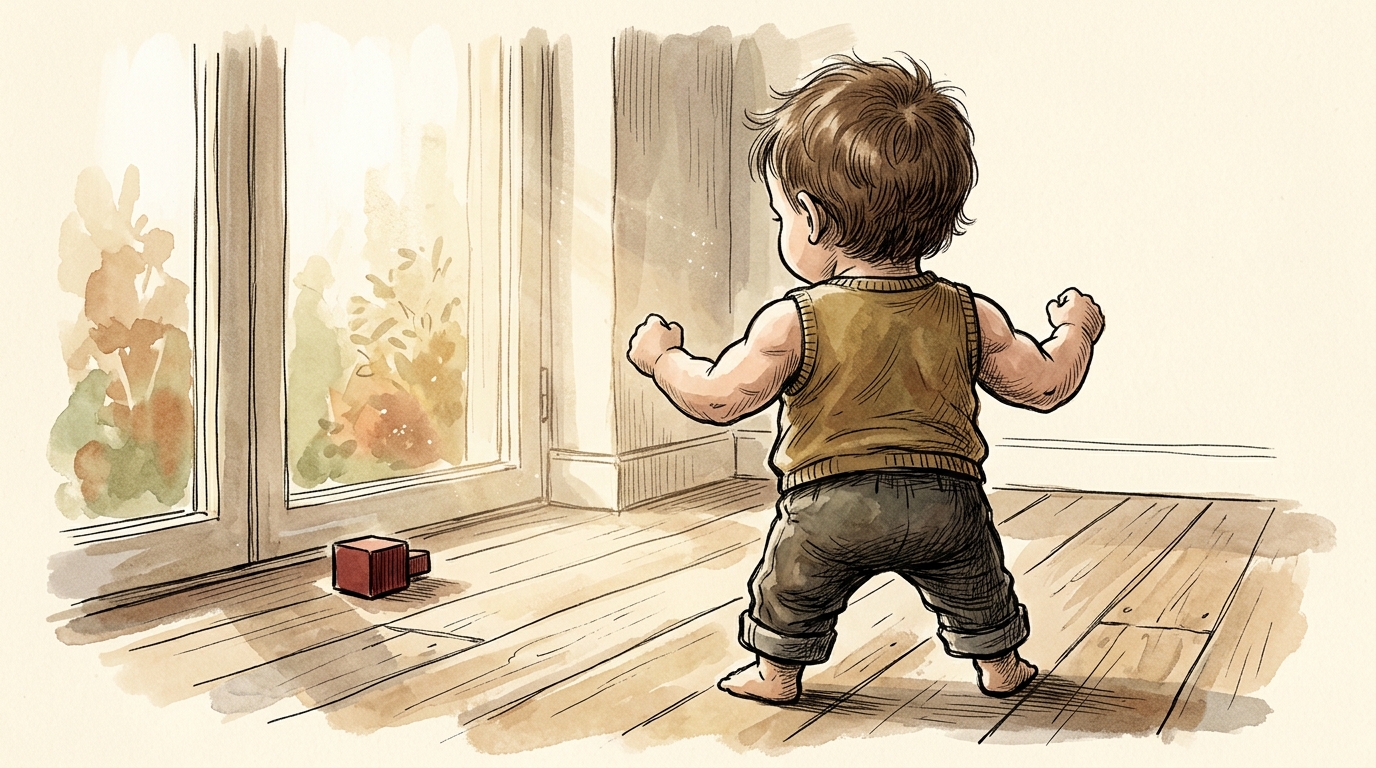
And then — a person. In 2004, doctors in Germany described a baby boy born extraordinarily muscular `F7a`. By age four he could hold a three-kilogram weight in each outstretched arm — a healthy, unusually strong child `F7b`. He carried two broken copies; his mother, a former athlete, one `F7c`. The tabloids called it the Hercules gene `F7d`.
07THE MECHANISM (hero)
So how does one missing protein do all this? Myostatin is a chemical messenger `F8a`. It docks onto a receptor on the muscle cell `F8b` and trips a relay inside — telling the muscle's own stem cells to hold back `F8c`. Cut the gene, and that stop is never sent. So the muscle builds more fibers — and makes each one bigger `F8d`.
08THE BET
Which raises a question. If turning this gene off builds muscle in the healthy — could blocking it rescue muscle in the sick? That became one of the great bets in muscle medicine. Against muscular dystrophy, spinal muscular atrophy, the wasting of age — drugmakers built antibodies to neutralize myostatin `F9`.
09THE OPEN THREAD
And it has been humbling. The drugs do what they promise — they add muscle. But again and again, that muscle hasn't become real-world strength, or function `F10`. The best case — a blocker for spinal muscular atrophy — showed real benefit in trials, yet as of 2026 still awaits approval. No myostatin drug has crossed the line `F11`.
10TIMELINE + SIGN-OFF
From mighty mice to double-muscled bulls to one uniquely strong boy, the lesson repeats: the body keeps a brake on its own strength — and we're still learning what it costs to let go. — The Gene Channel.
The write-up
In one line: MSTN makes myostatin — a protein your muscles release to tell themselves to stop growing; switch the gene off and muscle runs away with itself, which is why a single broken gene turns up in super-muscled cattle, faster dogs, and an extraordinarily strong child — and why "blocking the brake" is one of the biggest, and most humbling, bets in muscle medicine.
The gene
MSTN — also written GDF8 (growth/differentiation factor 8) — sits on the long arm of chromosome 2, at 2q32.2. It codes for myostatin, a small secreted protein of the TGF-β superfamily. The counterintuitive part is the direction it works in: muscle cells make myostatin, release it, and it acts straight back on muscle to limit how much it grows. Myostatin isn't the engine of muscle — it's the brake. (This is the trap the whole episode is built to state correctly: losing myostatin increases muscle.)
The hunt
The brake was found by removing it. In 1997, Alexandra McPherron, Ann Lawler, and Se-Jin Lee at Johns Hopkins deleted the gene in mice; the knockout animals grew individual muscles two to three times normal size — through a combination of hyperplasia (more fibres) and hypertrophy (bigger fibres) — and the press dubbed them the "mighty mice." Nature, it turned out, had run the experiment already. The same year, McPherron and Lee showed that two famously "double-muscled" cattle breeds carry inactivating myostatin mutations: the Belgian Blue an 11-nucleotide deletion that wrecks the protein, the Piedmontese a missense change to an invariant cysteine. In 2007, Dana Mosher and colleagues found a 2-bp deletion in the whippet: dogs with one broken copy are more muscular and measurably faster racers, while two copies produce a grossly over-muscled "bully whippet." And in 2004, Markus Schuelke's team in Germany described a baby boy, born extraordinarily muscular, homozygous for a myostatin splice mutation — strong (he held a 3-kg weight in each outstretched arm by age four) and, at the time of report, healthy. The tabloids called it the "Hercules gene."
The mechanism
Myostatin is a signalling messenger. It binds the activin type-II receptor (ActRIIB) on the muscle-cell surface; that recruits a type-I receptor and trips an intracellular relay — the SMAD2/3 pathway — which holds the muscle's own stem cells (satellite cells) and its growth programs in check. Knock out the gene and that "stop" is never sent, so muscle does two things at once: it forms more fibres and makes each one bigger. The same logic explains every animal above — different DNA lesions, one disabled brake.
The stakes, and the frontier
If turning the gene off builds muscle in the healthy, could blocking myostatin rescue muscle in the sick? That became one of the great bets in muscle medicine — antibodies, ligand/receptor traps, and gene therapies aimed at Duchenne muscular dystrophy, spinal muscular atrophy, and age-related wasting (sarcopenia/cachexia). The results have been humbling. The drugs reliably add muscle — but again and again, that extra muscle hasn't translated into real-world strength or function (Pfizer's domagrozumab, for example, increased muscle volume on MRI in DMD yet missed its stair-climb endpoint). The most encouraging case is apitegromab for SMA, which showed genuine functional benefit in the Phase 3 SAPPHIRE trial — but as of 2026 no myostatin-targeting drug has been approved (apitegromab's 2025 setback was a manufacturing-facility issue, not its efficacy data; it was resubmitted in 2026). The biology is vivid and proven; turning it into medicine is the open thread.
Sources
Full claim-by-claim evidence is in references.md. Primary anchors:
- McPherron, Lawler & Lee 1997, Nature 387:83 — myostatin (GDF8) knockout mice; muscles 2–3× via hyperplasia + hypertrophy.
- McPherron & Lee 1997, PNAS 94:12457 — double-muscling in Belgian Blue (11-nt deletion) and Piedmontese (missense) cattle.
- Mosher et al. 2007, PLoS Genetics 3(5):e79 — whippet 2-bp MSTN deletion; heterozygotes faster, homozygotes "bully."
- Schuelke et al. 2004, NEJM 350:2682 — homozygous MSTN mutation, gross muscle hypertrophy in a child.
- NCBI Gene 2660 / OMIM 601788 — MSTN locus 2q32.2; myostatin a TGF-β-family negative regulator of muscle mass.
- Wagner et al. 2020, Neuromuscul Disord — domagrozumab adds muscle but misses the DMD functional endpoint; Scholar Rock 2025–26 — apitegromab SAPPHIRE result and pending FDA status.
Accuracy note (the traps the fact-gate caught): (1) Direction of effect — myostatin is a brake; losing it increases muscle (the episode never calls it "the gene that builds muscle"). (2) No approval yet — as of 2026 no myostatin drug is approved; narration stays "still awaits approval." (3) Whippet dose — one broken copy = faster racer, two = "bully whippet." (4) The child — only what NEJM reported (strong and healthy at the time); no lifelong claims. (5) "Hercules gene" is a popular nickname, not an official term.
The evidence
Every claim, sourced
Each [F#] you hear in the film links to the source it came from. Nothing gets narrated until every one is checked and signed off.
Sign-off
- Facts checked against primary/authoritative sources (Nature 1997, PNAS 1997, PLoS Genet 2007, NEJM 2004, NCBI/OMIM, Scholar Rock/FDA, peer-reviewed reviews). All five ⚠️ traps stated correctly in
script.md. (Claude, 2026-06-14.) - Direction of effect kept correct throughout: myostatin is a brake; losing it increases muscle.
- Drug status kept qualitative ("pending / not yet approved") — no claim of approval. Re-verify F11 status the day narration is locked.
- "Hercules gene" framed as a popular nickname, not an official term.
- User length sign-off on the extended (~4 min) cut — approved 2026-06-14 (all 10 beats; cattle and dogs kept as separate exhibits, therapy split into bet + humbling-result).
**Gate OPEN** → narration + assets + render may proceed.
- F1
One gene, switched off, produces enormous muscle across species — super-muscled cattle, faster/over-muscled dogs, and an extraordinarily strong child all trace to the same broken gene
Loss-of-function of MSTN → muscle overgrowth is documented in mice, cattle, sheep, dogs, and humans
- F2
The gene is MSTN (myostatin; alias GDF8) and sits on chromosome 2 (2q32.2)
NCBI Gene ID 2660, cytogenetic location 2q32.2; OMIM *601788
- F3⚠ commonly confused
Muscle makes myostatin and releases it; it acts back on muscle with one instruction — stop growing. It's a brake (a negative regulator of muscle mass)
"a myokine … produced and released by myocytes and acts on muscle cells to inhibit muscle growth"; a TGF-β superfamily member essential for proper regulation of skeletal-muscle mass
- F4
1997: McPherron & Lee (Johns Hopkins) deleted the gene in mice → individual muscles 2–3× normal ("mighty mice"), from hyperplasia + hypertrophy
"Individual muscles of mutant animals weighed 2 to 3 times more … increase in mass appeared to result from a combination of muscle cell hyperplasia and hypertrophy"; GDF-8, 376-aa, TGF-β superfamily
- F5a
Belgian Blue and Piedmontese cattle are famously "double-muscled"
Two breeds with increased muscle mass relative to conventional cattle, both carrying MSTN mutations
- F5b
The cause is a broken myostatin gene — Belgian Blue carry an 11-nucleotide deletion (exon 3) that destroys the active protein; Piedmontese a missense (Cys→Tyr)
"Belgian Blue … contains an 11-nucleotide deletion in the third exon … eliminates virtually all of the mature, active region"; "Piedmontese … missense mutation … substitution of tyrosine for an invariant cysteine"
- F6a⚠ commonly confused
Whippets: dogs with one broken copy are more muscular and significantly faster racers (over-represented among top grades)
"Individuals carrying only one copy … are, on average, more muscular (p = 7.43×10⁻⁶) and are significantly faster than … wild-type in competitive racing (τ = 0.3619; p ≈ 0.00028)"
- F6b⚠ commonly confused
Two broken copies → a grossly over-muscled "bully whippet" (no health problems reported beyond shoulder/thigh cramping)
"two copies of a two-base-pair deletion in the third exon … premature stop at aa 313 … grossly over-muscled 'bully'"; "do not have any health abnormalities other than muscle cramping in the shoulder and thigh"
- F7a
2004: doctors in Germany described a baby boy born extraordinarily muscular (verified by ultrasound at 6 days)
"appeared extraordinarily muscular, with protruding muscles in his thighs and upper arms … verified by ultrasonography … at 6 days"
- F7b⚠ commonly confused
By ~4.5 yr he had increased bulk and strength — held a 3-kg weight in each outstretched arm; healthy at the time
"At age 4.5 years … able to hold two 3-kg dumbbells in horizontal suspension with his arms extended"
- F7c
He carried two broken MSTN copies (homozygous splice mutation, g.IVS1+5 G→A); his mother — a former professional athlete — carried one
"homozygous … guanine-to-adenine transition at g.IVS1+5 … may lead to missplicing. His mother was heterozygous"; mother a former professional sprinter
- F7d
Popular press nicknamed MSTN the "Hercules gene"
Media/popular nickname (not an official designation) — used in coverage of the Schuelke case and athletic-genetics reporting
- F8a
Myostatin is a secreted TGF-β-family signaling molecule
"a secreted growth differentiation factor … member of the TGF-β protein family"
- F8b
It docks onto a receptor on the muscle cell (activin type-II receptor, ActRIIB)
Myostatin signals through the activin type-II receptor (ActRIIB) → type-I receptor (ALK4/5)
- F8c
…which trips an internal relay (SMAD2/3) that holds muscle growth in check
Activated SMAD2/3 represses muscle differentiation/growth programs
- F8d
Cut the gene and the "stop" is never sent → muscle makes more fibers and bigger fibers
Loss of myostatin → hyperplasia + hypertrophy (mouse)
- F9
Because it's a brake, blocking myostatin is being tested to rescue muscle in muscular dystrophy, spinal muscular atrophy, and age-related wasting — via antibodies and gene therapies
Myostatin inhibition (antibodies, ligand/receptor traps, follistatin gene therapy) pursued across DMD, SMA, sarcopenia/cachexia, and metabolic disease
- F10
Results have been humbling: the drugs reliably add muscle but have repeatedly failed to improve strength/function (e.g., Pfizer's domagrozumab in DMD)
Domagrozumab phase 2 (DMD): MRI muscle-volume gain, but no effect on the 4-stair-climb primary endpoint (Δ 0.27 s, p = 0.94) or any secondary clinical endpoint
- F11⚠ commonly confused
The most encouraging case — a myostatin blocker for SMA (apitegromab) — showed real benefit in a large trial, yet as of 2026 still awaits approval; no myostatin drug has been approved
Apitegromab Phase 3 SAPPHIRE hit the HFMSE endpoint; FDA Complete Response Letter Sept 2025 (third-party fill-finish facility only, not efficacy/safety); resubmitted Mar 2026, approval anticipated 2026