MLH1
The Spell-Checker
Your cells run a spell-checker over every fresh copy of your DNA. Inherit one broken copy of the gene that coordinates it — MLH1 — and the typos pile up until a cell turns cancerous. It's called Lynch syndrome; about 1 in 300 people carry it, and it's one of the few inherited cancers you can see coming: surveillance, aspirin, an immunotherapy that turns the defect into a target — and now the first trial of a vaccine to stop the cancer before it starts.
The walkthrough
Beat by beat

HOOK
0:31
01HOOK
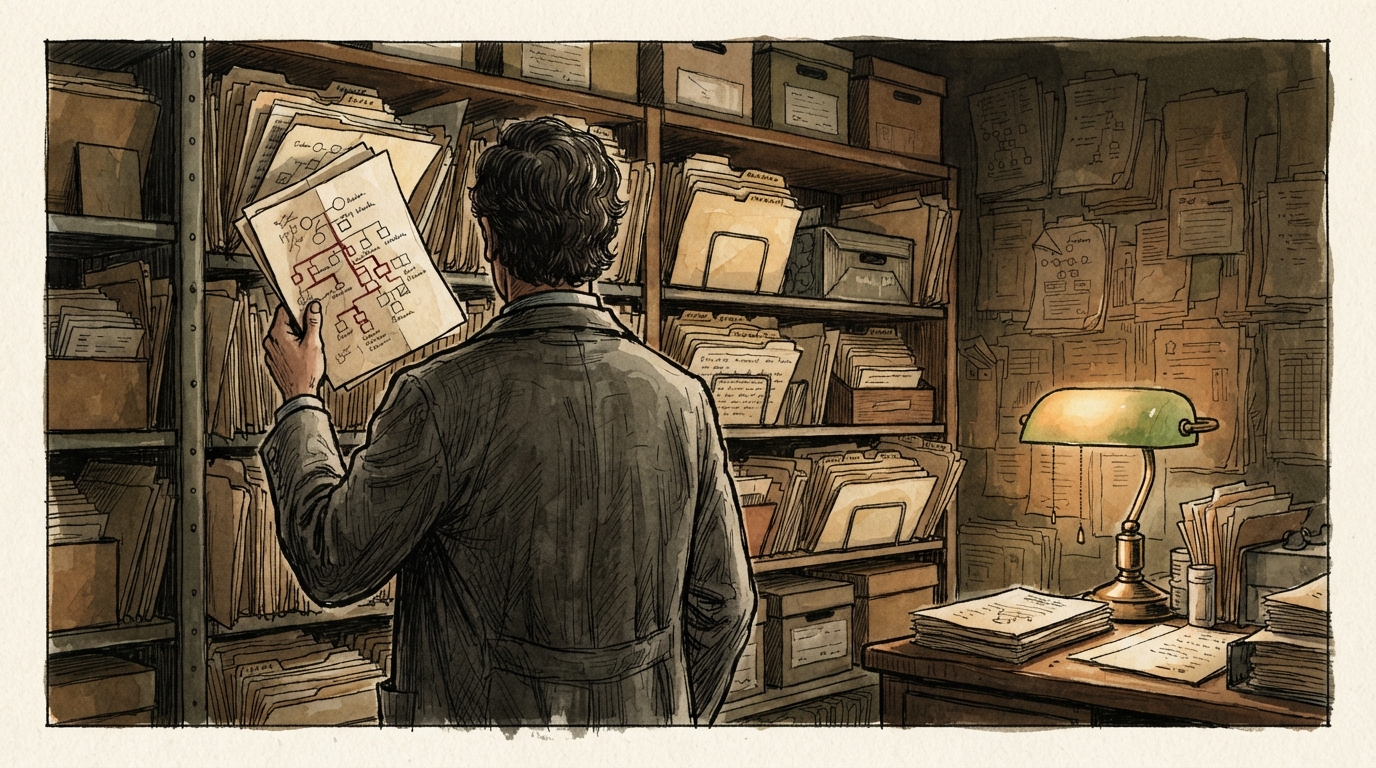
Lynch syndrome hides in about one in three hundred people. Most who carry it have never heard of it. F4 Yet they carry a mutation in every cell of the body. One that sharply raises the risk of colorectal and endometrial cancer, often decades early. F3 And most of those cancers are preventable. If you know to look. Lynch isn't one gene. It's a small family of them. This is the story of one: MLH1. F4
02THE NAME
MLH1 sits on chromosome three. F1 It builds half of a molecular machine called MutLα, which works quietly inside every dividing cell, checking freshly copied DNA. F1 Its job: find the typos your copying machinery leaves behind, and fix them before they turn permanent. F1F2 Think of it as the genome's spell-checker.
03THE HUNT
The families were hiding in plain sight. In 1966, a Nebraska physician named Henry Lynch found families where cancer struck generation after generation. Colon, uterus, stomach. A pattern nothing like chance. F5 He called it Cancer Family Syndrome. For years, few believed him. F5 Then, in 1994, two teams at once pinned down the gene at its center: MLH1. F6
04THE PROOF
MLH1 is a classic tumor suppressor. F11 One working copy is usually enough. But in Lynch syndrome, one copy is already broken in every cell, inherited from a parent. F11 Then, in a single cell, the second copy fails by chance. F11 Two hits. Both copies gone. In that one cell, the spell-checker is off. Errors begin to pile up. F2F11
05HOW THE SPELL-CHECKER WORKS (hero 1)
Every division copies three billion base pairs. DNA polymerase is fast, and usually accurate. But it slips. It stutters at a run of repeated letters and adds an extra one. F1F2 Left uncorrected, that error turns permanent on the next copy. First, the detector. The MSH2–MSH6 pair slides along the new strand, feeling for the bulge where a base doesn't fit. It clamps the mismatch, and calls for backup. F1 That is MLH1's cue. It arrives with PMS2 as MutLα, nicks the faulty strand, and brings in an enzyme that chews it back past the mistake. F1 Polymerase refills the gap, correctly this time. F1 MLH1 never spots the typo itself. It coordinates the crew that fixes it. F1
06WHAT LOSING THE SPELL-CHECKER DOES (hero 2)
Now switch the spell-checker off. F11 The mismatches accumulate. They pile up fastest at microsatellites, short stretches where the same few letters repeat. Without MLH1, those repeat lengths drift, different in every division. F2 That drift has a name. Microsatellite instability. MSI. F2 And some microsatellites sit inside other genes. Picture a growth-control gene with a run of repeats in its middle. One extra letter slips in. The reading frame shifts. The protein comes out broken, and the brake on growth is gone. F2 Now the cell divides unchecked. This is the cancer. Not one dramatic mutation. An avalanche of small ones, in the very genes meant to stop it. F2
07THE STAKES
Lynch syndrome is not a sentence. It is a raised lifetime risk. F3 Left untracked, about half of MLH1 carriers develop colorectal cancer, and roughly a third of women develop endometrial cancer, often decades early. F3 About one in three hundred people carry a Lynch mutation, and most have no idea. F4 Undiagnosed, the risk is invisible. Diagnosed, it is mostly manageable. F3
08INTERVENTION 1: SURVEILLANCE
If you know you carry MLH1, three things can change the outcome. First: a colonoscopy, every year or two, starting young. F7 In a fifteen-year study of Lynch families, not one person under regular surveillance died of colorectal cancer. Among the group that declined, nine did. F7 The scope finds the polyp and removes it before it ever becomes cancer. F7
09INTERVENTION 2: ASPIRIN
Second: aspirin. In a randomised trial of 861 Lynch carriers, a daily aspirin regimen taken for at least two years cut colorectal cancer roughly in half, with protection still visible ten years on. F8 This is a specific dose, run under a doctor, not the low-dose tablet on a shelf. F8 How it works is still being studied. But in the trial, the effect was real. F8
10INTERVENTION 3: THE REVERSAL
Third is the reversal. F9 If a Lynch cancer does develop, it carries a strange weakness. Because repair was broken, the tumor fills with hundreds of garbled proteins. Every one is foreign, a flag the immune system can read. F9 It is already circling. The tumor survives only by slipping its leash, through a checkpoint called PD-1. Drugs like pembrolizumab cut that leash. F9 In 2017, the FDA approved one for any microsatellite-unstable tumor, anywhere in the body. The first cancer drug ever cleared on a molecular signature alone, not the organ it grew in. F10 The defect that caused the cancer is what makes it treatable. The spell-checker is off. But the immune system can read the typos. F9F10
11THE FRONTIER: A VACCINE
There may soon be a fourth. F12 Here is the strange gift of Lynch syndrome. Those garbled proteins are largely the same from patient to patient. The typos are shared. F12 So you don't need a custom vaccine for each person. You can build one off the shelf and give it to a carrier who is still healthy, teaching the immune system the flags before any tumor exists. F12F13 In 2026, the first trial in healthy carriers reported. Forty-five people, none of them sick, vaccinated against two hundred and nine shared frameshift proteins. Nearly every one built a durable immune response, safely. F13 Nothing is approved yet, and prevention is still being tested. F13 But the idea is startling. A cancer vaccine meant not to treat a tumor, but to keep one from ever forming. F12F13
12RECAP + FOUNDATION SIGN-OFF
Sixty years. From families in Nebraska with no explanation, to a gene, to a mechanism, to a drug approved on that mechanism alone. F5F6F10 The families built the registries. The families funded the awareness. AliveAndKickn: built by patients, for patients, widening the reach of Lynch syndrome screening. Found in a clinic. Named by families. Find them at aliveandkickn.org. — The Gene Channel.
The write-up
In one line: MLH1 builds half of the cell's DNA proofreader; inherit one broken copy and you carry Lynch syndrome — one of the most common hereditary cancer predispositions, one of the most preventable, and now the target of a first-of-its-kind preventive vaccine.
The gene
MLH1 sits on chromosome 3, at 3p22.2. It encodes the larger subunit of MutLα, a protein pair (with PMS2) that coordinates DNA mismatch repair — the system that proofreads a freshly copied strand and corrects the typos DNA polymerase leaves behind. MLH1 is one of a small family of mismatch-repair genes behind Lynch syndrome (alongside MSH2, MSH6, PMS2, and EPCAM); about one in three hundred people carry a Lynch variant, and most have no idea.
One point worth keeping straight: MLH1 is the coordinator, not the detector. The MSH2–MSH6 pair (MutSα) slides along the new strand and clamps the mismatch; only then is MLH1–PMS2 (MutLα) recruited to nick the strand and call in the exonuclease that removes the error.
The hunt
Beginning in 1966, Henry Lynch, a physician in Nebraska, documented families in which colon, uterine, and stomach cancers clustered across generations. He called it Cancer Family Syndrome, and for years the field was skeptical. The genes came later: MSH2 was cloned first, in December 1993, and three months on, in March 1994, two teams — one at Johns Hopkins, one a broad consortium — independently pinned down a second, MLH1. (MSH2 preceded it; MLH1 was not "the first Lynch gene.")
The mechanism
Every division copies three billion base pairs. Polymerase is fast but it slips, especially at microsatellites — short runs where the same few letters repeat. Normally repair catches each slip: MutSα detects, MutLα coordinates the excision, and polymerase refills correctly. Lose MLH1 — the classic two hits, one copy inherited broken and the other lost in a single cell — and the proofreader goes dark. Errors then pile up fastest at those microsatellites, whose lengths drift from cell to cell: microsatellite instability (MSI). When that drift lands inside a coding microsatellite in a growth-control gene, the reading frame shifts and the protein comes out truncated. The brake is gone, and the cell divides unchecked. The cancer here isn't one dramatic mutation; it's an avalanche of small ones, landing in exactly the genes meant to prevent it.
The stakes, and the frontier
Lynch syndrome is a predisposition, not a verdict. Left untracked, roughly half of MLH1 carriers develop colorectal cancer and about a third of women develop endometrial cancer, often decades earlier than these cancers usually appear. But it is among the most manageable hereditary cancer risks known, and the interventions stack:
- Surveillance. A colonoscopy every one to two years, removing polyps before they turn. In a controlled 15-year study of Lynch families, none of the 133 people under regular surveillance died of colorectal cancer; nine of those who declined did.
- Aspirin. In the CAPP2 randomised trial (861 carriers), a daily aspirin regimen taken for at least two years roughly halved colorectal cancer, with protection still visible at ten years. It is a specific dose taken under a doctor — not the low-dose tablet on a pharmacy shelf.
- Immunotherapy — the reversal. Because repair was broken, a Lynch tumor fills with frameshift neoantigens: hundreds of garbled proteins the immune system reads as foreign. Pembrolizumab blocks the PD-1 checkpoint that holds the T-cell back, and in 2017 it became the first cancer drug ever approved on a molecular signature alone, regardless of the organ it grew in.
- A vaccine — the frontier. Those neoantigens are largely shared across patients, which makes an off-the-shelf, preventive vaccine feasible. In 2026 the first trial in healthy carriers reported: 45 people vaccinated against 209 shared frameshift proteins, nearly all of whom built a durable immune response, safely. Nothing is approved yet and prevention is still being tested — but the aim is startling: a cancer vaccine meant not to treat a tumor, but to keep one from ever forming.
This episode spotlights AliveAndKickn (aliveandkickn.org), a patient-built foundation advancing Lynch syndrome research, education, and screening.
Sources
Full claim-by-claim evidence is in references.md. Primary anchors:
- Function & mechanism: GeneReviews "Lynch Syndrome" (NCBI Bookshelf NBK1211); Jiricny, Nat Rev Mol Cell Biol 2006.
- Discovery: Lynch et al., Arch Intern Med 1966; Papadopoulos et al., Science 1994 + Bronner et al., Nature 1994 (MLH1); Fishel/Leach et al., Cell 1993 (MSH2, earlier).
- Cancer risks: Dominguez-Valentin et al., Genet Med 2020 — the Prospective Lynch Syndrome Database.
- Prevention: Järvinen et al., Gastroenterology 2000 (surveillance, PMID 10784581); Burn et al., Lancet 2011 & 2020 (CAPP2 aspirin).
- Immunotherapy: Le et al., NEJM 2015; FDA tissue-agnostic accelerated approval, May 2017.
- Vaccine: NOUS-209 preventive trial, Nature Medicine 2026; Kloor & von Knebel Doeberitz on shared frameshift neoantigens.
Accuracy note: Lynch syndrome is a raised lifetime risk, not a certainty, and MLH1 is one of several Lynch genes, not the only one. MLH1 coordinates repair; MSH2–MSH6 detects. MSI is the tumor-level signature of mismatch-repair loss and also arises in sporadic, non-Lynch cancers, so an MSI-high tumor is not by itself a Lynch diagnosis. The CAPP2 aspirin dose (600 mg daily) is not over-the-counter low-dose aspirin. The preventive vaccine is experimental — shown to be immunogenic and safe, not yet shown to prevent cancer.