MC1R
More Than Skin Deep
The gene that turns hair red also turns a dial on pain — redheads, on average, need more anesthesia, and it traces to a single receptor.
The walkthrough
Beat by beat
HOOK
0:30
01HOOK
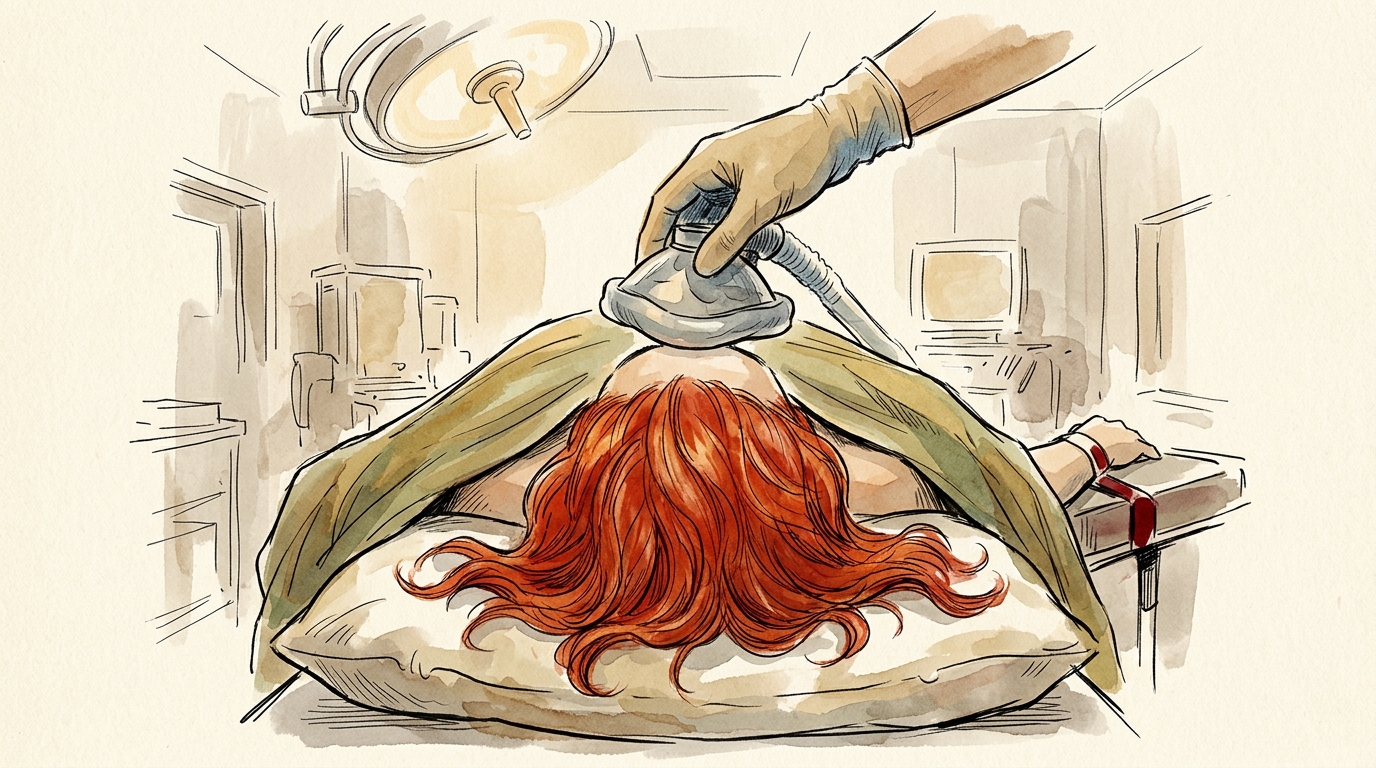
Put a redhead under anesthesia and, on average, they need more of it `F1`. They also tend to handle some kinds of pain differently from everyone else `F2`. That is not a personality quirk — it traces to a single gene `F3`. The same gene that turns hair red reaches all the way into how the body registers pain. Its name is MC1R.
02THE NAME
MC1R stands for melanocortin-1 receptor `F4`. It sits near the tip of chromosome 16 `F5`, and its job is to build a tiny antenna on the surface of melanocytes, the cells that make your pigment `F6`. When that antenna fires, it sets your color. When it stays quiet, everything downstream changes.
03THE MECHANISM (hero)
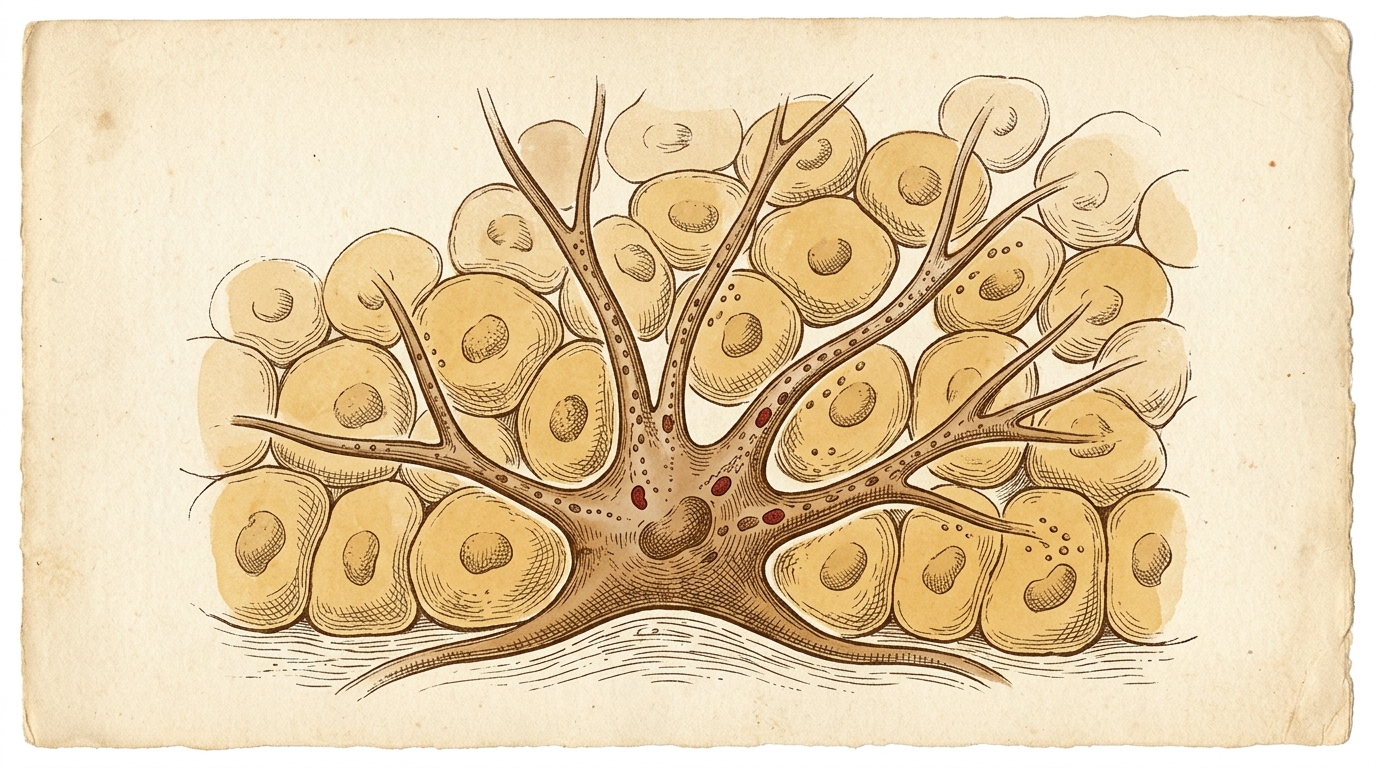
Here is the switch. When a hormone called alpha-MSH docks onto the receptor, it raises an internal messenger — cyclic-AMP — and the melanocyte makes eumelanin, the brown-black pigment that soaks up ultraviolet light and shields the DNA underneath `F7`. But many people carry MC1R variants whose receptor can't pass that signal `F8`. With the antenna quiet, the cell falls back to the other pigment — pheomelanin, a red-yellow pigment `F9`. That fallback is red hair, fair skin, and freckles `F10`.
04THE HUNT
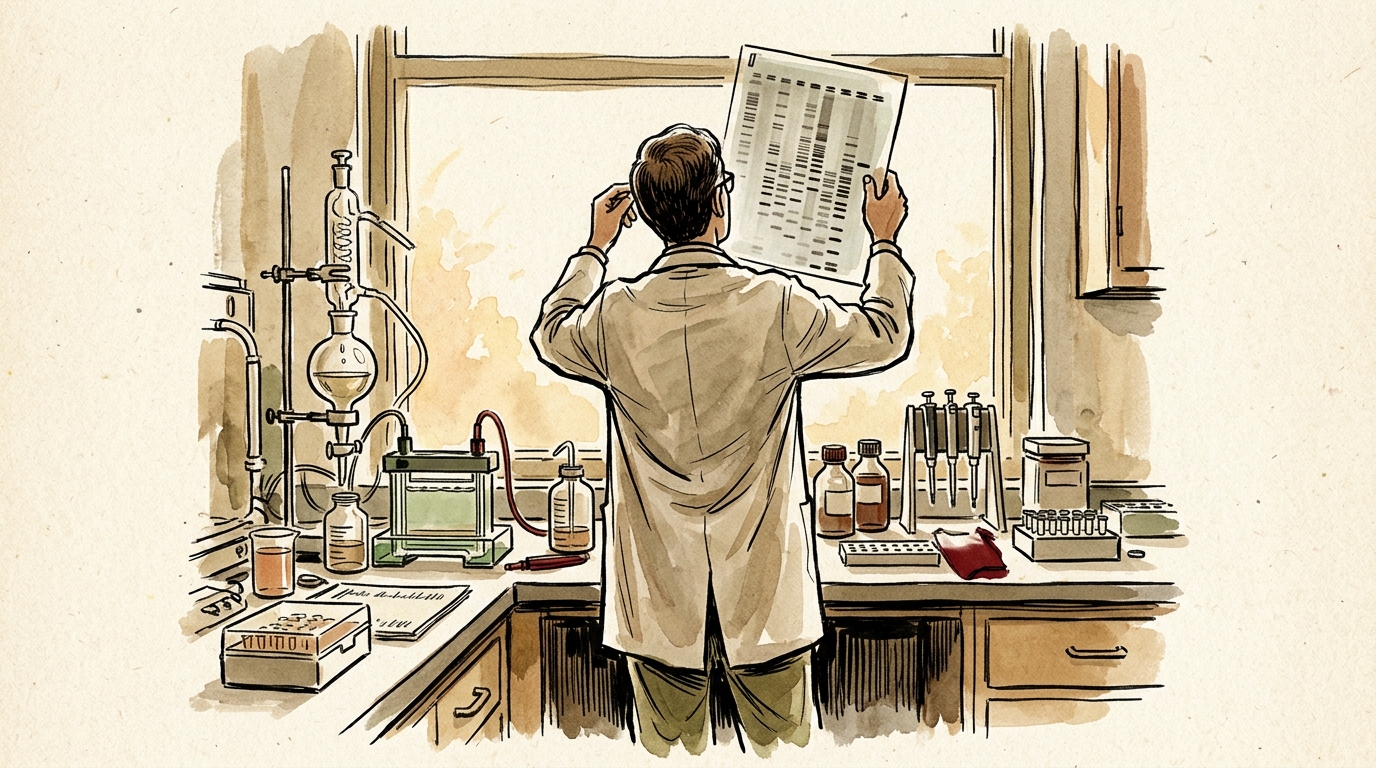
We learned to read that switch in stages. The receptor was cloned in 1992 `F11`. Three years later, a team in Edinburgh showed that specific MC1R variants tracked with red hair and fair skin — among the first clear links between a gene and ordinary human pigment variation `F12`.
05THE STAKES
And here is the cost. Pheomelanin is a poor sunscreen, so fair, freckled skin burns where others tan `F13`. But it is worse than that: the red pigment itself can generate damaging molecules inside the cell, adding to melanoma risk even with the sunlight removed `F14`. People who carry two red-hair variants of MC1R sit at a markedly higher lifetime risk of melanoma `F15`.
06THE OTHER LIFE OF THE GENE
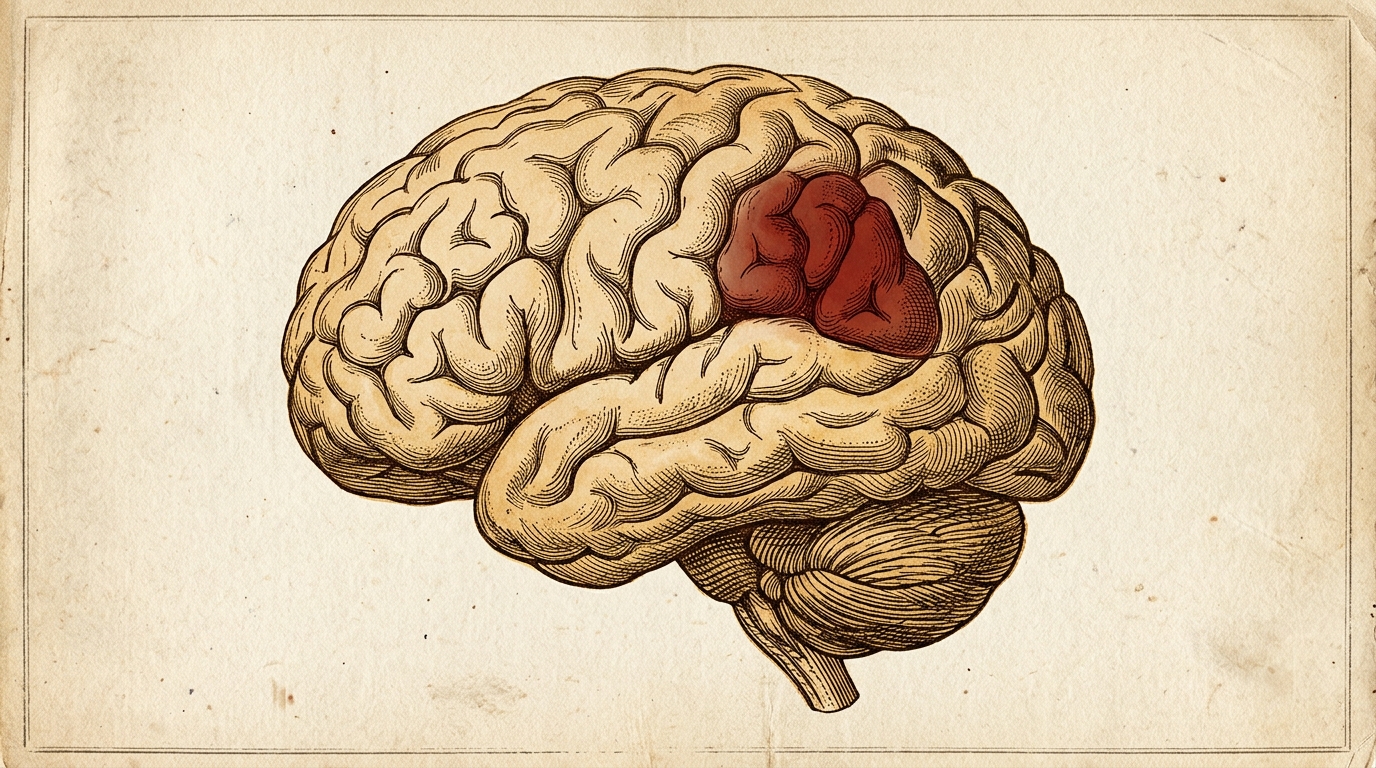
Now, back to the pain. The quiet receptor doesn't stop at color. With MC1R switched off, pigment cells release less of a signalling hormone — alpha-MSH — and with less of it reaching the brain, the opioid system there loses one of its natural brakes `F16`. The result in people: those with the red-hair variants can be more sensitive to some kinds of pain, yet more responsive to certain opioid painkillers, and they need more general anesthetic to stay under `F17`. A gene we filed under "hair color," quietly turning a dial on pain `F18`.
07THE DEEP HISTORY
Why do these variants exist at all? Away from the fierce equatorial sun, the pressure to stay dark relaxed, and MC1R became one of the most variable genes we carry `F19`. Even Neanderthals had their own loss-of-function version of it — they may have been pale, and some of them red-haired, long before modern humans walked into Europe `F20`.
08THE OPEN THREAD
There is nothing to cure here — red hair is not a disease `F21`. The open question is protection: if the problem is a receptor that won't fire, can we raise cyclic-AMP another way and coax fair skin into making the protective pigment anyway — a real tan from a cream, not from the sun? In mice missing a working receptor, researchers did exactly that — using forskolin, a compound that bypasses the broken receptor and raises cyclic-AMP directly, without ever needing it to fire `F22`. The frontier is turning a vulnerability into a defense.
09TIMELINE + SIGN-OFF
One receptor. It sets your color, your odds in the sun, and a dial on pain you never knew was there. — The Gene Channel.
The write-up
In one line: MC1R is the receptor that decides whether your pigment cells make brown, UV-shielding melanin or red — so it sets red hair, fair skin and freckles — but the same loss-of-function reaches into melanoma risk and even into how the body registers pain.
The gene
MC1R — the melanocortin-1 receptor — sits near the tip of the long arm of chromosome 16 (band 16q24.3). It encodes a small seven-pass, G-protein-coupled receptor that studs the surface of melanocytes, the cells in your skin and hair that make pigment. Think of it as an antenna: when it fires, the cell makes one kind of pigment; when it stays quiet, the cell makes another. That one decision ripples outward further than anyone expected when the gene was first cloned.
The hunt
The receptor was cloned in 1992 by Ken Mountjoy, Roger Cone and colleagues (and, independently, by Chhajlani and Wikberg the same year) — the first of the melanocortin-receptor family to be pulled out. Three years later, in 1995, a group in Edinburgh — Valverde, Healy, Jackson, Rees and Thody — showed that specific MC1R sequence variants tracked with red hair and fair skin: they turned up in more than 80% of red-haired or poorly-tanning people but in fewer than 20% of those with brown or black hair. It was one of the first clean links between a single gene and ordinary, everyday human pigment variation.
The mechanism
Here is the switch. The hormone α-MSH docks onto MC1R; the activated receptor turns on adenylyl cyclase and raises cyclic-AMP inside the melanocyte. High cAMP tells the cell to make eumelanin — the brown-to-black pigment that absorbs ultraviolet light and shields the DNA in the cells below. But many people carry MC1R variants whose receptor can't relay that signal. With the antenna quiet and cAMP low, the cell falls back to the other pigment — pheomelanin, a red-to-yellow pigment. That fallback is, visibly, red hair, fair skin and freckles.
The stakes, and the frontier
Sun. Pheomelanin is a poor sunscreen, so fair, freckled skin burns where darker skin tans. Worse, work from David Fisher's lab (Mitra et al., Nature 2012) showed in mice that the red pigment itself is part of the problem: in a Braf-driven model, switching off Mc1r promoted melanoma with no UV at all, and removing pheomelanin abolished the effect — a UV-independent, oxidative route to cancer. In people, carrying two red-hair MC1R variants raises lifetime melanoma risk severalfold.
Pain. And then the surprise. Redheads, on average, need more general anesthetic (Liem et al., Anesthesiology 2004, found ~19% more desflurane), and they handle some kinds of pain differently — more sensitive to certain stimuli, yet more responsive to certain opioid painkillers (Mogil and colleagues). The mechanism, worked out in 2021 (Robinson et al., Science Advances), is elegant and not what you'd guess: MC1R loss makes melanocytes secrete less POMC and α-MSH, and with less circulating α-MSH, the brain's own opioid signaling is left less restrained — raising baseline pain thresholds. A gene we filed under "hair color" is quietly setting a dial on pain, from the skin.
Deep history. Why do the variants exist? Away from the strong equatorial sun the constraint to stay dark relaxed, and MC1R became one of the most polymorphic genes we carry (Harding et al. found it nearly invariant in Africa, highly diverse in Europe). Even Neanderthals carried their own loss-of-function variant (R307G; Lalueza-Fox et al., Science 2007) — some of them were probably pale and red-haired, tens of thousands of years before us.
The open thread. There is nothing to cure — red hair is not a disease. The interesting question is protection: if the trouble is a receptor that won't fire, can you raise cAMP some other way and coax fair skin to make protective pigment anyway? In Mc1r-deficient "redhead" mice, topical forskolin (which raises cAMP) did exactly that — a real tan from a cream, with measurable UV protection (D'Orazio et al., Nature 2006). Turning a vulnerability into a defense is the frontier.
Sources
Full claim-by-claim evidence is in references.md. Primary anchors:
- Locus & receptor: NCBI Gene 4157; OMIM 155555; FISH mapping to 16q24.3 — https://omim.org/entry/155555
- Mountjoy et al., melanocortin-receptor cloning, Science 257:1248 (1992) — https://pubmed.ncbi.nlm.nih.gov/1325670/
- Valverde et al., MC1R variants ↔ red hair/fair skin, Nat Genet 11:328 (1995) — https://www.nature.com/articles/ng1195-328
- Mitra et al., UV-independent melanoma via pheomelanin, Nature (2012) — https://www.nature.com/articles/nature11624
- Liem et al., increased anesthetic requirement in redheads, Anesthesiology (2004) — https://pmc.ncbi.nlm.nih.gov/articles/PMC1362956/
- Robinson et al., the red-hair pain mechanism, Science Advances (2021) — https://www.science.org/doi/10.1126/sciadv.abd1310
- Lalueza-Fox et al., a Neanderthal MC1R allele, Science 318:1453 (2007) — https://pubmed.ncbi.nlm.nih.gov/17962522/
- D'Orazio et al., topical forskolin rescues tanning/UV protection, Nature (2006) — https://pubmed.ncbi.nlm.nih.gov/16988713/
Accuracy note: the episode is careful on three easy-to-overstate points. (1) The pain phenotype is mixed — redheads are not simply "less sensitive to pain"; they are more sensitive to some stimuli, more responsive to some opioids, and need more anesthetic. (2) The pain mechanism is melanocyte-driven (reduced α-MSH derepressing central opioids), not "MC1R acting directly in neurons." (3) The UV-independent melanoma route is a mouse-model finding; the narration says it can add to risk, not that it causes melanoma in people without sun.
The evidence
Every claim, sourced
Each [F#] you hear in the film links to the source it came from. Nothing gets narrated until every one is checked and signed off.
Sign-off
- Sourcing complete — every
[F#]mapped to a primary/authoritative source (Claude, 2026-06-12). - ⚠️ Pain trap stated correctly — the literature is genuinely mixed (↑ sensitivity to some pain and ↑ opioid analgesia and higher baseline thresholds in the mouse mechanism); narration kept qualitative ("differently / some kinds of pain") and never claims redheads simply "feel less pain."
- ⚠️ Pain mechanism corrected — driven by reduced melanocyte α-MSH derepressing central opioid tone (Robinson 2021), not "MC1R acting in neurons." Script seg-06 rewritten to match.
- ⚠️ UV-independent melanoma (F14) — flagged as a mouse-model mechanism; narration says "can … add to risk," not "causes melanoma in people without sun."
- Producer sign-off — user, 2026-06-12.
**Gate OPEN** → narration + assets may proceed.
- F1
Redheads need, on average, more anesthetic
Liem et al.: desflurane requirement 6.2 vs 5.2 vol% in red- vs dark-haired women (~19% more, P=0.0004); 9/10 redheads carried MC1R variants
- F2⚠ commonly confused
They handle some kinds of pain differently
Known-nuanced: ↑ thermal-pain sensitivity + reduced subcutaneous lidocaine efficacy in redheads (Liem 2005); yet greater κ-opioid analgesia (Mogil 2003). Narration kept qualitative
- F3
The trait traces to a single gene
The red-hair/fair-skin phenotype maps to MC1R variants
- F4
The gene is MC1R, the melanocortin-1 receptor
7-transmembrane G-protein-coupled receptor (317 aa) for α-MSH/ACTH
- F5
It sits near the tip of chromosome 16
MC1R mapped to 16q24.3 (long-arm telomeric band) by FISH
- F6
It builds a receptor on the surface of melanocytes (pigment cells)
MC1R is the MSH receptor expressed mainly on melanocytes
- F7
α-MSH → cyclic-AMP → eumelanin (brown-black, UV-shielding)
α-MSH binds MC1R → adenylyl cyclase → ↑cAMP → eumelanin; eumelanin absorbs UV / protects DNA
- F8
Many people carry variants that can't pass the signal (loss of function)
80 MC1R variants described; loss-of-function alleles reduce the cAMP response
- F9
With the receptor quiet, the cell defaults to pheomelanin (red-yellow)
MC1R activity sets the eumelanin:pheomelanin ratio; low activity → pheomelanin
- F10
That default = red hair, fair skin, freckles
MC1R variants in >80% of red-haired/fair-skinned, <20% brown/black hair
- F11
The receptor was cloned in 1992
Mountjoy, Robbins, Mortrud & Cone, Science 257:1248 (1992); independently Chhajlani & Wikberg 1992
- F12
1995, a team in Edinburgh tied MC1R variants to red hair / fair skin
Valverde, Healy, Jackson, Rees & Thody, Nature Genetics 11:328 (1995)
- F13
Pheomelanin is a poor sunscreen — fair, freckled skin burns
MC1R-variant skin tans poorly / burns; pheomelanin gives little UV protection
- F14⚠ commonly confused
The red pigment itself can drive melanoma even without UV
Mitra et al.: in Braf-mutant mice, inactivating Mc1r promoted melanoma with zero UV; deleting pheomelanin (albino) abolished it — a UV-independent oxidative pathway. (Mouse model.)
- F15
Two red-hair variants → markedly higher lifetime melanoma risk
Meta-analysis: ≥1 RHC variant OR ≈2.2; two RHC variants OR ≈5.0 (≈3.6 adjusted for skin type)
- F16⚠ commonly confused
Switched-off MC1R → pigment cells release less α-MSH → the brain's opioid system is less restrained
Robinson et al.: in red-hair mice, MC1R loss ↓ melanocyte POMC/α-MSH → derepresses central OPRM1 opioid tone (via MC4R / periaqueductal gray) → higher pain thresholds; melanocyte-dependent, melanin-independent
- F17⚠ commonly confused
Redheads: more sensitive to some pain, more responsive to certain opioids, need more anesthetic
Composite, carefully hedged across Liem 2004 (anesthetic), Mogil 2003 (κ-opioid analgesia), Liem 2005 (thermal sensitivity), Robinson 2021 (mechanism)
- F18
(summary) a "hair-color" gene that tunes pain
—
- F19
MC1R is one of the most variable genes — constraint relaxed away from strong sun
Harding et al.: MC1R near-invariant in Africa (functional constraint), high diversity in Europe (neutral, relaxed constraint); >80 variants
- F20
Neanderthals carried their own loss-of-function MC1R → likely pale, some red-haired
Lalueza-Fox et al.: the R307G variant in two Neanderthals reduces MC1R activity (like human red-hair alleles)
- F21
Red hair is not a disease
Framing — a common, normal pigment phenotype (no pathology claim)
- F22
In receptor-deficient mice, raising cAMP made fair skin make protective pigment ("a tan from a cream")
D'Orazio et al.: topical forskolin (raises cAMP) elicited eumelanin + UV protection in Mc1r-e/e red-hair mice