KCNQ1
The Reset
The gene builds the channel that resets your heart after every beat. Lose one of two copies and the reset drags — so a hard swim can spin the rhythm into a lethal spiral. Yet it is one of the most treatable inherited heart conditions, the moment anyone thinks to look.
The walkthrough
Beat by beat
HOOK
0:20
01HOOK
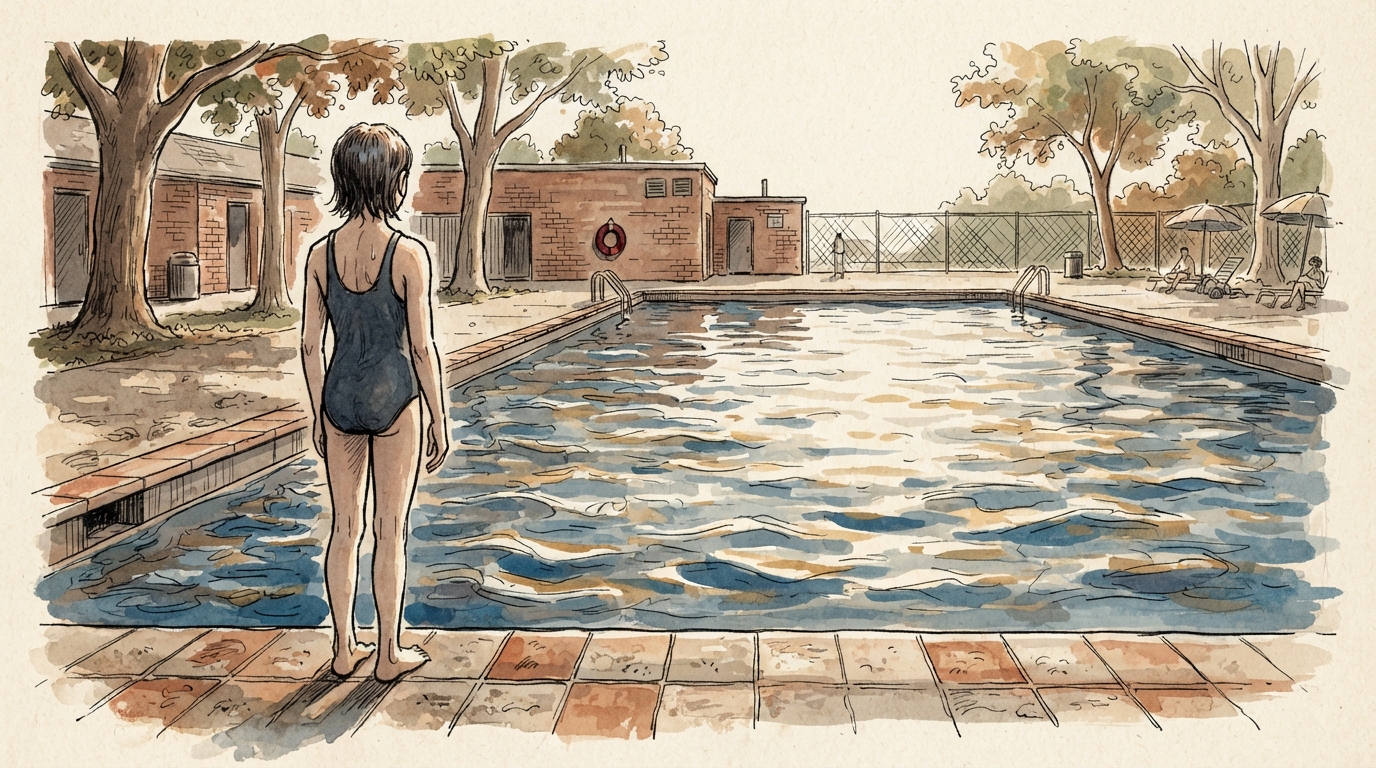
Every summer, children drown who shouldn't — F5 not because of the water. Their hearts stop, during something ordinary, because one gene can't do its job: F1 the gene that resets your heart after every beat. Its name is KCNQ1.
02THE NAME
KCNQ1 sits on chromosome eleven F1 and builds a protein called Kv7.1, whose one job is to open a gate in a heart cell and let potassium out. F1 That outward flow is the reset — it pulls the cell's charge back to zero after it fires, making room for the next beat. F1
03THE CHANNEL
Kv7.1 doesn't work alone. F1 Four copies form a pore, and a partner protein — KCNE1, or MinK — wraps around it to complete the channel, called IKs, F1 tuned for the slow, sustained reset the heart leans on hardest when you push it. F4
04THE HUNT + WHY THE WATER
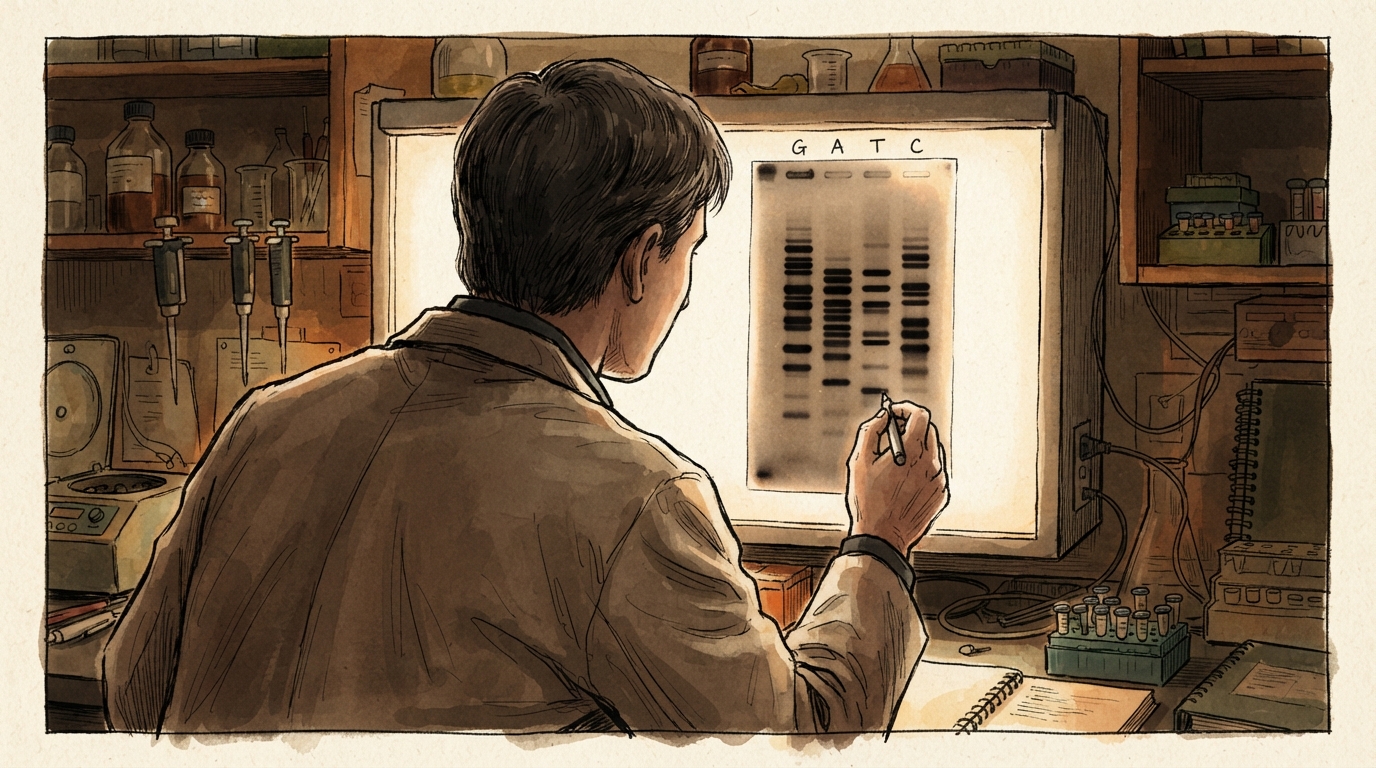
For decades, young people died in the water with no explanation. F9 Then, in nineteen ninety-six, a team led by Mark Keating traced a chromosome-eleven signal through sixteen families F3 and found the gene — eleven mutations, each breaking the same function. F3 It was the most common cause of inherited sudden cardiac death in the young. F2F3 And it explained the water: swimming is the cruelest trigger — hard effort floods the heart with adrenaline, just as the cold plunge fires a reflex that unsettles its rhythm. F5
05THE TELL
There's a tell. F7 On an electrocardiogram, the gap between two peaks — the Q and the T — measures how long the reset takes. F7 With a KCNQ1 mutation that gap runs longer F1 — sometimes by only a few milliseconds — but it holds the heart's window of vulnerability open too long. F7 And the trigger is almost always movement. F5
06HOW THE RESET WORKS (hero 1)
Here's what happens inside a heart cell with every beat. F1 It fires — sodium rushes in, calcium floods behind it, the voltage shoots up. F1 Now it has to reset, and to reset, potassium must leave. F1 The IKs channel opens slowly and carries potassium out in a long, steady stream; F1F4 the voltage drops, the reset completes, the next beat fires on time. F1 Now push your heart. Start swimming. F4 Adrenaline arrives, and a protein called PKA tags Kv7.1 directly — telling it to open wider and faster: F4 more potassium, quicker reset, your heart racing without losing its rhythm. F4 IKs is the channel the heart needs most, exactly when you push it hardest. F4
07WHAT THE MUTATION BREAKS (hero 2)
Now halve it. F1 One copy of KCNQ1 is broken — half the channels missing or defective. F1 At rest, the survivors may be enough: the QT runs a little long, but the heart holds. F7 Then you swim. F5 Adrenaline calls for more current — but there aren't enough channels to answer. F4F5 The reset doesn't speed up; the cell stays stretched and vulnerable while the heart beats its fastest. F4F5 In that window, a rogue electrical whisper appears — an early afterdepolarization — F7 and triggers another, and another, until the rhythm twists into torsades de pointes. F7 It lasts seconds. Or it doesn't stop. F7 A child goes under — and it wasn't the water that stopped her heart. F5
08THE STAKES
There's almost nothing to warn you. F9 No pain, no symptoms between episodes — often just a QT a few milliseconds too long, if anyone thinks to look. F2F9 And LQT1 runs in families: F9 when one person is found — often after a collapse, or a drowning — testing turns up carriers — parents, siblings, cousins who'd been swimming their whole lives. F9
09THE OPEN THREAD
And here's what should be shouted: F8 this is one of the most treatable inherited heart conditions we know — if you know you have it. F8F9 A daily beta-blocker blunts the adrenaline signal before it reaches the channel, and most people live normally; F8 for the rest, a nerve-cutting surgery and an implantable defibrillator wait in reserve. F8 And in the lab, a gene therapy is taking shape — silencing the broken gene, then installing a corrected copy it can't touch; in LQT1 rabbits, it normalized the QT. F10 It's early, and in animals — but the target has been known since nineteen ninety-six. F3 The bottleneck was never the treatment. It was the diagnosis. F9
10RECAP + FOUNDATION SIGN-OFF
Thirty years: from sixteen families and a cloned potassium channel to a mechanism we understand, treatments that work, and a gene therapy taking shape. F3F8F10 In between stands the SADS Foundation — built to end deaths that were never inevitable. F9 Found in a gene. Carried by families. Find them at sads.org. — The Gene Channel.
The write-up
In one line: KCNQ1 builds Kv7.1, the potassium channel that resets your heart after every beat — lose one working copy and the reset drags (long QT syndrome type 1), so a surge of adrenaline during exercise or swimming can stretch the reset until the rhythm spins into a lethal arrhythmia; yet it is one of the most treatable inherited heart conditions once it's found, and a silence-and-replace gene therapy has already normalized the beat in rabbits.
The gene
KCNQ1 sits on chromosome 11 (11p15.5) and builds a protein called Kv7.1. Four copies of Kv7.1 form a pore, and a partner protein — KCNE1, also called MinK — wraps around it to complete the channel known as IKs. Its job is to carry potassium out of each heart-muscle cell after it fires — the "reset" that pulls the cell's charge back to zero and clears the way for the next beat. IKs is the heart's rate-adaptive reserve: the current it leans on hardest when you push it.
The hunt
For most of the twentieth century, young people died suddenly — often in the water — with no explanation. In 1996, a team led by Mark Keating at the University of Utah (Qiting Wang, Mark Curran, Igor Splawski and colleagues) used positional cloning to trace a chromosome-11 signal through 16 families, and found the gene — with 11 distinct mutations (one small in-frame deletion and ten single-letter changes), each breaking the same function. It was the most common cause of inherited sudden cardiac death in the young. LQT1 (KCNQ1) accounts for roughly 45–50% of genetically confirmed long QT syndrome, a condition that affects on the order of 1 in 2,500 people.
The mechanism
With every beat, a heart cell fires — sodium rushes in, calcium behind it, the voltage shoots up — and then it must reset. To reset, potassium must leave, and the IKs channel opens slowly to carry it out; the voltage falls, and the next beat fires on time. When you exercise, adrenaline arrives and a signalling protein, PKA, tags Kv7.1 directly so IKs opens wider and faster — the reset keeps pace as the heart races. In LQT1, one broken copy leaves about half the channels. At rest the survivors may cope, but when adrenaline calls for more current there aren't enough channels to answer: the QT interval won't shorten, the cell stays stretched and vulnerable at the fastest heart rate, and a rogue secondary depolarization — an early afterdepolarization — can fire an extra beat that lands on the T wave and spins the rhythm into torsades de pointes. This is why swimming is LQT1's signature danger: hard effort floods the heart with adrenaline just as the cold-water plunge fires a reflex that unsettles the rhythm.
The stakes, and the frontier
There is almost nothing to warn you — no pain, no symptoms between episodes, often just a QT interval a few milliseconds too long, if anyone thinks to look. LQT1 runs in families, so when one person is found (often after a collapse or a drowning) cascade testing turns up carriers among parents, siblings and cousins who had been swimming their whole lives. The reassuring half of the story: this is one of the most manageable inherited sudden-death conditions we know. A daily beta-blocker (non-selective agents such as nadolol are first-line) blunts the adrenaline signal before it reaches the channel, and most people live normally; for the rest, left cardiac sympathetic denervation and an implantable defibrillator wait in reserve. The bottleneck was never the treatment — it was the diagnosis. And the biology points further: a suppression-and-replacement gene therapy, delivered by an AAV9 vector, silences the KCNQ1 gene and installs a corrected, silencing-immune copy; in transgenic LQT1 rabbits it normalized the QT interval and restored the adrenergic response. It is early, and in animals only — but the target has been known since 1996. Much of the awareness push is led by families as well as clinicians — the SADS Foundation (sads.org), founded in 1991, was built to end deaths that were never inevitable.
Sources
Full claim-by-claim evidence is in references.md. Primary anchors:
- Wang Q, Curran ME, Splawski I, et al. "Positional cloning of a novel potassium channel gene: KVLQT1 mutations cause cardiac arrhythmias." Nature Genetics 12:17–23 (1996). PMID 8528239.
- Wu J, Ding WG, Horie M. "Molecular pathogenesis of long QT syndrome type 1." J Hum Genet 61:1–8 (2016). PMC5063268.
- Schwartz PJ, Stramba-Badiale M, Crotti L, et al. "Prevalence of the congenital long-QT syndrome." Circulation 120:1761–1767 (2009). PMC2784143.
- Tamargo J, et al. "Effectiveness of beta-blockers depending on the genotype of congenital long-QT syndrome: A meta-analysis." PLoS ONE 12:e0185680 (2017). PMC5653191 — with the 2025 network meta-analysis (PMC12748156, nadolol first-line in LQT1) and the 2022 ESC guideline review (PMC11264164).
- Bains S, Giammarino L, Nimani S, et al. "KCNQ1 suppression-replacement gene therapy in transgenic rabbits with type 1 long QT syndrome." Eur Heart J 45:3751–3762 (2024). PMID 39115049. PMC11439107.
- GeneReviews: "Long QT Syndrome" (NBK1135); "Jervell and Lange-Nielsen Syndrome" (NBK1405).
Accuracy note: A few points the episode states carefully — the LQT1 trigger is exercise / swimming (adrenergic), not sudden noise (that's LQT2/KCNH2) or rest and sleep (LQT3/SCN5A); on the ECG, LQT1 shows a broad-based T wave (repolarization slowed and widened in place), not the long flat ST with a late, discrete T that marks LQT3. Heterozygous KCNQ1 loss causes Romano-Ward syndrome (dominant, heart only, no deafness); only biallelic loss causes Jervell and Lange-Nielsen syndrome (recessive, with congenital deafness). "Nothing can be done" is wrong — LQT1 is highly treatable once diagnosed. QT prolongation means the electrical reset is slow, not that the heartbeat is slow. And the suppression-and-replacement gene therapy is preclinical (rabbit model) only — not in clinical trials.