HTT
A Clock in the Code
Forty repeats of a single codon, and the outcome is written — decades in advance. Huntington's disease starves and poisons the very neurons that keep movement in check, and for 150 years there was nothing to do but watch it come. Now, for the first time, a therapy aimed at the cause is in sight.
The walkthrough
Beat by beat



HOOK
0:22
01HOOK
You can know — precisely, decades in advance — that a disease is coming. F3 Not a risk. A certainty. Forty or more repeats of a single codon, and the outcome is written. F1 Most people who carry it choose not to find out. F3 The gene is HTT. And it contains a clock.
02THE NAME
HTT sits at the very tip of chromosome four. F1 It encodes huntingtin — one of the largest, most important proteins in the brain. F1F2 In a healthy neuron, it works as a scaffold — keeping a vital survival signal moving to the cells that depend on it. F2 (The full BDNF supply line — cortex → axon → striatum — is the hero of seg-05; this beat only names the gene and its job, then hands off.)
03THE HUNT
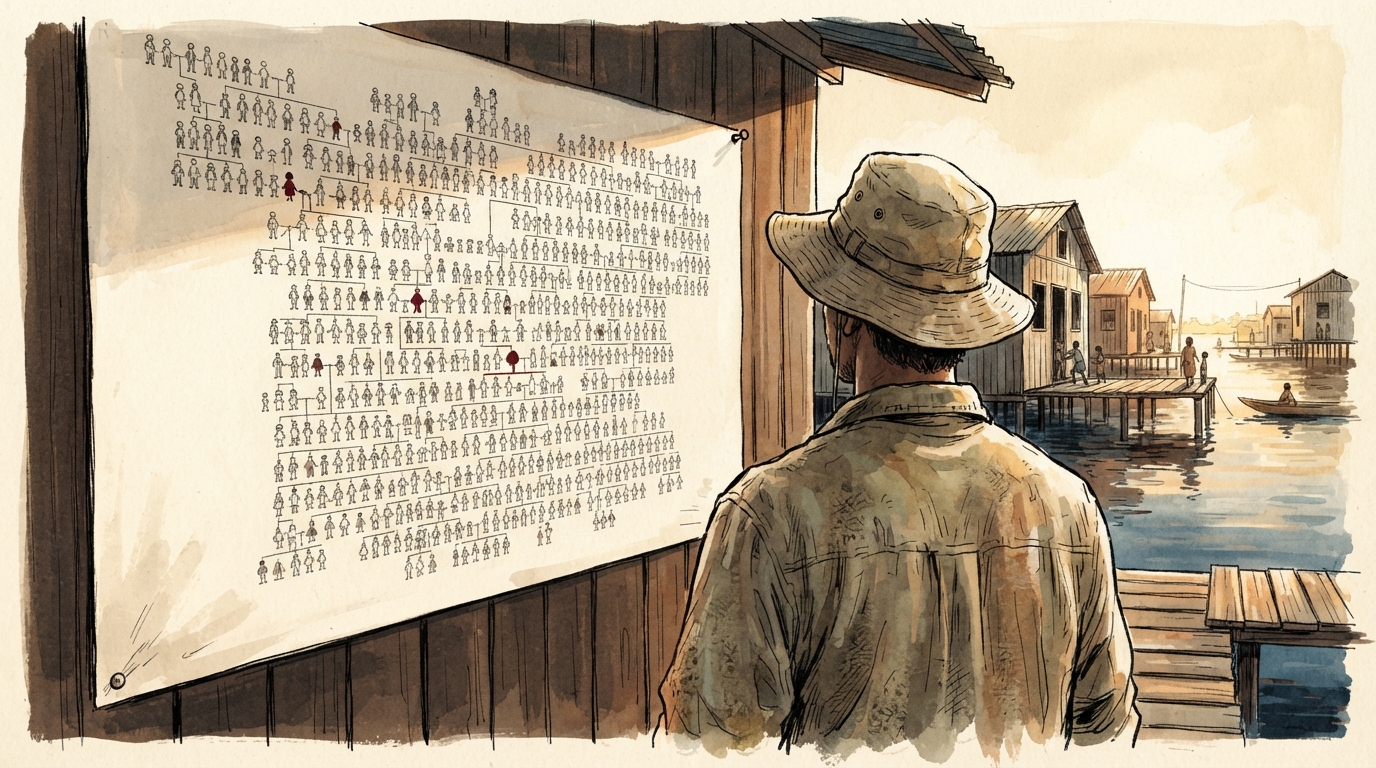
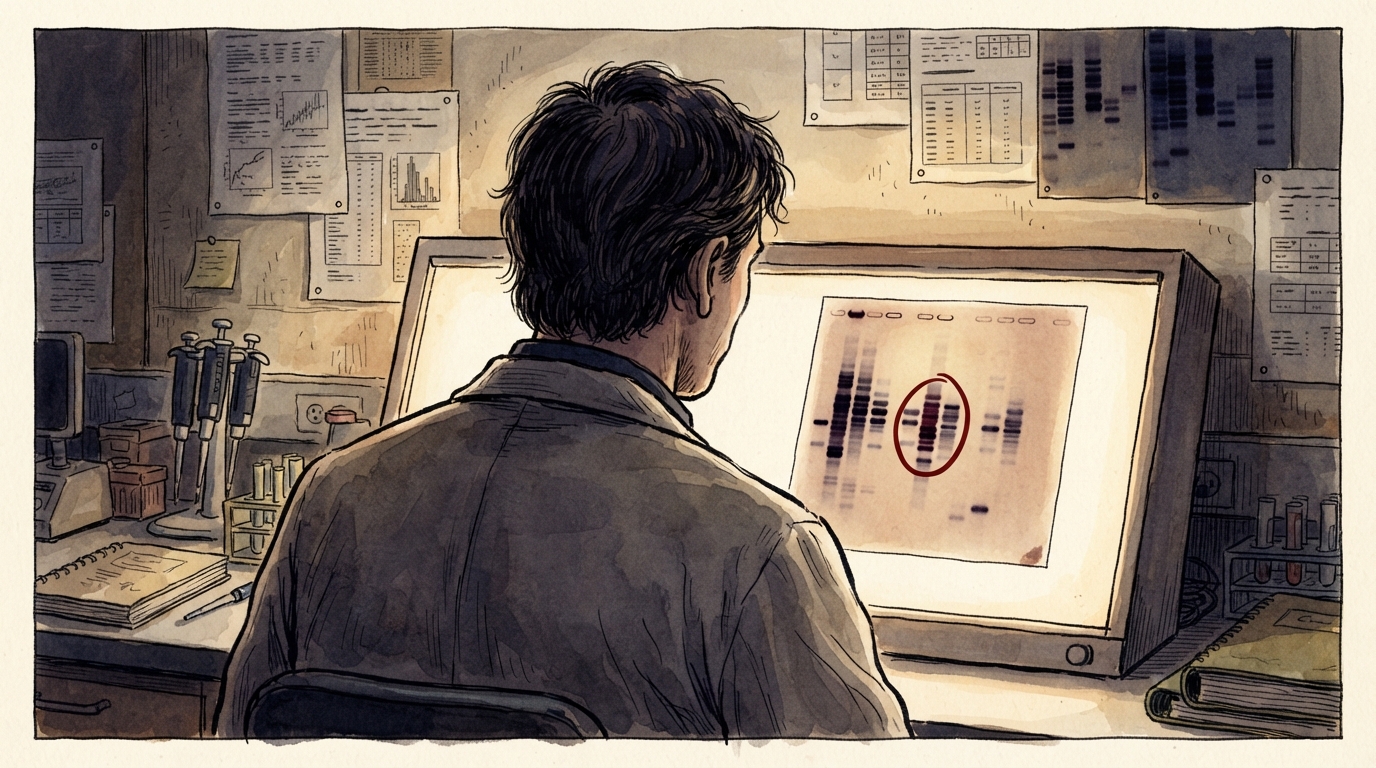
Physicians had recognized this disease for over a hundred years before they found its cause. In eighteen seventy-two, a young doctor named George Huntington described it from Long Island — his father and grandfather had watched the same families pass it down for generations. F4 Chorea: involuntary, dance-like movements. Dementia. A psychiatric shadow that fell before the body did. And always — never skipping a generation. F4 The search for the gene took another century. In nineteen eighty-three, James Gusella and Nancy Wexler and their colleagues mapped it to chromosome four — using families from a remote Venezuelan village on Lake Maracaibo, where HD had run through the same kindred for generations, ten generations deep. F5 First time a disease had ever been pinned to the genome using DNA markers. F5 But the gene itself took ten more years to find. In nineteen ninety-three, the Huntington's Disease Collaborative Research Group — almost sixty scientists across six institutions — identified it: a stuttered codon, CAG, repeated far too many times in the first exon of a gene they called IT15. F6 Published in Cell. The first trinucleotide repeat expansion disease mapped to its cause. F6
04THE CAG THRESHOLD
In a healthy gene, CAG repeats seventeen times. Maybe twenty. Maybe twenty-six. F3 That encodes a short stretch of glutamine — a normal part of the protein. F1 Expand it past forty, and everything changes. F3 The protein folds wrong. A sticky, glutamine-rich tail that clings to everything it should not. F1F7 The cell cannot clear it. And what it clings to, it disrupts. F7 The repeat is also unstable. When a father passes it to a child, the repeat can grow longer still — arriving in the next generation earlier, heavier, harder. F12
05HOW THE BRAIN DEPENDS ON BDNF (hero 1)
Here is what huntingtin does every day in a healthy brain. In the cortex, a neuron makes BDNF — brain-derived neurotrophic factor, the signal that keeps striatal cells alive. F2 To deliver it, the cell loads BDNF into a small vesicle, and huntingtin assembles the transport machine: a scaffold linking the vesicle to microtubule motor proteins — kinesin and dynein — that walk it down the axon, across the long distance, to the striatum below. F2 The striatal neurons receive the BDNF, bind it at their surface, and survive. F2 Huntingtin also sits in the nucleus and nudges transcription toward more BDNF production. F2 Without that supply, the striatal cells have no backup. F2
06WHAT THE MUTATION BREAKS
Now introduce the expanded polyQ. F1F7 Fragments of mutant huntingtin, cleaved from the full protein, fold into sticky oligomers. In the nucleus, they trap the transcription factors that normally drive BDNF production — CBP, SP1 — holding them in place, away from their targets. F7 The BDNF gene goes quiet. F7 The mutant protein also fails to hold the REST repressor in the cytoplasm — so REST moves into the nucleus and silences BDNF further. F7 At the synapse, the transport scaffold breaks down. BDNF vesicles stall. F2F7 The striatal cells that depend on that signal begin to starve.
07THE TOLL ON THE CELL
But starvation is only half of it. The mutant fragments are toxic in their own right. F13 They clog the cell's clean-up machinery — the systems that should clear misfolded protein back up and fail. F13 And they cripple the mitochondria, the neuron's power plants — energy production falters, calcium handling goes wrong. F13 A striatal cell losing its lifeline and its power at once has little left to hold on with. And the cells that fall first are not random. F8 The D2 medium spiny neurons — the ones wired into the pathway that normally suppresses unwanted movement — lose their grip before any other cell type. F8 When they fail, the circuit that says "don't move" goes dark. What replaces it is chorea — involuntary, choreiform movement, the disease's signature. F8 Later, as D1 neurons and cortical cells follow, the movements slow and freeze, and the mind follows. F8
08THE COURSE
Huntington's disease moves in one direction. F1 The motor symptoms come first, but the psychiatric shadow often arrives earlier — depression, irritability, apathy, years before the diagnosis lands. F7 Then the chorea. Then the cognitive decline. The disease unfolds across fifteen to twenty years.
09THE STAKES
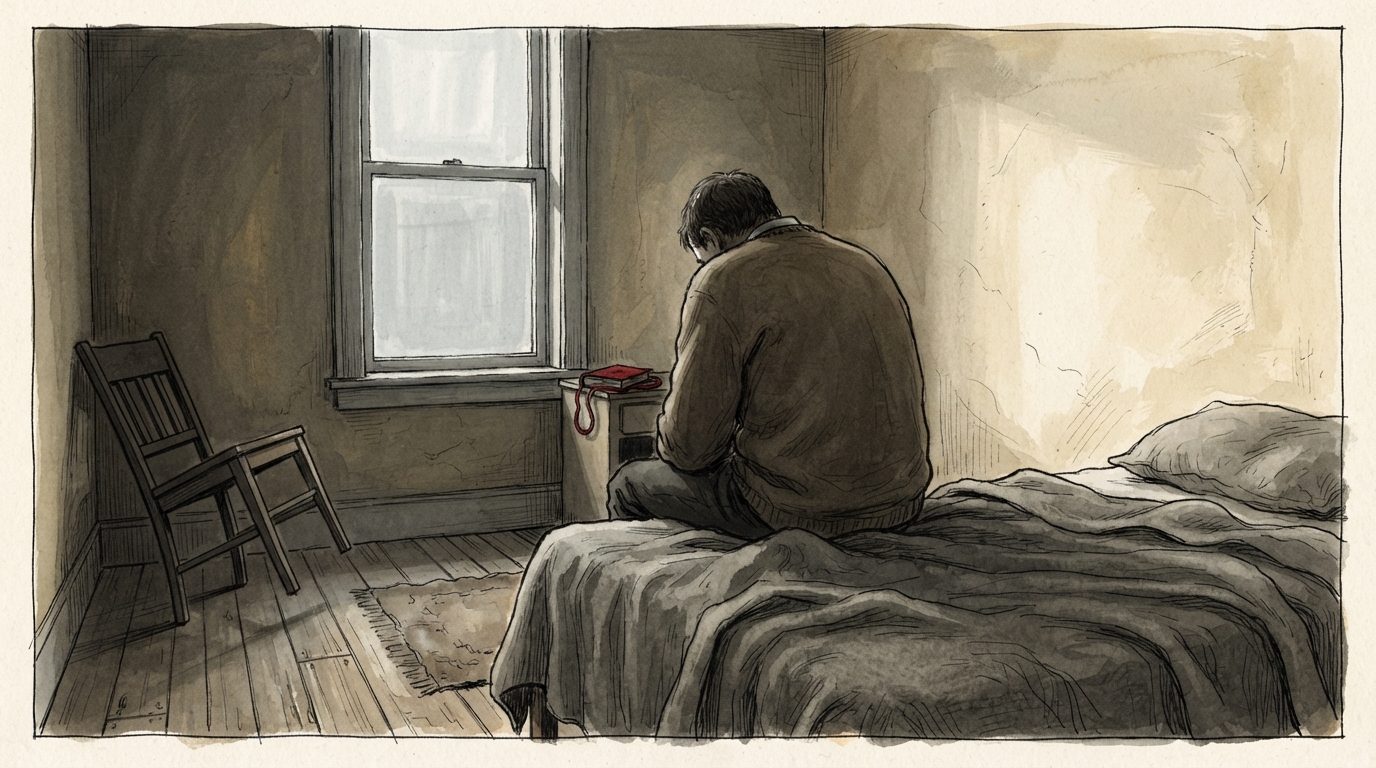
And it is hereditary — autosomal dominant, one altered copy is enough — so every child of an affected parent carries a fifty percent chance. F1 The test has existed since nineteen ninety-three. F6 Most people who are at risk choose not to take it. F3
10THE OPEN THREAD
For decades, medicine could only treat the symptom. F9 Tetrabenazine, approved in two thousand eight, quiets the involuntary movements by depleting the dopamine that drives them — but it does not touch the underlying degeneration. F9 Then came the effort to go deeper: to silence the mutant gene itself. The first attempt — an antisense oligonucleotide called tominersen — could lower the level of mutant huntingtin in the spinal fluid. F10 But in two large trials spanning five years, that biomarker success did not translate into clinical benefit. Tominersen was discontinued in July twenty twenty-six. F10 Now a different approach is in play. AMT-130 is a one-time treatment — a viral vector injected directly into the brain, carrying a microscopic RNA tool that hijacks the cell's own silencing machinery. F11 That tool finds the huntingtin message and marks it for destruction — selectively, inside the neurons where it matters most. F11 At three years out, patients who received the high dose showed disease progression that was seventy-five percent slower than matched controls. F11 The science has not finished. But the data have moved, and a regulatory application is now in preparation. F11 The first attempt at a disease-modifying therapy is in sight.
11RECAP + FAMILIES SIGN-OFF
A hundred and fifty years from a doctor on Long Island, to a chromosome, to a codon counted too many times — to a viral tool threading into the brain of the first patients. F4F5F6F11 Marjorie Guthrie founded the Society the same year her husband Woody died. She did not live to see this. The families who came after her have kept the search alive. Huntington's Disease Society of America: research, support, and community since nineteen sixty-seven. Find them at hdsa.org. — The Gene Channel.
The write-up
In one line: A single codon, counted too many times, writes a neurological disease decades before it arrives — and the first therapy aimed at the cause is finally in sight.
The gene
HTT sits at the very tip of chromosome 4 (4p16.3) and encodes huntingtin, one of the largest proteins in the brain. In a healthy neuron huntingtin works as a scaffold: it assembles the transport machine that carries BDNF — a survival signal — down the long cortical axon to the striatum, and it nudges the nucleus toward making more BDNF. The striatal neurons at the far end can't make enough of that signal themselves; they live on what they receive.
The hunt
Physicians recognized the disease for a century before they found its cause. In 1872 a 22-year-old physician, George Huntington, described it from Long Island in "On Chorea" — involuntary dance-like movement, dementia, a psychiatric shadow, and an inheritance that never skipped a generation. In 1983 James Gusella, Nancy Wexler, and colleagues mapped it to chromosome 4 using the vast Venezuelan kindreds at Lake Maracaibo — the first disease ever pinned to the genome with DNA markers. Ten years later, in 1993, the ~60-scientist Huntington's Disease Collaborative Research Group found the gene itself: a CAG codon repeated far too many times in the first exon of a gene they called IT15 — the first trinucleotide-repeat-expansion disease mapped to its cause.
The mechanism
In a healthy gene, CAG repeats about 17–26 times, coding a short, harmless stretch of glutamine. Past ~40 repeats the protein misfolds into a sticky, glutamine-rich form — a toxic gain-of-function, not a missing gene. The damage is two-sided. In the nucleus, mutant fragments trap the transcription factors that drive BDNF (CBP, SP1) and let the REST repressor slip in, so the BDNF gene goes quiet. At the synapse, the transport scaffold breaks and BDNF vesicles stall. The striatal neurons starve — and are poisoned from within, as the same fragments cripple their mitochondria and clog the cell's protein-clearance machinery. The D2 medium spiny neurons of the "don't-move" indirect pathway fail first, and the circuit that suppresses movement goes dark — which is chorea. As D1 and cortical neurons follow, the movements slow and freeze, and the mind follows.
The stakes, and the frontier
Huntington's is autosomal dominant — one altered copy is enough — so each child of an affected parent carries a 50% chance. A predictive test has existed since 1993, yet most people at risk choose not to take it. The disease unfolds over 15–20 years, often with a psychiatric shadow years before the movement disorder. For decades medicine could only treat the symptom: tetrabenazine (2008) quiets chorea but does nothing for the underlying degeneration. The first attempt to silence the gene itself — the antisense drug tominersen — lowered mutant huntingtin in spinal fluid but failed to help patients across two trials, and was discontinued in July 2026. A different approach is now in play: AMT-130, a one-time AAV gene therapy carrying an RNA tool that silences the mutant message inside neurons. At three years, high-dose patients showed disease progression roughly 75% slower than matched controls, and a regulatory application is in preparation — the first disease-modifying therapy for HD in sight.
Sources
Full claim-by-claim evidence is in references.md. Primary anchors:
- The Huntington's Disease Collaborative Research Group. "A novel gene containing a trinucleotide repeat that is expanded and unstable on Huntington's disease chromosomes." Cell 72:971–983 (1993). PMID 8458085.
- Gusella JF, Wexler NS, Conneally PM, et al. "A polymorphic DNA marker genetically linked to Huntington's disease." Nature 306:234–238 (1983). PMID 6316146.
- GeneReviews, "Huntington Disease" (NBK1305, updated 2026) — CAG thresholds, inheritance, clinical course.
- Mechanism & cytotoxicity: Jurcau, Biomedicines 10:1432 (2022); Arrasate & Finkbeiner, Nature 431:805 (2004); Cui et al., Cell 127:59 (2006).
- Therapy: uniQure AMT-130 Phase 1/2 topline (2025) — ~75% slowing at 36 months; tominersen discontinuation (Roche/Genentech, July 2026).
Accuracy note: HD is a toxic gain-of-function, not haploinsufficiency — the normal copy can't rescue the neuron. Forty or more CAG repeats is fully penetrant; 36–39 is a reduced-penetrance zone, not a certainty. The toxic species are the soluble misfolded fragments/oligomers, not the visible inclusion bodies. Tominersen has failed (both trials; discontinued 2026); AMT-130 is not yet approved — its application is in preparation. The 1993 discovery was the collaborative group's, not any single scientist's.