FOXP2
The Language Gene That Wasn't
Crowned “the language gene” on the strength of two amino acids — then a Neanderthal, a singing finch, and a second look at the data quietly took the crown back.
The walkthrough
Beat by beat
HOOK
0:28
01HOOK
In London, three generations of one family shared a strange inheritance. About half of them could not reliably turn thought into spoken words — could not master the rules of grammar. Not deafness. Not a lack of intelligence. The cause was a single misspelled letter, in a single gene. F1
02THE NAME
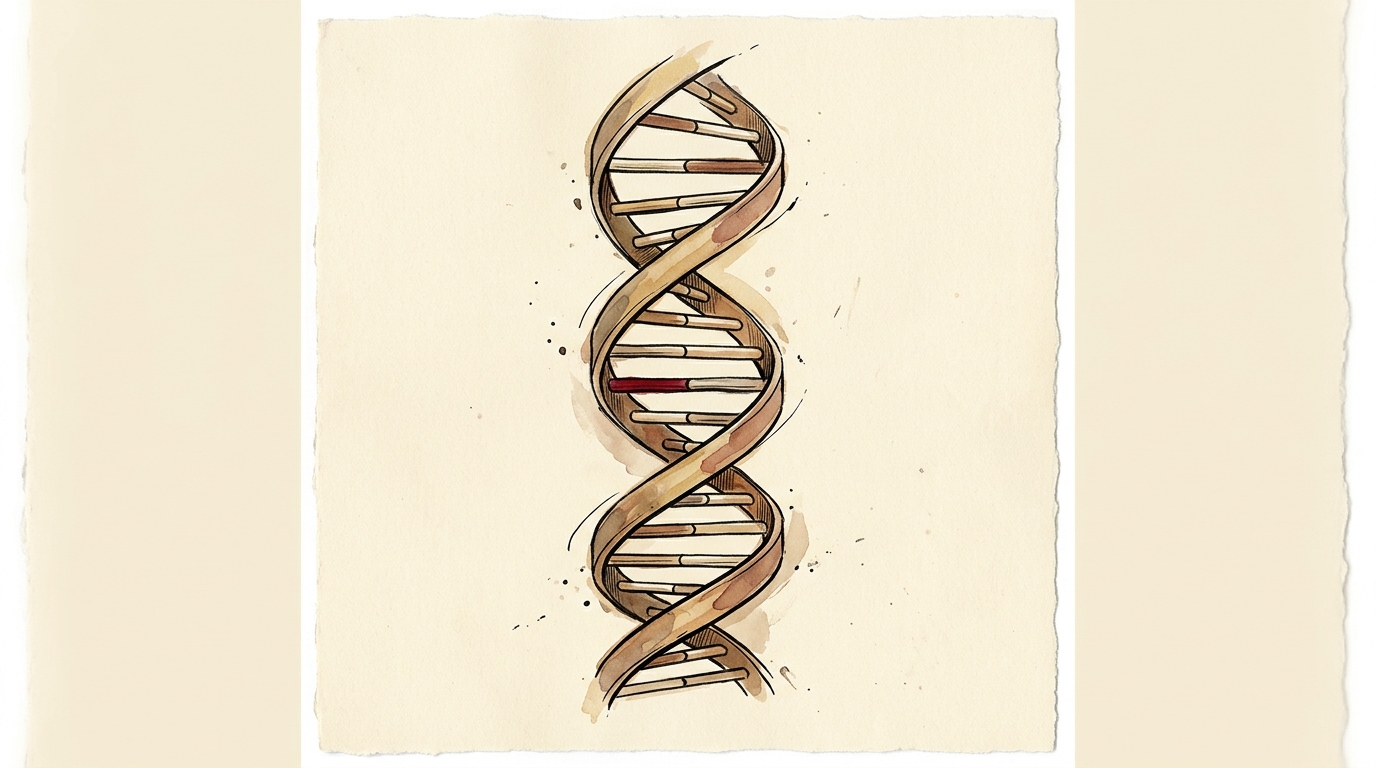
The gene is FOXP2, on the long arm of chromosome 7. F3 It doesn't build the machinery of speech directly — it's a transcription factor, a master switch that turns hundreds of other genes on and off. F3 In this family, one letter had flipped — arginine to histidine — deep in the part of the protein that grips DNA. F2
03THE CROWNING
Then, in 2002, a comparison electrified the field. The human version of FOXP2 differs from a chimpanzee's by just two amino acids. F4 Two changes — and, it seemed, only our species could speak. The headlines wrote themselves: the language gene. The molecular spark that lit human thought.
04THE MECHANISM (hero)
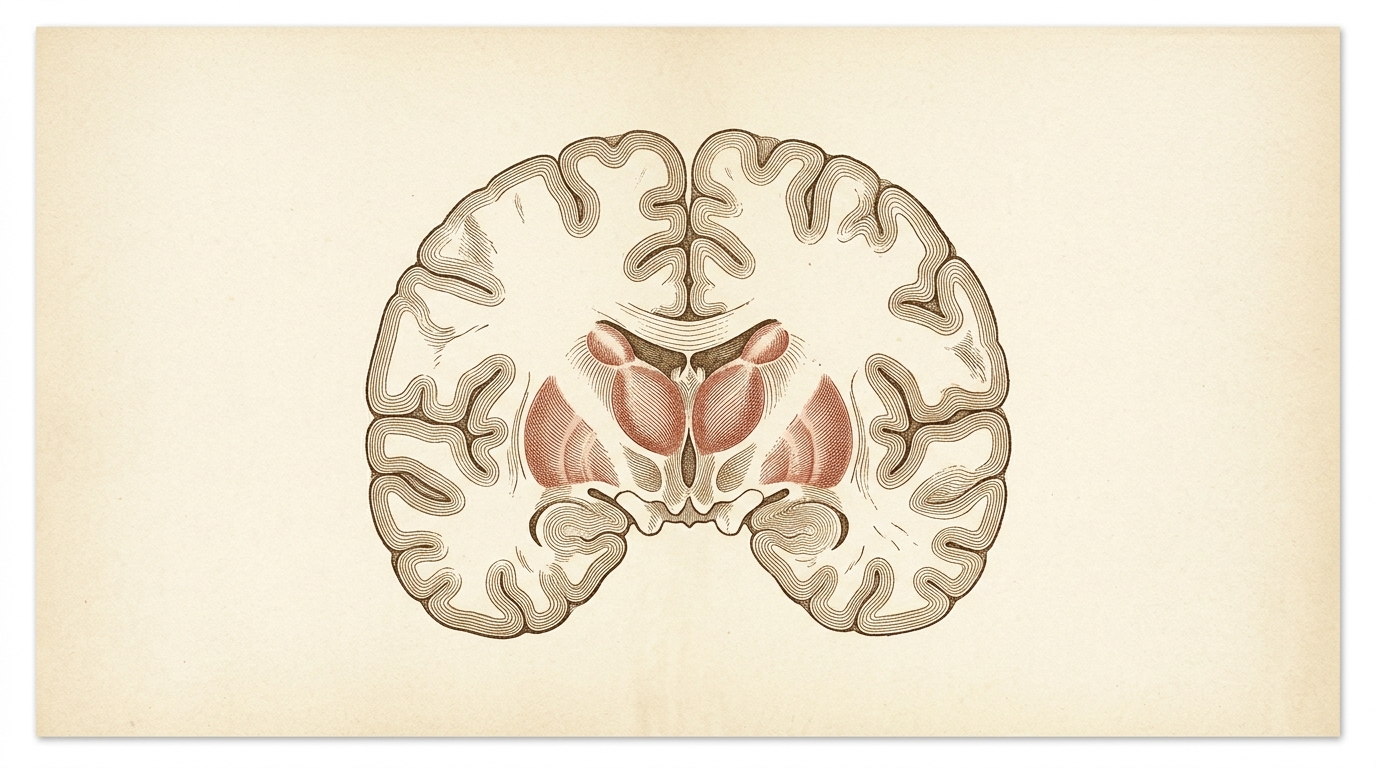
But FOXP2 was never a "grammar gene." Follow it into the brain and it lights up the basal ganglia — the caudate, the deep circuits that chain movements into fluent sequences. F5 When scientists engineered mice to carry the two human changes, the mice didn't talk. Their striatal neurons grew differently, their dopamine shifted, and they learned motor routines faster — sliding sooner from conscious effort into automatic habit. F6 Not language. The machinery of learned, sequenced movement.
05THE TWIST
And then the grand story came apart. In 2007, Neanderthal bones gave up their DNA — and they carried the very same two changes. F7 Whatever those mutations did, it wasn't what made us uniquely human. Then in 2018, a larger, more diverse genetic survey went looking for the famous "selective sweep" that supposedly fixed FOXP2 in our ancestors. It wasn't there. The original signal was an artifact of who had been sampled. F8
06WHAT IT REALLY IS
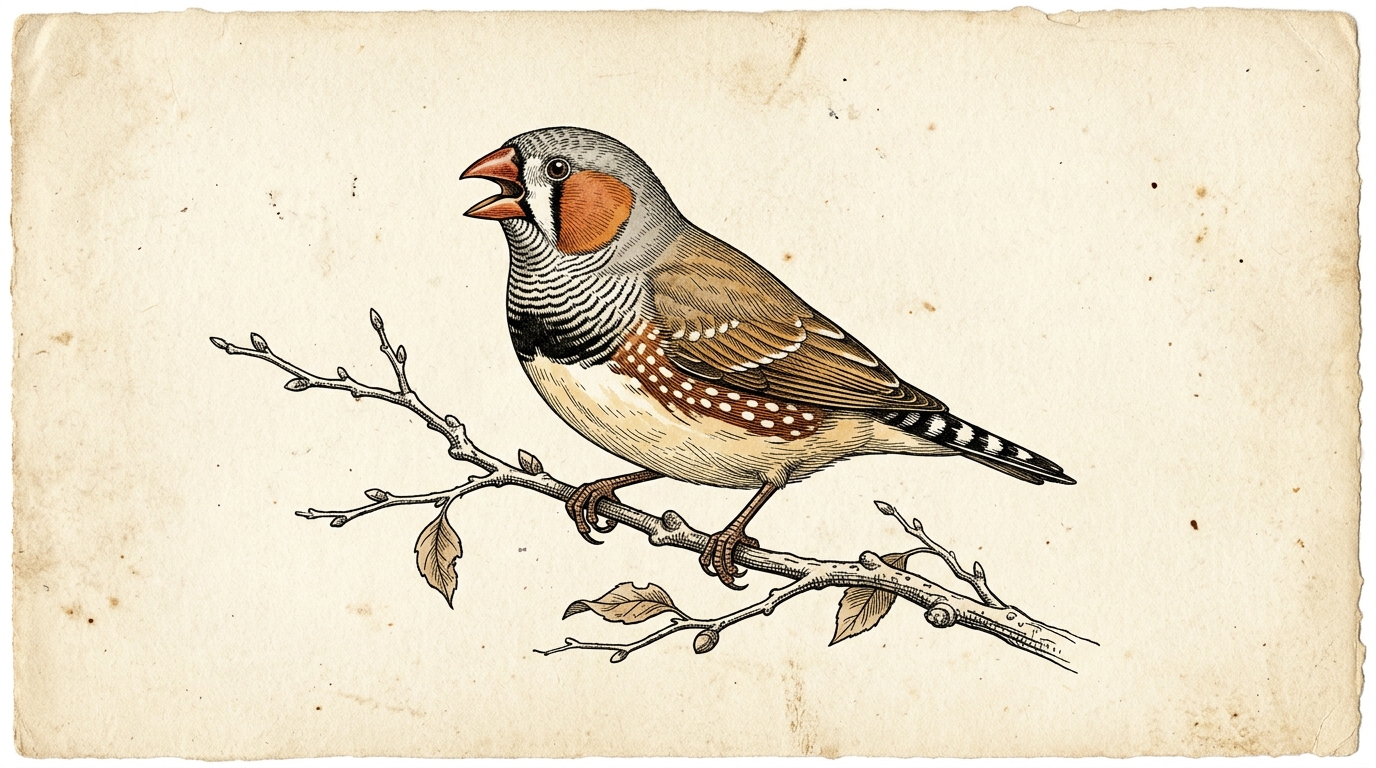
So what is FOXP2, really? A deeply ancient gene, almost unchanged across the vertebrates, switched on in the lung and the gut and the heart as well as the brain. F9 Silence it in a young songbird, and it can no longer copy its father's song cleanly. F10 FOXP2 isn't the gene for language. It's a tuner for learned vocal sequences — one node in a network we are still mapping.
07THE OPEN THREAD
Language was never going to be one gene. FOXP2 was just the first thread we pulled — and pulling it showed us how much larger the tapestry really is.
08TIMELINE + SIGN-OFF
From a London family, to a chimp, to a Neanderthal, to a singing finch — the gene we crowned, then learned to understand. — The Gene Channel.
The write-up
In one line: FOXP2 was crowned "the language gene" on the strength of two amino acids — and then the evidence quietly took the crown back.
The gene
FOXP2 ("forkhead box P2") sits on the long arm of chromosome 7 (7q31). It doesn't build the machinery of speech directly; it's a transcription factor — a regulatory switch that turns hundreds of other genes on and off. It came to science through the KE family, a three-generation London pedigree in which about half the members inherit a severe speech-and-language disorder (developmental verbal dyspraxia / childhood apraxia of speech: orofacial-motor deficits plus expressive and receptive language problems). In 2001 the cause was pinned to a single change in FOXP2 — R553H, arginine to histidine, in the protein's DNA-binding (forkhead) domain.
The crowning
In 2002 came the headline finding: human FOXP2 differs from the chimpanzee's by just two amino acids (T303N and N325S — both distinct from the KE family's R553H). The same paper argued the gene had been swept through our species by recent positive selection, roughly coincident with the dawn of language. The story was irresistible: two changes, and humanity could speak. The press dubbed it the language gene.
The mechanism
What FOXP2 actually does is subtler — and not about grammar. It is expressed in the basal ganglia (the striatum/caudate) and shapes corticostriatal circuits. KE-family members show structural and functional differences in the caudate. When researchers engineered mice to carry the two human amino acids, the mice didn't talk: their striatal neurons grew differently, dopamine shifted, and they moved faster from declarative to procedural learning — i.e., they automated motor routines sooner. FOXP2's domain is learned, sequenced movement, not syntax.
The fall — and what's really true
Then the grand narrative came apart. In 2007, ancient DNA showed Neanderthals carried the same two changes — so they can't be what made modern humans uniquely able to speak. In 2018, a large, globally diverse genetic survey found no evidence of a recent selective sweep at FOXP2; the original signal was an artifact of sample composition. And FOXP2 turns out to be a deeply conserved, pleiotropic gene — expressed in lung, gut and heart as well as brain, and required by songbirds to copy their songs. It isn't "the gene for language." It's one node in a vast network — the first thread we pulled.
Sources
Full claim-by-claim evidence is in references.md. Primary anchors:
- Lai et al. 2001, Nature — FOXP2 identified; R553H in the KE family.
- Enard et al. 2002, Nature — two human-vs-chimp substitutions; the (later-refuted) selection claim.
- Watkins et al. 2002, Brain; Vargha-Khadem et al. 2005, Nat Rev Neurosci — basal-ganglia phenotype.
- Krause et al. 2007, Current Biology — Neanderthals share the two derived changes.
- Haesler et al. 2007, PLoS Biology — FoxP2 knockdown impairs songbird vocal imitation.
- Enard et al. 2009, Cell; Schreiweis et al. 2014, PNAS — humanized-mouse corticostriatal/procedural effects.
- Atkinson et al. 2018, Cell — no evidence of recent selection at FOXP2.
Accuracy note: This episode is deliberately built against three traps in the popular FOXP2 story. (1) The KE mutation R553H is not one of the two human-vs-chimp changes (T303N/N325S) — different positions, different meaning (disease vs. evolution). (2) There was no recent selective sweep, and the two changes are shared with Neanderthals — so "two amino acids made modern humans speak" is unsupported. (3) FOXP2 is not "the language gene" and there is no evidence it confers syntax or recursion; it is a pleiotropic regulator of vocal-motor / procedural-sequence learning.
The evidence
Every claim, sourced
Each [F#] you hear in the film links to the source it came from. Nothing gets narrated until every one is checked and signed off.
Sign-off
- PhD sign-off — facts above are correct; the R553H vs T303N/N325S distinction and the "no sweep / not the language gene" corrections are stated correctly in
script.md. (Signed off 2026-06-13.) - Numbers/dates verified (2001 gene ID · 2002 two-aa + sweep claim · 2007 Neanderthal · 2009 humanized mouse · 2014 procedural learning · 2018 sweep refuted) — narration keeps figures qualitative where exact values aren't load-bearing.
Gate OPEN → narration + render may proceed. (Honest rise-and-fall angle approved at the ~3 min cut.)
- F1
A 3-generation London family ("the KE family") carries an inherited speech-and-language disorder: ~half of members across the pedigree have a severe developmental verbal dyspraxia (childhood apraxia of speech) — orofacial motor deficits plus expressive/receptive language and grammar impairment — segregating as an autosomal-dominant trait.
KE family pedigree; speech + language (incl. grammar) deficits in affected members; ~half affected, dominant inheritance.
- F2
The KE mutation is a single residue change — R553H (arginine→histidine) — in the forkhead (DNA-binding) domain of FOXP2. (Distinct from F4.)
Heterozygous G→A point mutation; R553H at an invariant forkhead-domain residue; disrupts DNA binding.
- F3
FOXP2 ("forkhead box P2") is a transcription factor (regulates other genes); human locus chromosome 7q31.
FOX/winged-helix TF; NCBI Gene ID 93986; SPCH1 locus 7q31.
- F4
Human FOXP2 protein differs from the chimpanzee ortholog by exactly two amino-acid substitutions (T303N, N325S; exon 7), both on the human lineage. (Distinct from F2; these are NOT in the DNA-binding domain.)
2 of 715 residues differ from chimp (3 from mouse); T303N/N325S. Nuance: N325S is not human-unique and only T303N is functionally important in mice — so "two magic changes" oversells N325S.
- F5
FOXP2 acts in the basal ganglia (striatum/caudate) and corticostriatal circuits; affected KE members show caudate (and IFG, cerebellum) structural/functional abnormalities.
Reduced caudate grey matter + abnormal caudate/IFG activation on MRI/PET in affected members.
- F6
"Humanized" mice (mouse Foxp2 carrying T303N+N325S) show altered striatal medium-spiny-neuron dendrites, lower dopamine, greater synaptic plasticity, altered vocalizations, and a faster shift from declarative to procedural learning — they did not acquire language.
Cortico-basal-ganglia effects (Enard 2009); accelerated declarative→procedural transition on T-maze (Schreiweis 2014). State explicitly: no speech/language/syntax gained.
- F7
Neanderthals carried the same two derived FOXP2 amino-acid changes as modern humans.
Neanderthal DNA shows the 303N/325S forms; reaffirmed for Neanderthals + Denisovans (2023). Undercuts "these changes made modern humans speak."
- F8
A large, globally diverse 2018 study found no evidence of a recent positive-selection sweep at FOXP2; the original 2002 signal was an artifact of sample composition / unmodeled demography.
Tajima's-D signal replicated only when bottlenecked out-of-Africa pops were pooled; vanished analyzing African pops separately.
- F9
FOXP2 is deeply conserved across vertebrates and pleiotropic — expressed beyond the brain (lung/respiratory, gut, heart). It is not "the language gene."
Conserved FOX TF; broad expression; many downstream targets — a single node in a large network.
- F10
Knocking down FoxP2 in the basal-ganglia song nucleus (Area X) of juvenile songbirds causes incomplete, inaccurate vocal imitation — a parallel to human speech-motor learning.
Lentiviral FoxP2 knockdown in zebra-finch Area X → abnormally variable, inaccurate song copying.