FOXO3
The Switch That Lives to 100
Live to a hundred, and the odds are you carry one particular version of this gene — a master switch, first found in a worm, that tells stressed cells to defend, repair, and clean house.
The walkthrough
Beat by beat



HOOK
0:39
01HOOK
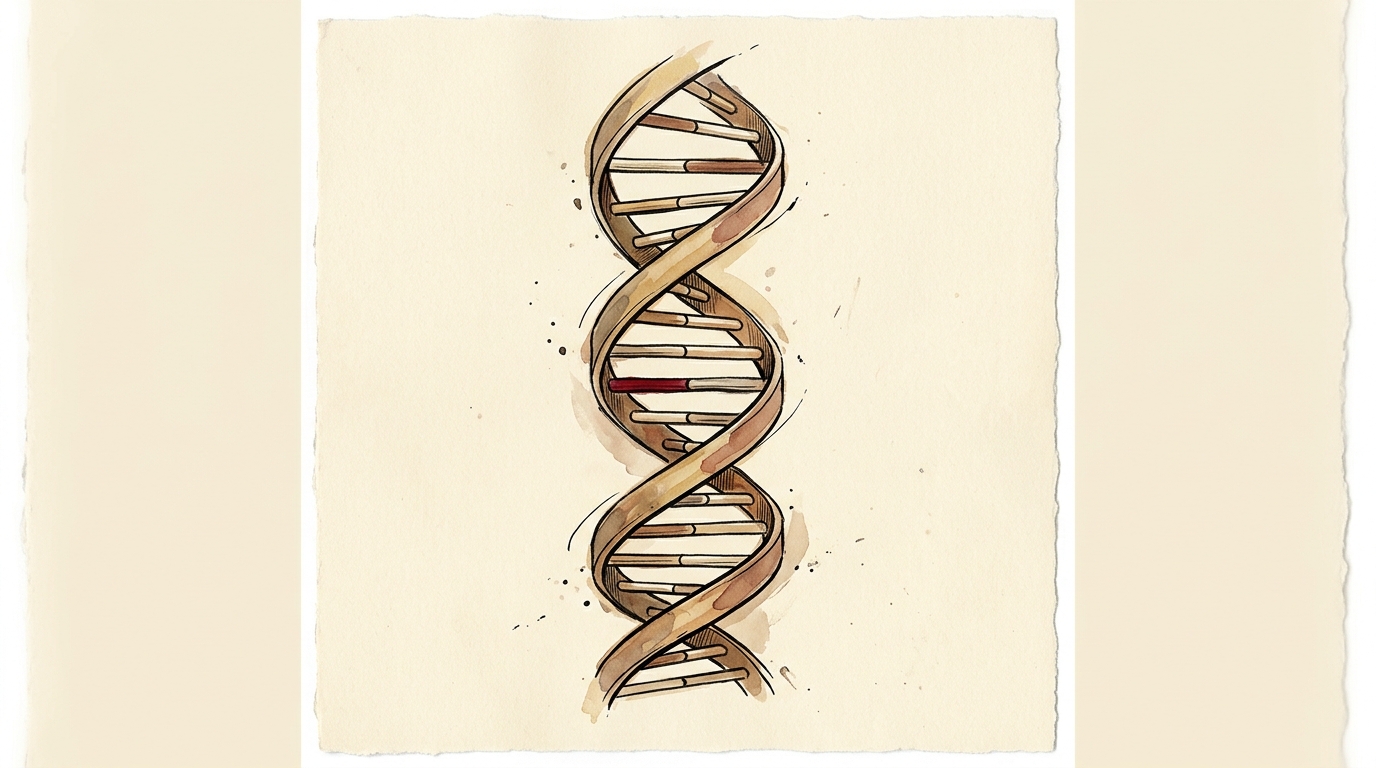
Live to a hundred, and the odds are you carry a particular version of a single gene. It turns up again and again in the world's longest-lived people — in Okinawa, in Germany, in Italy, in California `F1`. Apart from one gene already famous for Alzheimer's risk, no gene has been tied to a very long life more consistently `F2`. It's called FOXO3 — and inside your cells, it's a switch.
02THE NAME
It sits on the long arm of chromosome 6 `F3`. And it does something deceptively powerful: it's a transcription factor — a master switch that turns whole sets of other genes on at once `F4`. Specifically, the genes a cell reaches for when it's under threat.
03THE HUNT
We didn't find it by studying old people. We found it in a worm. In 1993, biologists discovered that changing a single gene let the roundworm C. elegans live more than twice as long as normal `F5` — but only if a second gene was intact. That second gene was daf-16 `F6`. And daf-16 turned out to be the worm's copy of the FOXO family — the same family our FOXO3 belongs to `F7`.
04THE METHOD
So in 2008, researchers in Hawaii went looking in people. Studying men of Japanese ancestry, they compared the exceptionally long-lived to everyone else — and there it was: a version of FOXO3 carried by those who reached the greatest ages `F8`. One copy nearly doubled the odds of living into the mid-nineties; two copies nearly tripled them `F9`. Then it replicated — in German, Italian, Chinese, and other populations around the world `F10`.
05THE MECHANISM (hero)
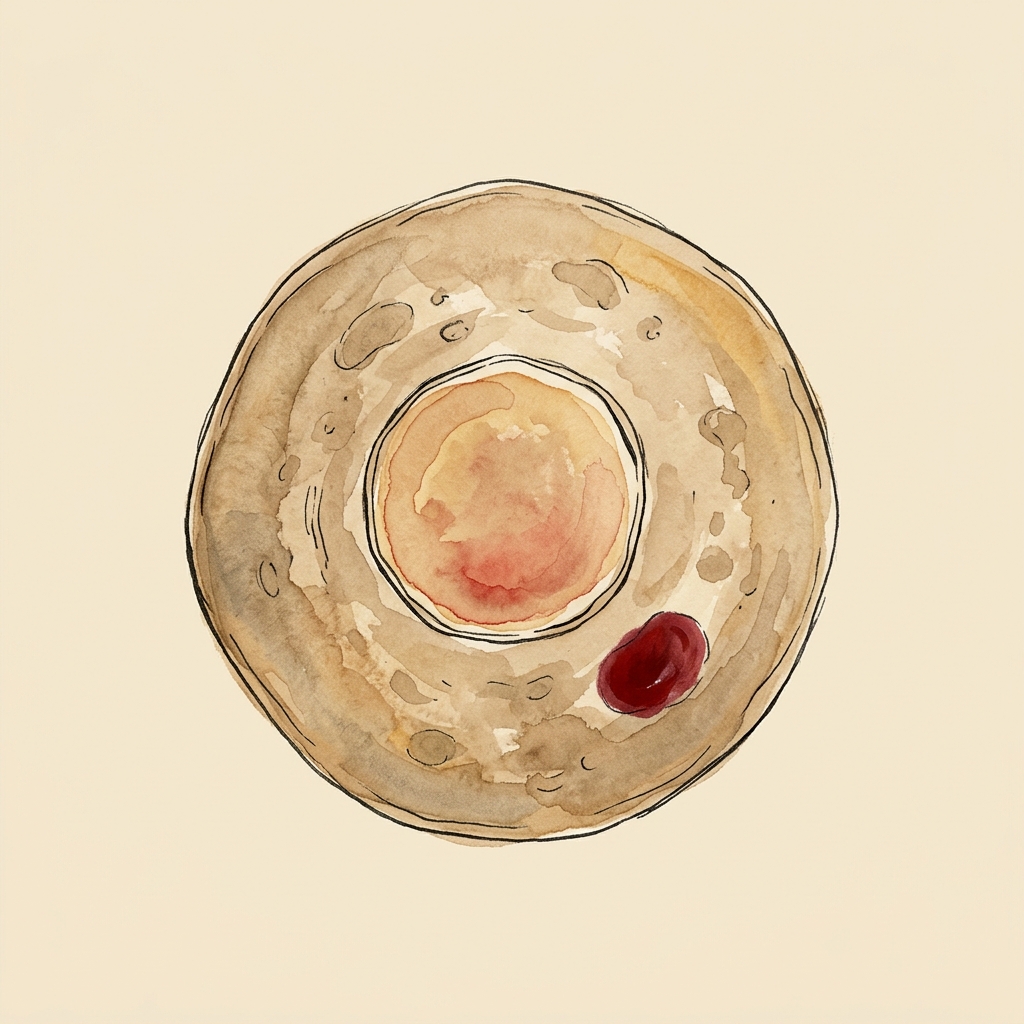
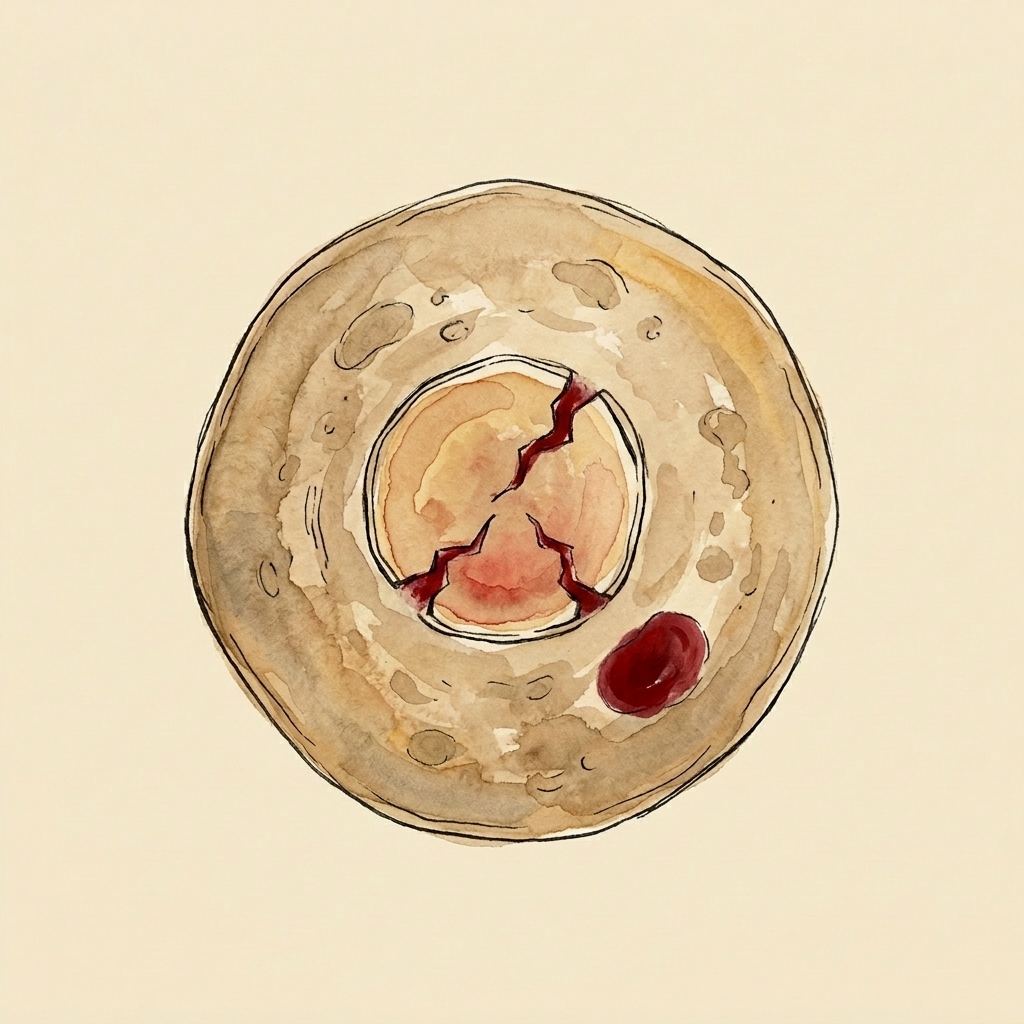
Here's what that switch actually does. When food is plentiful and growth signals — insulin and IGF-1 — run high, an enzyme called AKT tags FOXO3 and parks it out in the cytoplasm, idle `F11`. But when the cell is stressed — oxidative damage, scarcity — FOXO3 is released. It slips into the nucleus `F12`, and there it switches on the cell's defense program: antioxidant enzymes that neutralize damage, DNA-repair genes, and autophagy — the machinery that digests and recycles a cell's own broken parts `F13`. Defend, repair, clean house. That is FOXO3's job.
06THE STAKES
This is why the longevity version matters. It isn't a gene for living forever — it's a gene for cells that defend themselves better, for longer. Carriers don't just reach older ages; they show lower rates of heart disease and other diseases of aging `F14`. Healthspan, not just lifespan.
07THE OPEN THREAD
There's no FOXO3 pill `F15`. But the pathway it sits on is exactly the one that fasting, exercise, and caloric restriction push on `F16` — the same insulin-and-growth signaling, turned down, that frees FOXO3 to work. The open question is whether we can hand everyone the protection that a lucky few simply inherit `F17`.
08TIMELINE + SIGN-OFF
From a long-lived worm in 1993 to centenarians across the world, the same switch keeps surfacing — a cell's own built-in program for staying alive, and well, longer. — The Gene Channel.
The write-up
In one line: FOXO3 is a master switch inside your cells — held idle when growth signals run high, but released into the nucleus under stress to turn on antioxidant defense, DNA repair, and cellular recycling; one version of it keeps turning up in the people who live to 100.
The gene
FOXO3 (forkhead box O3) sits on the long arm of chromosome 6, at 6q21. It doesn't build a structural part or an enzyme that does one job — it's a transcription factor, a master switch that binds DNA and turns whole sets of other genes on at once. The set it controls is the cell's threat-response program. Apart from APOE (the gene best known for Alzheimer's risk), FOXO3 is the most consistently replicated genetic association with human longevity ever found — the two genes the CHARGE GWAS meta-analysis singled out across populations.
The hunt
The longevity link didn't start with old people — it started with a worm. In 1993, Cynthia Kenyon's lab showed that changing a single gene (daf-2) let C. elegans live more than twice as long as normal — but only if a second gene, daf-16, was intact. daf-16 turned out to be the worm's single copy of the FOXO family of forkhead transcription factors (mammals later split that one ancestral gene into four: FOXO1/3/4/6). The worm had handed us the pathway. Then in 2008, Bradley Willcox and colleagues, studying long-lived men of Japanese ancestry in Hawaii, found a version of FOXO3 carried by those who reached the greatest ages: one protective copy nearly doubled the odds of living into the mid-90s, two copies nearly tripled them. It replicated in German, Italian, Chinese, and other cohorts worldwide.
The mechanism
FOXO3 is governed by where it sits in the cell. When food is plentiful and growth signals — insulin and IGF-1 — run high, the PI3K→AKT pathway phosphorylates FOXO3; a 14-3-3 protein then binds it and holds it out in the cytoplasm, idle. When the cell is stressed — oxidative damage, nutrient scarcity — that brake comes off and FOXO3 moves into the nucleus, where it switches on the defense program: antioxidant enzymes (SOD2/MnSOD, catalase) that neutralize reactive oxygen species, DNA-repair genes (e.g. GADD45), and autophagy — the machinery that digests and recycles a cell's own damaged parts. Defend, repair, clean house.
The stakes, and the frontier
This is why the longevity variant matters: it isn't a gene for immortality, it's a gene for cells that defend themselves better, for longer. Carriers of the FOXO3 longevity genotype show lower coronary-heart-disease mortality and reduced rates of other aging-related disease — healthspan, not just lifespan. There is no FOXO3 drug. But the pathway it sits on is the very one that fasting, exercise, and caloric restriction push on: dial the insulin/IGF growth signal down, and FOXO3 is freed to work. The open question is whether we can hand everyone the protection that a lucky few simply inherit.
Sources
Full claim-by-claim evidence is in references.md. Primary anchors:
- Kenyon et al. 1993, Nature 366:461 — C. elegans daf-2 mutant lives twice as long; requires daf-16.
- Willcox et al. 2008, PNAS 105:13987 — FOXO3 genotype strongly associated with human longevity.
- Flachsbart et al. 2009, PNAS 106:2700 — replication in German centenarians.
- Broer et al. 2015 (CHARGE), J Gerontol A 70:110 — GWAS confirms APOE and FOXO3 candidacy.
- Brunet et al. 1999, Cell 96:857 — AKT phosphorylation governs FOXO cytoplasmic retention.
- Kops et al. 2002, Nature 419:316 / Tran et al. 2002, Science 296:530 — FOXO3 drives antioxidant (MnSOD) and DNA-repair (GADD45) programs.
Accuracy note (the traps the fact-gate caught): (1) daf-16 is the worm's single, ancestral FOXO gene — not "FOXO3 specifically"; the episode says "the FOXO family FOXO3 belongs to." (2) The longevity SNP (rs2802292) is a regulatory/non-coding variant that changes how much FOXO3 is expressed — it does not break the protein — so the episode says "version/variant," never "mutant," and frames longevity as an association, not a guarantee. (3) The original 2008 association was found in men; later work extended it to women.
The evidence
Every claim, sourced
Each [F#] you hear in the film links to the source it came from. Nothing gets narrated until every one is checked and signed off.
Sign-off
- PhD sign-off — facts above are correct; the ⚠️ traps (F7 daf-16 = ancestral FOXO, not FOXO3; F8 the longevity SNP is regulatory/non-coding and male-discovered) are stated correctly in
script.md. (Signed off 2026-06-13.) - Numbers/dates verified or kept qualitative: 1993 (Kenyon), 2008 (Willcox); odds "nearly doubled / nearly tripled" (≈1.9× / ≈2.7×) kept as round language; locus 6q21.
- Longevity framed as association, not determinism ("odds rose," "carriers"), and the variant as a version/variant (regulatory), never a damaged protein.
**Gate OPEN** (2026-06-13) → narration + render may proceed. Lean ~2–2.5 min cut approved.
- F1
A FOXO3 variant recurs in the world's longest-lived people — Okinawa/Japan, Germany, Italy, California
Original association in Japanese-ancestry men (Hawaii); replicated in German, Italian, and other cohorts; Okinawan longevity-genotype work
- F2
Apart from APOE, no gene has been tied to longevity more consistently
FOXO3 is the second consistently-replicated human longevity gene after APOE; the CHARGE GWAS meta-analysis "confirms APOE and FOXO3 candidacy" as the two robust loci
- F3
FOXO3 sits on the long arm of chromosome 6 (6q21)
"Human FOXO3 is located on the long arm of chromosome 6 (6q21)"
- F4
FOXO3 is a forkhead transcription factor — a master switch turning on whole gene sets
FOXO3 is an O-subclass forkhead-box transcription factor; activates programs for stress response
- F5
1993: changing one gene let C. elegans live more than twice as long
Kenyon et al.: daf-2 mutation makes adult hermaphrodites "live more than twice as long as wild type"
- F6
…but only with a second gene, daf-16, intact
Same paper: the lifespan extension "requires the activity of a second gene, daf-16"
- F7⚠ commonly confused
daf-16 is the worm's copy of the FOXO family that FOXO3 belongs to (NOT FOXO3 specifically — the worm has one ancestral FOXO)
daf-16 is the single C. elegans forkhead/FOXO gene; mammals have four paralogs (FOXO1/3/4/6); script says "the FOXO family … FOXO3 belongs to," not "is FOXO3"
- F8⚠ commonly confused
2008, Hawaii, men of Japanese ancestry: a FOXO3 variant carried by those reaching the greatest ages
Willcox et al.: 3 FOXO3 SNPs (lead rs2802292) associated with longevity in long-lived Japanese-American men. Trap: the longevity SNP is intronic/regulatory — it changes FOXO3 expression, not the protein sequence → narrate "version/variant," never "broken/mutant protein." Original cohort was male; later extended to women.
- F9
One copy ≈ doubled odds of living to ~mid-90s; two copies ≈ tripled
Willcox 2008: heterozygotes ~1.9-fold and homozygotes ~2.7-fold greater odds of reaching ~95 vs. non-carriers
- F10
Replicated in German, Italian, Chinese, and other populations
German centenarians (Flachsbart 2009); southern Italian (Anselmi 2009); broadly replicated across ≥11 independent studies of diverse ancestry
- F11
High insulin/IGF-1 → AKT tags FOXO3 → held in the cytoplasm, inactive
Insulin/IGF-1 act via PI3K→AKT; AKT phosphorylation drives 14-3-3 binding and cytoplasmic retention of FOXO3 (inactivation)
- F12
Under stress / low signaling → FOXO3 moves to the nucleus
PI3K inhibition / cellular stress → FOXO3 dephosphorylation and nuclear accumulation, where it acts as a transcription factor
- F13
In the nucleus it switches on antioxidant enzymes, DNA-repair genes, and autophagy
FOXO3 transactivates antioxidants (SOD2/MnSOD, catalase), DNA-repair (e.g. GADD45), and autophagy/ATG genes
- F14
Carriers show lower rates of heart disease and other aging diseases
FOXO3 longevity genotype associated with reduced coronary heart disease mortality across three American populations; lower CHD/cause-specific mortality
- F15
There is no approved FOXO3-targeting drug
No FOXO3-directed therapeutic is approved; FOXO3 modulation remains preclinical/research (kept qualitative)
- F16
Fasting, exercise, and caloric restriction act on the same insulin/IGF–IIS pathway upstream of FOXO3
Caloric restriction / low insulin–IGF signaling de-represses FOXO/FOXO3 activity; conserved IIS→FOXO longevity axis
- F17
Open question: can we give everyone the protection a lucky few inherit?
Framing/derived from F2 + F15 (no current drug; pathway is the target)