FLG
The Barrier Gene
Your skin makes its own moisturizer — from a single gene. Break it, and the barrier leaks: the strongest genetic risk we know for eczema, and the opening act of the allergic march.
The walkthrough
Beat by beat

HOOK
0:12
01HOOK
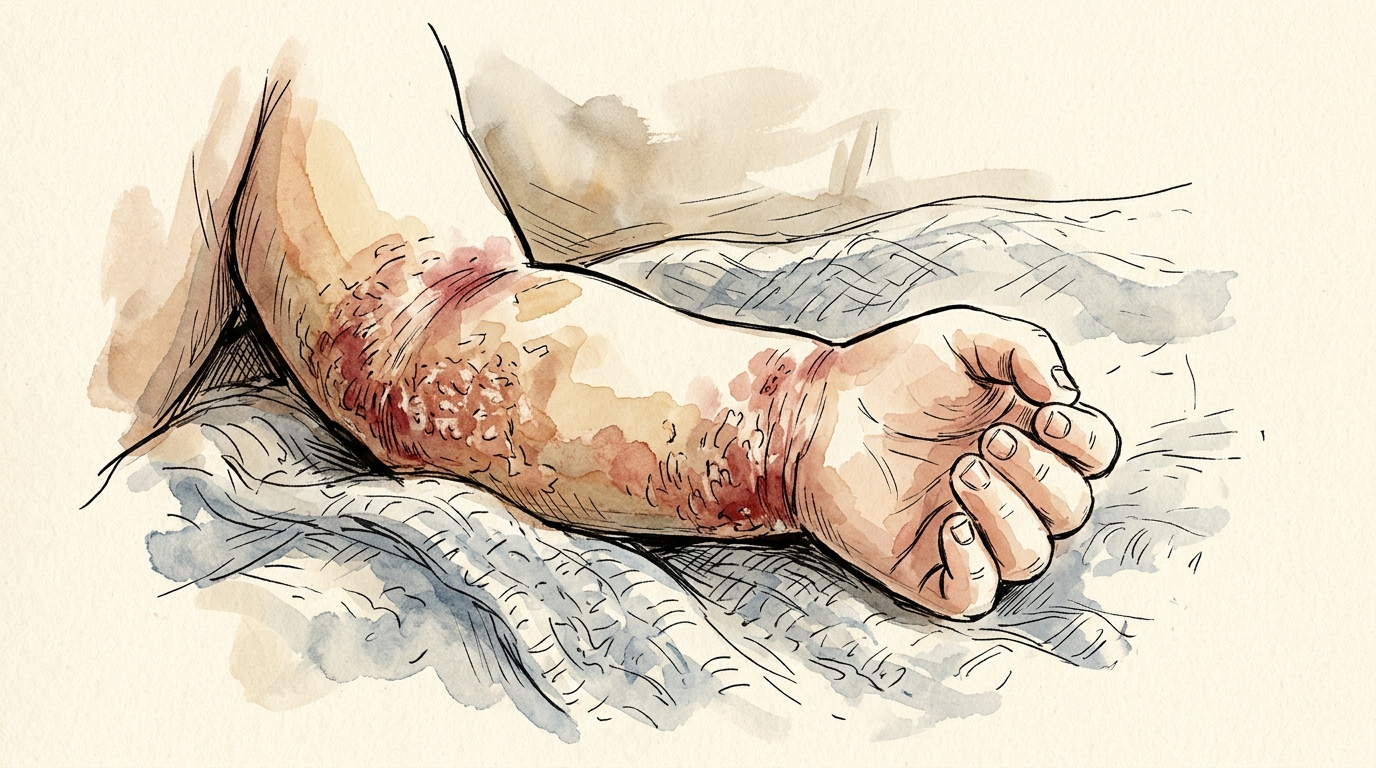
Your skin makes its own moisturizer — brewed from a protein called filaggrin. F1 Break the gene behind it, and you inherit the single strongest genetic risk we know for eczema. F2
02THE NAME
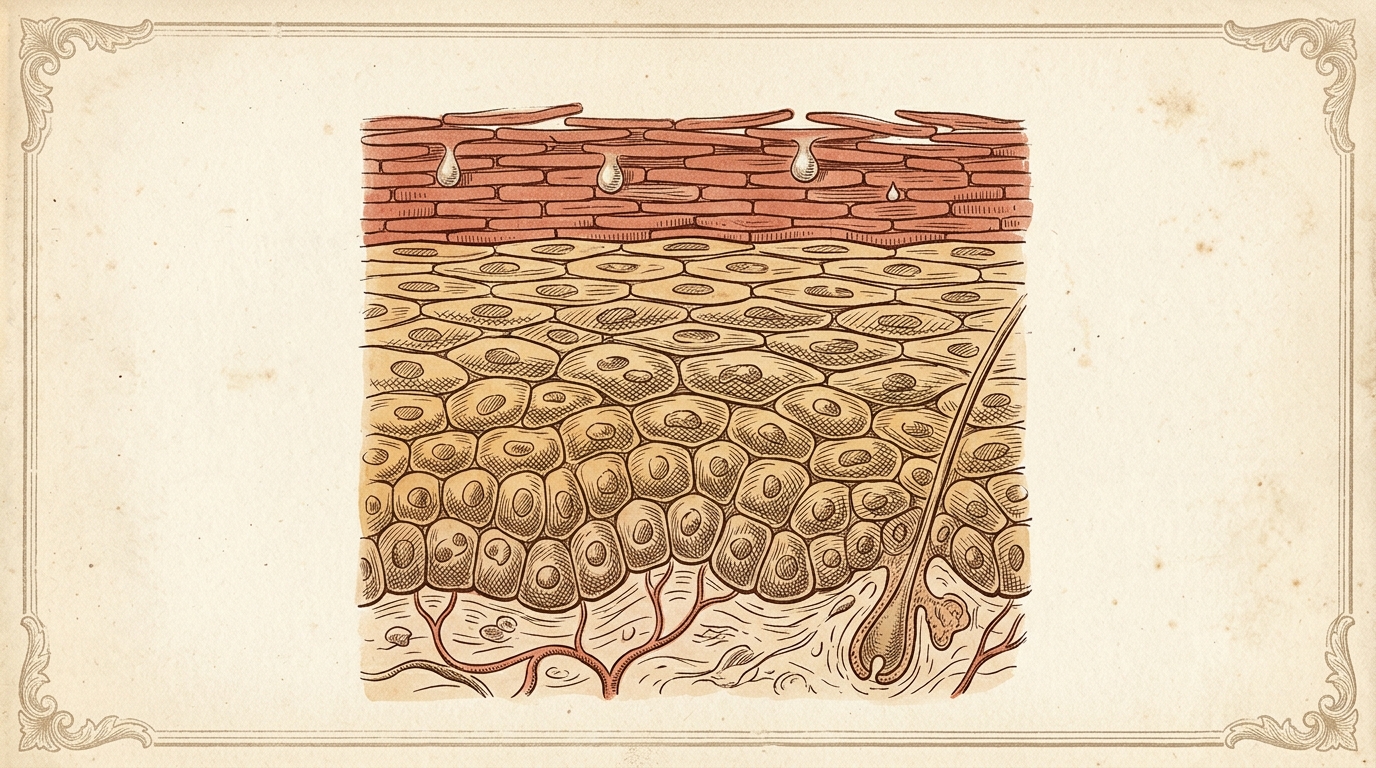
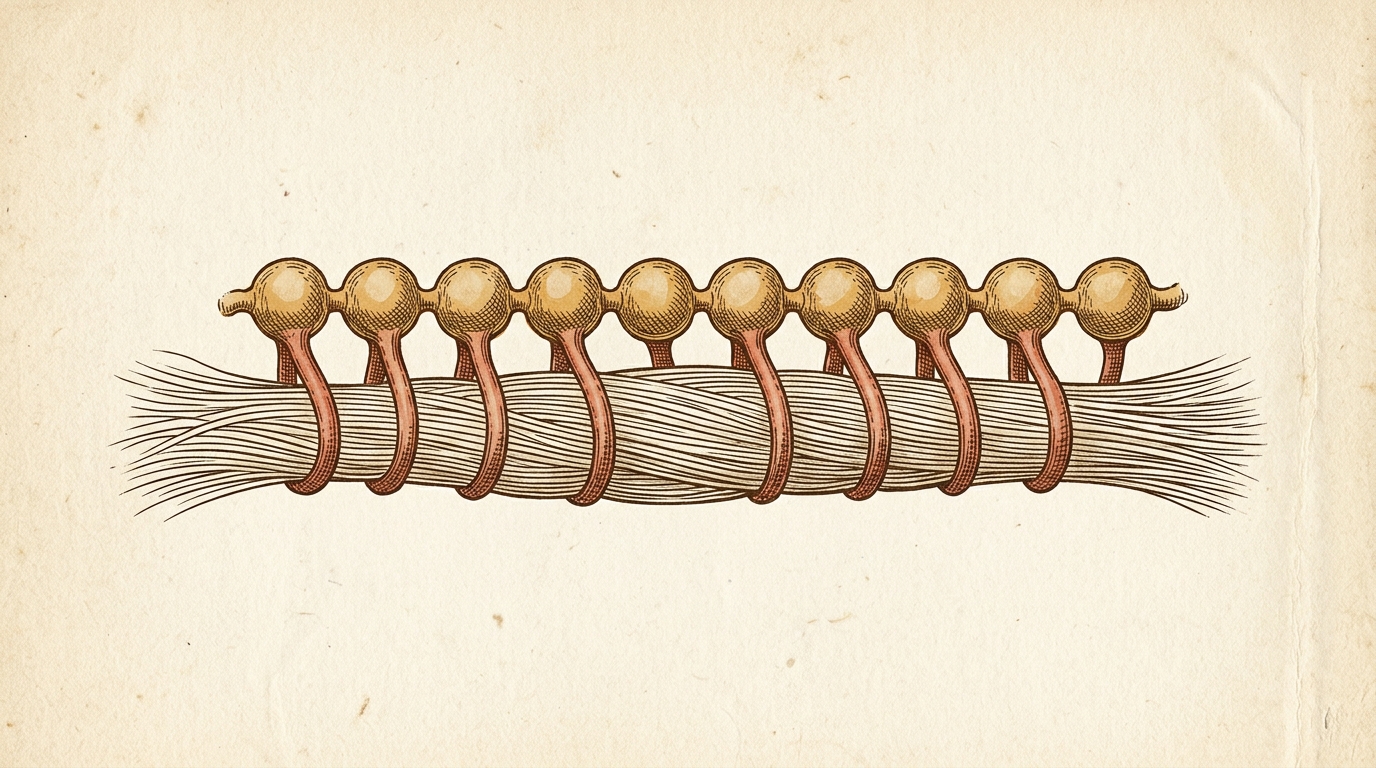
The gene is FLG — filaggrin, short for "filament-aggregating protein." F3 It sits on chromosome 1, inside a tight cluster of skin-barrier genes called the epidermal differentiation complex. F4 And roughly one in ten people of European ancestry carry a broken copy. F5 Its job: bundle the keratin scaffolding inside your outermost skin cells, packing them into flat, tough plates — the bricks of the barrier. F6
03THE HUNT (the scientist)
For decades the gene hid in plain sight. The protein filaggrin was named back in 1981 F7 — but its gene resisted everyone, because its core is a long run of near-identical repeats that ordinary sequencing simply can't read. F8 In 2006, a team led by Irwin McLean at the University of Dundee — with Frances Smith, Alan Irvine, and Colin Palmer — finally pinned it down. F9
04THE METHOD
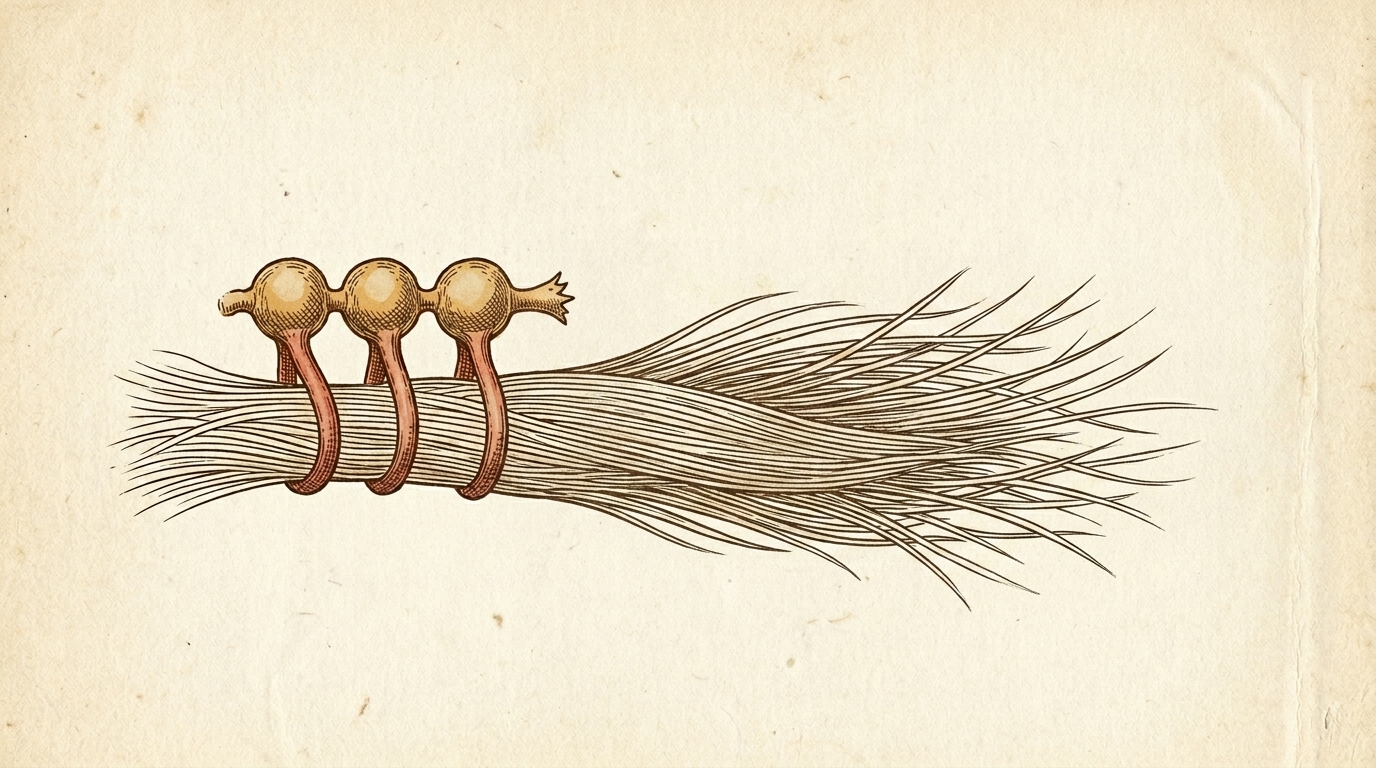
They started with ichthyosis vulgaris — the most common inherited dry, scaly skin. F10 To read FLG at all, they amplified its giant repeat region in overlapping pieces and reassembled it like a jigsaw. F8 Two "off-switch" mutations kept surfacing in European families — R501X and 2282del4. F11 Then came the twist: those very same mutations were also a major risk factor for eczema. F12
05THE MECHANISM (hero)
Here's why it matters. Healthy filaggrin does two jobs. First it aggregates keratin — collapsing each surface cell into a flat plate, the bricks of the barrier. F6 Then it's broken down into a pool of amino acids and acids — "natural moisturizing factor" — the skin's built-in humectant that holds water and keeps the surface slightly acidic. F13 Lose filaggrin, and you lose both: the bricks don't pack tight, the moisturizer isn't made, water escapes. F14 Now allergens slip through the broken barrier, and the immune system, meeting them there, learns to react. Barrier first, allergy second. F15
06THE STAKES
That reframed a whole cascade. A leaky barrier in infancy is now seen as the opening act of the "atopic march" — eczema, then food allergy, then asthma and hay fever. F16 Filaggrin loss is even linked to peanut allergy F17 — the body sensitized not through the gut, but through the skin. F16
07HOW TO USE IT
So what do you do with it? The discovery flipped eczema from a pure immune mystery to a barrier you can help repair — which is why gentle, barrier-friendly moisturizers are front-line treatment. F18 But one honest caveat: slathering emollient on every newborn does not prevent eczema — two large trials found no benefit, and a hint of more skin infections. F19 Emollients manage the barrier; they don't rewrite the gene. And there's no filaggrin "fix" yet — today's best drugs calm the immune half of the loop. F20
08TIMELINE + SIGN-OFF
From a protein named in 1981 to a gene cracked in 2006 F9, filaggrin turned skin from a passive wrapper into an active border — the wall that decides what the world gets to touch. Mind the barrier. — The Gene Channel.
The write-up
In one line: FLG builds the protein that packs your skin into a waterproof wall and becomes the skin's own moisturizer — break it, and the barrier leaks, making a broken copy the single strongest genetic risk factor known for eczema and the opening act of allergic disease.
The gene
FLG sits on chromosome 1q21.3, inside a tight cluster of skin-barrier genes called the epidermal differentiation complex. It encodes filaggrin — short for "filament-aggregating protein," the name Peter Steinert and Beverly Dale gave it in 1981 for what it does. The protein is made as a giant, repetitive precursor, profilaggrin, stored in the granules of the skin's upper layer; as those cells terminally differentiate, profilaggrin is cleaved into many copies of the working filaggrin monomer. About 1 in 10 people of European ancestry carry at least one broken (loss-of-function) copy.
The hunt — and the scientist
For decades the gene hid in plain sight. The protein was well characterised, but its gene resisted everyone, because the core of FLG (exon 3) is a giant run of near-identical tandem repeats that ordinary short-read PCR sequencing simply cannot resolve. In 2006, a team led by W. H. Irwin McLean at the University of Dundee finally cracked it — using long-range PCR to amplify the whole repeat region and reassembling it from overlapping fragments like a jigsaw. It was a genuine team achievement: Frances Smith was first author on the ichthyosis-vulgaris paper, Colin Palmer on the atopic-dermatitis paper, and Alan Irvine (Dublin) was a co-driver throughout. Two "off-switch" mutations kept surfacing in European families — R501X and 2282del4 (different populations carry different FLG-null mutations). Starting from ichthyosis vulgaris — the most common inherited dry, scaly skin, a semidominant trait — they showed those same variants were also a major risk factor for eczema.
The mechanism
The stratum corneum is a "bricks and mortar" wall: flattened dead cells (corneocytes) are the bricks, lipids are the mortar. Filaggrin works inside the bricks, doing two jobs. First it aggregates keratin filaments, collapsing each cell into a tough, flat plate. Then filaggrin is itself broken down into a pool of amino acids and acids — "natural moisturizing factor" (NMF), including PCA and urocanic acid — the skin's own built-in humectant that holds water and helps keep the surface slightly acidic. Lose filaggrin and you lose both: the bricks don't pack tight, the moisturizer isn't made, water escapes (raised transepidermal water loss), and the barrier leaks. Allergens and microbes then penetrate the broken barrier, and the immune system — meeting them through the skin — is sensitised. This is the "outside-in" model: barrier first, allergy second. (It is the leading model from the genetic evidence, though the biology is bidirectional — immune signals like IL-4/IL-13 also suppress filaggrin.)
The stakes, and how to use it
A leaky barrier in infancy is now seen as the opening act of the "atopic march" — eczema, then food allergy, then asthma and allergic rhinitis. Notably, FLG raises asthma risk mainly in the context of eczema (there is no filaggrin in the airway) — the sensitisation route is the skin, not the lung; FLG loss is even linked to peanut allergy.
The discovery's biggest practical legacy is conceptual: it reframed eczema from a purely immune mystery into a barrier disease you can help repair, putting gentle, barrier-friendly moisturisers front-line for treatment. One honest caveat matters, though: moisturising every newborn does not prevent eczema. Two large randomised trials — BEEP and PreventADALL (both Lancet 2020) — found daily emollient did not prevent atopic dermatitis, and BEEP saw a signal of more skin infections. Emollients manage the barrier; they don't rewrite the gene. And there is no filaggrin "fix" yet — today's best drugs (e.g. dupilumab) calm the immune half of the loop, restoring filaggrin only indirectly. FLG genotyping remains a research tool, not routine clinical care.
Sources
Full claim-by-claim evidence is in references.md. Primary anchors:
- Smith FJD, Irvine AD, … McLean WHI. Loss-of-function mutations in the gene encoding filaggrin cause ichthyosis vulgaris. Nat Genet 2006. [PMID 16444271]
- Palmer CNA, Irvine AD, … McLean WHI. Common loss-of-function variants of filaggrin are a major predisposing factor for atopic dermatitis. Nat Genet 2006. [PMID 16550169]
- Irvine AD, McLean WHI, Leung DYM. Filaggrin mutations associated with skin and allergic diseases. NEJM 2011. [PMID 21991953]
- Brown SJ, McLean WHI. One remarkable molecule: Filaggrin. J Invest Dermatol 2012. [PMC3378480]
- van den Oord RA, Sheikh A. Filaggrin gene defects and risk of allergic sensitisation and disorders: systematic review & meta-analysis. BMJ 2009. [PMC2714678]
- Chalmers JR et al. Daily emollient during infancy for prevention of eczema (BEEP). Lancet 2020. [PMID 32113509] · Skjerven HA et al. PreventADALL. Lancet 2020. [PMID 32113507]
Accuracy note: the episode is careful to say FLG nulls cause ichthyosis vulgaris (semidominant Mendelian) but are a risk factor for atopic dermatitis (complex disease); to credit the team, not a lone scientist; to mark R501X/2282del4 as European-specific; to keep filaggrin intracellular (NMF is its breakdown product, not the lipid mortar); to route asthma risk through eczema; to separate emollients-as-treatment from the negative prevention trials; and to soften the contested skin-pH claim.
The evidence
Every claim, sourced
Each [F#] you hear in the film links to the source it came from. Nothing gets narrated until every one is checked and signed off.
Sign-off
- PhD sign-off — every
[F#]maps to a primary/authoritative source (Smith & Palmer Nat Genet 2006, Irvine NEJM 2011, Brown JID 2012, van den Oord BMJ 2009, BEEP Lancet 2020…); the seven traps are stated correctly inscript.md. - Length approved — Extended ~3:45 cut (493 words, 225s), locked to serve the four-part brief (discovery · scientist · clinical significance · how-to-use).
- Numbers/dates kept qualitative on purpose (odds ratios, prevalence, carrier rates); only firm facts stated as fact — dates 1981 / 2006, locus 1q21.3.
**Gate OPEN** — sourced & trap-checked via a three-researcher primary-source review; narration baked, render-ready. Flag any correction before publish.
- F1
Skin makes its own moisturizer from filaggrin
Filaggrin is broken down in the stratum corneum into "natural moisturizing factor" (NMF) — free amino acids + derivatives that retain water.
- F2
A broken FLG gene = the single strongest genetic risk factor for eczema (atopic dermatitis)
FLG null is the most replicated / most significant genetic risk factor for AD; meta-analysis pooled OR ≈ 4.8 (case-control), higher in severe/persistent disease.
- F3
FLG = filaggrin = "filament-aggregating protein"
Named for its function of aggregating keratin intermediate filaments.
- F4
Locus: chromosome 1q21.3, in the epidermal differentiation complex (EDC)
FLG lies on 1q21 within the EDC, a dense cluster of keratinocyte-differentiation / barrier genes.
- F5
~1 in 10 people of European ancestry carry an FLG null allele
Carrier frequency (≥1 null allele) across the full common panel (R501X + 2282del4 + R2447X + S3247X): "present in 7–10% of the white European population" — stated verbatim in Brown & McLean 2012. Not to be confused with the ~4% combined allele frequency of R501X + 2282del4 alone (see trap below).
- F6
Filaggrin aggregates keratin, flattening surface cells into the "bricks" of the barrier
Monomeric filaggrin binds keratins 1/10, condensing the cytoskeleton and flattening corneocytes into squames.
- F7
The protein filaggrin was named in 1981
Steinert, Dale et al. named "filaggrin" (fil-ag-grin) in 1981 for its filament-aggregating activity.
- F8
FLG resisted sequencing — a long run of near-identical repeats; read by long-range PCR "jigsaw"
Identification delayed to 2006 because FLG exon 3 is a giant, highly homologous tandem-repeat array; conquered via long-range PCR + overlapping short PCRs reassembled like a jigsaw.
- F9
2006: team led by Irwin McLean (Univ. of Dundee), with F. Smith, A. Irvine, C. Palmer, found it
Two 2006 Nat Genet papers from the McLean group; Smith (IV) & Palmer (AD) first authors; Irvine (Dublin) co-driver.
- F10
Ichthyosis vulgaris = most common inherited dry/scaly skin; caused by FLG (semidominant)
FLG nulls cause IV, the most frequent ichthyosis (~>95% of ichthyoses); semidominant — heterozygotes mild, homozygotes marked.
- F11
Two European "off-switch" mutations: R501X and 2282del4
R501X (nonsense) and 2282del4 (frameshift) in the first filaggrin repeat; ~7–10% of white Europeans; European-specific (Asian populations carry different mutations).
- F12
The same FLG mutations are a major risk factor for eczema
Palmer et al. showed R501X + 2282del4 are a major predisposing factor for atopic dermatitis.
- F13
Filaggrin breakdown → NMF (PCA, urocanic acid): holds water, keeps skin slightly acidic
Filaggrin (histidine-rich) is degraded to PCA + trans-urocanic acid; these help retain water and maintain the epidermal acid mantle.
- F14
Losing filaggrin → poorly packed bricks, no NMF, water escapes (barrier leaks)
FLG-null skin shows reduced NMF and increased transepidermal water loss / dryness.
- F15
Barrier breach lets allergens in; immune system sensitizes ("outside-in", barrier first)
Barrier deficiency is an early driving event: FLG loss ↑ permeability → allergen entry → sensitization. Leading model from genetic evidence (bidirectional in reality).
- F16
The "atopic march": eczema → food allergy → asthma / hay fever; airway risk operates via eczema
FLG raises asthma/rhinitis risk in the context of eczema, not alone (no bronchial filaggrin) — sensitization through skin.
- F17
Filaggrin loss is linked to peanut allergy
FLG loss-of-function variants are a significant risk factor for peanut allergy.
- F18
Reframed eczema as a barrier disease → barrier-friendly moisturizers are front-line treatment
Barrier-first model shifted care toward emollients / barrier repair; moisturizers improve barrier function in established AD.
- F19
Daily emollient does not prevent eczema in newborns — 2 large RCTs negative, + skin-infection signal
BEEP: eczema 23% vs 25% (aRR 0.95, ns); skin infections higher (IRR 1.55). PreventADALL likewise negative.
- F20
No filaggrin "fix" yet; today's best drugs target the immune side (e.g. dupilumab)
Direct FLG replacement/up-regulation is research-stage; dupilumab blocks IL-4/IL-13 (immune axis) and restores FLG only indirectly. FLG genotyping is not routine clinical care.