FBN1
The Leash and the Aorta
One in 5,000 people carry it: a single gene that makes the body tall and graceful — and the aorta a slow, silent ticking clock. FBN1 builds the beaded cable that scaffolds the great vessel, suspends the lens of the eye, and shapes the skeleton; it's also a molecular leash on a growth factor. When the cable frays, the same failure that makes the body tall lets that growth factor run loose in the aortic wall. No cure — but imaging, the right drugs, and surgery before the crisis have turned a median lifespan of 32 into 72.
The walkthrough
Beat by beat

HOOK
0:30
01HOOK
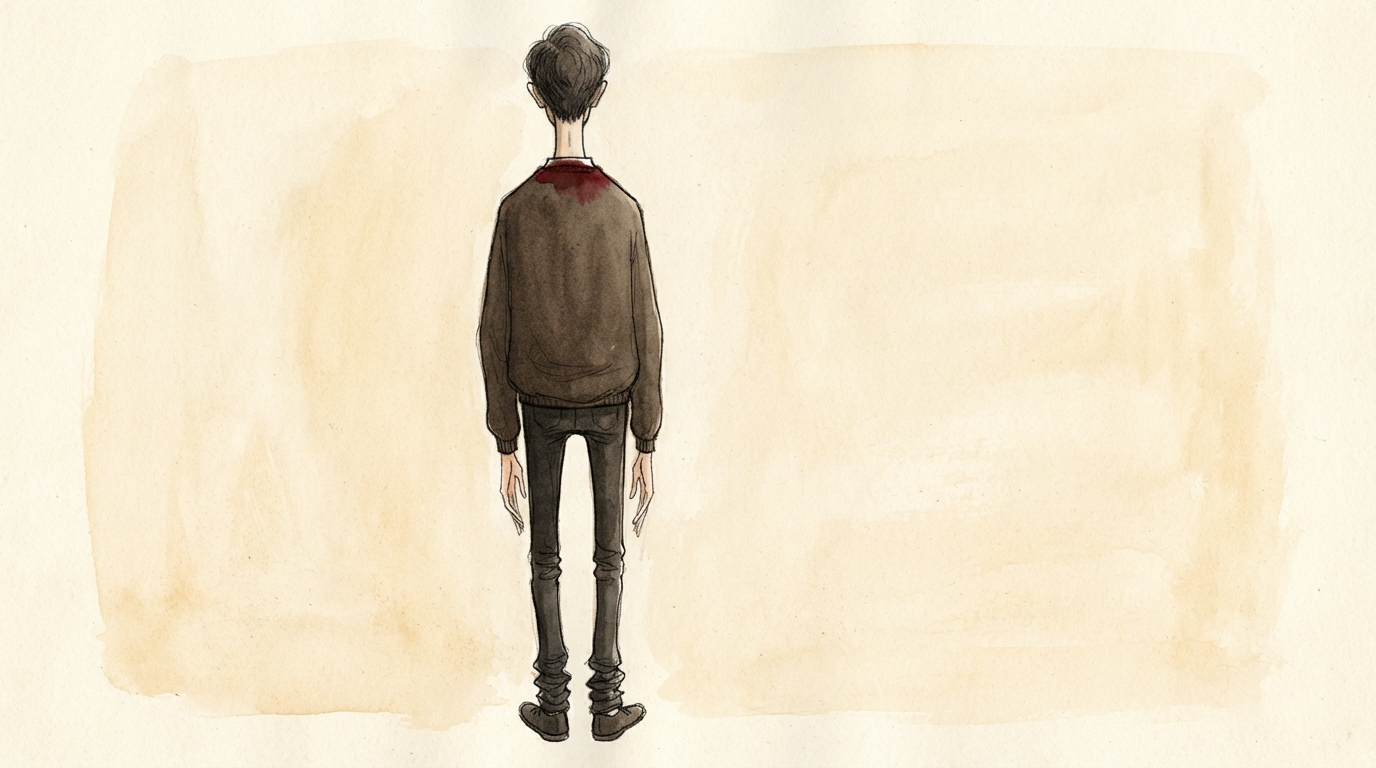
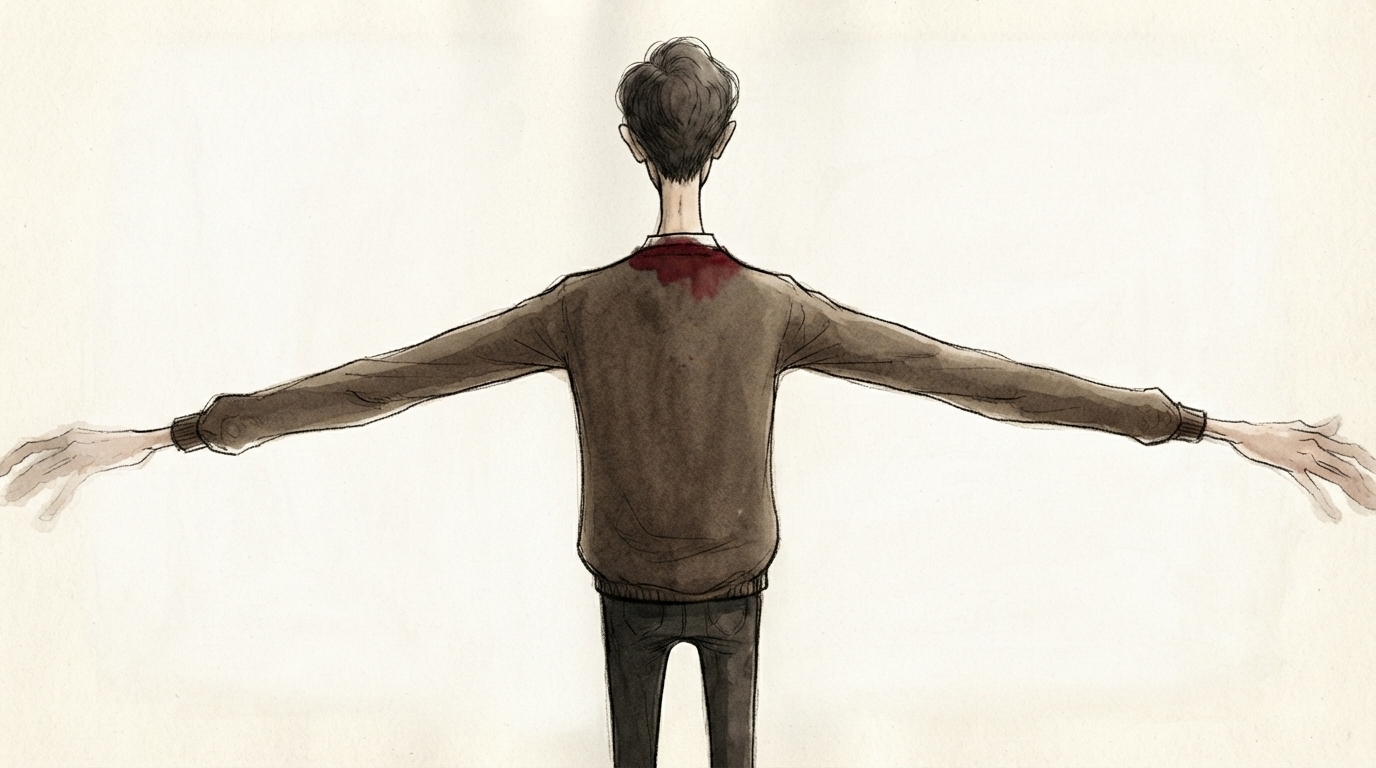
One in five thousand people carries a mutation that makes the aorta a slow ticking clock. F5 The same gene shapes the whole body: tall, long-limbed, with an unusual reach and long, slender fingers. F11 From outside it can look graceful, full of apparent health. But the wall of the aorta is quietly coming apart — and the first sign is sometimes the last one. The gene is FBN1.
02THE NAME
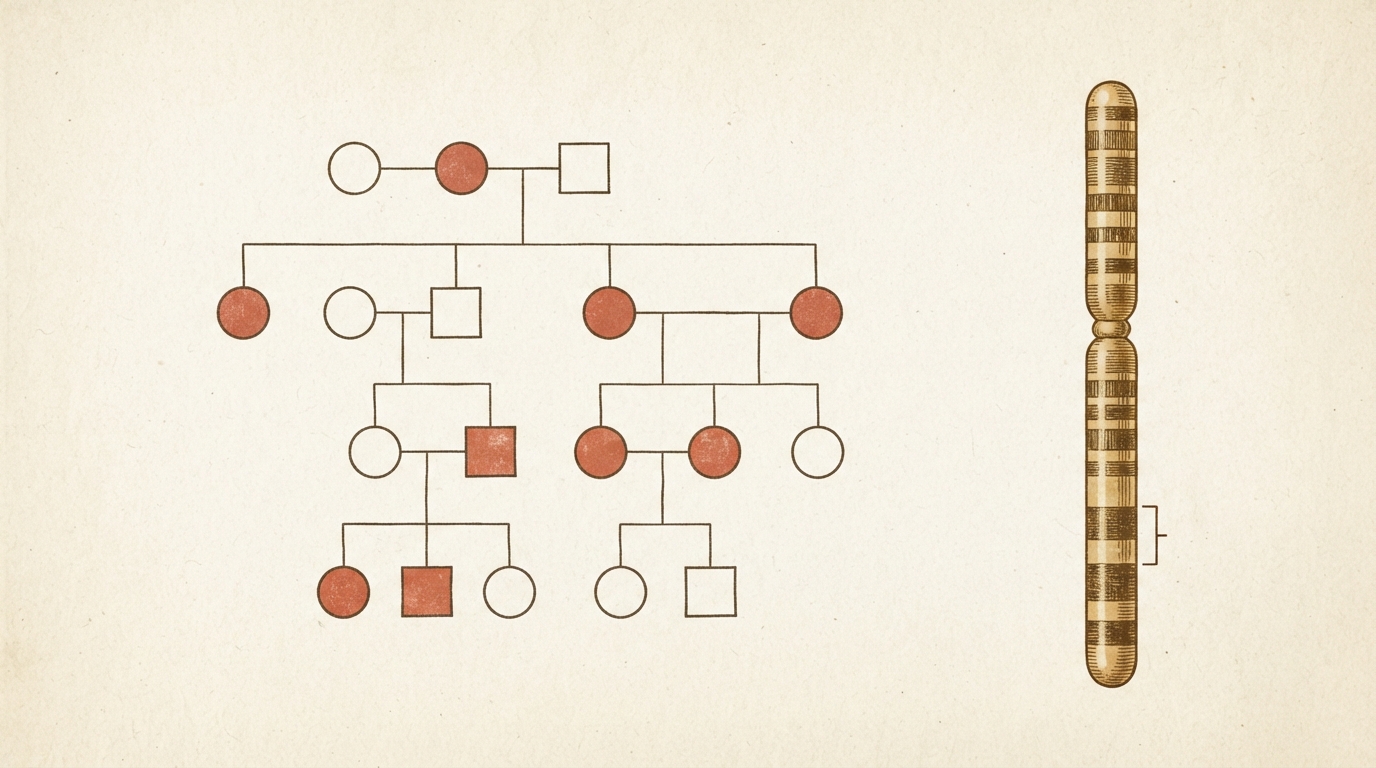
FBN1 sits on chromosome fifteen. F1 It builds a protein called fibrillin-1 — not an enzyme, not a receptor, but a scaffold. F1 Fibrillin-1 chains link head to tail to form microfibrils: beaded cables, ten nanometres across, threaded through the walls of the aorta, the skin, and the lungs. F1 Everywhere the body needs to flex and spring back, fibrillin microfibrils are the frame those elastic fibres wrap around. F1
03THE HUNT
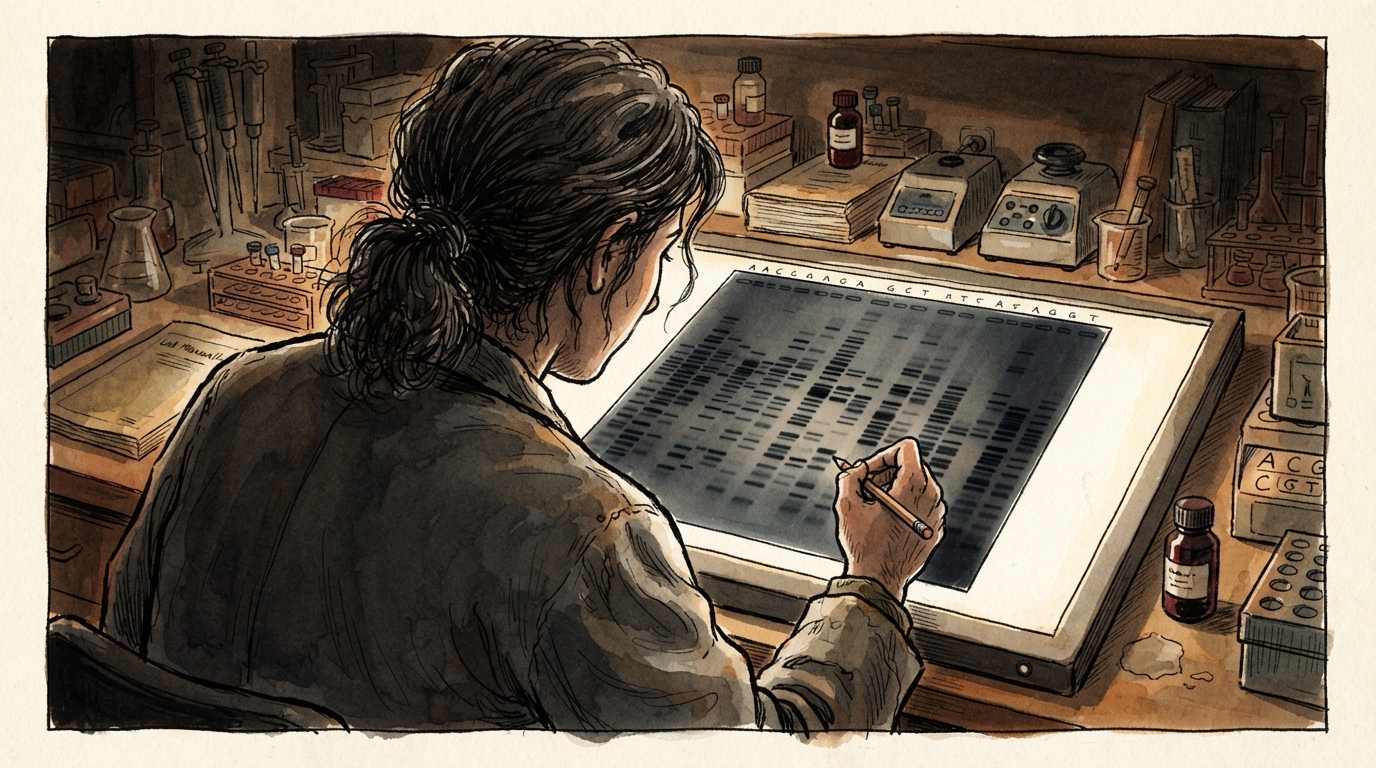
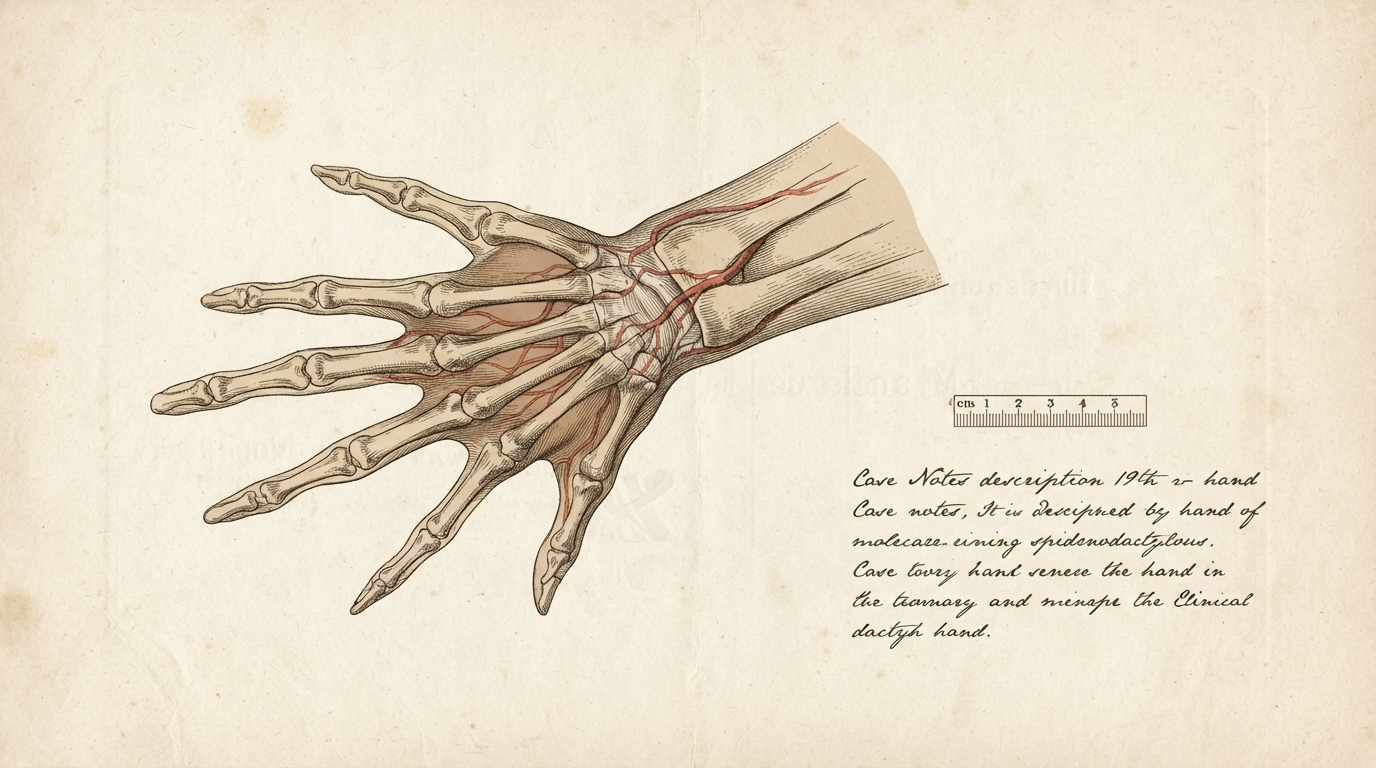
For most of medical history, Marfan syndrome was a clinical diagnosis — a checklist of unusual body proportions, with no molecular anchor. F4 In 1896, the French paediatrician Antoine Marfan described a five-year-old girl with fingers so long they looked like spider legs: the case that would give the syndrome its name. F4 Nearly a century passed before the gene was found. In 1990, researchers mapped the culprit to chromosome fifteen. F3 Then, in 1991, Harry Dietz, Reed Pyeritz, Lynn Sakai, and their colleagues identified the mutation itself: a single letter altered in the fibrillin gene, in patients with sporadic Marfan syndrome. F3 Every change was new in the child; neither parent carried it. F1 Published in Nature — and a molecular era began. F3
04THE VARIANT
The harmful variants in FBN1 span the whole gene — missense changes, truncations, splice errors, deletions. F1 Most disrupt the assembly of fibrillin-1 into microfibrils: the cables form, but they are fewer, or brittle, or fail to interlock at the right angles. F1 About one in four cases carries a brand-new mutation — no family history. F1 In those who inherit it, the same fragile scaffold passes from parent to child. F1
05THE SCAFFOLD (hero 1)
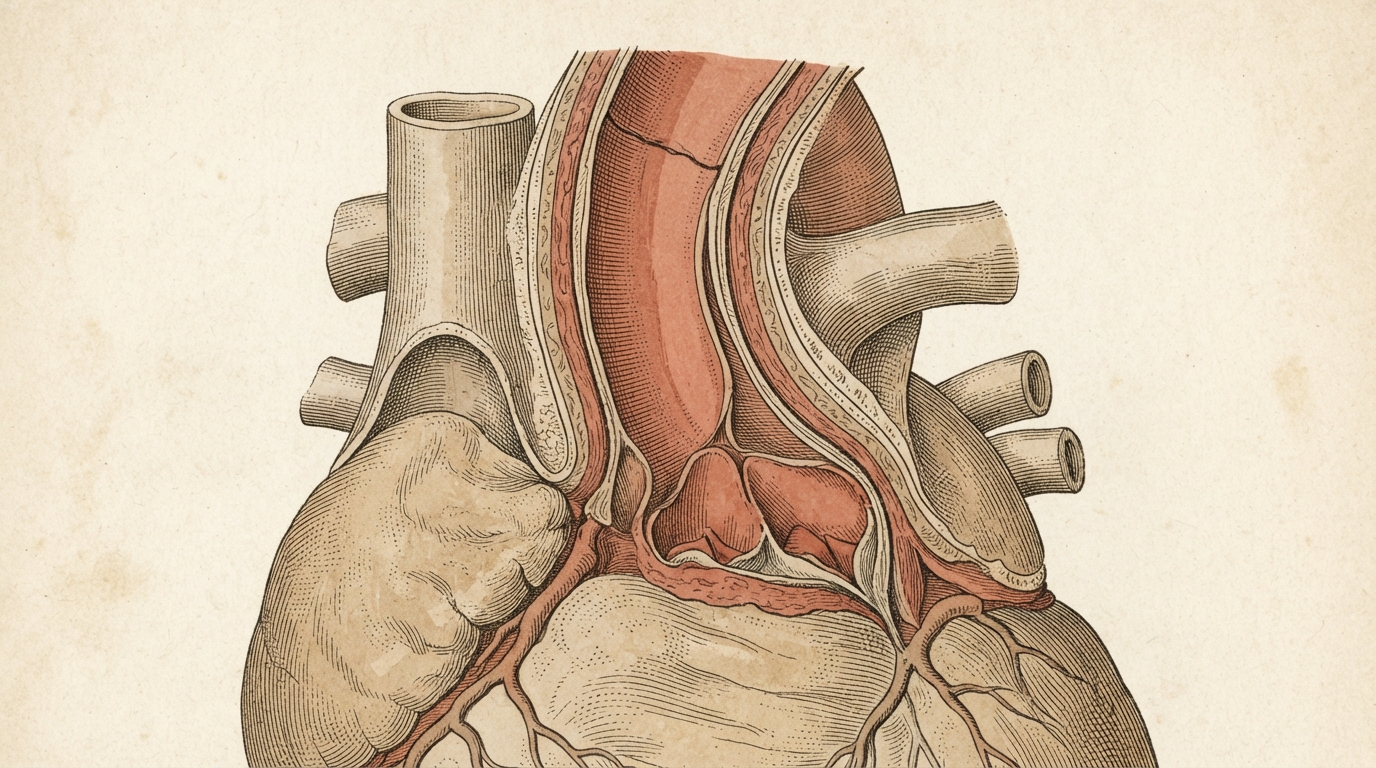
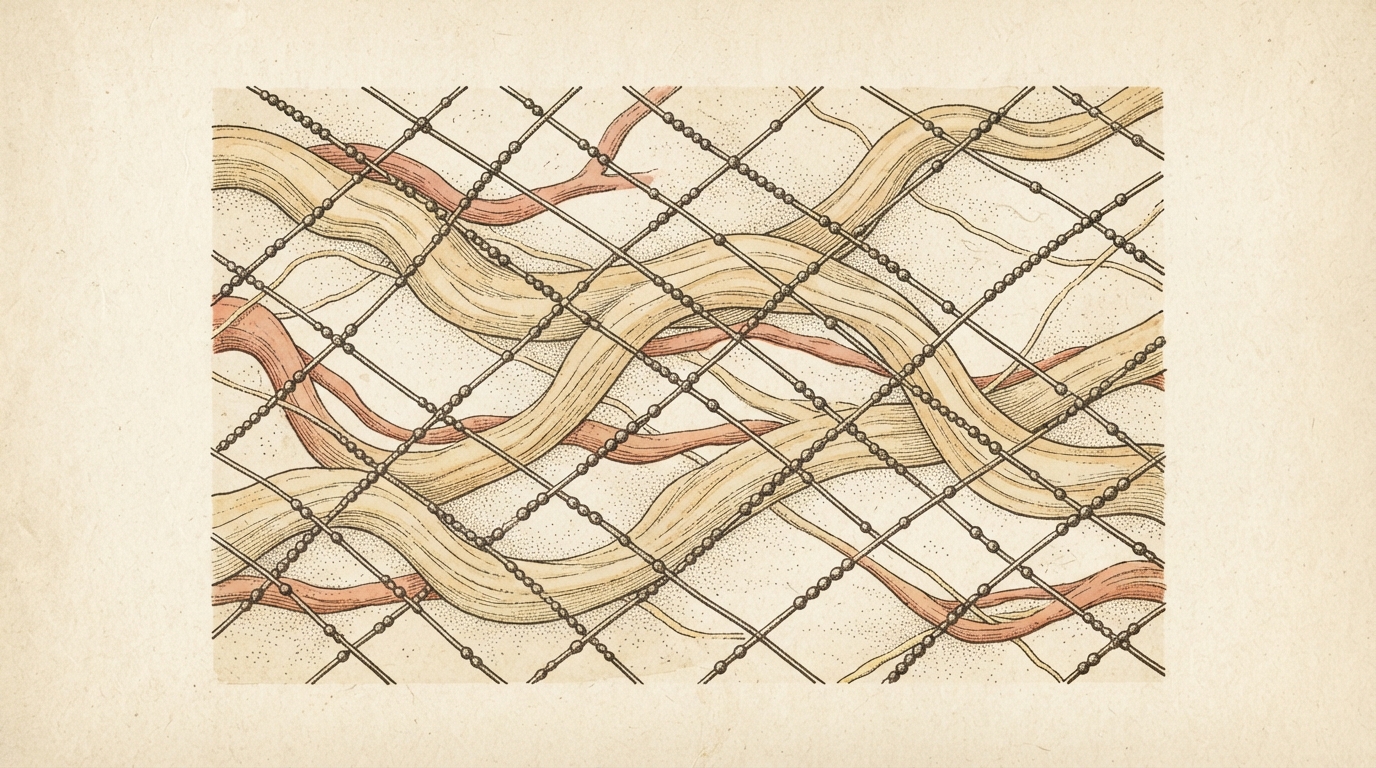
Walk inside the aortic wall. F1F2 Smooth muscle cells are stacked in layers, each sandwiched by sheets of elastic fibre. Those elastic sheets need a foundation — and that foundation is the fibrillin-1 microfibril lattice. F1 The cables run through the medial layer like rebar through concrete, anchoring the cell layers and transmitting the pulse of every heartbeat into an orderly spring. F1 When fibrillin-1 is defective, the lattice frays. The elastic lamellae lose their anchor. Under fifty years of pulsatile pressure, the wall expands, slowly at first, then faster, the aortic root widening millimetre by millimetre until it reaches the threshold for tearing. F10 Now move to the eye. F6 The ciliary zonule, the set of cables that suspends the lens, is made almost entirely of fibrillin-1. No elastin. Pure fibrillin scaffold. F6 When the fibrillin lattice fails, the zonule snaps. The lens slips upward, out of focus, out of position — ectopia lentis, present in six of every ten people with this condition. F6 Two organs, the same cable, the same failure.
06THE LEASH (hero 2)
But the scaffold is only half the story. F2 Fibrillin microfibrils also function as a molecular leash. Tethered to the fibrillin cables, through a linker protein, is TGF-β — a growth factor that drives tissue remodelling, inflammation, and cell dysfunction when it gets loose. F2 In a healthy aortic wall, most TGF-β is locked in an inactive complex, physically anchored to the fibrillin scaffold, unable to signal. F2 When the scaffold fails, the leash breaks. TGF-β floods the aortic wall. F2 It drives smooth muscle cells toward a remodelling state, degrades the matrix, thins the wall. F2 The result is not just structural weakness but an active biochemical attack — a runaway growth factor, loose in the aortic wall. F2
07WHY SO TALL (the same leash, in reverse)
But the same broken leash also explains the body you can see. F11 Around the growing bones, the story runs in reverse. F11 In healthy bone, fibrillin holds a reserve of TGF-β in the sheath that wraps each growing bone. F11 When fibrillin is missing, less is held there — and researchers think that missing brake is what lets the long bones grow longer. F11 Too much signal in the aorta; too little around the bone. F2F11 One failed scaffold, two opposite faces: the tall, long-limbed build, and the fragile vessel inside it. And it is this runaway signalling that finally opened a door to treatment. F9
08THE STAKES
Marfan syndrome is a life lived near an invisible edge. F7 Without monitoring or surgery, the median lifespan used to be around thirty-two years — most deaths from aortic dissection, often without warning, often in young adulthood. F7 Today, with serial imaging and the option of preventive surgery, the median has risen to around seventy-two. F7 Forty years of life, recovered. But the aorta must be watched — every year, for life. F10 When it reaches a critical width, surgeons replace the root before it tears. F10 It is preventive surgery, deliberate and planned — not emergency repair.
09THE OPEN THREAD
Two lessons from the molecular biology pointed straight at treatment. F8F9 First: slow the pounding. Beta-blockers reduce the heart's contractile force and the pulse pressure that slams the aortic wall with each beat. A landmark trial in 1994 showed they genuinely slow aortic root growth. F8 Second: cut the signal. If TGF-β floods the wall when the fibrillin leash breaks, then blocking TGF-β's downstream path should help. Losartan, an angiotensin receptor blocker first approved for blood pressure, does exactly that. It quiets the same signalling cascade that excess TGF-β activates. F9 A long-term study in adults found fewer aortic dissections and fewer deaths in patients using losartan. F9 In a head-to-head trial in children, it worked about as well as a beta-blocker — but no better. F9 The answer for now is both approaches, often together, alongside lifelong imaging, and surgery before the crisis. F9F10 No cure — but a framework that gives most people with Marfan syndrome a nearly normal lifespan. F7F9F10
10RECAP + FOUNDATION SIGN-OFF
One hundred and thirty years: from a girl with spider-legs and no name for her condition, to a molecular mechanism we can target, to the surgery that changes the outcome. F3F4F7 The Marfan Foundation, built by families, for families, has funded more than twenty-three million dollars in research since 1986. They serve every person living with Marfan, Loeys-Dietz, or vascular EDS — any condition where the aorta holds the risk. Found in a lab. Watched by a cardiologist every year. Supported by a community. Find them at marfan.org. — The Gene Channel.
The write-up
In one line: FBN1 builds fibrillin-1, the scaffold woven through the aorta, the lens of the eye, and the growing skeleton — and the same broken cable that makes the body tall lets a growth factor run loose in the aortic wall, turning the great vessel into a slow, silent ticking clock.
The gene
FBN1 sits on chromosome 15 (15q21.1) and encodes fibrillin-1 — not an enzyme, not a receptor, but a structural protein. Fibrillin-1 monomers link head-to-tail into microfibrils: beaded cables about ten nanometres across, threaded through the walls of the aorta, the skin, and the lungs. Everywhere the body needs to flex and spring back, these microfibrils are the frame the elastic fibres wrap around — and in the eye, the ciliary zonule that suspends the lens is made almost entirely of fibrillin, with no elastin at all. Inheritance is autosomal dominant, and about one in four cases is a brand-new (de novo) mutation with no family history.
The hunt
For most of medical history, Marfan syndrome was a clinical diagnosis — a checklist of unusual body proportions with no molecular anchor. In 1896 the French paediatrician Antoine Marfan described a five-year-old girl with strikingly long, slender limbs: the case that would give the syndrome its name. (Historians now think that particular child had a related but distinct condition — Beals syndrome, caused by FBN2 — so Marfan is credited with the first clinical description, not with the molecular diagnosis.) The gene was mapped to chromosome 15 in 1990, and in 1991 Harry Dietz, Reed Pyeritz, Lynn Sakai and colleagues identified the mutation itself — a recurrent de novo change in the fibrillin gene in patients with sporadic Marfan syndrome. Published in Nature, it opened the molecular era of the disease.
The mechanism
One broken scaffold fails in two ways.
Structurally, defective fibrillin-1 frays the microfibril lattice of the aortic wall. The elastic sheets that give the vessel its spring lose their anchor, and under fifty years of pulsatile pressure the aortic root widens — slowly at first, then faster — until it nears the threshold for tearing. The same failure snaps the ciliary zonule and lets the lens slip out of position (ectopia lentis, seen in about six of every ten patients).
As a signal, fibrillin is also a molecular leash: it tethers latent TGF-β, a growth factor, keeping it inactive in the matrix. When the scaffold fails, the leash breaks — free TGF-β floods the aortic wall and drives an active biochemical remodelling that thins and weakens it. Around the growing bones the same sequestration failure runs in reverse: less TGF-β is held locally, a brake on the growth plate lifts, and the long bones overgrow. Too much signal in the aorta; too little around the bone — one failed scaffold, two opposite faces.
The stakes, and the frontier
Untreated, the median life expectancy in Marfan syndrome was around thirty-two years, most deaths from aortic dissection, often without warning. With annual imaging and preventive aortic-root surgery performed before the vessel tears, the median has risen to around seventy-two — roughly forty years of life recovered. Two lessons from the molecular biology became treatment: slow the pounding (beta-blockers, shown in a 1994 trial to slow aortic-root growth) and cut the signal (losartan, an angiotensin-receptor blocker that quiets the same TGF-β cascade — fewer dissections and deaths in long-term adult follow-up, though in a head-to-head paediatric trial it worked about as well as a beta-blocker, not better). There is no cure, but a framework of medication, lifelong imaging, and timely surgery now gives most people with Marfan syndrome a nearly normal lifespan. The episode spotlights The Marfan Foundation (marfan.org), built by families, for families.
Sources
Full claim-by-claim evidence is in references.md. Primary anchors:
- Sakai LY et al. "FBN1: The Disease-Causing Gene for Marfan Syndrome and Other Genetic Disorders." Gene 591:279–291 (2016). PMC6639799.
- Dietz HC et al. "Marfan syndrome caused by a recurrent de novo missense mutation in the fibrillin gene." Nature 352:337–339 (1991). PMID 1852208.
- Chaudhry SS et al. "Fibrillin-1 regulates the bioavailability of TGFβ1." J Cell Biol 176:355–367 (2007). PMC2063961.
- Sedes L et al. "Fibrillin-1 … perichondrium … longitudinal bone growth." Hum Mol Genet 31(19):3281 (2022). PMID 35567544.
- Shores J et al. "…long-term β-adrenergic blockade in Marfan's syndrome." NEJM 330:1335–1341 (1994). PMID 8152445.
- van Andel MM et al. (COMPARE long-term). Eur Heart J 41:4181–4187 (2020). PMID 32548624. · Lacro RV et al. (Pediatric Heart Network RCT). NEJM 371:2061–2071 (2014). PMID 25405392.
- Murdoch JL et al. "Life expectancy and causes of death in the Marfan syndrome." NEJM 286:804–808 (1972). PMID 5013988.
Accuracy note: (1) FBN1 loss means less fibrillin and therefore more free TGF-β — the "sequestration paradox"; the gene does not make TGF-β, it holds it. (2) The tall, long-limbed build reflects a local TGF-β deficit around growing bone — the reverse of the aortic excess — not excess signal; ARBs do not treat the skeletal features. (3) Antoine Marfan's 1896 index patient most likely had Beals syndrome (FBN2), not FBN1 Marfan syndrome. (4) Losartan is not proven superior to beta-blockers. (5) Loeys-Dietz and vascular Ehlers-Danlos are distinct conditions, not subtypes of Marfan (the Foundation serves all three communities).