DNMT3A
The Code on Top of the Code
Every cell carries a chemical memory of what it's meant to be — and one enzyme writes it. Break that writer, and the same gene spells childhood overgrowth, a deadly leukemia, and a clock ticking quietly in your blood.
The walkthrough
Beat by beat

HOOK
0:24
01HOOK
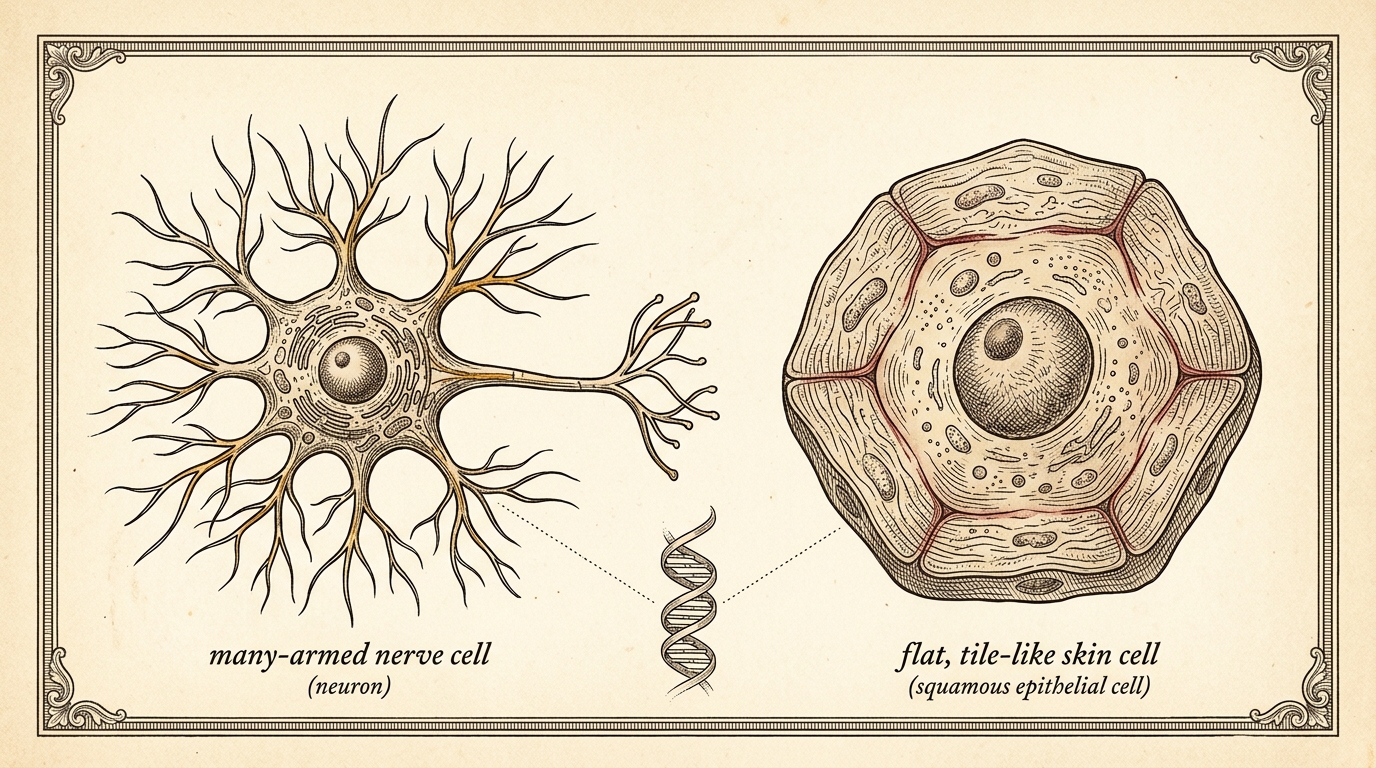
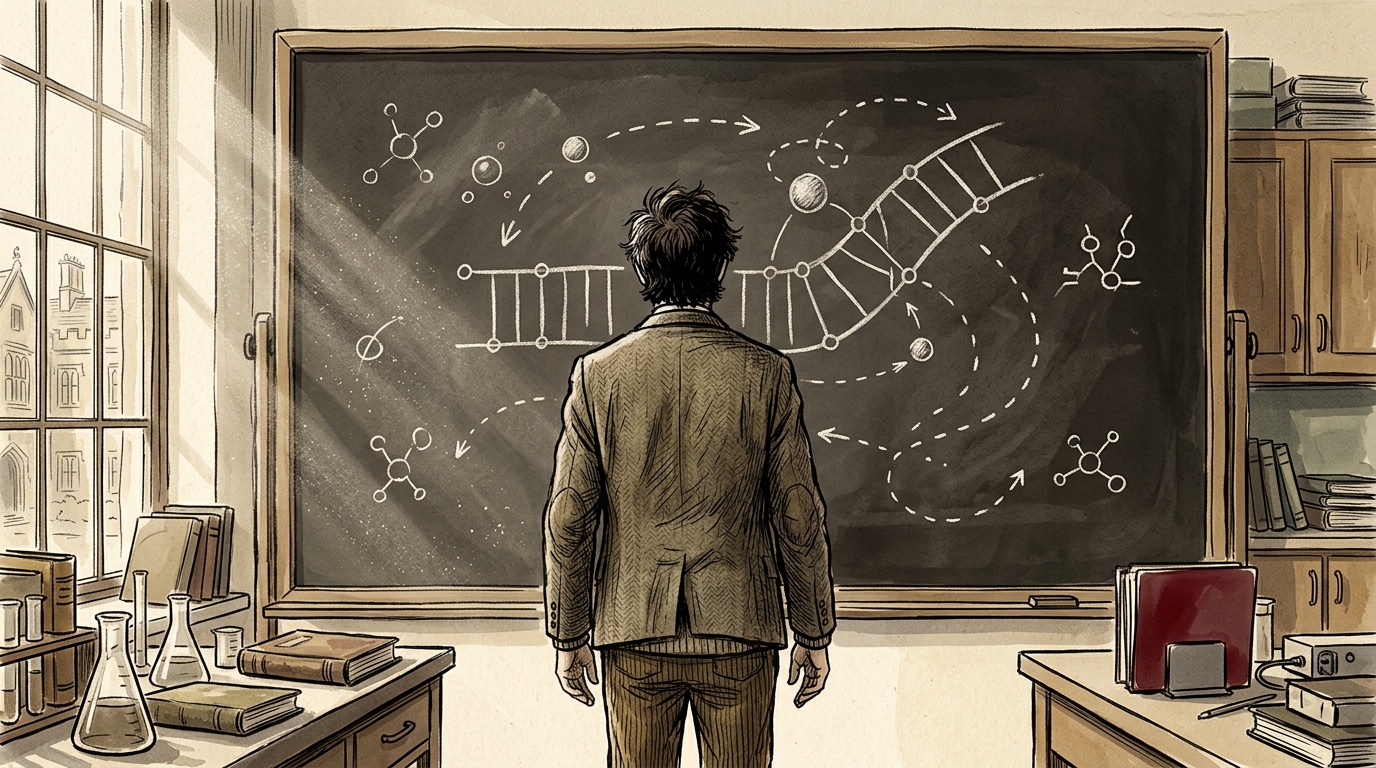
Every cell in your body holds the same DNA, letter for letter — and yet a brain cell and a skin cell could not be more different `F1`. What sets them apart isn't the code. It's a second layer of marks written on top of it, deciding which genes are switched on and which stay silent `F2`. This is the story of one of the molecules that does the writing.
02THE NAME
That molecule is built by a gene called DNMT3A — DNA methyltransferase 3-alpha — on the short arm of chromosome 2 `F3`. It writes the most basic epigenetic mark there is: a tiny methyl tag clamped onto the DNA letter C, cytosine — and where it writes, genes fall quiet `F4`. Biologists call it a de novo methyltransferase: the enzyme that lays down brand-new marks `F5`.
03THE WORD
The idea came long before the molecule. In 1942, the biologist Conrad Waddington gave a name to the layer that sits between the genes you inherit and the body you become — epigenetics `F6`. Above genetics: a set of instructions the DNA sequence alone could never explain.
04THE PREDICTION
In 1975, two scientists made it concrete. Working separately, Robin Holliday and Arthur Riggs argued that a cell remembers what it is through methyl marks on its DNA — copied to its daughters at every division `F7`. That would take two enzymes: one to write new marks, and one to copy the old. The writer was still hypothetical.
05THE HUNT
It stayed hypothetical for twenty-three years. Then, in 1998, Masaki Okano, in the lab of En Li, cloned it — the long-sought de novo writer — and named it Dnmt3a `F8`. Within a year, they showed how essential it was: mice engineered without it could not develop, and died within weeks of birth `F9`.
06THE MECHANISM (hero)
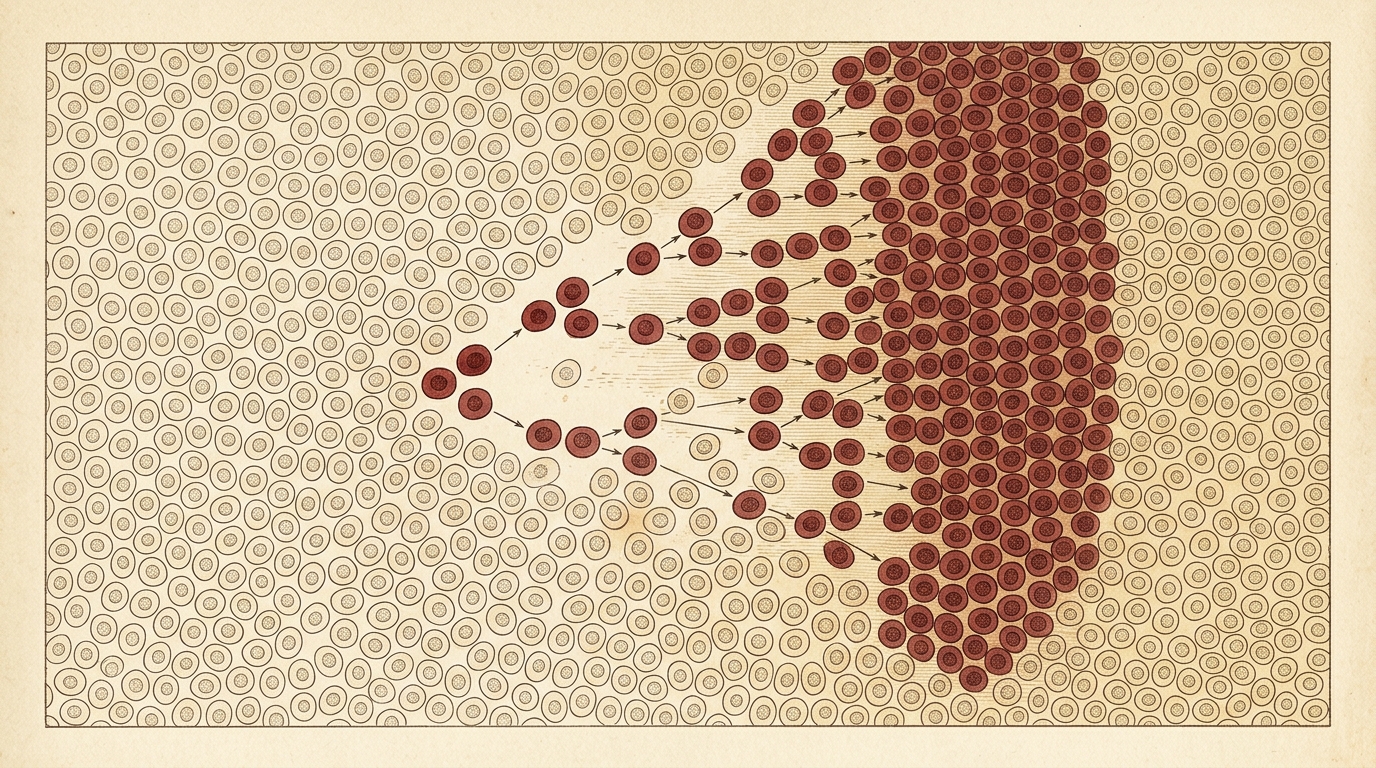
Here is what it actually does. DNMT3A finds a spot where a C sits next to a G — a CpG site — and transfers a methyl group onto the cytosine `F10`. Repeat that across a gene's control switch, and the cell reads it as: keep this one off. And every time the cell divides, a second enzyme copies the pattern onto the new strand — so the memory of which genes are silenced survives, division after division `F11`. That is how a single fertilized egg becomes hundreds of different kinds of cell.
07THE CANCER
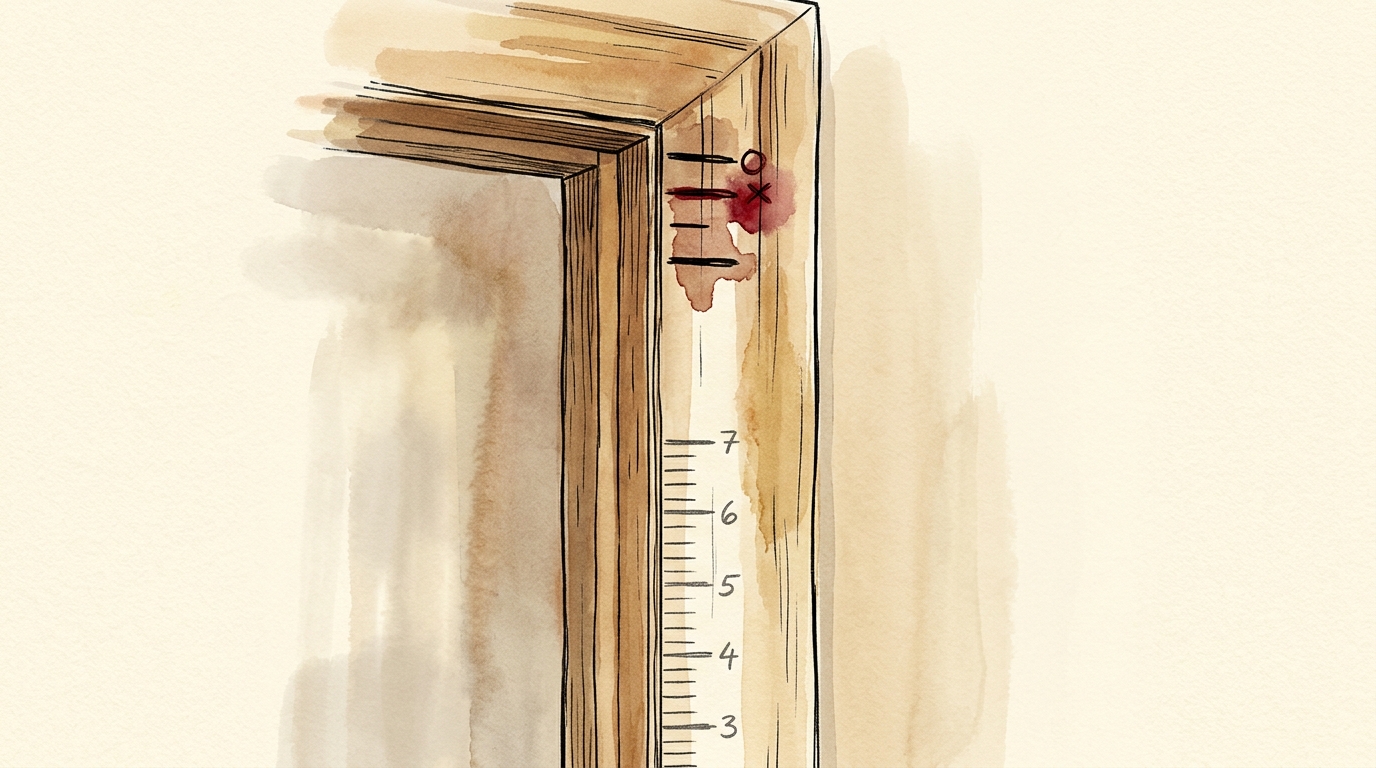
Now corrupt the writer. In 2010, DNMT3A was found mutated in more than one in five adults with acute myeloid leukemia — an aggressive blood cancer `F12`. And the damage struck the same spot, over and over: position 882 — one recurrent typo that jams the enzyme, and lets blood cells forget how to grow up `F13`.
08THE AGING
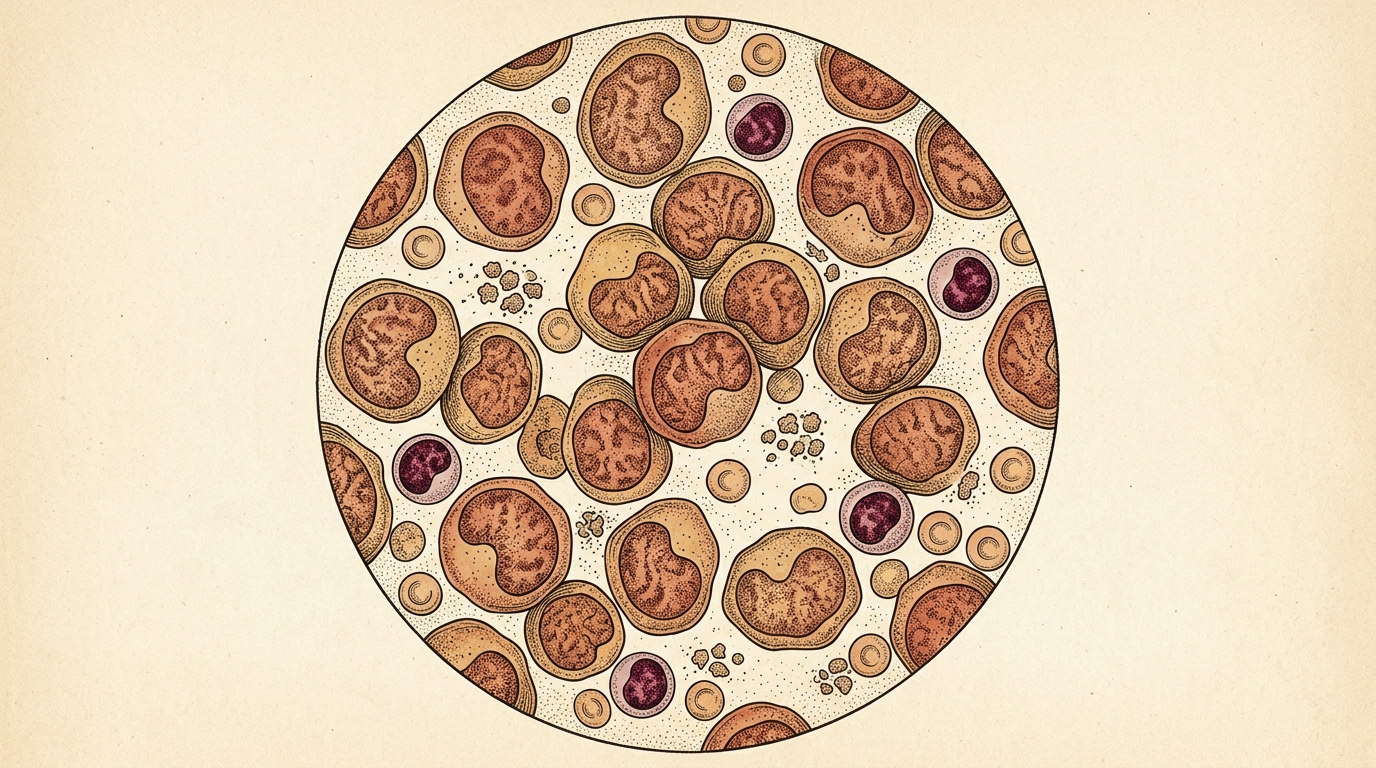
But the stranger story is aging. As we grow older, our blood stem cells collect mutations — and no gene is hit more often than DNMT3A `F14`. By the age of seventy, more than one in ten of us carries a mutant clone spreading silently through the blood — a condition called clonal hematopoiesis `F15`. Most never fall ill. But, on average, it raises the risk of blood cancer — and, surprisingly, of heart disease `F16`.
09THE OPEN THREAD
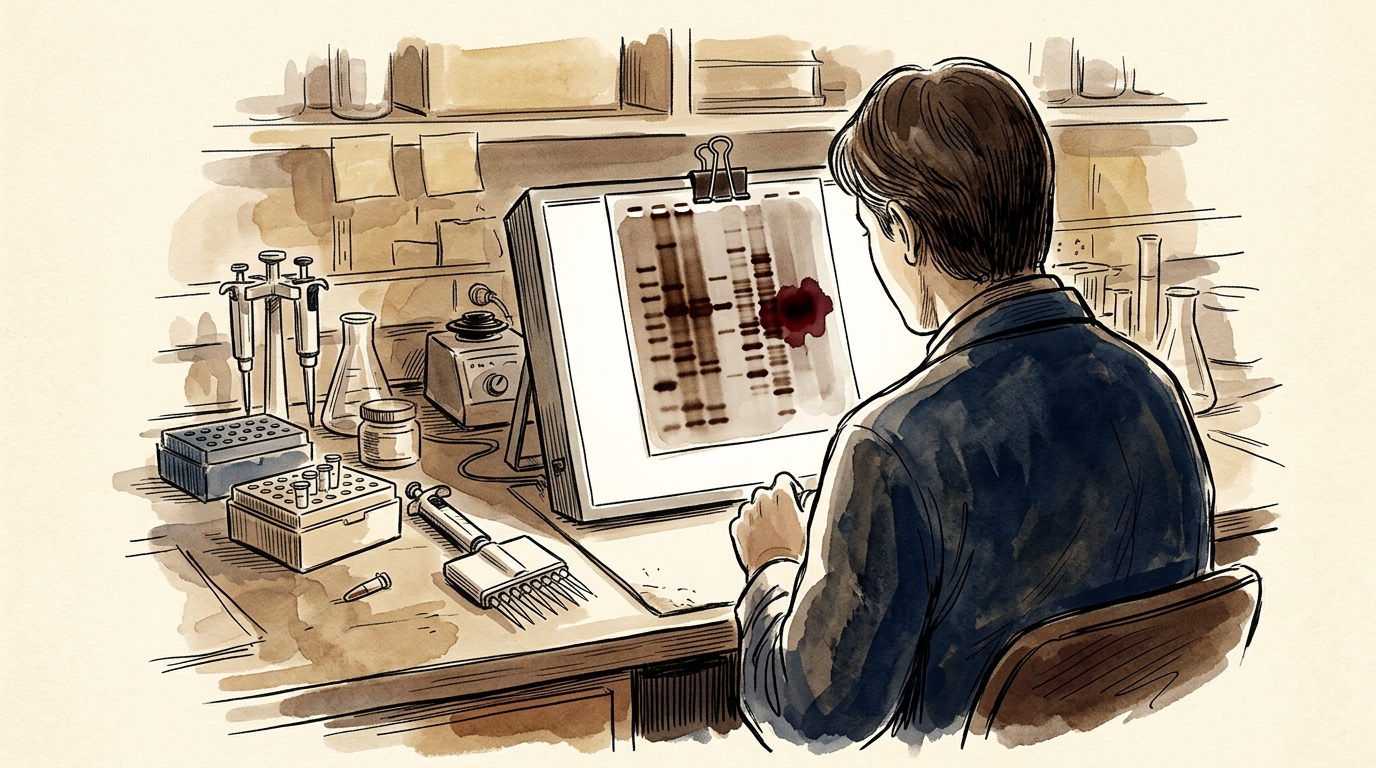
There's a mirror image, too. Children born with a single faulty copy of DNMT3A grow up unusually tall, with learning difficulties — an overgrowth syndrome named only in 2014 `F17`. So one gene, broken in different ways, shapes growth, cancer, and aging itself — and leaves a genuinely open question. A DNMT3A clone in your blood is neither clearly a disease, nor clearly safe: a signature of getting older that medicine is only beginning to read `F18`.
10TIMELINE + SIGN-OFF
From a word coined in 1942, to a prediction in '75, to the gene itself in '98 — DNMT3A writes the code that sits on top of the code. The letters, it turns out, are only half the story. — The Gene Channel.
The write-up
In one line: DNMT3A is the enzyme that writes the epigenetic "code on top of the code" — and the same gene, corrupted in different ways, drives a childhood overgrowth syndrome, a deadly leukemia, and the quiet clonal drift of an aging body.
The gene
DNMT3A — DNA methyltransferase 3 alpha — sits on the short arm of chromosome 2 (2p23.3). It writes the most fundamental epigenetic mark in the genome: a methyl group placed onto cytosine, almost always where a C sits next to a G (a "CpG" site). Across a gene's promoter, that methylation reads as off. DNMT3A is a de novo methyltransferase — it lays down brand-new marks — as distinct from DNMT1, the maintenance enzyme that copies existing marks onto the new DNA strand every time a cell divides. Together they let a cell remember what it is.
The idea, and the hunt
The concept outran the molecule by half a century. Conrad Waddington coined "epigenetics" in 1942 for the developmental layer between the genes you inherit and the body you become. In 1975, Robin Holliday and Arthur Riggs independently proposed the mechanism that would make Waddington's layer heritable: methyl marks on DNA, copied at each division — a scheme that required two enzymes, one to write and one to copy. The writer stayed hypothetical until 1998, when Masaki Okano in En Li's lab cloned Dnmt3a (and Dnmt3b); a year later, knockout mice proved how essential it was — animals built without it died within weeks of birth.
The mechanism
DNMT3A transfers a methyl group onto cytosine at CpG sites. Repeated across a gene's control region, the marks silence it; DNMT1 then copies the pattern at every cell division, so the "memory" of which genes are off survives through a lifetime of divisions. That is how one fertilized egg gives rise to hundreds of cell types from a single genome.
The stakes — cancer, and aging
Corrupt the writer and the consequences are profound. In 2010, Ley and colleagues found DNMT3A mutated in 22% of adult acute myeloid leukemia, clustered at a single recurrent hotspot — R882 — a loss-of-function / dominant-negative change that cripples the enzyme and impairs blood-cell maturation. Even more striking is aging: DNMT3A is the most frequently mutated gene in clonal hematopoiesis, the age-related expansion of mutant blood-cell clones. By age 70, more than 1 in 10 people carry such a clone; most stay well, but on average it raises the risk of blood cancer and — unexpectedly — of atherosclerotic heart disease. And in the germline, a single faulty copy causes Tatton-Brown–Rahman syndrome (DNMT3A-overgrowth syndrome): tall stature and intellectual disability, first described in 2014.
The frontier
A DNMT3A clone in the blood sits in a genuinely uncertain place — neither clearly a disease nor clearly benign. It is a newly legible signature of getting older, and medicine is still working out when, or whether, to act on it.
Sources
Full claim-by-claim evidence is in references.md. Primary anchors:
- Okano, Xie & Li, Nat Genet 19:219–220 (1998); Okano, Bell, Haber & Li, Cell 99:247–257 (1999) — discovery / essentiality.
- Holliday & Pugh, Science 187:226 (1975); Riggs, Cytogenet Cell Genet 14:9 (1975) — the heritable-methylation prediction.
- Ley et al., NEJM 363:2424–33 (2010) — DNMT3A in AML, R882 hotspot.
- Jaiswal et al., NEJM 2014 & 2017; Genovese et al., NEJM 2014 — clonal hematopoiesis, cancer & cardiovascular risk.
- Tatton-Brown et al., Nat Genet 46:385–8 (2014) — TBRS / DNMT3A-overgrowth syndrome.
Accuracy note: the episode is careful on five easily-confused points — methylation→silencing applies to promoters/control switches (gene-body methylation can track with expression); DNMT3A is the de novo writer, not the DNMT1 maintenance enzyme; Waddington's 1942 "epigenetics" meant development, not today's molecular sense; the AML R882 hotspot is loss-of-function (a crippled writer, not an overactive one); and clonal hematopoiesis is a risk state, not a diagnosis.
The evidence
Every claim, sourced
Each [F#] you hear in the film links to the source it came from. Nothing gets narrated until every one is checked and signed off.
Sign-off
- PhD sign-off — facts above correct; the five ⚠️ traps stated correctly in
script.md: - Length gate — extended ~3:40–4:00 cut (10 beats: 3-beat scientist arc + cancer + aging) approved 2026-06-27.
- Numbers verified (22.1% AML / R882 / ">10% over 70" / dates 1942·1975·1998·2010·2014) or kept qualitative.
**Gate OPEN** → narration + assets + render may proceed.
- F1
Every cell carries the same DNA, yet cell types (e.g. neuron vs skin) differ profoundly
Differentiated cells share one genome; identity is set epigenetically, not by sequence change
- F2
A second layer of chemical marks on top of DNA decides which genes are on/off
DNA methylation (+ histone marks) regulate gene expression; promoter/CpG-island methylation is associated with silencing
- F3
DNMT3A = "DNA methyltransferase 3 alpha," short arm of chromosome 2
NCBI/GTR Gene ID 1788, cytogenetic location 2p23.3
- F4⚠ commonly confused
Adds a methyl tag to cytosine (C); where it writes (gene control switches), genes fall silent
DNMT3A methylates the 5-carbon of cytosine, mainly at CpG; promoter methylation → transcriptional silencing. (Trap: gene-body methylation can track WITH expression — script restricts the "silencing" claim to a gene's "control switch"/promoter.)
- F5⚠ commonly confused
DNMT3A is a de novo methyltransferase — lays down brand-new marks
De novo enzymes (DNMT3A/3B) establish new patterns; DNMT1 maintains them. (Trap: don't conflate DNMT3A with the maintenance enzyme DNMT1.)
- F6⚠ commonly confused
In 1942, Conrad Waddington named the layer between inherited genes and the resulting body — "epigenetics"
Waddington coined "epigenetics" (1942, Endeavour; "The epigenotype") for the developmental processes linking genotype → phenotype. (Trap: his 1942 meaning was developmental, NOT today's molecular "heritable marks without sequence change" — the script says "the layer between the genes you inherit and the body you become," which matches Waddington's original sense.)
- F7
In 1975, Holliday and Riggs (separately) proposed DNA methylation as heritable cell memory, copied at each division, needing two enzymes (a writer + a copier)
Holliday & Pugh, Science 187:226 (1975); Riggs, Cytogenet Cell Genet 14:9 (1975) — independent papers proposing a de-novo-establishing + maintenance-copying methylation system for cell-state inheritance
- F8
In 1998, Masaki Okano (En Li lab) cloned the long-sought de novo writer, Dnmt3a
Okano, Xie & Li, Nat Genet 19:219–220 (1998), "Cloning and characterization of a family of novel mammalian DNA (cytosine-5) methyltransferases" — identified Dnmt3a/Dnmt3b as the candidate de novo enzymes
- F9
A year later, knockout mice couldn't develop and died within weeks of birth
Okano, Bell, Haber & Li, Cell 99:247–257 (1999) — Dnmt3a/3b essential for de novo methylation; Dnmt3a-null mice die ~4 weeks after birth, Dnmt3b-null die in utero
- F10
DNMT3A finds a C next to a G (a CpG site) and transfers a methyl group onto the cytosine
De novo methylation occurs mainly at CpG dinucleotides; methyl from SAM → 5-methylcytosine
- F11
At each division a second enzyme copies the pattern onto the new strand → cell memory survives
DNMT1 targets hemimethylated DNA after replication, copying the mark to the nascent strand (maintenance) — the "copier" of the 1975 prediction
- F12
In 2010, DNMT3A was found mutated in more than one in five adults with acute myeloid leukemia (AML)
Ley et al., NEJM 363:2424–33 (2010): DNMT3A mutations in 62/281 (22.1%) of AML
- F13⚠ commonly confused
The damage clusters at position 882; it jams the enzyme and lets blood cells fail to mature
R882 is the recurrent hotspot (~60–65% of AML DNMT3A mutations; R882H most common). R882H is loss-of-function / dominant-negative — too LITTLE methylation, impairing differentiation. (Trap: the cancer comes from a crippled writer, NOT a hyperactive one.)
- F14
With age, blood stem cells collect mutations; DNMT3A is the most frequently mutated gene
"DNMT3A was by far the most frequently mutated gene in clonal hematopoiesis."
- F15
By ~70, >1 in 10 carry a silently expanding mutant clone — clonal hematopoiesis (CHIP)
Age-related clonal hematopoiesis: >10% of people over 70 carry ≥1 detectable somatic driver mutation
- F16
Most never fall ill, but on average it raises risk of blood cancer and (surprisingly) heart disease
CHIP → ↑ risk of hematologic cancer + ↑ all-cause mortality (Jaiswal 2014); independently ~2× atherosclerotic cardiovascular disease (Jaiswal et al., NEJM 2017)
- F17
Children with a single germline faulty copy grow unusually tall, with learning difficulties — a syndrome named 2014
Tatton-Brown et al., Nat Genet 46:385–8 (2014): germline DNMT3A variants → overgrowth + intellectual disability = Tatton-Brown–Rahman syndrome (TBRS) / DNMT3A-overgrowth syndrome
- F18
A DNMT3A clone is neither clearly a disease nor clearly safe — an open question of aging
CHIP is a risk state, not a diagnosis; clinical management/intervention thresholds are unsettled and an active research frontier