CRBN
The Drug That Was Wrong Twice
A 1960s sleeping pill caused thousands of catastrophic birth defects — then, fifty years on, the protein it secretly hijacks turned it into one of oncology's most important drugs.
The walkthrough
Beat by beat

HOOK
0:19
01HOOK
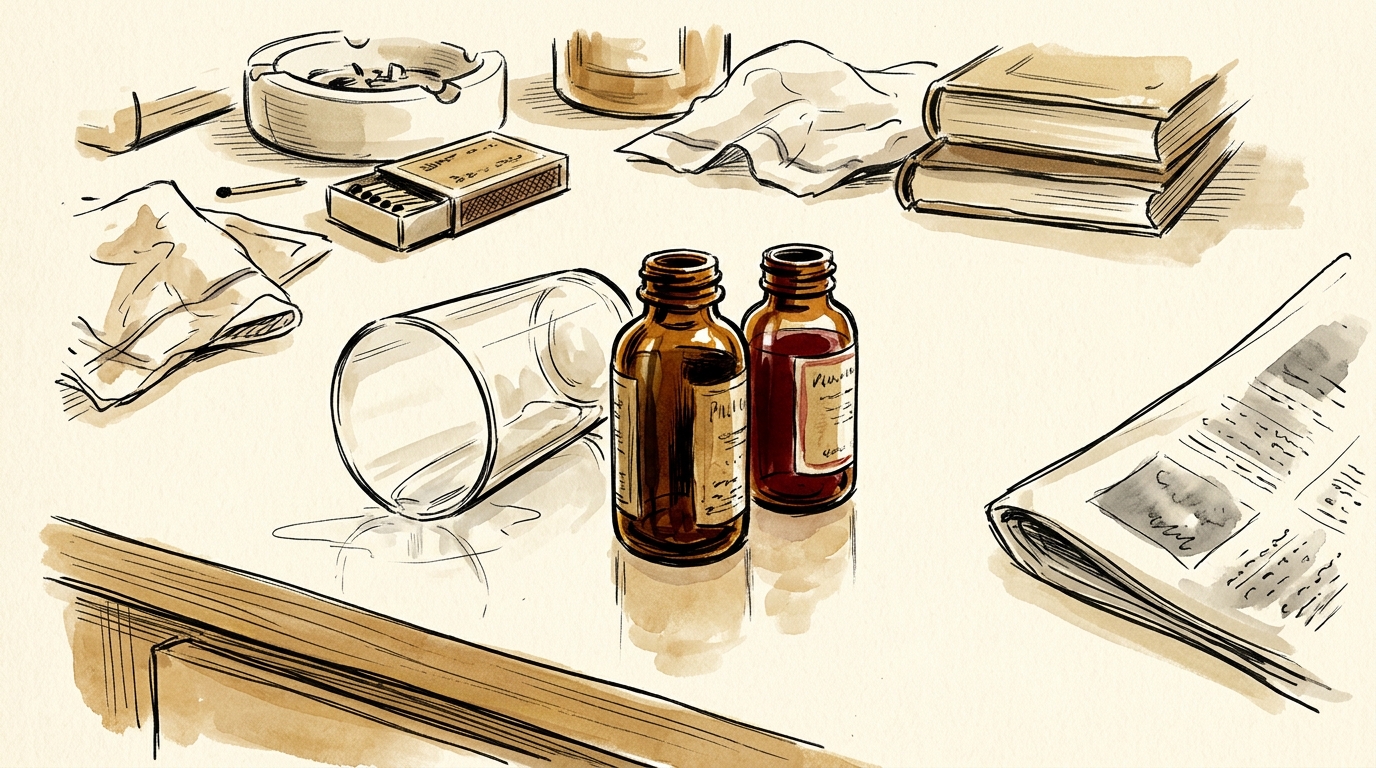
In the early 1960s, a sleeping pill sold in over 40 countries caused thousands of children to be born with missing or severely shortened limbs F1. The drug was pulled from the market. And for fifty years, nobody could explain exactly why it worked — or why it had done that.
02THE NAME
The gene is CRBN — cereblon. It sits at chromosome 3, band p26.3 F2, and encodes a 442-amino-acid protein that acts as the selection door of one of the cell's main protein-destruction complexes — an E3 ubiquitin ligase F3. When cereblon chooses a protein, it tags it for disposal. The question was: what makes it choose?
03THE HUNT
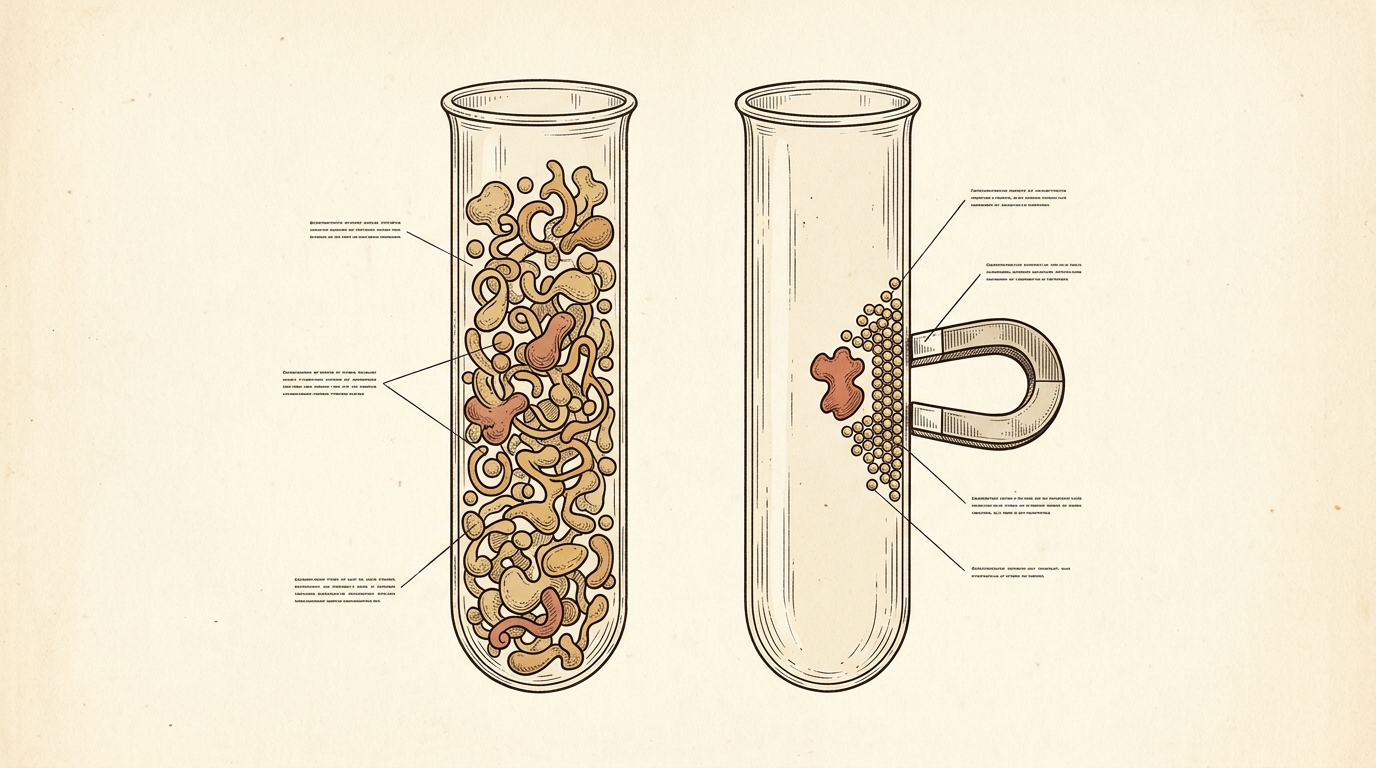
In Tokyo, biochemist Hiroshi Handa had spent decades perfecting a new way to find what drugs actually bind. His laboratory developed magnetic nanoparticles — FG beads — that you could coat with any drug molecule and then use to fish for its binding partners inside a soup of human proteins F4. When his team, led by Takumi Ito, coated those beads with thalidomide and dropped them into cell extracts, two proteins stuck F4. One of them was cereblon. Handa and Ito published in Science in 2010 F4. Fifty years of mystery, solved in a pull-down experiment.
04THE METHOD
What made FG beads work where earlier attempts had failed was their surface chemistry. Thalidomide is hydrophobic, and older agarose matrices stuck to almost everything — drowning the true signal in noise F5. FG beads are non-porous, physically stable, and magnetically separable, so you skip centrifugation and lose far fewer proteins F5. Coat the bead with thalidomide, stir it into cell lysate, hold a magnet to the tube, and you get back your drug — and whatever was bound to it.
05THE MECHANISM
Cereblon is the substrate receptor of the CRL4 ubiquitin ligase — the part of the machine that decides which proteins get tagged for destruction F6. Normally, it recognizes its own set of targets. But thalidomide binds inside cereblon's Tri-Trp pocket and reshapes the surface F6. Suddenly, cereblon can recruit proteins it would never bind on its own: neosubstrates F6. For lenalidomide and pomalidomide, those neosubstrates include Ikaros and Aiolos, transcription factors that myeloma cells depend on F7. The drug does not block them. It sentences them to death.
06THE STAKES
Multiple myeloma is a cancer of plasma cells — a blood cancer with no cure. Two research groups showed in 2014 that lenalidomide works by triggering the degradation of Ikaros and Aiolos via CRL4-CRBN F7. Before these drugs existed, median survival was around three years F8. Lenalidomide and pomalidomide became two of the most important drugs in oncology. The worst pharmaceutical story of the 20th century had quietly become one of its best.
07THE OPEN THREAD
Once scientists understood how cereblon worked, a question followed immediately: could you hijack it deliberately? Build a molecule with two arms — one end grabs cereblon, the other grabs any protein you want destroyed — and you have a machine that can eliminate almost any target in the cell F9. These are PROTACs: proteolysis-targeting chimeras. The first CRBN-based PROTAC, dBET1, was designed in 2015 to destroy a cancer-driving protein called BRD4 F9. In 2026, the first PROTAC ever approved by the FDA was a CRBN-recruiter — vepdegestrant, targeting the estrogen receptor in breast cancer F10. Thalidomide, the drug that was wrong twice, turned out to be a master key — to a protein that can now open almost any lock in the cell.
08TIMELINE + SIGN-OFF
1954 — sedative. 1961 — catastrophe. 2010 — cereblon discovered. 2015 — PROTACs begin. — The Gene Channel.
The write-up
In one line: Thalidomide — the sleeping pill that caused thousands of birth defects in the 1960s — works by hijacking cereblon, the "selection door" of a cellular protein-shredder; decoding that fifty years later turned the worst drug disaster of the century into blockbuster cancer drugs and a way to destroy almost any protein on demand.
The gene
The gene is CRBN — cereblon — at chromosome 3, band p26.3. It encodes a 442-amino-acid protein that serves as the substrate receptor of the CRL4 E3 ubiquitin ligase: one of the cell's main protein-disposal machines. Cereblon is the part that decides which proteins get tagged for destruction. The question that hung over it for decades was simple — what makes it choose?
The hunt
The answer came from an unlikely tool. In Tokyo, biochemist Hiroshi Handa had spent decades perfecting FG beads — non-porous magnetic nanoparticles you can coat with a drug molecule and use to fish out its binding partners from a soup of human proteins. Where older agarose matrices stuck to almost everything and drowned the true signal in noise, FG beads are physically stable and magnetically separable: coat the bead, stir it into cell lysate, hold a magnet to the tube, and you recover the drug along with whatever bound it. When Handa's team — led by Takumi Ito — coated the beads with thalidomide, two proteins stuck. One was cereblon. They published in Science in 2010: fifty years of mystery, resolved in a pull-down experiment.
The mechanism
Thalidomide binds inside cereblon's Tri-Trp pocket and reshapes the protein's surface. Suddenly cereblon can recruit proteins it would never bind on its own — neosubstrates. For lenalidomide and pomalidomide, those neosubstrates include Ikaros and Aiolos, transcription factors that multiple-myeloma cells depend on. The drug doesn't block these proteins; it sentences them to destruction. In 2014 two groups showed this is exactly how lenalidomide works — by driving the degradation of Ikaros and Aiolos through CRL4-CRBN.
The stakes, and the frontier
Multiple myeloma is a cancer of plasma cells; before these drugs, median survival was around three years. Lenalidomide and pomalidomide became two of the most important medicines in oncology — the worst pharmaceutical story of the 20th century quietly becoming one of its best. Then the idea generalized: if you build a molecule with two arms — one gripping cereblon, the other gripping a protein you want gone — you get a machine that can eliminate almost any target. These are PROTACs (proteolysis-targeting chimeras); the first CRBN-based PROTAC, dBET1, was designed in 2015 against BRD4. In 2026 the first PROTAC ever approved by the FDA was a CRBN-recruiter — vepdegestrant, targeting the estrogen receptor in breast cancer. Thalidomide, the drug that was wrong twice, turned out to be a master key to a protein that can now open almost any lock in the cell.
Sources
Full claim-by-claim evidence is in references.md. Primary anchors:
- Ito T et al. (2010) Science — PMID 20223979 — thalidomide's target identified as cereblon (FG beads)
- Ito & Handa (2020) review — PMC7298168 — FG-bead method, CRBN biology, Tri-Trp pocket
- Krönke et al. (2014) Science — PMC4292522 — lenalidomide degrades Ikaros/Aiolos via CRL4-CRBN
- Gandhi et al. (2014) Leukemia — PMC4232904 — independent confirmation in myeloma
- NCBI Gene 51185 — CRBN — locus, protein, E3-ligase role
Accuracy note: Cereblon is the substrate receptor of the CRL4 ligase, not the whole enzyme — thalidomide doesn't inhibit cereblon, it redirects it to new "neosubstrate" targets (a molecular-glue mechanism, distinct from a classic inhibitor). The teratogenic effects that made thalidomide infamous and its anti-cancer action are both downstream of this same neosubstrate recruitment.
The evidence
Every claim, sourced
Each [F#] you hear in the film links to the source it came from. Nothing gets narrated until every one is checked and signed off.
Sign-off
- PhD sign-off — all facts above are correct; traps above stated correctly in
script.md. - F8 — verify the specific pre-IMiD median OS (~3 years); or soften narration to "survival measured in years, not decades" if exact figure can't be confirmed from primary source.
- F10 — vepdegestrant (Veppanu) FDA approval May 1, 2026 confirmed; CRBN-based confirmed from trial document; narration updated to reference the approval directly.
- Numbers/dates in script verified or narration kept qualitative.
**Gate OPEN** — narration TTS and asset generation are unblocked. Proceed: run `gen-narration.mjs` → assets → Video.tsx → render → `writeup.md`.
- F1
Thalidomide sold in over 40 countries; caused severe limb defects (phocomelia) and ear malformations in newborns; withdrawn from market in early 1960s
"sold to more than 40 countries… McBride and Lenz independently reported that thalidomide is highly teratogenic… phocomelia and small ear" (PMC7298168, L9); first marketed 1954, withdrawn ~1961–1962
- F2
CRBN gene at chromosome 3p26.3
NCBI Gene record for CRBN (Gene ID: 51185), RefSeq locus 3p26.3
- F3
CRBN encodes a 441–442-amino-acid protein that is the substrate receptor of the CRL4 (Cullin-RING Ligase 4) E3 ubiquitin ligase complex, forming a complex with DDB1, Cul4, and Roc1
"CRBN is a 441 or 442 amino acid protein… CRBN forms a CRL4 ubiquitin ligase (E3) complex with DDB1, Cul4, and Roc1" (PMC7298168, L20 and L13)
- F4
In 2010, Hiroshi Handa and Takumi Ito (Tokyo Medical University) identified CRBN as the primary direct target of thalidomide teratogenicity, using thalidomide-coated FG (ferrite glycidyl methacrylate) beads to pull two proteins from human cell extracts: CRBN (~55 kDa) and its binding partner DDB1 (~127 kDa). Published in Science 327:1345–1350.
"in 2010 we identified cereblon (CRBN) as the sole direct target responsible for thalidomide teratogenicity" (PMC7298168, L12); "managed to purify two proteins… CRBN and DDB1" (L19)
- F5
FG beads succeeded because older agarose affinity matrices caused high non-specific binding to hydrophobic compounds like thalidomide, drowning the true signal. FG beads (ferrite nanocrystal core + glycidyl methacrylate shell) are non-porous, magnetically separable, and have lower non-specific background.
"this is partially why target deconvolution failed for a long time for this molecule… non-specific background is also reduced using affinity purification" (PMC7298168, L16–17)
- F6
When thalidomide or an IMiD binds to the "Tri-Trp pocket" in CRBN's thalidomide-binding domain, it acts as molecular glue — creating a new surface that recruits "neosubstrates" via a β-hairpin loop containing a critical glycine residue; the drug sentences those neosubstrates to ubiquitin-mediated destruction by the proteasome
"CELMoDs function as a molecular glue between CRBN and neosubstrates… β-hairpin loop containing a specific glycine in neosubstrates" (PMC7298168, L35); structural basis from 2014 crystal structures (Thoma group and Celgene/Ito group)
- F7
Lenalidomide and pomalidomide degrade Ikaros (IKZF1) and Aiolos (IKZF3) via CRL4-CRBN; two groups published this independently in 2014; IKZF1/3 degradation is the mechanism of myeloma cell killing
Both Krönke et al. and Gandhi et al. 2014 showed CRBN-dependent IKZF1/IKZF3 degradation; "lenalidomide confers CRBN with the ability to recognize Ikaros and Aiolos as neosubstrates" (PMC7298168, L27)
- F8
Before IMiDs and novel agents, multiple myeloma median overall survival was ~3 years; novel therapies (including lenalidomide) dramatically improved outcomes
Kumar SK et al. 2008 Blood 111:2516: "Improved survival in multiple myeloma and the impact of novel therapies" — cited by Costacurta review; confirms survival benefit. PMID 17975015. TODO: verify specific pre-IMiD median OS figure
- F9
In 2015, the Bradner lab developed dBET1, the first CRBN-based PROTAC — a heterobifunctional molecule linking thalidomide to BRD4 inhibitor JQ1 — which induced BRD4 degradation in cells expressing CRBN
"In 2015, Bradner and colleagues developed new heterobifunctional compounds composed of thalidomide and the bromodomain-containing protein 4 (BRD4) inhibitor JQ1. One of the heterobifunctional molecules, dBET1, is readily degraded by BRD4 in cells expressing CRBN" (PMC7298168, L48)
- F10
Vepdegestrant (brand name Veppanu), a CRBN-recruiting PROTAC targeting the estrogen receptor (ER), received full FDA approval on May 1, 2026, for ER+/HER2−, ESR1-mutated advanced or metastatic breast cancer — the first PROTAC to receive FDA approval
FDA approval announcement May 2026; trial doc tri_4b8e6e514655 explicitly states "Cereblon binding moiety"; confirmed ER degrader