CMLOxidase
Written in Sugar
A 75-year-old's skin, wound back below thirty-one — in a dish. Sugar quietly scars your longest-lived proteins for a lifetime; CMLase is an enzyme engineered to erase that scar — and it was found by searching AlphaFold's catalog of shapes.
The walkthrough
Beat by beat
HOOK
0:21
01HOOK
Take the skin of a seventy-five-year-old. Its proteins carry a lifetime of damage, written in sugar `F1`. Damage long thought permanent `F2`. Then, in a dish, one engineered enzyme winds that chemical age backward — below the skin of a thirty-one-year-old `F3`.
02THE DAMAGE I
First, the damage. Your blood carries sugar, and sugar is sticky `F4`. With nothing to guide it, it sticks to your proteins on its own `F4`. Slowly, molecular scars gather. Advanced glycation end products. AGEs `F5`.
03THE DAMAGE II
One scar matters most. Sugar reacts with the amino acid lysine and leaves a stub of carbon `F6`. Carboxymethyl-lysine. CML `F6`. One of the commonest AGEs in old tissue `F7`. And it doesn't just sit there. It fits a receptor called RAGE, read as a signal to inflame `F8`.
04WHY IT'S PERMANENT
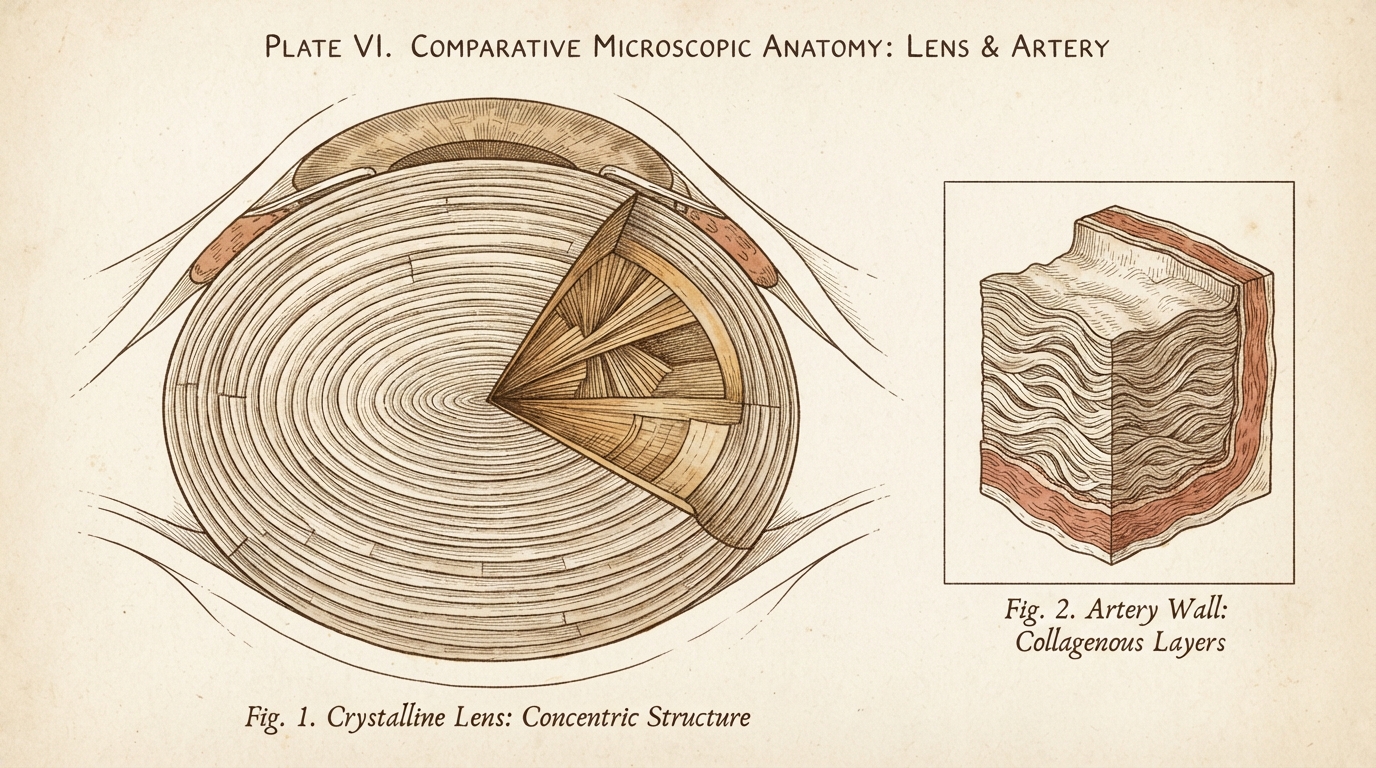
Some proteins you replace in days. Others last a lifetime `F9`. The collagen in your arteries. The crystallins in your eye's lens, among the longest-lived proteins in the body `F9`. So every scar they take, they keep `F10`. Your body can clear the raw sugars, but never the finished scar `F11`.
05THE IDEA
Unless something new could. Picture an enzyme that finds CML and snips the scar off, handing back the clean lysine `F12`. Add oxygen, cut the stub, and what's left is native lysine, plus two byproducts the body already clears `F13`. No such enzyme was known `F14`. So they built one.
06THE HUNT I
Where to start? With the shape of the scar. That carbon stub looks almost exactly like something bacteria eat: glycine `F15`. Bacteria carry an enzyme to break glycine down `F16`. Feed it loose CML, and it nibbles `F17`. But on a real protein, CML sits buried, and the enzyme's mouth is blocked by a tiny helix `F18`.
07THE HUNT II (the powerful idea)
So they hunted for a version born without that block. Not gene by gene. By shape `F19`. AlphaFold had just predicted the structures of hundreds of millions of proteins `F20`. They searched forty-four thousand bacterial enzymes like a catalog, for one missing that helix `F21`. Fewer than fifty fit `F22`. The winner came from a heat-loving microbe, its active site wide open `F23`.
08THE ENGINEERING
Found, but slow. A discovered enzyme is only a rough draft `F24`. So they ran it through directed evolution: breeding proteins like crops, but in days `F25`. They wired bacteria so only cells whose enzyme could cut CML would grow `F26`. The fastest won, round after round. Across five rounds, more than five hundred million variants `F27`. Out came an enzyme with seventeen changes. CMLase `F28`.
09THE PROOF I
Did it work? On damaged proteins in a tube, yes `F29`. CMLase lifted the scars and restored the lysine, leaving the protein whole `F30`. Across proteins from collagen to hemoglobin, it erased half to nearly all of the CML `F31`. Not every scar. The ones buried in tight folds it missed `F32`.
10THE PROOF II (human tissue)
Then the real test. Human donor tissue, decades old `F33`. In a sixty-four-year-old lens, CMLase cut CML by up to seventy-eight percent `F34`. In a seventy-five-year-old artery, more than seventy `F35`. In aged skin, below the level of a thirty-one-year-old `F36`. A lifetime of scars, lifted overnight `F37`.
11THE HONEST LIMITS
Now the honesty it deserves. Every test was done outside the body, on loose proteins and thin slices, where the enzyme can reach `F38`. A living artery is dense and armored. Whether CMLase can get inside, nobody yet knows `F39`. It's still far slower than nature's own enzymes `F40`. And CML is one scar among many `F41`.
12TIMELINE + SIGN-OFF
But something changed here. For a century, the sugar damage of age was a one-way door `F42`. Now there's a key that fits at least one lock `F43`. Every gene we cover, evolution wrote. This one, people did `F44`. Irreversible, it turns out, can just mean we haven't built the tool yet. — The Gene Channel.
The write-up
In one line: Over a lifetime, sugar reacts with your proteins and leaves a stable scar called CML — an advanced glycation end product that builds up on the proteins you never replace and was long considered irreversible. By mining tens of thousands of AlphaFold-predicted bacterial structures for an enzyme with a naturally open active site and then evolving it across more than 500 million variants, a team at Revel Pharmaceuticals, Calico, and CU Anschutz built CMLase — an enzyme that oxidizes CML back to the original lysine and reversed the scar in aged human skin, artery, and lens tissue (in the dish).
The damage: sugar, written into your proteins
This is not a natural human gene — it's an engineered enzyme, and the reason it exists is a slow chemistry that runs in all of us. Sugars in your blood react non-enzymatically with the amino acids in your proteins (the Maillard reaction — the same browning chemistry as toast, only at body temperature over decades). The stable end products are advanced glycation end products (AGEs), a hallmark of mammalian aging. One of the most abundant is Nε-carboxymethyl-lysine (CML): a carbon "stub" left on a lysine residue.
CML is not just a passive marker. It is a ligand for RAGE (the receptor for advanced glycation end products); the CML–RAGE axis activates NF-κB and drives chronic inflammation and oxidative stress — "inflammaging" — and is implicated in diabetic and vascular disease. And it lands where it does the most lasting harm: on long-lived proteins. The collagen in your artery walls, and the crystallins in your eye's lens (among the longest-lived proteins in the body — carbon-dated studies show lens crystallins carry the atmospheric signature of your birth year), are barely renewed. So every scar they take, they keep. Your body's glyoxalase system can clear the reactive precursors (like methylglyoxal) before they strike — but nothing endogenous reverses the stable adduct once it has formed. CML was, in effect, a one-way door.
The idea, and the reaction
CMLase is an FAD-dependent oxidase. It finds CML and oxidizes the ε-nitrogen, cleaving the carboxymethyl stub to regenerate the native lysine, with glyoxylic acid and hydrogen peroxide as byproducts — both of which your metabolism already clears. In other words, it doesn't mask the damage; it repairs the original residue. No such enzyme was known to exist in nature, so the team built one.
The hunt: mining AlphaFold by shape
The clue was a look-alike. CML's carboxymethyl group closely resembles glycine — and bacteria carry glycine oxidase to break glycine down. A glycine oxidase from Bacillus subtilis nibbles free CML, but it has no activity on CML buried inside a protein: a helix (α9) sits over the active-site mouth like a lid, admitting only small substrates.
So the search was for a version of the enzyme born without that lid — and not by reading genes one at a time, but by 3-D shape. This is the powerful move: the team queried oxidase families in UniProt, kept the 56,499 sequences with AlphaFold-predicted structures, filtered by length to 44,783, and structurally screened all of them for a ≥10-residue deletion of the α9 helix. Fewer than fifty qualified; forty were tested. The winner was a glycine oxidase from the thermophile Calidithermus roseus (CrGO) — missing a 20-residue stretch including the entire α9 helix, its active site open to peptides. The AlphaFold Protein Structure Database (~200 million predicted structures, released 2022; 214M+ today) turned the biosphere's enzyme catalog into something you can search by shape.
The engineering: directed evolution
The found enzyme was only a rough draft, so the team ran five rounds of directed evolution — the discipline Frances Arnold won the 2018 Chemistry Nobel for. They wired an E. coli lysine auxotroph so that only cells whose enzyme could cut CML would grow, adapted the selection to peptidyl-CML, and screened a cumulative >500 million variants (error-prone PCR → loop trimming → active-site → stability → peptide tolerance). The end product, CMLase (CrGO-897), carries fifteen amino-acid substitutions and a two-residue deletion from the parent — seventeen changes in all.
The proof
On model proteins: CMLase removed CML and restored the lysine while leaving the protein intact (no fragmentation), erasing 52–97% of CML across a panel from collagen to hemoglobin. It is site-specific — a few lysines buried in tight, hydrophobic folds resisted repair.
On aged human tissue (ex vivo): in a 64-year-old lens, CML fell by 45% by mass-spectrometry / 78% by ELISA (the ELISA reads the more-accessible surface-exposed CML); in a 75-year-old artery, by more than 70%; and in aged skin, CML staining dropped more than 55%, to below the level of 31-year-old skin. A lifetime of scars, lifted overnight in a dish.
The honest limits
This is a genuine proof of concept — that damage once deemed irreversible is amenable to enzymatic repair — and not, yet, a therapy. Every result is ex vivo: homogenized protein or thin tissue sections where the enzyme's access is maximized; whether CMLase can penetrate the dense cross-linked matrix of a living organ is untested. Its catalytic efficiency is still 10–50× below nature's own editors (e.g. LSD1); its bacterial origin raises immunogenicity questions for repeat dosing; and CML is only one AGE among many — the dominant cross-link, glucosepane, remains resistant to reversal. But it establishes a platform, built from the two Chemistry Nobels it depends on — directed evolution (2018) and AlphaFold (2024), six years apart.
Sources
Full claim-by-claim evidence is in references.md. Primary and authoritative anchors:
- The paper: Trabosh N, Smith J, Hsu MY-H, Panja S, Nagaraj R, Olsson N, McAllister FE, Cravens A. "Reversal of protein chemical aging by enzymatic deglycation." Nature Communications 17:5926 (2026) — https://doi.org/10.1038/s41467-026-75141-2 (Revel Pharmaceuticals · Calico · CU Anschutz; NIH SBIR R43/R44AG084351)
- AGEs / the Maillard reaction in aging: Zgutka et al., Int J Mol Sci 2023 — https://www.ncbi.nlm.nih.gov/pmc/articles/PMC10298716/ ; Baynes, Diabetes 1991 — https://pubmed.ncbi.nlm.nih.gov/2010041/
- CML–RAGE → NF-κB inflammation: Kislinger et al., J Biol Chem 1999 — https://pubmed.ncbi.nlm.nih.gov/10531386/ ; Yamamoto & Yamamoto, Front Endocrinol 2013 — https://www.ncbi.nlm.nih.gov/pmc/articles/PMC3748367/
- Glyoxalase clears precursors, not adducts: Rabbani, Xue & Thornalley, Glycoconj J 2016 — https://www.ncbi.nlm.nih.gov/pmc/articles/PMC4975768/
- Lens crystallins are among the longest-lived proteins (¹⁴C bomb-pulse dating): Lynnerup et al., PLoS ONE 2008 — https://www.ncbi.nlm.nih.gov/pmc/articles/PMC2211393/
- Glucosepane, the dominant human cross-link: Sell, Biemel … Monnier, J Biol Chem 2005 — https://pubmed.ncbi.nlm.nih.gov/15677467/
- AlphaFold: Jumper et al., Nature 2021 — https://www.ncbi.nlm.nih.gov/pmc/articles/PMC8371605/ ; AlphaFold DB (200M+ structures, 2022) — https://www.embl.org/news/science-technology/google-deepmind-partnership-renewal/
- Directed evolution (2018 Chemistry Nobel, Frances Arnold): https://www.nobelprize.org/prizes/chemistry/2018/arnold/facts/
Accuracy notes (the traps this episode states carefully):
- Every result is ex vivo — donor tissue homogenates / thin sections and lab proteins, where access is maximized. This is a proof of concept, not a demonstration in a living body, a lifespan result, or restored tissue function.
- Skin — not artery — is the "younger than a 31-year-old" claim. In arterial tissue the result is a >70% reduction; the age-equivalence (down to below 31-year-old levels) is the skin result. Some press coverage conflated the two.
- The lens numbers are one 64-year-old donor by two methods — 45% by LC-MS/MS and 78% by ELISA (which reads the more-accessible surface-exposed CML) — not a range across donors.
- CMLase is an oxidase, and it regenerates lysine. It uses O₂ and yields glyoxylic acid + H₂O₂ (both cleared by metabolism); it is not a hydrolase, and the byproduct is glyoxylate, not glycine.
- CMLase is engineered, not natural — it is CrGO-897, an engineered variant of a bacterial glycine oxidase (from Calidithermus roseus). Humans have no enzyme that reverses protein CML.
- "Searching a library" here means the AlphaFold structure database — ~44,783 predicted bacterial oxidase structures screened for one lacking the α9 helix, not a wet-lab metagenomic screen.
- It reverses CML only — not carboxymethyl-arginine, not glucosepane, not "aging" broadly. CML is one adduct among many.
The evidence
Every claim, sourced
Each [F#] you hear in the film links to the source it came from. Nothing gets narrated until every one is checked and signed off.
Sign-off
- Fact-gate verified against the primary paper (read in full, on disk). Every
[F1]…[F44]maps to [P] (or, for F20 only, the AlphaFold DB scale — externally confirmed). - Background independently corroborated (see section above) — AGE/Maillard, CML–RAGE, glyoxalase, long-lived proteins, glucosepane, AlphaFold, directed evolution all confirmed against primary/authoritative sources other than [P]; no claim contradicted; precision-caveats logged.
- All 7 traps above stated correctly in
script.md(ex-vivo framing; skin-vs-artery; lens two-method; oxidase/byproducts; engineered-not-natural; AlphaFold-DB-as-library; CML-only). - Numbers verified as narrated: 44,783 structures ("forty-four thousand"), <50 fit, >5×10⁸ ("five hundred million"), 17 changes, 52–97% ("half to nearly all"), lens up to 78%, artery >70%, skin <31-yo.
- Domain review (user is the technical/PhD authority on this episode) — pending final nod before narration bake.
Gate OPEN → narration + render may proceed.
- F1
Aged skin proteins carry a lifetime of damage "written in sugar" (CML accumulates in old skin)
AGEs form by the nonenzymatic reaction of sugars with amino acids and accumulate on long-lived proteins; CML measured in donor skin aged 20–75 (Fig 4D, Supp 18–20)
- F2
That damage was long thought permanent
Abstract: "the stable CML adduct has historically been considered irreversible"; Discussion: "categorized as a chemically stable and irreversible AGE"
- F3⚠ commonly confused
In a dish, one engineered enzyme winds aged skin's chemical age back below a 31-year-old's
"In elderly human skin, CMLase treatment resulted in more than a 55% reduction in CML staining… and reversed levels of CML staining to less than those found in 31-year-old skin"
- F4
Sugar reacts with proteins on its own, with no enzyme guiding it
AGEs "formed by the nonenzymatic reaction of sugar- and lipid-derived reactive carbonyls with amino acids" (the Maillard reaction)
- F5
These build up as molecular scars — advanced glycation end products, AGEs
"The accumulation of advanced glycation end products (AGEs) in long-lived proteins is a hallmark of mammalian aging"
- F6
Sugar + the amino acid lysine leaves a carbon stub → carboxymethyl-lysine (CML)
"N^ε-carboxymethyl-lysine (CML)… conversion of cationic lysine residues to anionic carboxymethyl adducts"
- F7
One of the commonest AGEs in old tissue
CML "is particularly abundant in aging tissues"; "a critical, chemically stable adduct found abundantly in long-lived proteins during aging"
- F8
CML fits a receptor called RAGE, read as a signal to inflame
CML "acts as a ligand for the receptor for advanced glycation end products (RAGE)… the CML–RAGE axis… activates NF-κB and… pro-inflammatory cytokines"
- F9
Some proteins renew in days; others last a lifetime — arterial collagen, eye-lens crystallins, among the longest-lived in the body
"Lens crystallins are among the longest-lived proteins in the human body"; CML on ECM/vascular collagen
- F10
So every scar those long-lived proteins take, they keep
AGE accumulation "inhibit[s] normal protein turnover"; long-lived proteins accumulate CML over decades
- F11⚠ commonly confused
The body clears the raw sugars/precursors, but never the finished scar
"the glyoxalase system (Glo1)… scavenge[s] reactive dicarbonyl precursors like methylglyoxal, but they do not reverse stable AGE adducts once formed"
- F12
An enzyme that finds CML and snips the scar off, restoring native lysine
CMLase "engineered to specifically oxidize CML and restore the native lysine residue"
- F13⚠ commonly confused
Add oxygen, cut the stub → native lysine + two byproducts the body clears
Fig 1A: oxidation of the ε-nitrogen of CML → lysine + glyoxylic acid + H₂O₂; Discussion: "hydrogen peroxide and glyoxylate are naturally present… and efficiently cleared by metabolic enzymes"
- F14
No such enzyme was known to exist
A Cladosporium CML-oxidase was reported but its sequence "was unavailable" and the isolate "was inactive"; no native reverser of protein CML
- F15
CML's carbon stub looks almost exactly like glycine
"chemical similarity between the carboxymethyl-amino moiety of CML and glycine"
- F16
Bacteria carry an enzyme to break glycine down (glycine oxidase)
FAD-dependent glycine oxidase (GO) chosen as scaffold; B. subtilis GO on N-alkyl glycines
- F17
Feed it loose CML, and it nibbles (partial activity on free CML)
BsGO "observed activity on free CML" (k_cat/K_M ≈ 8.6×10⁻³, ~30× below glycine)
- F18
But CML on a real protein sits buried, and the enzyme's mouth is blocked by a tiny helix
BsGO "showed no detectable activity… against peptidyl-CML"; helix α9 would "obstruct access to the active site"
- F19
They searched by shape, not gene by gene
Computational structural screen: "pairwise structural alignments" to find enzymes lacking helix α9
- F20
AlphaFold had just predicted the structures of hundreds of millions of proteins
AlphaFold DB: ~200M structures uploaded Jul 28 2022; 214M+ by 2024
- F21
They searched ~44,000 bacterial enzymes like a catalog, for one missing the helix
71,426 oxidase sequences → 56,499 with AlphaFoldDB structures → length-filtered (250–650 aa) → 44,783, screened for ≥10-residue α9 deletion (paper has an internal 44,783/44,873 typo)
- F22
Fewer than fifty fit
"Fewer than fifty unique sequences… satisfied these criteria; from these, forty were selected for experimental characterization"
- F23
Winner from a heat-loving microbe, active site wide open
Glycine oxidase from Calidithermus roseus (CrGO) — a thermophile — with a 20-aa deletion incl. the complete absence of the 12-residue α9 helix, active on peptidyl-CML
- F24
A discovered enzyme is only a rough draft (CrGO's activity was low)
"CrGO's notably low activity on peptidyl-CML… we aimed to develop an engineering strategy to enhance its activity"
- F25
So they ran it through directed evolution — breeding proteins, but in days
Five rounds of directed evolution (error-prone PCR + selection); colonies scored within ~2 days
- F26
They wired bacteria so only cells whose enzyme could cut CML would grow
Growth-coupled genetic selection: E. coli lysine auxotroph whose growth depends on the enzyme producing lysine from CML (periplasmic peptidyl-CML variant)
- F27
Across five rounds, more than five hundred million variants
"a cumulative screening total of >5 × 10⁸ variants"; "five rounds of directed evolution"
- F28⚠ commonly confused
Out came an enzyme with seventeen changes — CMLase
"a highly active CMLase (CrGO-897) featuring fifteen amino acid substitutions and a two amino acid deletion" (15 + 2 = 17) vs the parent CrGO
- F29
On damaged proteins in a tube, yes (in vitro)
CMLase (5 µM) on CML-BSA produced H₂O₂ at 0.90 µmol/L/h; activity across a protein panel
- F30
It restored the lysine and left the protein whole
SDS-PAGE: "protein remained intact… no evidence of fragmentation"; western: enzyme-dependent anti-CML reduction
- F31
Across proteins from collagen to hemoglobin, it erased half to nearly all of the CML
Panel (BSA, casein, hemoglobin, collagen, eye TPE): ELISA CML reductions "ranged from 52% to 97%"
- F32
Not every scar — the ones buried in tight folds it missed
Site-specific: 3 lysines (K131, K504, K573) <5% reduction; lower activity near hydrophobic flanks; favors solvent-accessible sites
- F33
Then the real test — human donor tissue, decades old
CMLase tested "directly on human tissues where CML has had decades to accumulate"; donors 20–75 (NDRI, Declaration of Helsinki)
- F34⚠ commonly confused
64-year-old lens: CML cut by up to 78%
Lens crystallins (64-yo donor): 45% by LC-MS/MS, 78% by CML ELISA (surface-exposed CML more accessible) — one donor, two methods
- F35⚠ commonly confused
75-year-old artery: more than 70%
"CMLase treatment reduced CML content by more than 70% in elderly arterial tissue" (75-yo aorta, IHC/DAB)
- F36
Aged skin: below a 31-year-old's
(see F3) — >55% reduction, to below 31-yo skin
- F37
A lifetime of scars, lifted overnight (ex vivo)
Tissue/homogenate "incubated overnight with CMLase"
- F38⚠ commonly confused
Every test was done outside the body, where the enzyme can reach
"findings in skin, arterial, and lens tissues utilized homogenized protein or thin, FFPE sections where substrate accessibility is maximized"
- F39
Whether CMLase can get inside a living artery, nobody yet knows
"the ability of an enzyme to penetrate the dense, cross-linked architecture of the ECM must be evaluated" (in intact organs)
- F40
Still far slower than nature's own enzymes
Catalytic efficiency on peptides "approximately 10–50 fold lower" than PTM editors like LSD1
- F41⚠ commonly confused
CML is one scar among many (worst cross-links unreversed)
"CML will only be one of many age-related modifications… glucosepane is a dominant cross-link… currently resistant to reversal"
- F42
For a century, the sugar damage of age was a one-way door
Maillard reaction described 1912; CML long "irreversible"; a "long-standing goal… to slow or reverse the accumulation of AGEs"
- F43
Now there's a key that fits at least one lock
"proof-of-concept that protein damage previously deemed irreversible is amenable to enzymatic repair"
- F44⚠ commonly confused
Every gene we cover, evolution wrote — this one, people did
CMLase is an engineered enzyme (computational screen + directed evolution of a bacterial GO); not a natural human gene