CHD3
The Cure, and the Death It Hid
A child's entire syndrome came down to a single misspelled letter of DNA — and a new kind of molecular pencil can rewrite exactly that letter without cutting the double helix. In a mouse, it worked. Then a team carried it into a six-year-old, off the books; seven days later she was dead, and the trial was never made public. CHD3 is the ATP-powered motor a developing brain uses to switch the right genes on — and its story became the year's hardest lesson in the difference between a cure and its guardrails.
The walkthrough
Beat by beat

HOOK
0:30
01HOOK
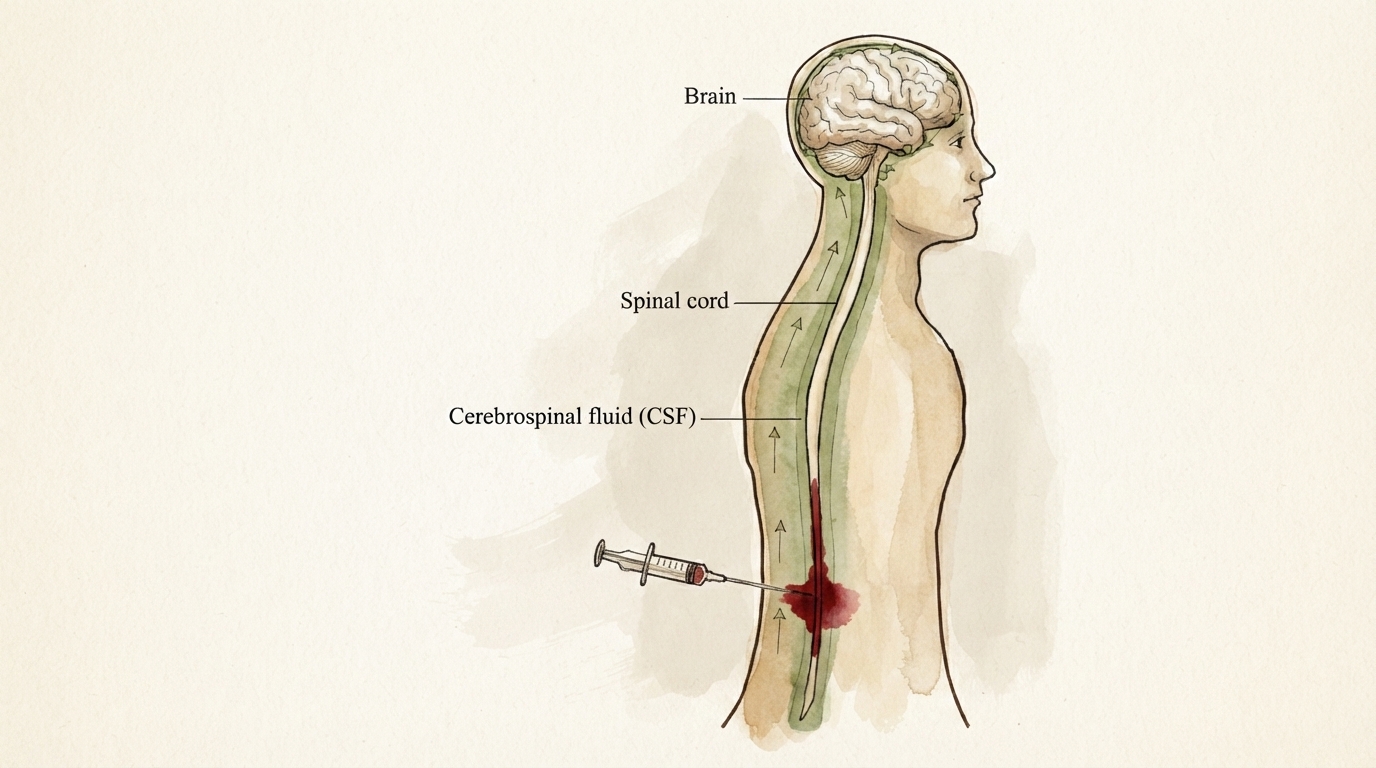
In March of 2025, a six-year-old girl was given a single injection into her spine — trillions of engineered viruses, carrying a molecular tool built to rewrite one letter of her DNA. F9 Seven days later, she was dead. F1 The trial she died in was never made public — until an investigation, in July of 2026, forced it into the light. F1 This is the gene they were trying to fix.
02THE NAME
The gene is called CHD3. It sits on the short arm of chromosome 17. F2 It doesn't build a muscle, or a pigment. It builds a machine that decides which other genes are allowed to speak. F2 The DNA in a cell isn't loose thread — it's spooled tight around protein cores, like beads on a string. To read a gene, the cell has to slide those beads aside. CHD3 is one of the motors that does the sliding: the engine at the heart of a complex called NuRD. F2F3
03THE SYNDROME
Change one letter in CHD3, and that motor jams. F4 The result is Snijders Blok–Campeau syndrome — first described only in 2018. F4 Children born with it have larger-than-average heads, delayed development, and, above all, trouble with speech. F4 It is not fatal. Most live a normal lifespan. F4 And it is vanishingly rare — around 237 people in the entire world are known to have it. F5 Rare enough that no drug company will ever build a therapy for it. If a cure was coming, it would have to be built from scratch.
04THE MECHANISM (hero)
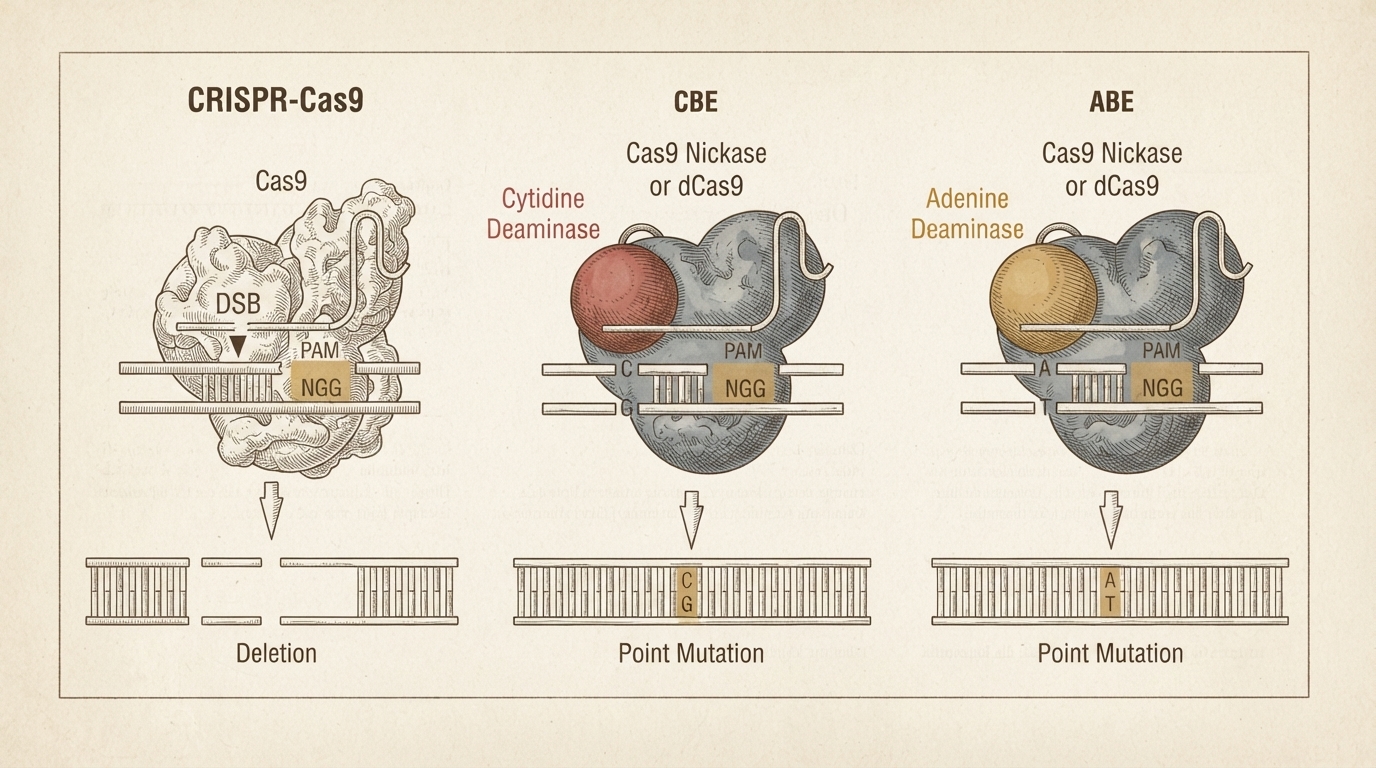
Here is what made CHD3 so tempting to fix. In this girl's case, the whole syndrome came down to a single typo. F6 One rung of the DNA ladder, a spot where a C should sit, had been swapped for a T. F6 One letter, out of three billion. And there is now a tool that can change a single letter without cutting the strand in two. It's called a base editor. F7 It clamps onto that exact spot and chemically rewrites the base back: the errant A-T pair flipped to the G-C it was always supposed to be. F7 No break in the DNA. Just one letter, corrected. On paper, it is the perfect fix for the perfect disease.
05THE TRIAL
And it works. In mice. In February of 2026, a team led by the neuroscientist Zilong Qiu published exactly that: base-edit the mouse version of the gene, and the animals' behavior improved. F8 The paper ran in Nature. F8 But the same team had already taken the next step. They packaged the base editor into a virus, a pair of AAVs, to be infused into a child's spinal fluid and carried up into the brain. F9 To turn a mouse result into a human cure. The family paid for it themselves. More than eight hundred thousand dollars. F10
06THE DEATH
The girl, given the name "Mei" to protect her, received the infusion in March 2025. F1 Seven days later, her body was shutting down. The cause was thrombotic microangiopathy: a storm of tiny clots, her own blood vessels turning against her. Most likely an overwhelming immune reaction to the flood of virus. F11 The hospital's own ethics board would later judge her death "definitely related" to the treatment. F11 She was six years old.
07THE CONTROVERSY
What turned a tragedy into a scandal was everything that didn't happen next. The death was not announced. F1 The trial hadn't run as a nationally-approved study. It ran under a loophole for "innovative" hospital treatments, with little outside oversight. F12 Then, a year later, that Nature paper — the one celebrating the cure in mice — went to print. It made no mention that a child had already died receiving it. F13 The investigation went further. It reported that the risks had been downplayed to the family, and that warning signs in the animal data, liver and kidney damage in treated monkeys, had come before the girl was treated, not after. F14 When reporters finally exposed it, in July 2026, Nature flagged the paper, experts called for a retraction, and the university opened an investigation. F13F16
08SIGN-OFF
None of this means the tool is the villain. That same year, in Philadelphia, a baby called K.J. got a base editor built just for him — but for a different disease, a liver disorder, and delivered a different way: not a virus into the brain, but tiny fat bubbles carrying it to the liver. F15 Done in the open, under full regulatory watch. He lived. F15 The difference was never the science, or even the delivery. It was the guardrails. CHD3 is a story about how close we now are to editing a single letter of a life. And how the hardest part may not be the biology at all. For the families still waiting, the dream is real. It just has to be done right. — The Gene Channel.
The write-up
In one line: CHD3 is the molecular motor that decides which genes a developing brain switches on — and its story became the year's hardest lesson in the difference between a cure and its guardrails.
The gene
CHD3 sits on the short arm of chromosome 17 (17p13.1). It doesn't make a structural protein — it makes a machine that regulates other genes. Cellular DNA is wound tightly around protein spools (nucleosomes), and to read a gene the cell must slide those spools aside. CHD3 is the ATP-powered motor that does the sliding: the catalytic engine of the NuRD (Nucleosome Remodeling and Deacetylase) complex, one of three mutually-exclusive subunits (CHD3/4/5).
The syndrome
A single de novo change in CHD3's helicase domain jams that motor and causes Snijders Blok–Campeau syndrome, first described in 2018. It brings macrocephaly, developmental delay, and — most characteristically — impaired speech and language. It is not fatal; most people live a normal lifespan. It is also vanishingly rare: roughly 237 known people worldwide, per the CHD3 Foundation. Too rare for any company to build a drug — which is exactly why a cure, if one came, would have to be built bespoke.
The dream, and the mechanism
In the child at the center of this story, the entire syndrome came down to one letter: a rung of the DNA ladder where a C had become a T (c.3073C>T, p.R1025W). Modern base editors can rewrite a single base without cutting the double helix — an adenine base editor flips the errant A•T pair back to G•C. In February 2026, a team led by neuroscientist Zilong Qiu showed in Nature that base-editing the mouse version of Chd3 rescued the animals' behavior. On paper, the perfect fix for the perfect disease.
What happened
The same team carried the base editor — packaged into a pair of AAV viruses — into a child. In March 2025, a six-year-old ("Mei") received a single intrathecal infusion; her family had paid more than $800,000 to fund it. Seven days later she died of thrombotic microangiopathy, most likely an immune reaction to the viral dose; the hospital's ethics board judged the death "definitely related" to the treatment.
The controversy
The death was never made public. The trial had run under a hospital-level "innovative treatment" pathway rather than national approval. A year later, the celebrated Nature mouse paper went to print with no mention that a child had already died receiving the therapy. A July 2026 Science / Retraction Watch investigation reported that risks had been downplayed to the family and that animal-safety warning signs (liver and kidney damage in treated monkeys) had preceded the human treatment. Nature added an Editor's Note (July 29, 2026); experts called for retraction; the university opened an investigation.
This is reporting on an ongoing, unadjudicated matter: the death, the payment, the paper's omission, and the probe are established; questions of intent and consent are allegations from the investigation, and are described as such.
The point
The technology is not the villain. The same year, at Children's Hospital of Philadelphia, a baby (K.J.) received a base editor built just for him — in the open, under full FDA oversight — and lived. The difference wasn't the science; it was the guardrails. CHD3 shows how close we are to editing a single letter of a life, and that the hardest part was never the biology.
Sources
Full claim-by-claim evidence is in references.md. Primary anchors:
- Snijders Blok et al., Nat Commun 2018 (PMID 30397230) — the syndrome's discovery.
- "In vivo base editing of Chd3 rescues behavioural abnormalities in mice," Nature 2026 (DOI 10.1038/s41586-026-10113-6) — the mouse result (Editor's Note added July 29, 2026).
- Science / Retraction Watch investigation, July 23, 2026 — the death and the controversy.
- CHD3 Foundation (chd3.org) — the ~237 families.
Accuracy note: CHD3 is a chromatin remodeler, not a DNA-replication helicase; the syndrome is de novo
dominant, not inherited; base editing does not cut the double strand; and this is not the 2018 He Jiankui
embryo-editing case. See references.md for the full trap list.
The evidence
Every claim, sourced
Each [F#] you hear in the film links to the source it came from. Nothing gets narrated until every one is checked and signed off.
Sign-off
- PhD sign-off — facts above are correct; confirmed-vs-alleged discipline honored; traps stated correctly. Independently corroborated by two research passes (gene/syndrome biology + trial/controversy), 2026-07-31; no material discrepancies.
- Numbers/dates verified: ~237 cases (foundation figure; published cohorts total ~115, Gao 2024 — narrate as "known" cases), ~$860K, 7 days, Mar 2025 infusion, Nature Feb 18 2026, Editor's Note Jul 29 2026, probe ~Jul 27 2026.
- Primary-literature spot-check: Snijders Blok 2018 (PMID 30397230) read via PMC6218476; 2026 Nature base-editing paper confirmed by DOI + published Editor's Note (paper very recent — cited from abstract/reporting).
**Gate OPEN** — user sign-off 2026-07-31 (keep ~5:20 extended cut). Narration baked from this signed script.
- F1
A 6-yr-old girl ("Mei") died 7 days after an intrathecal gene-editing infusion; the death was never made public until a July 23, 2026 investigation.
CONFIRMED
- F2
CHD3 is on chr 17 (17p13.1); it encodes an ATP-dependent chromatin remodeler — the catalytic ATPase subunit of the NuRD complex.
CONFIRMED
- F3
NuRD repositions nucleosomes to regulate which genes are transcribed (esp. in neurodevelopment); CHD3/CHD4/CHD5 are mutually-exclusive catalytic subunits.
CONFIRMED
- F4
De novo missense in CHD3's helicase/ATPase domain → Snijders Blok–Campeau syndrome (macrocephaly, developmental delay, prominent speech impairment, hypotonia); generally normal lifespan; first described 2018.
CONFIRMED
- F5
Ultra-rare — ~237 known people worldwide.
CONFIRMED (foundation count)
- F6
The girl's syndrome traced to one recurrent variant — a base where a T sits where a C belongs (c.3073C>T, p.Arg1025Trp / R1025W).
CONFIRMED
- F7
A base editor rewrites that single base without a double-strand break — an adenine base editor flips the errant A•T pair back to G•C.
CONFIRMED
- F8
Qiu's team showed in vivo base editing of Chd3 rescued behavioral abnormalities in mice (Nature, Feb 18 2026).
CONFIRMED
- F9
The therapy was delivered as a pair of AAVs (dual AAV9) carrying the base editor, infused into the spinal fluid (intrathecal).
CONFIRMED
- F10
The family paid > $800,000 (~$860K) to fund the experimental treatment.
CONFIRMED
- F11
She died 7 days later of thrombotic microangiopathy (a clotting/vessel-injury syndrome, likely immune reaction to AAV); the hospital's ethics board judged the death "definitely related" to the treatment.
CONFIRMED (cause) / REPORTED (board quote)
- F12
The trial ran under a hospital-level "innovative/exceptional treatment" pathway (NCT06860672), not full national regulatory approval, with little outside oversight.
REPORTED
- F13
The Nature mouse paper made no mention of the child's death; after the investigation Nature added an Editor's Note (Jul 29 2026) and experts called for retraction.
CONFIRMED
- F14
The investigation reported that risks were downplayed to the family and that primate-tox warning signs (liver/kidney damage in treated monkeys) preceded the human treatment.
REPORTED / ALLEGED — must attribute
- F15
Contrast: baby K.J. (CHOP, 2025) received a bespoke base-editing therapy under full FDA oversight and public disclosure, and survived — for a different disease, delivered a different way (a liver/urea-cycle disorder; lipid-nanoparticle infusion to the liver, NOT AAV to the brain).
CONFIRMED
- F16
Shanghai Jiao Tong University School of Medicine opened an investigation (~Jul 27 2026).
CONFIRMED