CCR5
The Missing Door
Some people are born resistant to HIV — the virus simply can't find the door. A 32-letter deletion in one gene explains it, and that accident of evolution led to the first person ever cured of HIV, a class of drugs, and the most notorious experiment in modern biology.
The walkthrough
Beat by beat
HOOK
0:23
01HOOK
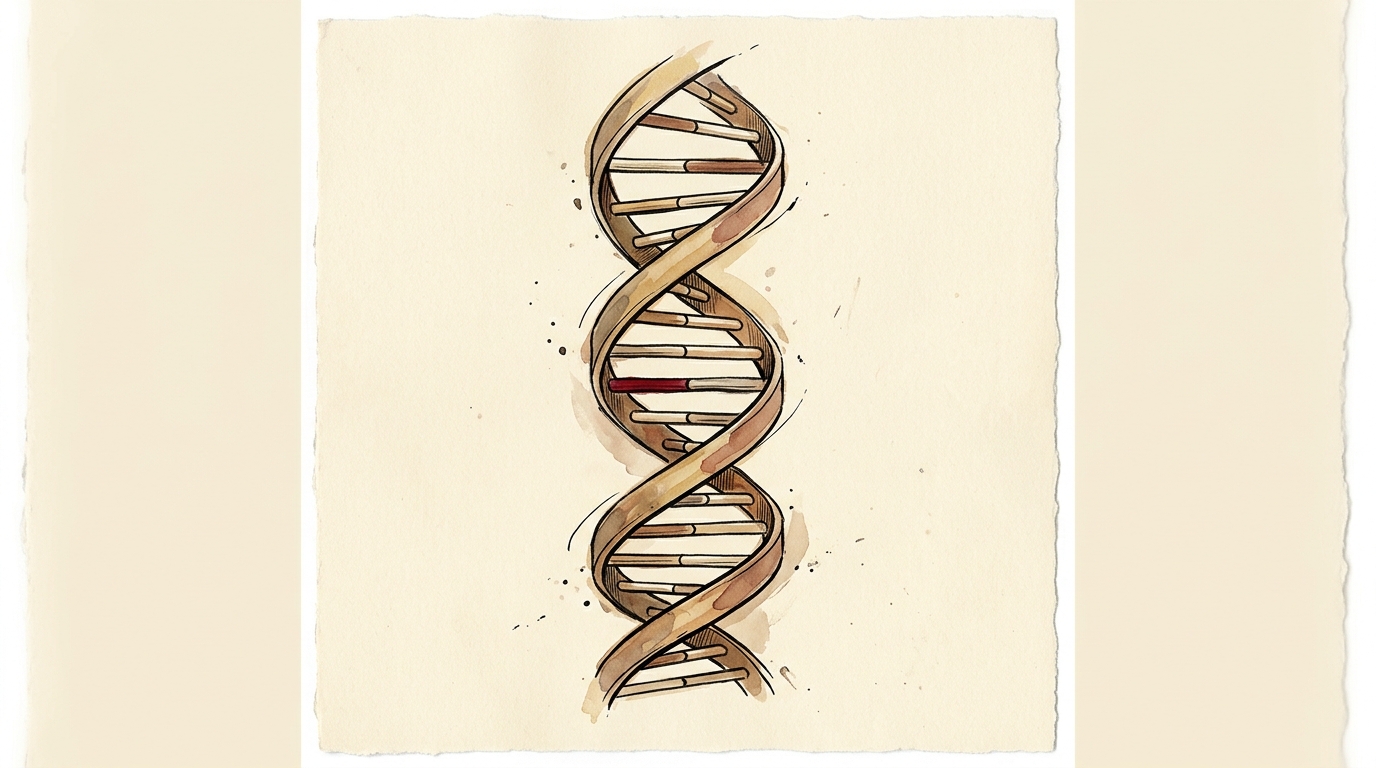
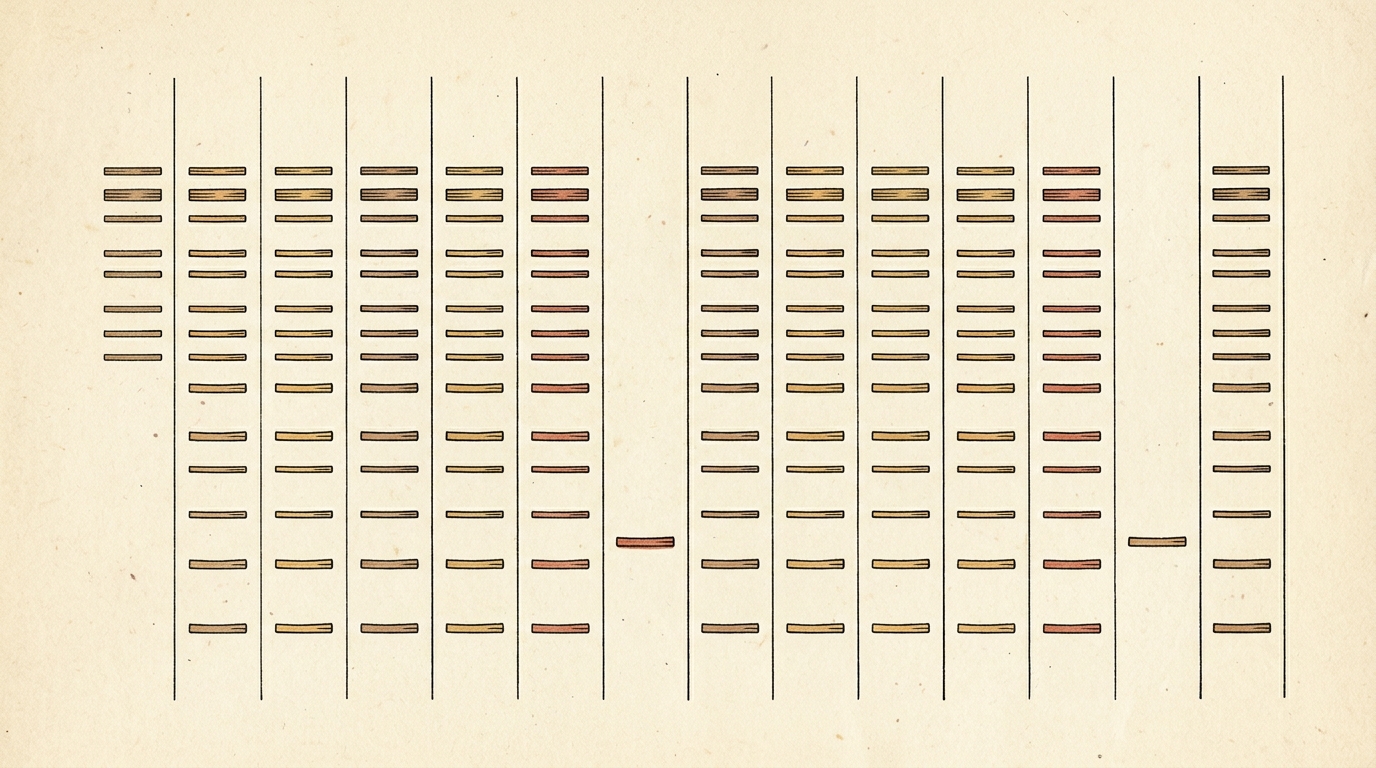
A small number of people are essentially immune to HIV — not vaccinated, not treated, but born that way `F1`. The reason is almost absurdly small: thirty-two letters of DNA, missing from a single gene `F2`. This is the story of that gene — the cures it made possible, and the line a scientist crossed because of it.
02THE NAME
The gene is CCR5, tucked into the short arm of chromosome 3 `F3`. Its job is to build a small receptor — a docking port that studs the surface of your immune cells and helps them read the chemical signals of inflammation `F4`. Useful — but, it turns out, something your body can largely live without `F5`.
03THE MECHANISM (hero)
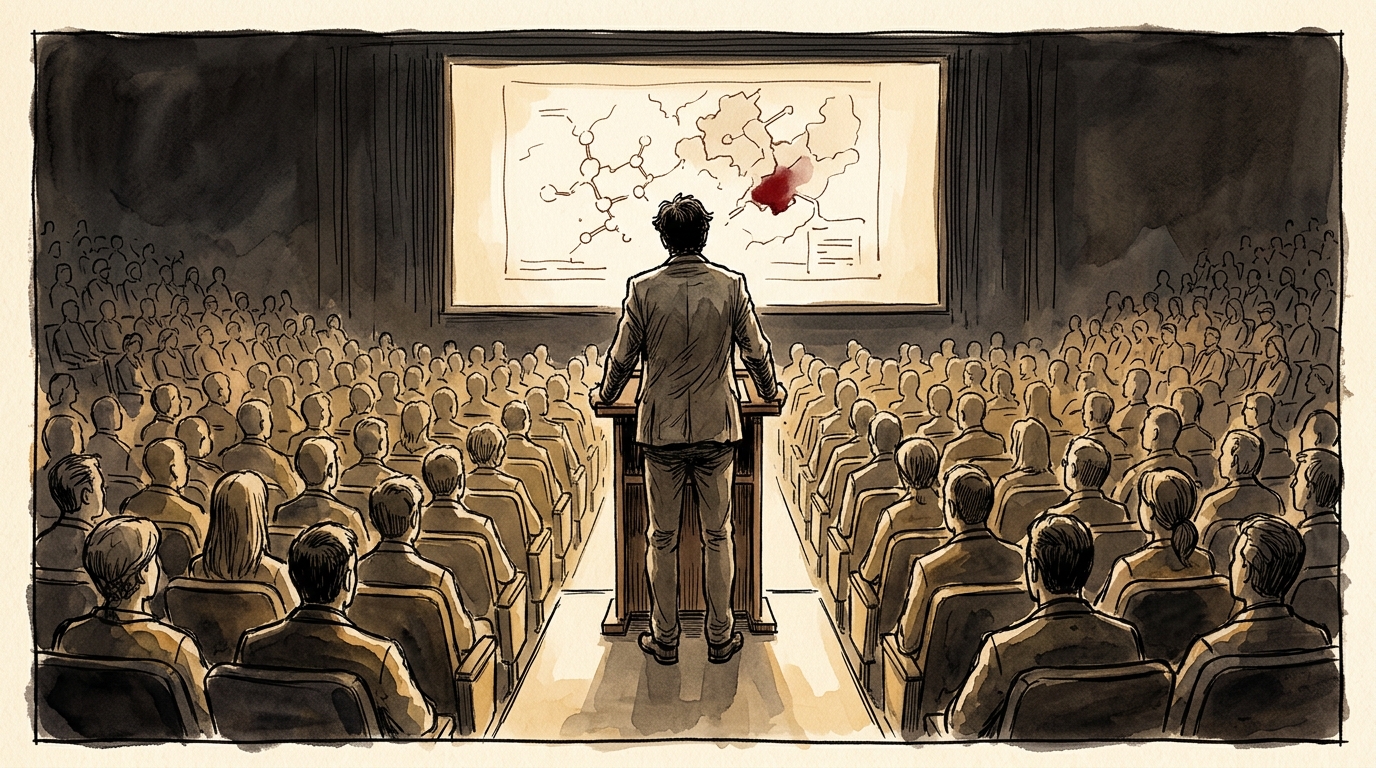
Here is why those thirty-two letters matter. To break into a cell, HIV needs two handholds: first a protein called CD4, then a co-receptor — and for the strains behind most new infections, that co-receptor is CCR5 `F6`. Delete the thirty-two letters, and the gene is read out of frame: the receptor comes out garbled and never reaches the cell's surface `F7`. No docking port, no way in. The one catch — a rarer form of the virus uses a different door, so the shield isn't absolute `F8`.
04THE HUNT
How did anyone find this? In the mid-1990s, doctors kept meeting people who had been exposed to HIV over and over and simply never caught it `F9`. In 1996, several teams cracked the puzzle at once: those people carried two broken copies of CCR5 `F10`. The deletion was common across Europe — roughly one allele in ten — and almost unknown elsewhere `F11`.
05THE FIRST CURE
That discovery handed medicine an audacious idea. In Berlin, a man named Timothy Ray Brown had both HIV and leukemia. His doctor, Gero Hütter, deliberately chose a bone-marrow donor with two copies of the deletion `F12`. Brown's immune system grew back resistant, and his HIV disappeared — he became the first person ever cured `F13`. Years later, a second man, in London, was cured the same way `F14`.
06THE LINE
But where some saw a careful cure, one scientist saw a shortcut. In 2018, a Chinese researcher, He Jiankui, used the gene-editing tool CRISPR to switch off CCR5 in human embryos — and then implanted them `F15`. Twin girls, code-named Lulu and Nana, were born: the first gene-edited humans in history `F16`. He revealed it to a stunned scientific summit in Hong Kong `F17`.
07THE FALLOUT
Then the story curdled. He hadn't recreated the natural deletion at all — his edits were new, untested mutations, different in each twin and patchy from cell to cell `F18`. Worse, the children had never been in real danger of HIV; a routine procedure already keeps an infected father from passing it on `F19`. The backlash was immediate. A court sent him to prison for practicing medicine illegally `F20`.
08USED TODAY
The honest path forward borrows the mutation, not the recklessness. There is already a drug — maraviroc — that caps the CCR5 receptor from the outside; it has treated HIV since 2007 `F21`. Labs are learning to edit a patient's own immune cells to delete CCR5 safely, no donor required `F22`. And the strangest twist of all: the same missing gene seems to help the brain heal — people who carry it recover better after a stroke `F23`.
09TIMELINE + SIGN-OFF
One gene. Thirty-two missing letters. From a virus that couldn't get in, to the first cure, to a line we crossed far too soon `F24`. Nature edited this gene a long time ago — and, for now, its edits are still steadier than ours. — The Gene Channel.
The write-up
In one line: A 32-letter deletion in CCR5 makes some people resistant to HIV — and that accident of evolution gave us the first cure for HIV, a class of drugs, and the most notorious experiment in modern biology.
The gene
CCR5 sits on the short arm of chromosome 3 (3p21.31). It builds a small receptor — a docking port that studs the surface of immune cells like T cells and macrophages — that normally reads the chemical signals of inflammation. Useful, but, as it happens, something the body can largely do without.
The mechanism
HIV doesn't break into a cell with one key. It needs two: the protein CD4, and then a co-receptor. For the strains that drive most new infections — the "R5-tropic" virus — that co-receptor is CCR5. The famous Δ32 allele is a 32-base-pair deletion that knocks the gene out of frame; the receptor comes out truncated and never reaches the cell surface. With no CCR5 on the door, R5 HIV has nowhere to dock. People with two broken copies are strongly resistant; people with one copy progress more slowly. The important caveat: a rarer "X4-tropic" virus uses a different door (CXCR4), so the protection is not absolute.
The hunt
In the mid-1990s, clinicians kept meeting people exposed to HIV again and again who never got infected. The phenotype came first (Paxton et al., Nature Medicine, 1996); the genotype followed within months, when several independent teams showed those people were Δ32 homozygotes (Liu et al., Cell; Samson et al., Nature; Dean & O'Brien et al., Science — all 1996). The deletion is common in Europe (~10% allele frequency, on a north–south cline) and nearly absent in African and East Asian populations.
The first cure
The discovery suggested an audacious move: rebuild someone's immune system out of CCR5-negative cells. In Berlin, Timothy Ray Brown had both HIV and leukemia; his physician Gero Hütter deliberately picked a bone-marrow donor homozygous for Δ32. Brown's HIV vanished, and he became the first person ever cured (he later died, in 2020, of recurrent leukemia — not HIV). A second man, Adam Castillejo, the "London Patient," was cured the same way. These transplants are a proof of principle, not a scalable therapy — they are brutal procedures justified only because each patient also needed a transplant for a blood cancer. (One later case, the "Geneva Patient," even reached remission with an ordinary CCR5 donor, complicating the simple story.)
The line that was crossed
In 2018, the biophysicist He Jiankui used CRISPR to disable CCR5 in human embryos and implanted them, producing twin girls — pseudonyms Lulu and Nana — the first gene-edited humans, with a third child following in 2019. He announced it at the Second International Summit on Human Genome Editing in Hong Kong, to immediate, near-universal condemnation. The crucial, widely-misreported fact: he did not recreate the protective Δ32 deletion. The CRISPR edits were new, untested mutations, different in each twin and mosaic from cell to cell — at least one twin was edited on only one of two copies — so even the intended "HIV resistance" was unproven. And the experiment was medically pointless: sperm washing already prevents an HIV-positive father from passing the virus to an embryo. A Chinese court convicted He of "illegal practice of medicine" in December 2019, sentencing him to three years in prison and a 3-million-yuan fine.
How CCR5 is used today
The honest path borrows the mutation, not the recklessness:
- A drug. Maraviroc (FDA-approved 2007) is a CCR5 antagonist — a small molecule that caps the receptor from the outside, mimicking what Δ32 does by accident (against R5-tropic virus only).
- Editing your own cells. Rather than a risky donor transplant, trials have edited a patient's own CD4 T cells ex vivo to disable CCR5 (Sangamo's zinc-finger approach; Tebas et al., NEJM 2014) — a safety proof of concept, not yet a cure.
- Beyond HIV. Strikingly, CCR5 also acts as a brake on brain plasticity: blocking it improves recovery after stroke and traumatic brain injury in models, and human Δ32 carriers recover better after stroke (Joy et al., Cell 2019). This is an active frontier, not settled medicine.
Sources
Full claim-by-claim evidence is in references.md. Primary anchors:
- Liu et al., Cell 1996; Samson et al., Nature 1996; Dean et al., Science 1996 — Δ32 and HIV resistance.
- Gupta et al., Nature 2019 / Lancet HIV 2020 — the London Patient; Hütter (Berlin Patient).
- MIT Technology Review (leaked-manuscript analysis, 2019); Ryder, The CRISPR Journal 2019 — what He Jiankui actually edited.
- Pfizer/FDA 2007 (maraviroc); Tebas et al., NEJM 2014; Joy et al., Cell 2019.
Accuracy note: This episode carefully states three things that popular coverage routinely gets wrong — (1) Δ32 blocks the R5-tropic virus, not all HIV; (2) "~1 in 10" is the allele frequency in Europeans, not the share of immune people; and (3) He Jiankui did not recreate Δ32 — his edits were novel, mosaic, and unproven. It also avoids a retracted 2019 claim that Δ32 shortens lifespan.
The evidence
Every claim, sourced
Each [F#] you hear in the film links to the source it came from. Nothing gets narrated until every one is checked and signed off.
Sign-off
- PhD sign-off — facts above are correct; the ⚠️ traps stated correctly in
script.md. (Signed off 2026-06-28.) - Runtime sign-off (length gate) — extended cut (~4 min, 9 segments) approved by user 2026-06-28.
- Numbers/dates verified or kept qualitative (Δ32 = 32 bp; allele freq "~1 in 10"; maraviroc 2007; He Jiankui 3 yrs / 3M yuan / Dec 2019).
Gate OPEN → narration + render may proceed. Next: `gen-narration.mjs` → assets → Video.tsx → render → finalize `writeup.md`.
- F1
A small number of people are essentially immune to HIV from birth
People homozygous for CCR5-Δ32 (~1% of Europeans) are strongly resistant to (R5) HIV-1 even after repeated high-risk exposure — the basis of "born immune"
- F2
The cause is 32 letters of DNA missing from one gene
CCR5-Δ32 = a 32-base-pair deletion in the CCR5 open reading frame
- F3
CCR5 sits on the short arm of chromosome 3
Cytogenetic location 3p21.31 (GRCh38). (Older sources say 3p21 / 3p21.3 — same locus, lower resolution.)
- F4
CCR5 builds a receptor on immune cells that reads inflammation signals
"C-C chemokine receptor type 5" — a GPCR for inflammatory chemokines (MIP-1α/CCL3, MIP-1β/CCL4, RANTES/CCL5); expressed on T cells & macrophages, recruits/traffics immune cells
- F5
The body can largely live without CCR5
Δ32/Δ32 homozygotes are generally healthy — the premise of CCR5 as a drug target and of the Δ32-donor HIV cures
- F6
HIV entry needs CD4 + a co-receptor; CCR5 is the main one for transmitted strains
gp120 binds CD4 (primary receptor) → exposes co-receptor site → engages CCR5; R5-tropic virus dominates early/transmitted infection
- F7
Δ32 → gene read out of frame → garbled receptor never reaches the cell surface
The 32-bp deletion causes a frameshift + premature stop; "the truncated protein … is apparently not expressed at the cell surface"
- F8⚠ commonly confused
A rarer form of HIV uses a different door — protection isn't absolute
X4-tropic HIV-1 uses CXCR4, not CCR5; documented HIV-1 infections in Δ32/Δ32 individuals via X4 virus
- F9
Mid-1990s: people repeatedly exposed yet uninfected
Paxton et al.: CD4 cells from people uninfected despite multiple high-risk exposures resisted HIV-1 in vitro (phenotype first)
- F10
In 1996, several teams showed those people carry two broken copies of CCR5
Δ32-homozygosity explains the resistance — reported near-simultaneously by independent groups
- F11⚠ commonly confused
Common in Europe — ~1 allele in 10 — and almost unknown elsewhere
Δ32 allele frequency ~10% in Europeans, north→south cline (~16% N. Europe → ~4% Greece); absent in sub-Saharan African & East Asian samples. (Allele freq ≠ carrier freq — carriers ~18–20%, homozygotes ~1%.)
- F12
Timothy Ray Brown ("Berlin Patient"); Dr. Gero Hütter chose a donor with two copies of Δ32
Brown had HIV + AML; Hütter (Charité, Berlin) used a hematopoietic stem-cell transplant from a CCR5-Δ32/Δ32 donor (2007 & 2008)
- F13
He became the first person ever cured of HIV
NIH: "the first person cured of HIV." (Note † : Brown died Sept 2020 of recurrent leukemia — NOT HIV; remission held to death.)
- F14
A second man, in London, cured the same way
London Patient (Adam Castillejo): remission after a CCR5-Δ32/Δ32 transplant (2019); confirmed cure at 30 months (2020)
- F15
2018: He Jiankui used CRISPR to switch off CCR5 in human embryos, then implanted them
He (assoc. prof., SUSTech Shenzhen; biophysics PhD, no medical license) edited embryos targeting CCR5 to attempt HIV resistance
- F16
Twin girls Lulu and Nana — the first gene-edited humans
Twins born late 2018 (Oct; announced Nov). (A third edited child, "Amy," was born 2019 — confirmed by China late 2019.)
- F17
He revealed it to a scientific summit in Hong Kong
Announced Nov 25–26 2018; presented Nov 28 at the Second International Summit on Human Genome Editing, University of Hong Kong (Nov 27–29 2018); organizers called it "irresponsible"
- F18⚠ commonly confused
He did NOT recreate the natural deletion; edits were new, untested, different in each twin, patchy
Leaked-manuscript analysis: neither twin has Δ32; novel indels (Lulu a 15-bp del on one allele; Nana +4 bp / −1 bp); mosaic, ≥1 twin edited on only one allele → protection unproven. Urnov: claim to have reproduced Δ32 is "a deliberate falsehood."
- F19
The children were never in real danger of HIV — a routine procedure already prevents it
Fathers were HIV+, mothers HIV−; standard sperm washing (which He's team performed) prevents paternal→embryo transmission → no medical necessity
- F20
A court sent him to prison for practicing medicine illegally
Dec 30 2019, Shenzhen Nanshan District People's Court: guilty of "illegal practice of medicine," 3 years prison + 3 million yuan fine (he had no medical license / faked ethics review). (Released ~April 2022.)
- F21
A drug, maraviroc, caps CCR5 from the outside; treating HIV since 2007
Maraviroc (Selzentry/Celsentri) — first-in-class CCR5 antagonist, FDA approved Aug 6 2007; blocks the R5-tropic-HIV entry route (R5 only)
- F22
Labs are editing a patient's own immune cells to delete CCR5 (no donor)
Sangamo zinc-finger nuclease knockout of CCR5 in autologous CD4 T cells (SB-728-T); Phase 1 safety/feasibility (n=12)
- F23
The same missing gene seems to help the brain heal — Δ32 carriers recover better after stroke
CCR5 is a suppressor of neural plasticity; knockdown / maraviroc improves motor + cognitive recovery in models, and human Δ32 carriers showed greater post-stroke recovery. (Emerging — contested in parts of the literature; not an approved use.)
- F24
Arc: virus-can't-get-in → first cure → a line crossed too soon
Composite of F10 (1996), F12–F14 (2007/2019 cures), F15–F20 (2018 He Jiankui)