APOE
Three Letters
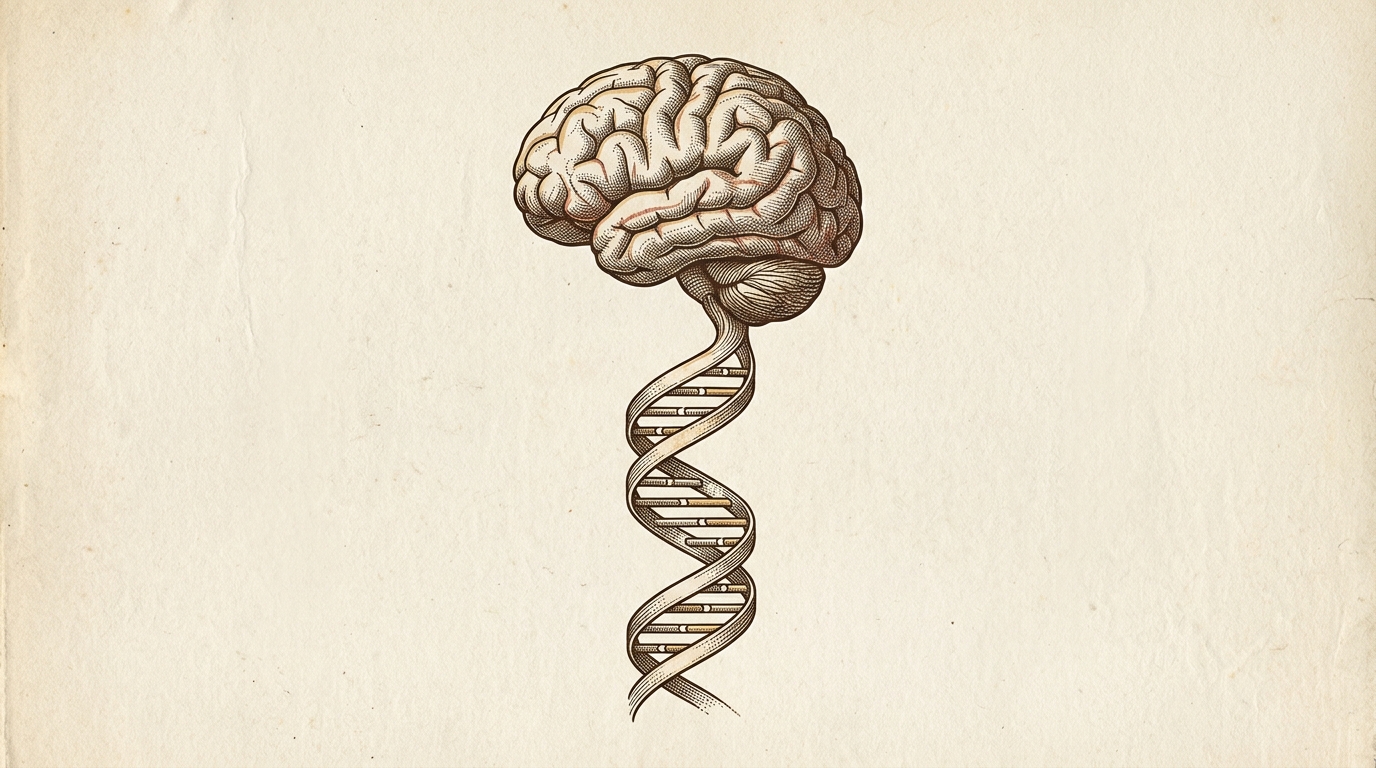
Everyone carries this gene — in one of three versions. Inherit two of the riskiest and your odds of Alzheimer's can climb more than tenfold; inherit another and you're likelier to reach a hundred. Same gene, opposite ends of a life.
The walkthrough
Beat by beat


HOOK
0:30
01HOOK
Everyone carries this gene — and it comes in three versions. `F1` Inherit two copies of one of them, and your odds of Alzheimer's can climb more than tenfold. `F2` Inherit a different one, and you're more likely to reach a hundred. `F3` Same gene — opposite ends of a life. And the strangest part: the riskiest version is the one our species carried first. `F4`
02THE NAME
The gene is APOE — apolipoprotein E. It sits on chromosome 19. `F5` Its everyday job is moving fat: it wraps cholesterol into tiny particles and ferries them through your blood. `F6` And inside your brain, it's the main delivery service — built mostly by support cells called astrocytes, carrying cholesterol to your neurons. `F7` A humble courier. Nothing about that job sounds like dementia.
03THE HUNT
In 1993, a team at Duke University led by Allen Roses went looking. `F8` The field was fixed on the sticky plaques in an Alzheimer's brain — but Roses followed the families. A linkage signal pointed to chromosome 19, `F9` and there sat APOE. One version of it — called ε4 — turned up far more often in people with late-onset Alzheimer's. `F10` A cholesterol gene was the biggest common risk factor anyone had ever found.
04THE THREE LETTERS
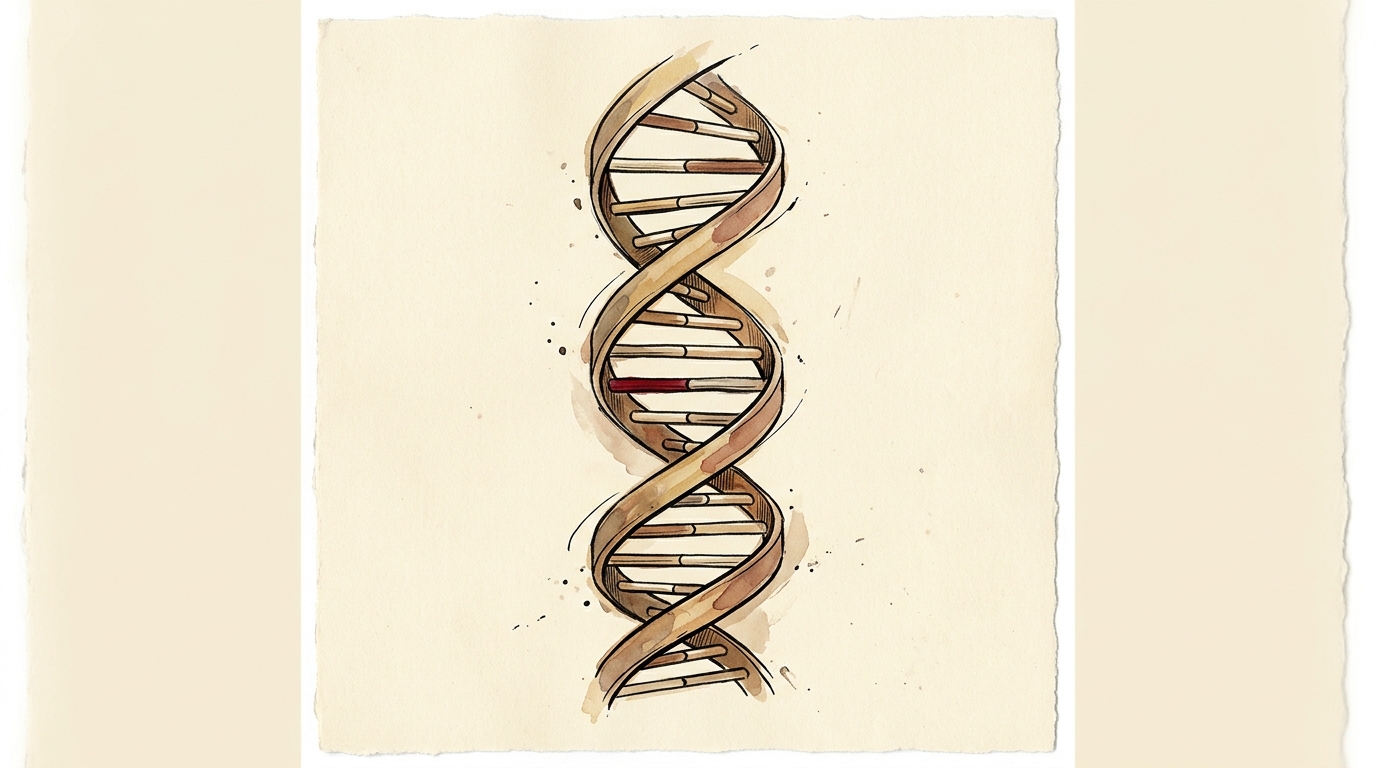
The three versions differ by almost nothing — just two tiny swaps in the protein's chain. `F11` We call them ε2, ε3, and ε4; ε3 is the common one most people carry. `F12` But the effect of ε4 comes in doses: one copy raises your risk — two copies raise it far more, and pull the age it strikes earlier. In those first families, each ε4 dragged the typical onset down from the mid-eighties toward the late sixties. `F13`
05THE MECHANISM (hero)
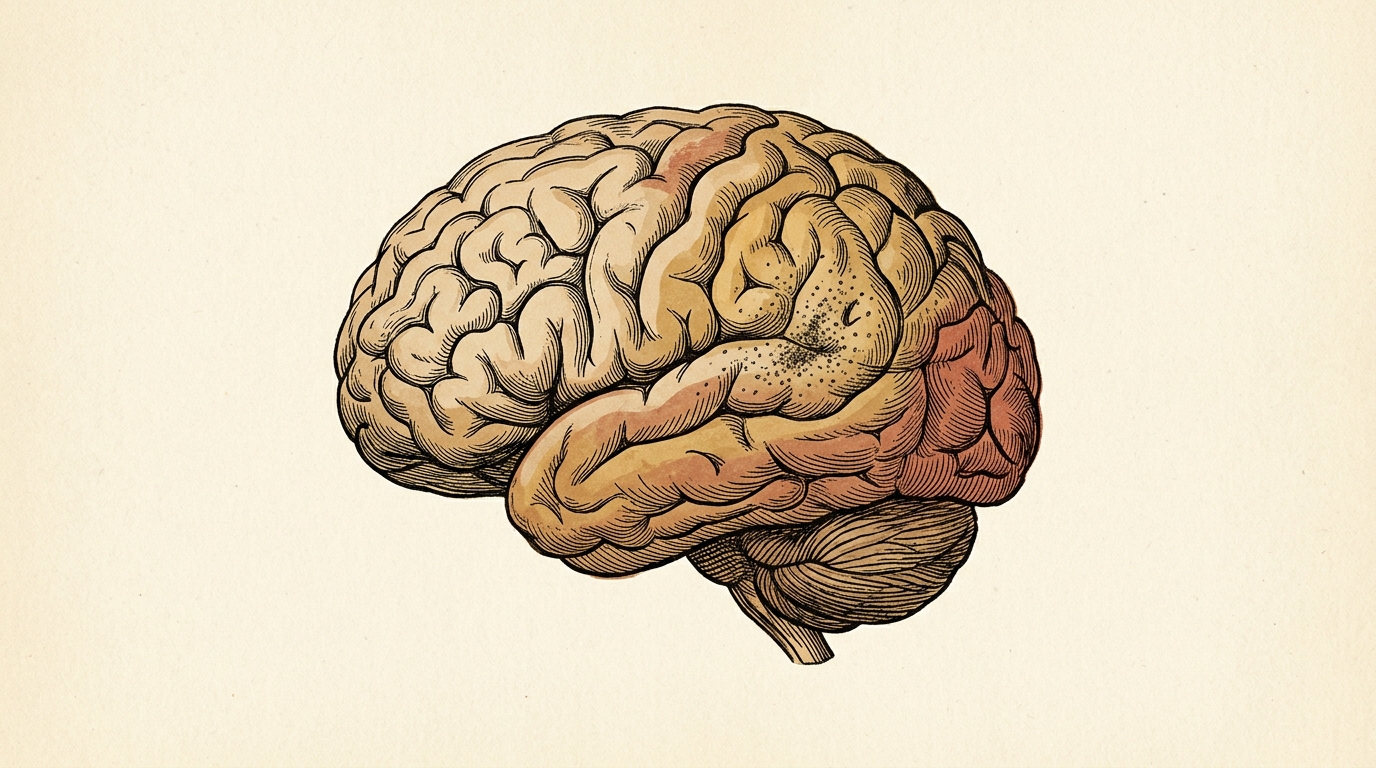
Here's why the version matters. As your brain works, it sheds a sticky scrap called amyloid-beta. `F14` APOE's job is to help haul it away before it piles up. ε2 and ε3 are good at the cleanup — but ε4's shape makes it clumsy. The amyloid lingers, clumps, and hardens into plaques. `F15` And ε4 doesn't stop there: it inflames the brain's immune cells and worsens the tangles of a second protein, tau. `F16` The courier meant to keep things clear becomes the reason they clog.
06THE OTHER END
Now turn the gene around. The rare version, ε2, does the opposite — it shows up far more often in people who reach a hundred. `F17` Why? ε2 seems to guard the systems that age fastest: it clears amyloid better, with lower Alzheimer's risk, and tends toward a healthier cholesterol profile and fewer heart attacks. `F24` ε4, meanwhile, quietly thins out of the oldest age groups — not because the gene changes, but because the people who carry it tend to die younger. `F18` Dodge the diseases that end most lives, and the years add up. One small gene, tilting both ends of a human life.
07THE OPEN THREAD
You can't trade in the alleles you were born with — but APOE has become one of the most chased targets in Alzheimer's research. `F19` The clues are tantalizing. A woman who should have developed Alzheimer's in her forties stayed sharp into her seventies — shielded by a single rare APOE variant. `F20` Gene therapies are now trying to deliver the protective version straight into the brain. `F21` And in 2024, a study argued that carrying two ε4 copies isn't merely a risk — it may be its own genetic form of the disease. `F22`
08TIMELINE + SIGN-OFF
One gene. Three letters. From a cholesterol courier — to the single biggest clue we have about who gets Alzheimer's, and who gets to grow very old. `F23` — The Gene Channel.
The write-up
In one line: APOE is a humble cholesterol courier that comes in three versions — and which two you inherit is the single biggest common genetic dial on Alzheimer's risk at one end of life, and on the odds of reaching 100 at the other.
The gene
APOE (apolipoprotein E) sits on the long arm of chromosome 19, at 19q13.32. Its everyday job is lipid transport: it wraps cholesterol and other fats into lipoprotein particles and shuttles them around the body, acting as a ligand for the LDL-receptor family that pulls those particles back out of circulation. Inside the brain it is the dominant lipid carrier — produced mostly by support cells called astrocytes — ferrying cholesterol to neurons. Nothing about that delivery-truck role hints at dementia, which is exactly what made the discovery so surprising.
The twist that opens the episode: the three common versions — ε2, ε3, ε4 — are not equal, and ε4 is the ancestral allele, the one our lineage carried first. ε3 (now the most common, in more than half of people) and ε2 (the rarest) arose later in human evolution. "Oldest" turned out to mean "riskiest."
The hunt
By the early 1990s Alzheimer's research was fixated on the amyloid plaques seen in patients' brains. The APOE link came from a different direction — the families. A chromosome-19 linkage signal (Pericak-Vance, 1991) pointed the way, and in 1993 Allen Roses' group at Duke University landed it: ApoE bound amyloid-β, and the ε4 version was strikingly over-represented in people with late-onset Alzheimer's (Strittmatter et al.; Saunders et al.). The capstone was Corder et al. (1993), which showed the effect was a gene dose: across 42 late-onset families, risk climbed from ~20% to ~90% and the mean age of onset fell from ~84 to ~68 years as ε4 copies went from zero to two. A cholesterol gene was the largest common genetic risk factor ever found for the disease.
The mechanism
The three versions differ by almost nothing — two amino-acid swaps (cysteine↔arginine) at positions 112 and 158 of the mature protein. (Variant databases sometimes number these from the precursor, as 130/176; same residues, plus the 18-residue signal peptide.) ε3 = Cys112/Arg158; ε2 = Cys112/Cys158; ε4 = Arg112/Arg158. Those tiny changes reshape the protein and what it does in the brain.
As the brain works, neurons continually shed amyloid-β, a sticky peptide that must be cleared before it accumulates. APOE helps with that cleanup, but isoform-dependently: amyloid-β accumulation and plaque deposition follow the order ε4 > ε3 > ε2. ε4's shape makes it a poorer partner for clearing and a better one for aggregation, so the amyloid lingers and hardens into plaques. ε4 doesn't stop there — it also worsens tau pathology (partly independent of amyloid), drives neuroinflammation, and impairs cerebrovascular function. The courier meant to keep the space clear becomes part of the reason it clogs.
The other end of life
Turn the gene around and the same dial points the opposite way. ε2 is over-represented in centenarians (Schächter et al., 1994), and APOE consistently surfaces as a top locus in human-longevity GWAS. Meanwhile ε4 thins out of the oldest age groups — not because the gene changes, but because the people who carry it tend to die younger (a survivorship effect). One small gene tilts both ends of a human life.
The frontier
You can't trade in the alleles you were born with, but APOE has become one of the most pursued targets in Alzheimer's research, and the leads are tantalizing:
- The woman who resisted. A Colombian carrier of an autosomal-dominant early-onset Alzheimer's mutation (PSEN1 E280A) — who should have declined in her 40s — stayed cognitively intact into her 70s. She was homozygous for a rare APOE variant, APOE3-Christchurch (R136S), which appears to blunt tau spread despite a very high amyloid burden (Arboleda-Velasquez et al., 2019).
- Deliver the good version. Gene therapies are attempting to introduce the protective APOE2 into the brains of high-risk patients (e.g. an AAV-APOE2 program, early-phase/biomarker-stage).
- Two ε4 copies as its own disease. A 2024 study argued that ε4 homozygotes — roughly 2% of people — show such near-universal Alzheimer's pathology that the genotype behaves less like a risk factor and more like a distinct genetic form of the disease (Fortea et al.).
A practical note from the clinic: the new anti-amyloid antibodies (lecanemab, donanemab) carry a higher risk of brain-swelling side effects (ARIA) in ε4 carriers — highest in homozygotes — which is why APOE genotyping is now done before treatment.
The important caveat the episode keeps front and center: for carriers in general, ε4 is a risk factor, not destiny — many ε4 carriers never develop Alzheimer's, and many patients carry no ε4. That is categorically different from the rare autosomal-dominant early-onset genes (APP, PSEN1, PSEN2), where the mutation is essentially causative. (The ε4/ε4 homozygote case above is the emerging exception that proves the rule.)
Sources
Full claim-by-claim evidence is in references.md. Primary anchors:
- Strittmatter et al. 1993, PNAS 90:1977 — ApoE binds amyloid-β; ε4 enriched in late-onset familial AD.
- Corder et al. 1993, Science 261:921 — ε4 gene dose raises risk and lowers age of onset.
- Saunders et al. 1993, Neurology 43:1467 — ε4 association with late-onset AD.
- Farrer et al. 1997, JAMA 278:1349 — meta-analysis of ε4 odds ratios (and their ancestry/sex dependence).
- Liu, Kanekiyo, Xu & Bu 2013, Nat Rev Neurol 9:106 — APOE in AD: risk, mechanisms, therapy (canonical review).
- Liao, Yoon & Kim 2017, Curr Opin Lipidol 28:60 — APOE metabolism/function in the brain; isoform effects.
- Fullerton et al. 2000, Am J Hum Genet 67:881 — ε4 is the ancestral allele; ε3/ε2 derived.
- Schächter et al. 1994, Nat Genet 6:29 — ε2 enriched, ε4 depleted in centenarians.
- Arboleda-Velasquez et al. 2019, Nat Med 25:1680 — APOE3-Christchurch resistance case.
- Fortea et al. 2024, Nat Med 30:1284 — ε4 homozygosity as a distinct genetic form of AD.
Accuracy notes (the traps the fact-gate caught): (1) The ">tenfold" figure is for ε4 homozygotes (~12–15× vs ε3/ε3); one copy is ~2–3×, and all of these are ancestry-dependent — so the episode keeps numbers qualitative and ties "more than tenfold" to two copies. (2) ε4 is ancestral but not most common (ε3 is). (3) Amino-acid positions are given in mature-protein numbering (112/158); databases may use precursor numbering (130/176). (4) The mechanism is framed as impaired clearance / promoted aggregation, not amyloid over-production. (5) ε4's decline with age is survivorship, not the gene "changing." (6) The Christchurch protective variant is on an ε3 background (APOE3ch), not ε2. (7) Gene therapy is early/biomarker-stage, not a proven treatment.
The evidence
Every claim, sourced
Each [F#] you hear in the film links to the source it came from. Nothing gets narrated until every one is checked and signed off.
Sign-off
- PhD sign-off — facts above correct; the ⚠️ traps stated correctly in
script.md. (Signed off 2026-06-14.) - F24 added 2026-06-14 (seg-06 feedback: "why ε2 → longevity") — sourced to Corder 1994 / Bennet 2007 / Sebastiani 2019; narration kept hedged ("seems to," "tends toward"), mechanism noted as partly open. Within the signed-off scope.
- Length approval — user approved the extended ~2.5–3 min cut (covers function · discovery · AD · longevity), above the lean ~90–150s default.
- Numbers kept qualitative in narration ("more than tenfold", "mid-80s → late-60s"); exact ORs/CIs live here.
Gate OPEN → narration + render may proceed.
- F1
APOE comes in three common versions (alleles)
Three common alleles ε2/ε3/ε4, defined by two coding polymorphisms
- F2⚠ commonly confused
Two ε4 copies → late-onset AD odds > tenfold
ε4/ε4 homozygote OR ≈ 14.9 (95% CI 10.8–20.6) vs ε3/ε3 (Caucasian); one copy OR ≈ 3.2. ⚠️ This is the homozygote figure — narration says "two copies." Ancestry-dependent (weaker in African-American/Hispanic, stronger in Japanese).
- F3
A different version (ε2) → more likely to reach ~100
ε2 significantly enriched, ε4 depleted, in centenarians
- F4⚠ commonly confused
The riskiest version (ε4) is the one humans had first (ancestral)
ε4 is the ancestral allele; ε3 derived from it (~200 ky), ε2 most recent (~80 ky); chimp APOE resembles ε4. ⚠️ "ancestral" ≠ "most common today" — ε3 is now most common (see F12).
- F5
APOE sits on chromosome 19 (19q13.32)
NCBI Gene location 19q13.32, GRCh38
- F6
Wraps cholesterol into particles, ferries it through the blood
ApoE combines with lipids to form lipoproteins; LDL-receptor ligand for lipoprotein clearance
- F7
In the brain: the main lipid carrier, made mostly by astrocytes, supplies cholesterol to neurons
"In the brain, apoE is produced predominantly by astrocytes… facilitates the transfer of cholesterol and phospholipid between cells"
- F8
1993, Duke University, team led by Allen Roses
The Duke group (Roses, sr. author) established the APOE–AD link in 1993
- F9
A linkage signal pointed to chromosome 19
Pericak-Vance's chr-19 linkage in familial AD pointed the search there
- F10
The ε4 version was far more frequent in late-onset Alzheimer's
"increased frequency of type 4 allele in late-onset familial Alzheimer disease"
- F11⚠ commonly confused
The versions differ by two tiny swaps in the protein chain
ε3 = Cys112/Arg158; ε4 = Arg112/Arg158; ε2 = Cys112/Cys158 — two Cys↔Arg sites. ⚠️ 112/158 = mature protein; databases may use precursor numbering 130/176 (offset = 18-aa signal peptide); same residues.
- F12
ε3 is the common version most people carry
ε3 found in >half the population
- F13
Effect comes in doses: each ε4 raises risk and pulls onset earlier (mid-80s → late-60s)
Corder 1993: with ε4 dose, AD risk rose 20%→90% and mean onset fell 84.3 → 68.4 yr in 42 late-onset families
- F14
The brain continually sheds a sticky scrap, amyloid-beta
Aβ is produced from APP and released into brain interstitial fluid; normally cleared
- F15⚠ commonly confused
ε2/ε3 clear Aβ well; ε4 clears it poorly → it aggregates into plaques
Brain Aβ accumulation/deposition follows ApoE4 > ApoE3 > ApoE2; impaired clearance + promoted aggregation. ⚠️ "impaired clearance" better supported than "increased production."
- F16
ε4 also inflames brain immune cells and worsens tau pathology
ApoE4 exacerbates neuroinflammation and tau-mediated neurodegeneration (partly Aβ-independent)
- F17
ε2 shows up far more often in people who reach a hundred
ε2 over-represented in centenarians
- F18⚠ commonly confused
ε4 thins out of the oldest groups — carriers tend to die younger, not the gene changing
Age-related decline in ε4 frequency = survivorship (selective mortality), not allele conversion
- F24⚠ commonly confused
Why ε2 → longevity: it clears amyloid better (lower AD risk, slower plaque) and tracks with a healthier lipid profile + fewer heart attacks
ε2 ≈ 50% lower AD vs ε3/ε3 + slower amyloid accumulation; ε2 carriers: lower LDL, higher HDL, ≈ 20% lower coronary risk; longevity partly via this disease protection. ⚠️ Exact mechanism still partly open — keep "seems to / associated," not causal; ε2 longevity may be partly AD-independent.
- F19
APOE is now one of the most chased drug targets in AD
APOE-directed therapeutic strategies reviewed
- F20⚠ commonly confused
A woman who should have had early AD (40s) stayed sharp into her 70s, shielded by a rare APOE variant
PSEN1 E280A carrier, homozygous APOE3-Christchurch (R136S), resisted AD ~3 decades. ⚠️ Protective variant is on an ε3 background (not ε2), single case report.
- F21⚠ commonly confused
Gene therapies now trying to deliver the protective version into the brain
AAVrh.10-APOE2 (LEXEO LX1001), Phase 1/2 in ε4/ε4 AD: dose-dependent CSF APOE2, biomarker changes. ⚠️ Early-phase, biomarker-stage, not proven on cognition.
- F22⚠ commonly confused
2024: two ε4 copies may be its own genetic form of Alzheimer's
ε4/ε4 homozygotes: near-universal AD pathology/biomarkers from ~55; argued to be a distinct genetic form. ⚠️ Homozygotes only — do not generalize to one-copy carriers.
- F23
Summary: APOE = biggest common AD risk factor and a longevity signal
Synthesis of F2, F10 (biggest common risk factor) + F3, F17 (longevity)