ACTA2
The Wall
The same gene builds the muscle that holds your aorta together and the one that closes your pupil. Change a single letter at one position and big vessels balloon toward a tear while small ones narrow toward a stroke — one mutation, two opposite catastrophes, and a molecular pencil now aimed at the wrong letter.
The walkthrough
Beat by beat
HOOK
0:24
01HOOK
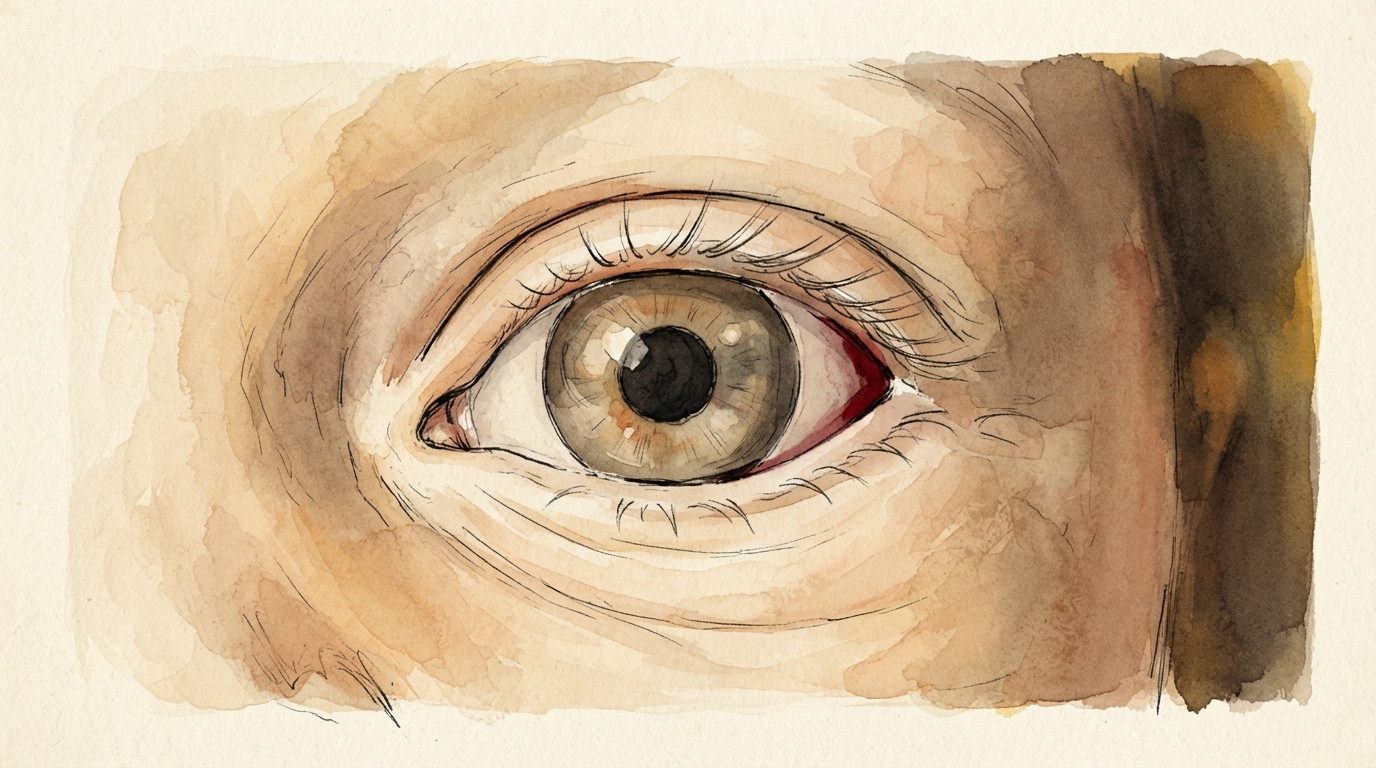
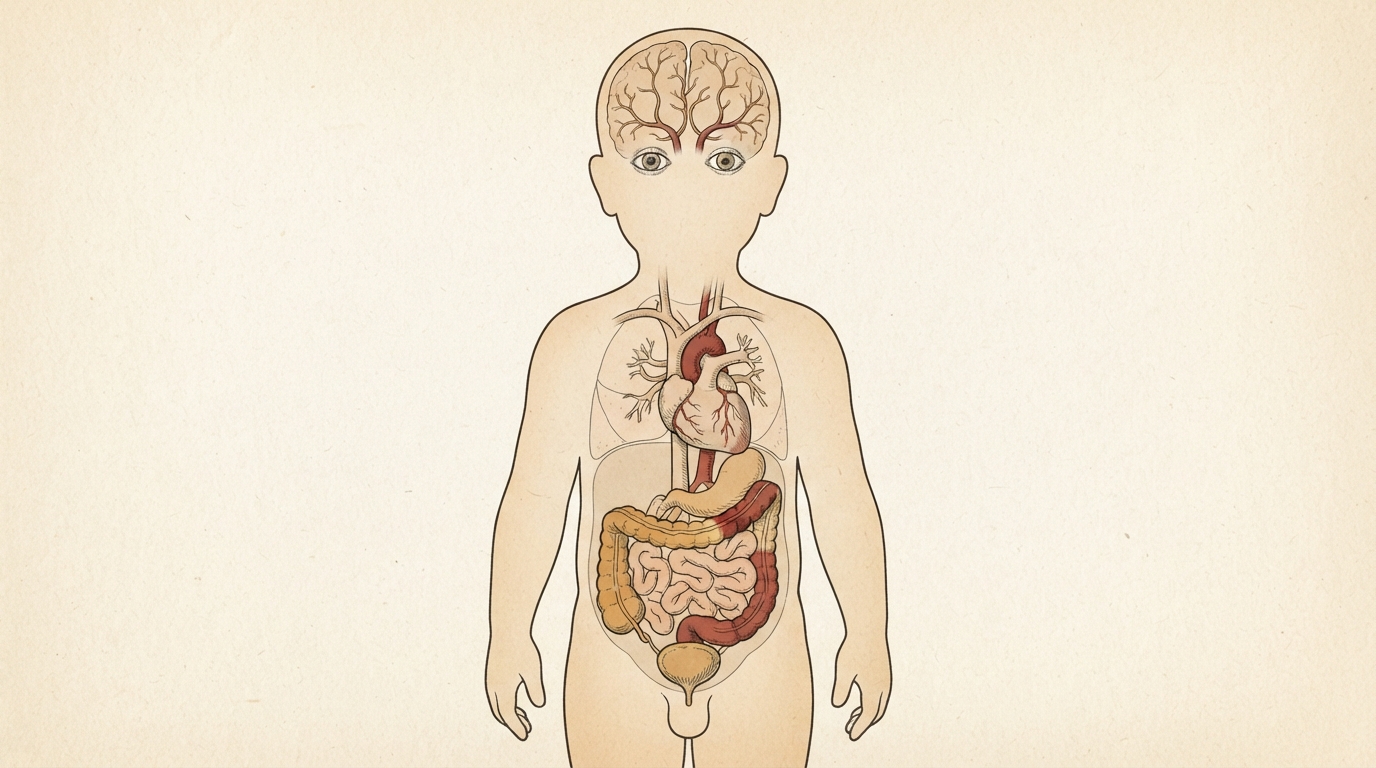
Some children are born with eyes that never close to the light. F3F4 Pupils wide open. In darkness or in sun, never narrowing, never adjusting. Not a nerve injury. Not a shadow over the eye. The muscle that should draw the pupil shut cannot contract. The actin it is built from is mutated. ACTA2.
02THE NAME
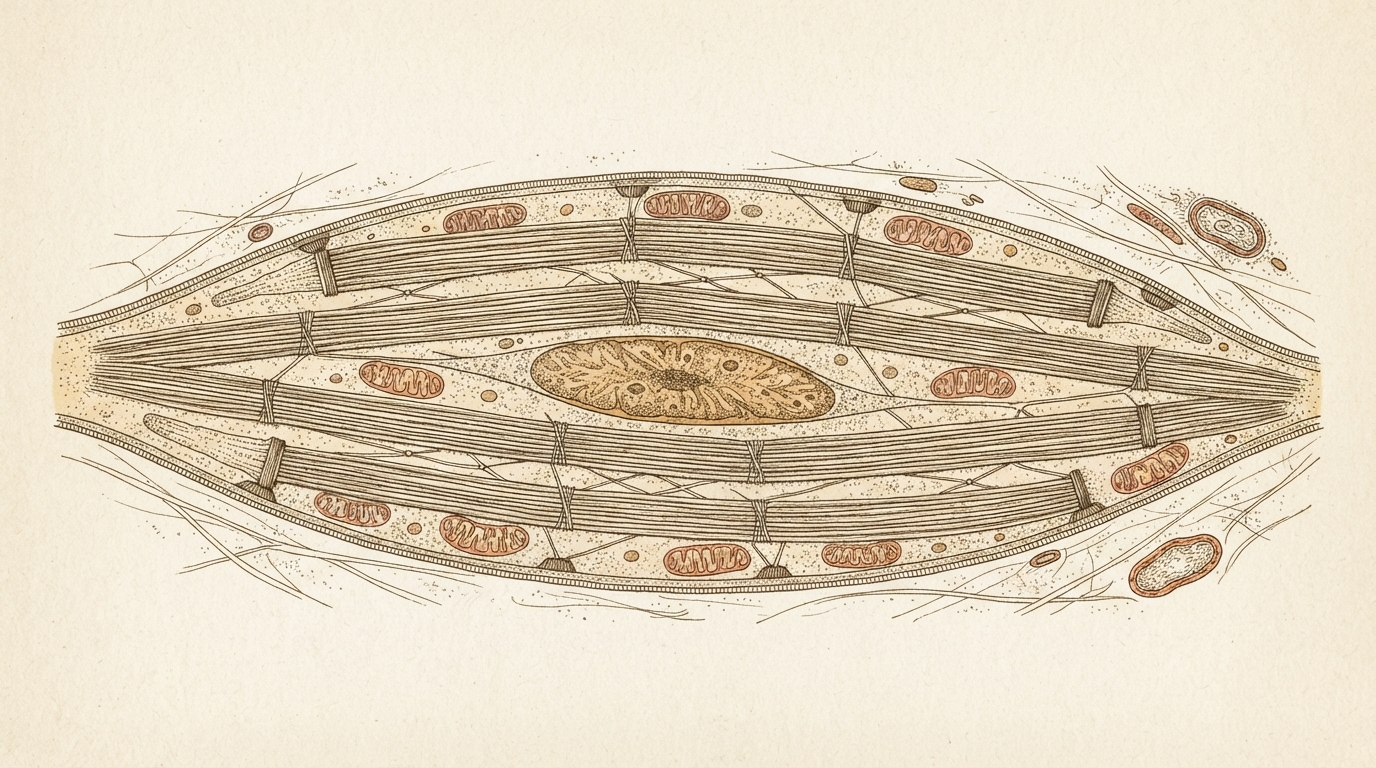
ACTA2 sits on chromosome ten. F1 It encodes one protein: smooth muscle alpha-actin. Smooth muscle lines the walls of your arteries, your gut, your bladder. F1 Not the muscle that lifts your arm. That is a different actin entirely. F1 This one works quietly, and it never stops. It links into long filaments, grips the motor protein myosin, and pulls. F1 That pull gives the aorta, the great artery leaving the heart, its strength. Without it, the wall gives way.
03THE HUNT
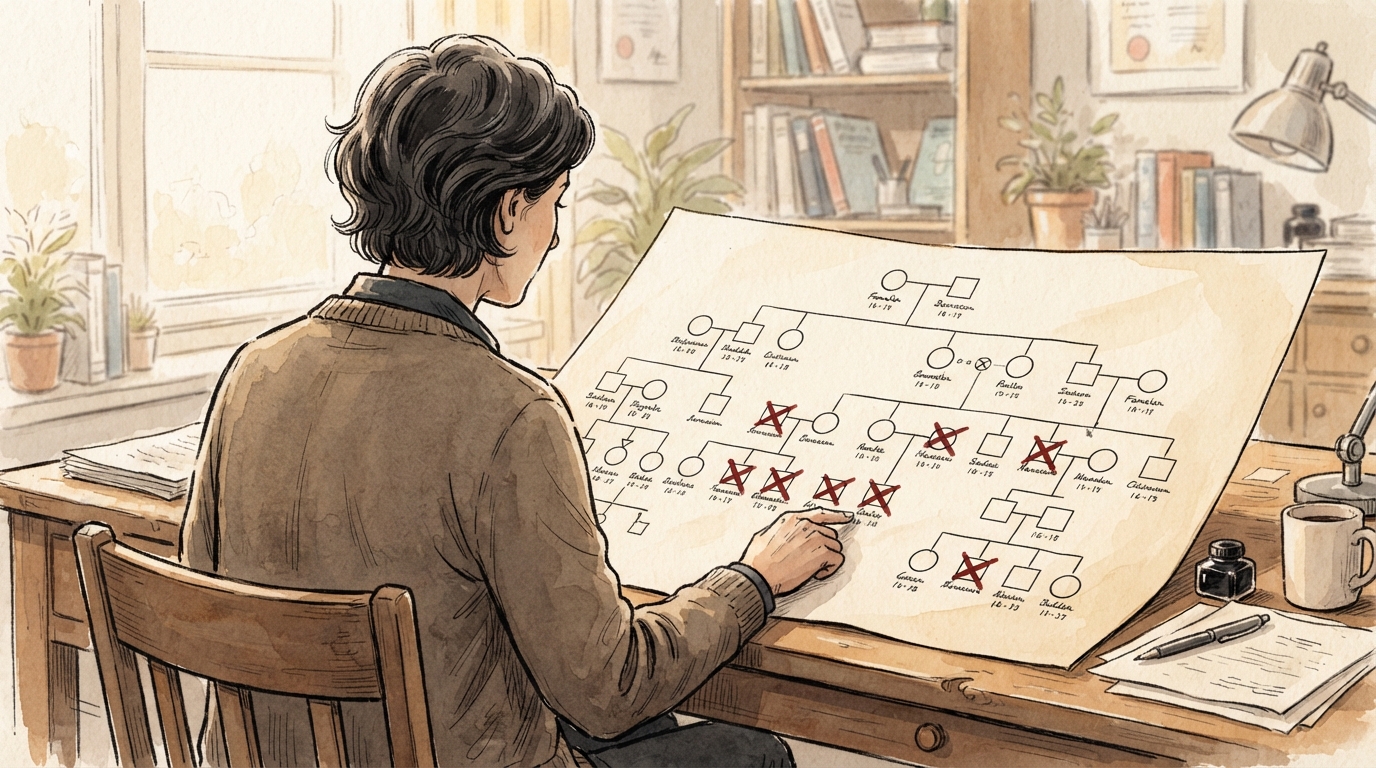
For decades, cardiologists watched families lose members the same way. A tear in the aorta. A dissection, at forty, at thirty, sometimes younger. F2 In two thousand seven, Dong-Chuan Guo and Dianna Milewicz, at UT Houston, traced it through family after family to a single gene. F5 ACTA2. F5 In about one inherited aortic case in seven, this gene carried the damage. F2 One broken copy is enough. F2
04THE PROOF
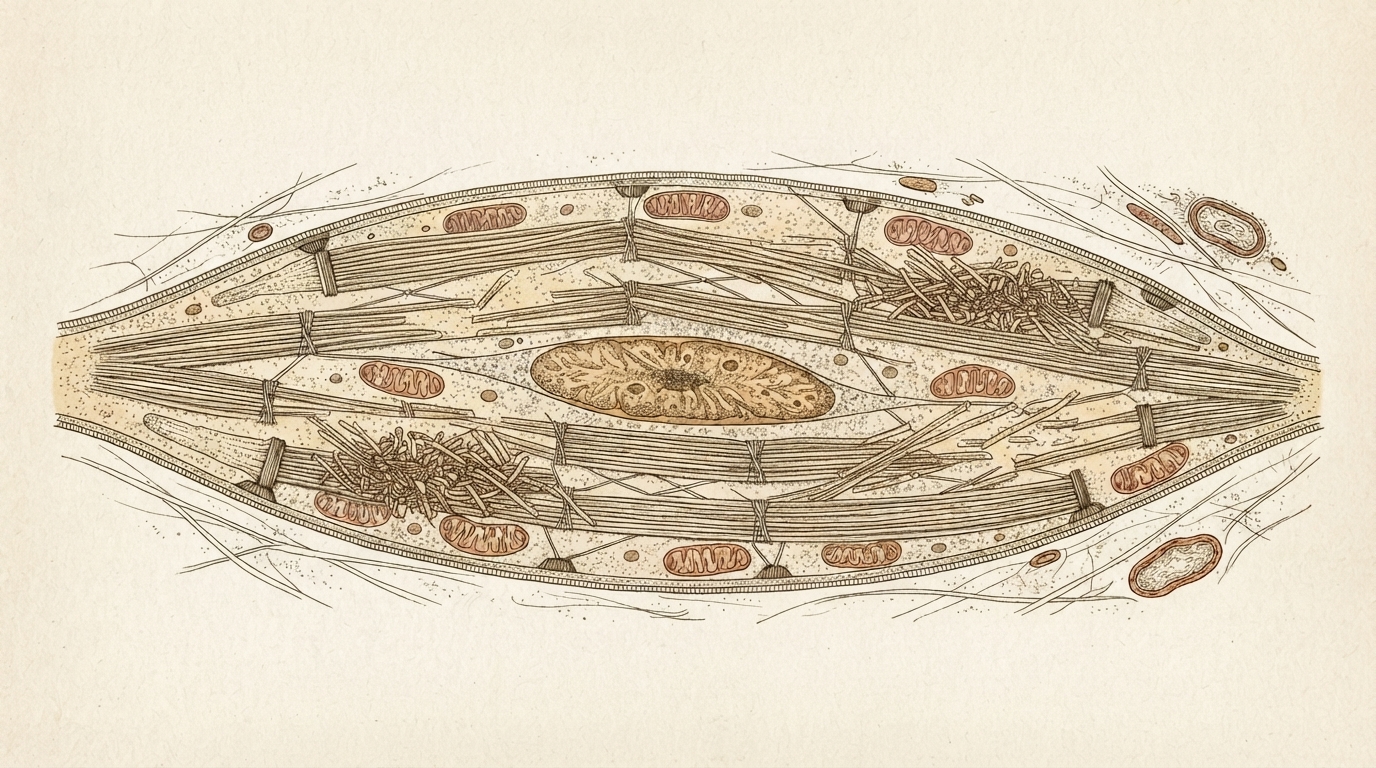
So why does one faulty copy cause disease? F2 The inheritance is dominant. One mutant copy out of two is enough, and the healthy copy cannot make up the difference. F2 The mutant actin is still built, and it fouls the filaments it joins. F1 In smooth-muscle cells from patients, the actin comes out disordered, unable to assemble cleanly. F1 The wall loses tension. The tissue starts to splay. F2 And the numbers are sobering. In a registry of two hundred seventy-seven carriers, three in four suffer an aortic event in their lifetime. F2 One in four of those kills at the first episode. F2 Some tear below five centimetres, under the old surgical threshold. F2
05HOW SMOOTH-MUSCLE ACTIN BUILDS A WALL (hero 1)
Start with what healthy actin does. F1 In the arterial wall, single actin molecules link head to tail into long helical filaments. F1 The filaments braid into a cable network running through each smooth-muscle cell. Myosin grips the cables and pulls. The cell contracts. That contraction does two jobs. It sets blood pressure, narrowing or opening the vessel. And it holds the aortic wall taut, under billions of heartbeats, for a lifetime. F1 Weaken that force, and the wall dilates instead of holding steady. F1 The aorta swells like a balloon with every beat. Until, one day, the pressure opens a tear.
06WHAT R179 BREAKS
But one position stands apart. Arginine one seventy-nine. F3 Most variants fail one way. Too little contraction, and the aorta dilates. F2 This arginine does something stranger. F3F6 It still breaks the filaments in the cytoplasm. But it also slips into the nucleus. F6 Because this actin is not only a building block. It is a gene regulator. F6 There, it helps mature the cell into a committed, contractile worker. F6 The mutation cuts that supply in half. So the cells never fully grow up. F6
07TWO OPPOSITE PROBLEMS (hero 2b)
And immature, dividing cells crowd small vessels from the inside, narrowing them. F6 One mutation. Two opposite problems. F3F6 The aorta, a large vessel, dilates toward a tear. F3 The brain's small arteries narrow toward stroke. F3F6 And the pupils? The iris dilator is smooth muscle too. It never matured. F3F4 Those open eyes were never nerve damage. A window onto the aorta's fate.
08THE STAKES
In the most severe form, called MSMDS, every smooth-muscle organ is under threat. F3 The ductus arteriosus, which should seal at birth, stays open. F3 The bladder cannot empty. The gut slows. The brain's small arteries narrow. F3 And by age twenty-five, in every untreated patient, an aortic event has struck. F3 Families raise these children listening for the next emergency. Monitoring. Imaging. Deciding when to operate before the tissue decides for them. F7 Reach the aorta before it tears, and the outcome is far better. That is what today's care is built to do. F7
09THE OPEN THREAD
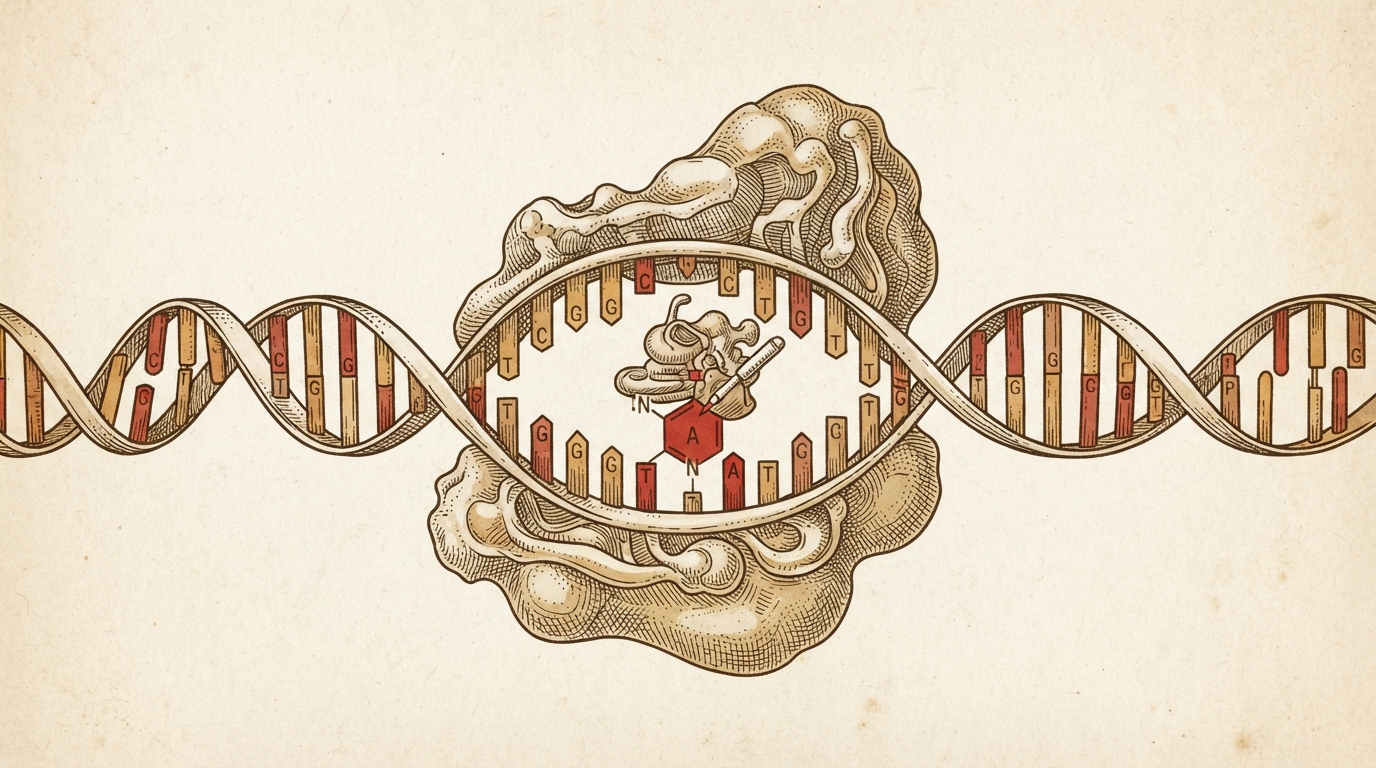
Today, no approved treatment changes the course of the disease. F8 But a single-letter mutation points straight at what a cure might be. If R179H is one wrong nucleotide in every cell, what if you could correct that letter? F8 That is the idea behind two programs building CRISPR base editors. F8 A base editor is a molecular pencil that rewrites one DNA letter without breaking the double helix. F8 In mice carrying the human mutation, a single dose extended median survival almost fourfold. F8 Researchers are moving toward human trials. Nothing has entered a clinical study yet. F8 But now the wrong letter is known, and a tool exists precise enough to correct it. F8
10RECAP + FAMILIES SIGN-OFF
Seventeen years. From families who kept losing members to a tear in the aorta, to a gene, to a mechanism, and now to a molecular pencil aimed at the right letter. F5F8 The families tracked down the research. The families built the registry. The ACTA2 Alliance keeps them connected, to each other and to the science. Found in the arterial wall. Carried by families. Find them at acta2alliance.org. — The Gene Channel.
The write-up
In one line: ACTA2 builds the smooth-muscle actin that holds your arterial wall taut — and when one letter changes at arginine 179, the same mutation makes big vessels balloon toward a tear and small vessels narrow toward a stroke, all traced back to a single misread nucleotide a molecular pencil may soon be able to correct.
The gene
ACTA2 sits on chromosome 10 (10q23.31) and encodes just one protein: smooth muscle alpha-actin (αSMA) — the predominant contractile actin of the vascular smooth-muscle cells (VSMCs) that line your arteries, gut, and bladder. This is not the actin that lifts your arm; that's a different isoform entirely, and ACTA2 disease is vascular, never a skeletal myopathy. [F1] Single actin molecules link head-to-tail into long helical filaments; those filaments braid into a cable network, grip the motor protein myosin, and pull. That pull sets blood pressure and holds the aorta — the great artery leaving the heart — taut under billions of heartbeats. Weaken it, and the wall dilates instead of holding steady.
The hunt
For decades, cardiologists watched families lose members the same way: a tear in the aorta, a dissection at forty, at thirty, sometimes younger. [F2] In 2007, Dong-Chuan Guo, Hariyadarshi Pannu, Van Tran-Fadulu and colleagues in Dianna Milewicz's lab at UT Health Houston traced it through family after family to a single gene — ACTA2. [F5] It turned out to account for roughly 14% of inherited thoracic aortic aneurysm and dissection (TAAD) — the single most common identified genetic cause. [F2] The inheritance is autosomal dominant with a dominant-negative twist: the mutant actin is still built and fouls the filaments it joins, so the healthy copy can't fully rescue. In a registry of 277 carriers, lifetime aortic-event penetrance reached 76% by age 85, with 25% mortality at the first event — and some dissections struck below the standard 5.5 cm surgical threshold. [F2]
The mechanism
Healthy αSMA does two jobs: it builds the contractile cables that maintain arterial tone, and — less obviously — it slips into the nucleus of a maturing VSMC and helps run the gene program that turns that cell into a committed, contractile worker. [F1][F6] One position stands apart: arginine 179. Most ACTA2 variants fail one way (too little contraction → the aorta dilates). R179 does something stranger. It breaks the cytoplasmic filaments and cuts nuclear αSMA by more than half, so the cells never fully grow up. [F6] The result is two opposite problems from one mutation: the aorta (a large vessel) dilates toward a tear, while the brain's small arteries narrow as immature, proliferating cells crowd the lumen — a moyamoya-like pattern, not classic moyamoya disease. [F3][F6] Even the fixed, wide pupils some children are born with trace to the same cause: the iris dilator is smooth muscle too, and it never matured — a contractile failure, not nerve damage. [F3][F4]
The stakes, and the frontier
In the most severe form — Multisystemic Smooth Muscle Dysfunction Syndrome (MSMDS), caused by de novo R179 variants — every smooth-muscle organ is under threat from birth: patent ductus arteriosus, congenital mydriasis, a bladder that can't empty, a slowed gut, narrowing brain arteries, and a cumulative aortic-event risk that reaches 100% by age 25. [F3] There is no approved disease-modifying therapy as of 2026. [F8] But surveillance, blood-pressure control, and prophylactic surgery already save lives — reaching the aorta before it tears changes the outcome dramatically. [F7] And because the disease is a single wrong nucleotide in every cell, two research programs are building CRISPR adenine base editors — molecular pencils that rewrite one DNA letter without cutting the helix — aimed squarely at R179H. In humanized mice, a single dose extended median survival roughly fourfold. Nothing has entered a human trial yet, but the wrong letter is known, and a tool precise enough to correct it now exists. [F8]
Sources
Full claim-by-claim evidence is in references.md. Primary anchors:
- Guo DC, Pannu H, Tran-Fadulu V, et al. "Mutations in smooth muscle alpha-actin (ACTA2) lead to thoracic aortic aneurysms and dissections." Nat Genet 39:1488–1493 (2007). PMID 17994018.
- Regalado ES, Guo D, Prakash S, et al. Circ Cardiovasc Genet 8:98 (2015). PMID 25759435 / PMC4601641 (277-carrier registry; penetrance, mortality, R179 cumulative risk).
- Regalado ES, Mellor-Crummey L, De Backer J, et al. "Clinical History and Management Recommendations of the Smooth Muscle Dysfunction Syndrome Due to ACTA2 Arginine 179 Alterations." Genet Med 20:1407 (2018). PMID 29261177 / PMC6034999 (33-patient MSMDS cohort).
- Kwartler CS, Pedroza AJ, Kaw A, et al. "Nuclear Smooth Muscle α-actin in Vascular Smooth Muscle Cell Differentiation." JCI Insight (2023). PMC10002808.
- Alves CRR, Das S, Kleinstiver BP, et al. "Treatment of a severe vascular disease using a bespoke CRISPR–Cas9 base editor in mice." Nat Biomed Eng (2025). doi:10.1038/s41551-025-01499-1. And Ding Q, Gan P, et al. Circulation (2025). PMID 40378078 / PMC12220935.
- Foundation spotlight: ACTA2 Alliance — https://www.acta2alliance.org
Accuracy note: ACTA2 is smooth-muscle α-actin (ACTA1 is the skeletal isoform) — this is a vascular/smooth-muscle disease, never a muscular dystrophy or limb myopathy. MSMDS (de novo R179, ~100% aortic risk by 25) is a distinct, more severe presentation from the broader familial TAAD spectrum (76% lifetime penetrance) — most ACTA2 variants cause the latter. The congenital mydriasis is iris-dilator smooth-muscle failure, not a nerve palsy or Horner syndrome; the cerebrovascular pattern is moyamoya-like (VSMC immaturity), not classic moyamoya disease (RNF213). CRISPR base editing is preclinical and R179H-specific — promising, but not approved and not yet in any human trial.